Well, no argument here.
I don’t think it will happen (it’s been quite the opposite, really), but it would be a good thing, for Republicans and America, if it did.
Well, no argument here.
I don’t think it will happen (it’s been quite the opposite, really), but it would be a good thing, for Republicans and America, if it did.
Eric Sanders has begun a new blog, Action in Action, at Big Think.
His first post discusses ‘The Beautiful Optimism of Libertarianism.’
Sanders writes that
I am now starting to believe that libertarianism — at least for those who espouse it honestly — stems from incredible optimism, an unshakable belief in human dignity, honesty, and generosity….
true libertarianism stems from the belief that people, left to their own devices, will eventually act in a manner that is beneficial to both themselves and to their society. It is this optimism that I find beautiful — this belief in the inherent goodness of others, if only they were given the opportunity to demonstrate it — and this is where I think those who generally look at libertarianism as a cynical, purely selfish world view can begin to engage and at least consider some typically ‘libertarian’ ways of thinking.
He’s right, of course: libertarians are the people who believe in these hopeful things, in opposition to the machinations of so many self-serving politicians, bureaucrats, and their particular, coddled friends in industry.
Good morning.
Whitewater has a sunny day with a high temperature of thirty-one to which to look forward. In Denver, it will be a mostly cloudy day with a high of thirty-seven.
Whitewater’s Tech Park Board meets today at 8 AM.
On this day in 1858, another great moment in legislative history:
1858 – Wisconsin Congressman Starts Fight in Legislature
Just before the Civil War, the issue of slavery tore apart the U.S. Congress. On February 8, 1858, Wisconsin Rep. John Potter (considered a backwoods hooligan by Southern aristocrats) leaped into a fight on the House floor. When Potter embarrassed a pro-slavery brawler by pulling off his wig, the gallery shouted that he’d taken a Southern scalp. Potter emerged from the melee covered in blood and marked by slave owners as an enemy.
Two years later, on April 5, 1860, he accused Virginia Rep. Roger Pryor of falsifying the Congressional record. Pryor, feeling his character impugned, challenged Potter to a duel. According to Southern custom, a person challenged had the right to choose weapons. Potter replied that he would only fight with “Bowie knives in a closed room,” and his Southern challenger beat a hasty retreat. Republican supporters around the nation sent Potter Bowie knives as a tribute, including this six-foot-long one. [Source: Badger Saints and Sinners by Fred L. Holmes]
Via Wisconsin Historical Society
I came across a post entitled, ‘The Secret Of Magic Island’: The Mysterious ‘Holy Grail’ For Movie Nerds (VIDEO), and the title easily hooked me.
Magic Island (the title in English) is a French film that features animals doing all sorts of things, like using the phone, playing an organ, etc.
The post where I learned of it asks, “Two questions surfaced in the office: how did the filmmakers get the animals to do this? And also, what in the hell is this?” Those are the relevant questions.
Here’s a trailer for the film, and a clip from it. The trailer’s narration is hopelessly corny, but watch it again with the sound off, and you’ll find yourself wondering about how the film was made, and how much patience it must have demanded. The post to which I’ve linked above, where I first learned of the film, has answers about its history.
Enjoy and be intrigued.
Clip —
Trailer —
I wrote earlier about the Wisconsin Economic Development Corporation’s millions for Spectrum Brands (Rayovac, among other brands). The professed purpose was to keep the company in Wisconsin. As it turned out, they took they money, as part of a relocation to Middleton, Wisconsin. There’s scant credible evidence that they truly were prepared to leave.
A reader writing from Georgia took exception to the post, quite sure that he was knowledgeable about these sort of deals. He’s free to assert what he wants, but all of the four points that I made are true:
Millions spent on a business relocation for a corporation that (1) withheld its identity, (2) was already in Wisconsin, (3) used flimsy worries about protests at the Capitol as way to curry favor with the Walker Administration, (4) where the head of the Wisconsin Economic Development Corporation now admits that the Wisconsin business’s move within Wisconsin was something he did not discuss with them.
That Spectrum Brands did withhold its identity for a full nine-months is undisputed. See, for example Emails: Spectrum hid identity in site search.
The reader seems to think that to assert they withheld their identity means they always withheld it, that they withheld it permanently. That’s just silly — the underlying story from WisconsinWatch.org on which the post was commentary and a subsequent story from the Wisconsin State Journal refer to a nine-month delay.
If I were to write that parents withheld a child’s dinner (a bad idea, in any event), it doesn’t imply that they starved the child to death.
If these were the extent of his objections, I wouldn’t bother to reply.
There’s another reason for my update. Along the way, the reader asserted that these deals only happen where there is a ‘multiplier effect.’ There was no assurance of any multiplier effect — even assuming one believes so very deeply in such government calculations — in this instance:
WEDC agreed to give the company $4 million in exchange for its promise to keep its 470 existing Dane County employees through Sept. 30, 2016, and invest $40 million in its Wisconsin operations by that time. If it fails to fulfill these requirements, it must pay back the $4 million with interest. Otherwise, it owes nothing beyond an $80,000 origination fee.
That’s no ‘multiplier’ at all — it’s a big corporation doing what it has been doing – in the state in which it has been doing it, with the help of taxpayer-dollars to do it in a new location. If they fulfill none of these terms, they still get a state-backed loan, at interest more lenient than what they’d find in the market.
If they do what they have been doing, they get a multi-million-dollar forgivable loan less eighty-thousand.
Walker Administration, Doyle Administration, etc. — it matters not at all; this is bad policy in any event. The people of Wisconsin owe Spectrum no public help.
State capitalism is sham capitalism. Government should not be making these loans.
Yet, so partisan is our politics, that as long as one’s own party makes these deals, it must be a good idea — it’s all for business, you see. That’s why Walker supporters (mostly) will turn a blind eye to these business-coddling deals. They were and are all for the market, until they take office and dish out public funds.
Good morning.
For Whitewater, a chance of flurries today with a high of thirty-three; for Madison, that same chance, but a predicted high of thirty-one.
In Whitewater, Common Council meets tonight at 6:30 PM.
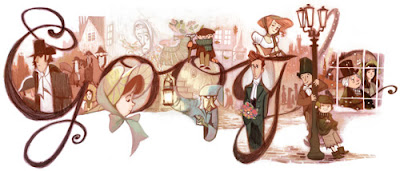
It’s Charles Dickens’s birthday, and Google celebrates with a doodle:
For Google’s puzzle today, some geography: “What single state is home to all of the following U.S. cities: Madrid, Toronto, Cincinnati, Denver, Hartford, and Norway?”
In Wisconsin history, from the Wisconsin Historical Society, another birthday:
On this date, U.S. Senator Herb Kohl was born in Milwaukee. Kohl received a BA in Business Administration from UW-Madison in 1956 and an MBA from Harvard in 1958. A businessman, president of an investment company, owner of a profesional basketball team, and former president of a business corporation, Kohl also served in the Army Reserve from 1958-1964. A Democrat, he was first elected to the U.S. Senate in 1988 and reelected in 1994, 2000 and 2006. [Source: Wisconsin Blue Book 1997-98]
Always a mistake for a person, or a place, to envy and conspire against others’ free, voluntary accomplishments.
I held this commercial from the preceding post of my other favorites, because it’s both longer and different: its political themes separate it from a conventional commercial, even a conventional Super Bowl commercial (if there should be such a thing).
There’s an optimism in this commercial that is, I think, justified: despite the most difficult times since the Depression, we are a resilient people sure to bounce back.
Videos of all the Super Bowl commercials are available online. If you missed a few, you can always check for good ones, or review favorites you saw last night.
Here are some of the ones that I liked:
A fine Super Bowl, I thought, but I’d be remiss not to post a few highlights from yesterday’s Puppy Bowl VIII.
Enjoy.
Good morning.
Whitewater’s forecast calls for a cloudy day, with a high of thirty-nine. In New York, it’s a sunny day ahead with a high of fifty-one.
The Wisconsin Historical Society records that on this day in 1967,
…nationally known activist Stokely Carmichael spoke at UW-Whitewater as part of a forum series entitled “Black Power and the Civil Rights Movement.” The chairman of the Student Non-Violent Coordinating Committee at Whitewater motivated students in attendance, stating that blacks must reclaim their identity and history, and organize to control local political offices, especially in large cities. [Source: Janesville Gazette]
The city’s still standing, all these years later.
On this day in 1952, Britain’s King George VI died, and was succeeded by his daughter, Elizabeth II. Of that daughter, there’s a Twitter parody from “Elizabeth Windsor,” @Queen_UK, “Queen, Head of the Commonwealth, Defender of the Faith, wife of the DoE, mother, grandmother and author of http://www.amazon.co.uk/dp/144473895X .”
Some of her recent Tweets:
Happy Birthday:
1849 – University of Wisconsin opens
On this day in 1849 the University of Wisconsin began with 20 students led by Professor John W. Sterling. The first class was organized as a preparatory school in the first department of the University: a department of science, literature, and the arts.
The university was initially housed at the Madison Female Academy building, which had been provided free of charge by the city. The course of study was English grammar; arithmetic; ancient and modern geography; elements of history; algebra; Caesar’s Commentaries; the Aeneid of Virgil (six books); Sallust; select orations of Cicero; Greek; the Anabasis of Xenophon; antiquities of Greece and Rome; penmanship, reading, composition and declamation.
Also offered were book-keeping, geometry, and surveying. Tuition was “twenty dollars per scholar, per annum.”
For a detailed recollection of early UW-Madison life, see the memoirs of Mrs. W.F. Allen [Source: History of the University of Wisconsin, Reuben Gold Thwaites, 1900]
I wouldn’t have expected that there would be no charges filed in a doping investigation of Lance Armstrong, but then the law is a human thing, and so filled with uncertain and unexpected results:
Lance Armstrong Doping Investigation Dropped: Prosecutors Close Inquiry, No Charges Filed.