
Good morning.

Tuesday in Whitewater will be sunny with a high of 75. Sunrise is 7:06 and sunset is 6:15 for 11 hours 9 minutes of daylight. The moon is a waxing crescent with 8.8 percent of its visible disk illuminated.
The Whitewater Schools’ Business, Operations & Finance Committee meets at 4:45 PM. Whitewater’s Ethics Board meets at 5 PM, the Public Works Committee at 5 PM, and the Police and Fire Commission at 6 PM.
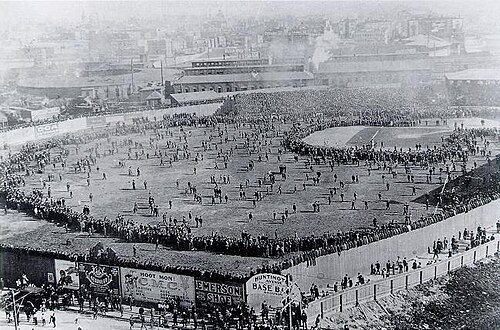
On this day in 1903, the Boston Red Sox win the first modern World Series, defeating the Pittsburgh Pirates in the eighth game.
Yesterday, Federal Reserve Bank of Cleveland President Beth Hammack delivered remarks to a meeting of the National Association of Business Economics. (Hammack is not on the Federal Reserve’s Board of Governors; she is president and chief executive officer of the Cleveland Fed — one of twelve regional banks — and, this year, also a voting member of the Federal Open Market Committee.)
Here’s her studied assessment of the American economy:
So, with that framework [how monetary policy should react to economic fundamentals to reach designated economic goals], here’s how these inputs read to me right now and how I expect the weather to develop. I’ll start with inflation, because it’s where the wind has been blowing hardest against us.
Inflation is elevated compared with our 2 percent objective. Headline PCE inflation was 3.4 percent in August this year, and core PCE was 3 percent. Both readings are above year-earlier levels, when headline was 2.7 percent and core was 2.9 percent. That’s not a stray gust; it’s a headwind that’s been with us for a while.
I see inflation pressures as relatively broad-based rather than concentrated in one component. Energy has been making headlines this year, with prices rising for oil, retail gasoline, and diesel, but it isn’t the whole story.
Higher tariff rates have been pushing up costs on the supply side. While a one-time increase in tariff rates could potentially be viewed as a one-time increase in the price level, multiple waves of tariff rate increases have resulted in a series of cost shocks.
And it’s not just the supply side. Demand-side pressures coming from the AI buildout are raising prices on key computer, electronic, and high-tech components. This is raising costs for data centers, yes, but also for projects that use similar components in aviation, electricity production, and construction.
When I talk with contacts across the District, I hear about additional cost pressures in health insurance, plastics, metals, grains, electricity, and other areas. Price pressures are also showing up in core services inflation excluding housing, a category that shouldn’t be especially exposed to tariffs or energy.
Trend inflation measures point in the same direction. Cleveland Fed researchers estimate that once the median and trimmed-mean inflation measures are adjusted to account for changes in skewness, trend inflation sits in the mid to high 2 percent range, in line with other statistical measures of trend inflation.
Because of the breadth of inflationary pressures, my baseline forecast is that it will take some time for inflation to return to 2 percent, even with appropriate monetary policy. A leveling off or decline in energy prices would certainly help move inflation in the right direction, but the demand-side pressures are not self-correcting. They are likely to be more persistent and usually require a more restrictive policy to [rein] them in.
See Beth M. Hammack, Trimming the Sails: Communicating My Reaction Function, Remarks at the 68th NABE Annual Meeting, October 12, 2026.
And so, and so: Inflation is elevated, it’s relatively broad-based rather than concentrated in one component, there are additional cost pressures in health insurance, plastics, metals, grains, electricity, and other areas, demand-side pressures are not self-correcting, and are likely to be more persistent and usually require a more restrictive policy.
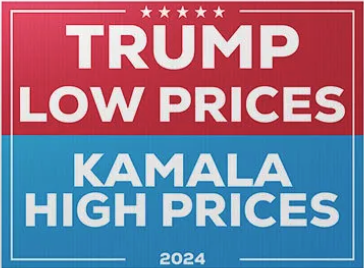
So to whom should we listen now? It wasn’t long ago that partisans in this city were putting up yard signs about the last presidential election. This libertarian blogger remembers them well — those partisans were ludicrously ignorant then and have proved to be more so now.
Then or now, there was no insight to be had in listening to men who’d struggle to fill even a Post-it® note with their economic understanding.
No thank you. So much better to read and accept the guidance of knowledgeable officials like Hammack, who now face the unfortunate task of managing the American economy to recover from the damage done to it.
Thieves steal 30,000 bottles of Italy’s most prized wines worth $5.8 million: