Thursday in Whitewater will be partly sunny with a high of 70. Sunrise is 6:59 and sunset is 6:25 for 11 hours 26 minutes of daylight. The moon is a waning crescent with 10.6 percent of its visible disk illuminated.
Whitewater’s Downtown Whitewater Activation Initiative holds an open house at 8:30 AM.
On this day in 1862, Union forces successfully halt the Confederate invasion of Kentucky after the Battle of Perryville.
Earlier this year, Donald J. Trump, having lived his whole life off an inherited real estate business from his father, declared of tariffs that “I believe the tariffs, paid for by foreign countries, will, like in the past, substantially replace the modern-day system of income tax, taking a great financial burden off” Americans. SeeAddress Before a Joint Session of Congress on the State of the Union, Feb. 24, 2026, transcript reproduced in PBS NewsHour.
No and no again. On the contrary, these many burdensome tariffs that Trump has imposed are paid by Americans, whether businesses or consumers. Economists at the Federal Reserve Bank of New York and Columbia University recently published an important study estimating how tariffs truly affect consumer prices. Tariffs raise consumer prices:
A tariff raises the price a U.S. importer (which could be a firm or a consumer) pays for a foreign good, unless the foreign exporter cuts its price to absorb some of the cost. In a previous post, we found that foreign exporters lowered their prices very little, so that nearly 90 percent of the 2025 tariffs were passed through to U.S. import prices. We find the same result here using data through February 2026. The effect is immediate: import prices rise almost one for one with tariffs in the first month after a tariff is raised. Our conclusion is unchanged when we account for exchange-rate movements: the dollar depreciated over this period, which also raised import prices, but we still estimate a tariff pass-through of around 90 percent.
[…]
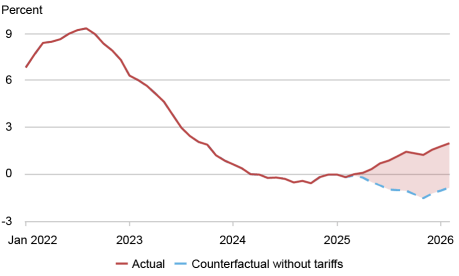
Our estimates attribute this increase [in consumer goods prices] to the tariffs: by February 2026, tariffs had contributed 2.9 percentage points to goods price inflation, and without them goods prices would have fallen slightly.
Tariffs Raised Consumer Goods Price Inflation
Sources: U.S. Bureau of Labor Statistics; U.S. Census Bureau, Foreign Trade Statistics; U.S. International Trade Commission (USITC); U.S. Bureau of Economic Analysis; authors’ calculations. Notes: The solid line is the twelve-month change in consumer prices for the sixty-seven non-oil goods categories in our sample, weighted by 2022 consumer expenditure. The dashed line subtracts our estimate of the contribution of tariffs, shown by the shaded area. The estimates compare goods that were more exposed to tariffs with goods that were less exposed, holding economy-wide factors fixed.
Consumer goods price inflation was falling quickly in 2023 and 2024, but began to rise (to a level now higher than in 2024) after Trump’s so-called “Liberation Day” imposition of tariffs.