
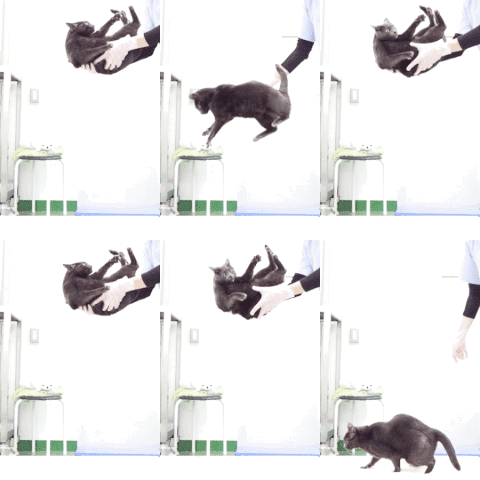
Cats are endlessly fascinating, and among their captivating qualities is an ability to land on their feet. An article in The New York Times describes the latest scientific findings:
In a paper, published last month in the journal The Anatomical Record, researchers offered a novel take on falling felines. Their evidence suggests new insights into the so-called falling cat problem, particularly that cats have a very flexible segment of their spines that allows them to correct their orientation midair.
Greg Gbur, a physicist and cat-falling expert at the University of North Carolina at Charlotte who was not involved with the paper, said the study was the first he knew of that explored “what the structure of the cat’s spine tells us about how a cat turns over while falling.” He added that the research uncovered many remarkable details about how cats maneuver while falling.
The researchers found that the feline spine was extremely flexible in the upper thoracic vertebrae, but stiffer and heavier in the lower lumbar vertebrae. The discovery matches video evidence showing the cats first turn their front legs, and then their lower legs. The results suggest the cat quickly spins its flexible upper torso to face the ground, allowing it to see so that it can correctly twist the rest of its body to match.
“The thoracic spine of the cat can rotate like our neck,” Dr. [Yasuo] Higurashi [physiologist at Yamaguchi University in Japan and lead author of the study] said.
See Taylor Mitchell Brown, Why Falling Cats Always Seem to Land on Their Feet (‘It takes backbone to solve an enigma like the “falling cat” problem’), New York Times, March 11, 2026.