It’s supposed to do a better job of controlling stomach acid than lighter coffees.
Free Markets, Laws/Regulations, Libertarians, Planning, Poverty
Reason.tv: Reason Saves Cleveland with Drew Carey — The Decline of a Once-Great City
by JOHN ADAMS •
Reason.tv: Reason Saves Cleveland with Drew Carey — The Decline of a Once-Great City
Here’s the first full episode of Drew Carey’s series on Cleveland, and ways to revitalize the city.
Sixty years ago, Cleveland was a booming city full of promise, opportunity, and people. Today, the city’s population is less half of what it was in its prime and it ranks as one of the poorest big cities in the United States. Hometown hero Drew Carey reflects on how the city became “the mistake on the lake” and wonders about the city’s future.
Link:
http://www.youtube.com/watch?v=096pjEOrdK4&feature=player_embedded
more >>
Free Markets, Government Spending, Laws/Regulations, Libertarians, Poverty
Reason.tv: Reason Saves Cleveland with Drew Carey — Introduction
by JOHN ADAMS •
Drew Carey has a series at Reason.tv about his hometown of Cleveland, Ohio. Cleveland’s a big place, but Carey’s proposals for revitalizing his town would apply to other places in the Midwest, including far smaller ones.
Here’s an introduction to his series:
Click …to watch Drew introduce the series that just might save his hometown. And yours.
Reason Saves Cleveland With Drew Carey is an original Reason.tv documentary series that will air during the week of March 15-19.
Featuring sitcom legend, Price Is Right host, and proud Clevelander Drew Carey, each 10-minute episode investigates and analyzes the problems that turned Cleveland from the nation’s sixth-largest city in 1950 into today’s “Mistake On The Lake.”
Like all too many American cities, Cleveland seems locked into a death spiral, shedding people, jobs, and dreams like nobody’s business. When it comes to education, business climate, redevelopment, and more, Clevelanders have come to expect the worse. Is a renaissance possible? Of course it is, but only if the city’s leaders and residents are willing to learn from other cities such as Houston, Chicago, Oakland, and Indianapolis. And only if they’re willing to try new approaches to old problems.
Reason.tv’s Nick Gillespie narrates and talks with educators, elected officials, businesspeople, policy experts, and residents from all walks of life. Stay tuned for a documentary series that maps a route back to prosperity and growth not just for Cleveland but for other once-great American cities.
Reason Saves Cleveland with Drew Carey is written and produced by Paul Feine; camera and editing by Roger Richards and Alex Manning; music by the Cleveland band Cats on Holiday.
The video below is a collection of scenes from the series, but it shows briefly both the beauty and decay of contemporary Cleveland.
Link:
http://www.youtube.com/watch?v=cBI02nn6X0s&feature=player_embedded more >>
Press Release
Press Release: Award-Winning Potter Offers Free Class in Lake Mills Studio
by JOHN ADAMS •
From the press release, that I am happy to post:
Bruce Johnson’s distinctive raku ceramic pieces have been enjoyed by people all over the nation for over 25 years. Johnson is now offering to share his knowledge and technique with others by offering a free lesson in wheel thrown and hand built ceramics.
“With my years of experience as a full-time artist, I believe I have much to offer those interested in ceramics, I want to try it to see if you like it” says Johnson, “whether they are just beginning or already experienced in working with clay.” In this unique learning opportunity, students will learn the art of making functional and decorative pottery, both hand built and wheel thrown. The pieces will be fired in food-safe, high-fire glazes, and in the ancient technique of raku firing.
All sessions will take place at Bruce Johnson Clay Studio, 302 W. Campus Street, in Lake Mills, Wisconsin, beginning the week
of March 30 2010. The class includes one session a week for seven weeks, 25 pounds of clay, and all glaze materials, including firing. Classes will be held Tuesday and Thursday nights from 6:30pm to 9pm, and Saturday mornings from 10am to 12:30pm. Each class is limited to six students to ensure individual attention for each student.
To register, or for further information, contact Johnson at 920-648-3049 or bruce@brucejohnsonclaystudio.com. Samples of work can be seen on his website, www.brucejohnsonclaystudio.com.
Bruce Johnson Clay Studio
302 Campus Street
Lake Mills WI 53551
920 648 3049 fax 920 648 6809
Daily Bread
Daily Bread for Whitewater, Wisconsin: 3-23-10
by JOHN ADAMS •
Good morning,
Today’s forecast for Whitewater calls for a sunny day, with a high of fifty-seven degrees.
The History Channel’s website has a post this morning that considers the expression “o.k.” Apparently, it’s older than one might have imagined:
On this day in 1839, the initials “O.K.” are first published in The Boston Morning Post. Meant as an abbreviation for “oll correct,” a popular slang misspelling of “all correct” at the time, OK steadily made its way into the everyday speech of Americans.
During the late 1830s, it was a favorite practice among younger, educated circles to misspell words intentionally, then abbreviate them and use them as slang when talking to one another. Just as teenagers today have their own slang based on distortions of common words, such as “kewl” for “cool” or “DZ” for “these,” the “in crowd” of the 1830s had a whole host of slang terms they abbreviated. Popular abbreviations included “KY” for “No use” (“know yuse”), “KG” for “No go” (“Know go”), and “OW” for all right (“oll wright”).
Of all the abbreviations used during that time, OK was propelled into the limelight when it was printed in the Boston Morning Post as part of a joke. Its popularity exploded when it was picked up by contemporary politicians. When the incumbent president Martin Van Buren was up for reelection, his Democratic supporters organized a band of thugs to influence voters. This group was formally called the “O.K. Club,” which referred both to Van Buren’s nickname “Old Kinderhook” (based on his hometown of Kinderhook, New York), and to the term recently made popular in the papers. At the same time, the opposing Whig Party made use of “OK” to denigrate Van Buren’s political mentor Andrew Jackson. According to the Whigs, Jackson invented the abbreviation “OK” to cover up his own misspelling of “all correct.”
The man responsible for unraveling the mystery behind “OK” was an American linguist named Allen Walker Read. An English professor at Columbia University, Read dispelled a host of erroneous theories on the origins of “OK,” ranging from the name of a popular Army biscuit (Orrin Kendall) to the name of a Haitian port famed for its rum (Aux Cayes) to the signature of a Choctaw chief named Old Keokuk. Whatever its origins, “OK” has become one of the most ubiquitous terms in the world, and certainly one of America’s greatest lingual exports.
Charity
Press Release: Dementia Basics Workshop Offered at Waukesha Memorial Hospital
by JOHN ADAMS •
I received the following press release that I am happy to post.
The Alzheimer’s Association will be presenting a three-part “Dementia Basics” workshop on consecutive Tuesdays beginning April 6, 2010 and continuing through April 20, 2010 from 6:00 to 8:00 p.m. at Waukesha Memorial Hospital, 725 American Avenue, in Waukesha.
The program will be held in the Education Center, Room E. This three-session program is ideal for those who have experienced the recent diagnosis of Alzheimer’s disease or a related dementia in their family, friend, or neighbor, and want to educate themselves on this topic. The program will cover the warning signs of dementia; the differences between dementia and Alzheimer’s disease, communication strategies, assessing behavior changes, safety issues, community resources and care for the caregiver.
There will also be an opportunity to exchange ideas and experiences with others who are coping with similar situations. The workshop will be presented by Krista Scheel, Program Director, Alzheimer’s Association. This information or to register, please contact the Alzheimer’s Association at 414-479-8800 or via email at rebecca.walker@alz.org.
The Alzheimer’s Association is a national non-profit organization whose mission is to eliminate Alzheimer’s disease through the advancement of research, to provide and enhance care and support for all affected and to reduce the risk of dementia through the promotion of brain health. For more information about Alzheimer’s disease and local services visit www.alz. org/sewi or call the 24/7 Helpline at 800-272-3900.
Daily Bread
Daily Bread for Whitewater, Wisconsin: 3-22-10
by JOHN ADAMS •
Good morning,
Today’s forecast for Whitewater calls for a sunny day, with a high of fifty-four degrees.
There’s no school this week, on a week that looks to be sunny and mild.
The Wisconsin Historical Society has a story on it’s website today about an episode in trickery, from the Wisconsin of 1854 — the claim that a prehistoric beast had been discovered:
1854 – Eugene Shepard, Father of the Hodag
On this date Eugene Shepard was born near Green Bay. Although he made his career in the lumbering business near Rhinelander, he was best known for his story-telling and practical jokes. He told many tales of Paul Bunyan, the mythical lumberjack, and drew pictures of the giant at work that became famous. Shepard also started a new legend about a prehistoric monster that roamed the woods of Wisconsin – the hodag. Shepard built the mythical monster out of wood and bull’s horns. He fooled everyone into believing it was alive, allowing it to be viewed only inside a dark tent. The beast was displayed at the Wausau and Antigo county fairs before Shepard admitted it was all a hoax. [Source: Badger saints and sinners, by Fred L. Holmes, p.459-474]
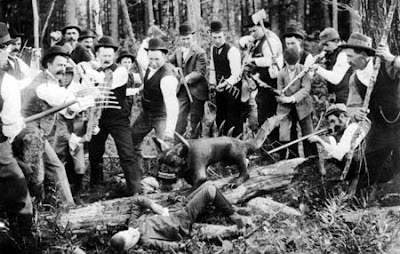
Rhinelander, Wisconsin has adopted the fictitious beast for a mascot, and there’s a music festival that carries the animal’s name.
Law, Public Meetings
Wisconsin State Journal — E-mails: Firing of Wis. Vets Secretary was Planned
by JOHN ADAMS •
It’s Sunshine Week in America, a “national initiative to open a dialogue about the importance of open government and freedom of information.” Open government in Wisconsin includes open meetings, surely, and Wisconsin law has clear provisions for open meetings. See, WOML, Wisconsin Statutes, 19.81-19.98.
Over at the Wisconsin State Journal, Mary Spicuzza has a story about how Veterans Affairs board members likely violated Wisconsin law by developing a secret meeting strategy before an official public meeting. The story, entitled, E-mails: Firing of Wis. Vets Secretary was Planned, describes a covert effort to script and stage a meeting, before the public meeting ever took place:
At least a week before Veterans Affairs Secretary John Scocos was fired, the department’s board members had secretly come up with a strategy to dismiss and replace him, complete with a “PR plan” and “talking points” about the decision, e-mails show.
And Gov. Jim Doyle’s office reportedly had advised a board member to openly criticize Scocos to “ensure public exposure prior to the actual removal vote,” according to the e-mails, which were obtained through a state open records request.
The board voted on Nov. 24 to fire Scocos and replace him with Ken Black, a department administrator. The governor’s office and board members have repeatedly said the board acted independently of Doyle, but the e- mails raise questions about whether that’s the case – and if the state’s open meetings law was violated.
Scocos has sued over his firing, which came about two months after he returned from a deployment in Iraq with the U.S. Army Reserve, alleging his dismissal violated a federal law that protects returning service members. Scocos, a Republican appointee, also alleges the Democratic governor and his appointees fired him for political reasons.
The state Department of Justice did not respond to specific questions about the legality of the secret discussion among board members. But the DOJ cautions public officials that agreeing on a course of action before a meeting could violate the state’s open meetings law, and specifically warns about possible violations via e-mail.
In the online version of the State Journal story, there’s a link to the emails that discuss in detail how to script the meeting, along a fixed and decided plan.
A normal person can see, easily, the wrong in this — a public meeting is more than a puppet show, more than dumb theater that simply reflects what insiders have scripted and planned secretly, away from public view. An insider can see it, too — that’s why they didn’t simply announce that they’d scripted the meeting. Now I know, and you know, that there are some insiders who’d say that this is simply a game, and this is how the game’s played.
Representative government has never been a game, official actions have never been sport, and those who think so are offensively wrong. They debase the American way of life, often cheapening it for no better reason than their desire to feel important, influential, or to achieve partisan success.
Here one sees a case of how a lawful, open process is subverted through email. There are other ways to achieve even greater subversion, as even a conniving person can attempt to circumvent the law through concealing some emails, or even more duplicitously, scheme only through phone calls or furtive conversations away from the public record. The latter method dares a person: do you think we discussed nothing about this, or can you guess that we schemed in ways you’ll be unable to confirm?
If a request for information receives a reply that there are no written records, about a subject certain to produce some discussion, one can reliably conclude that (1) records were withheld, or (2) conversations were covertly some discussion, one can reliably conclude that (1) records were withheld, or (2) conversations were covertly held in ways outside normal record-producing methods. In this way, officials would prove too clever by half (to use an English expression): concealing records to avoid embarrassment, but only at the price of the suspicious & dubious declaration that there was no normal or conventional communication. dubious declaration that there was no normal or conventional communication.
These covert plans are not, and should never be, a subterfuge against genuine open, public meetings. America is no small and vulgar place, and for not a moment should one endure conditions in which we are made small and vulgar through official misuse of authority. One would prefer lawful and honest official conduct, and so preferring it, one commits to advocacy, to help bring it about. It shouldn’t be this way; it’s worse to endure it servilely. About advocacy, one finds oneself committed and confirmed, and in the effort, one affirms one’s convictions as a true believer in America’s promise.
Daily Bread
Daily Bread for Whitewater, Wisconsin: 3-19-10
by JOHN ADAMS •
Good morning,
Whitewater’s forecast calls for a mostly cloudy day, with a high of fifty-three degrees.
At each of the schools in our public school district today, from 8:30 to 9:30, there’s a Coffee with the Principal hour. Spring Break begins at the end of today’s school day.
We’ve had a few days of Daylight Saving Time, but the practice is old. Congress passed legislation in 1918 about Daylight Saving, although the idea was considered far earlier:
Daylight Saving Time has been used in the U.S. and in many European countries since World War I. At that time, in an effort to conserve fuel needed to produce electric power, Germany and Austria took time by the forelock, and began saving daylight at 11:00 p.m. on April 30, 1916, by advancing the hands of the clock one hour until the following October. Other countries immediately adopted this 1916 action: Belgium, Denmark, France, Italy, Luxembourg, Netherlands, Norway, Portugal, Sweden, Turkey, and Tasmania. Nova Scotia and Manitoba adopted it as well, with Britain following suit three weeks later, on May 21, 1916. In 1917, Australia and Newfoundland began saving daylight.
The plan was not formally adopted in the U.S. until 1918. ‘An Act to preserve daylight and provide standard time for the United States’ was enacted on March 19, 1918. [See law] It both established standard time zones and set summer DST to begin on March 31, 1918. Daylight Saving Time was observed for seven months in 1918 and 1919. After the War ended, the law proved so unpopular (mostly because people rose earlier and went to bed earlier than people do today) that it was repealed in 1919 with a Congressional override of President Wilson’s veto. Daylight Saving Time became a local option, and was continued in a few states, such as Massachusetts and Rhode Island, and in some cities, such as New York, Philadelphia, and Chicago.
Uncategorized
Sunshine Week, March 14 – 20
by JOHN ADAMS •

Across America, it’s Sunshine Week, a “national initiative to open a dialogue about the importance of open government and freedom of information.”
Those who work for open government through efforts like Sunshine Week do so because they love their country and wish to fortify America’s tradition of liberty.
See, www.sunshineweek.org.
Charity, Uncategorized
Reagan on Equality
by JOHN ADAMS •
I saw recently that a senate candidate, in the Democratic party’s primary in California, quoted Reagan on equality. The candidate mentioned that Reagan had once said that equality required not merely formal equality before the law, but that people believed that they were “equal in the eyes of each other.” I could not remember hearing Reagan having said it. I thought I’d search around, and see if I could find if Reagan did say as much, and when.
He did use the expression, in 1992, at the Republican national convention, at which Presdient Bush was nominated to run for re-election against Bill Clinton. Here’s the portion of his address to the delegates in which he uses the expression:
Whether we come from poverty or wealth; whether we are Afro- American or Irish-American; Christian or Jewish, from big cities or small towns, we are all equal in the eyes of God. But as Americans that is not enough — we must be equal in the eyes of each other.
It’s true, as Johnson (speaking in a video I posted on Monday) or King would have known well — that formal equality before the law cannot easily endure without the conviction among people that all are worthy of that equality. Neither status nor position nor expectation changes the truth and necessity of the conviction.
The Democrat who quoted Reagan found Reagan’s expression memorable. It is; having encountered the expression, one is likely to recall it, easily. It’s more than memorable; the religious and philosophical foundation of equality is both a safeguard of a community and an enduring devotion between friends.
Daily Bread
Daily Bread for Whitewater, Wisconsin: 3-18-10
by JOHN ADAMS •
Good morning,
Today’s forecast calls for a clear day with a high of sixty-three.
It’s Market Day in Lincoln school. There will be pickup from 5 to 6 p.m. in the upper gym. It’s also Market Day at the High School, with pickup there from 4 to 5:30 p.m. During the day, the Middle School’s eighth grade band will make a tour today of district elementary schools.
On this day in Wisconsin history, the Wisconsin Historical Society recalls a wage increase in 1954 for workers at Parker Pen:
1954 – Parker Pen Employees Win Wage Increase
On this date employees of Parker Pen in Janesville won a 5-cent-an-hour wage increase in contract negotiations. After the raise, male employees made a base pay of $1.95 an hour while their female counterparts were paid $1.62 an hour. [Source: Janesville Gazette]
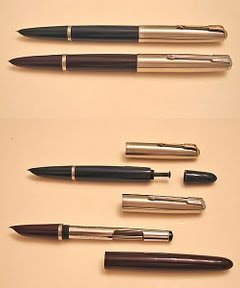
Here’s a picture of the Parker 51:
Daily Bread, Holiday
Daily Bread for Whitewater, Wisconsin: 3-17-10
by JOHN ADAMS •
Good morning,
Whitewater’s forecast calls for a sunny day, and a high of sixty-one degrees.
It’s St. Patrick’s Day. Here’s an excerpt from a description of St. Patrick Day:
Little is known of Patrick’s early life, though we know he was born in Roman Britain in the fifth century, into a wealthy Romano-British family. His father was a deacon in the Church, like his father before him. At the age of sixteen, he was kidnapped by Irish raiders and taken captive to Ireland as a slave.[1] It is believed he was held somewhere on the west coast of Ireland, possibly Mayo, but the exact location is unknown. According to his Confession, he was told by God in a dream to flee from captivity to the coast, where he would board a ship and return to Britain. Upon returning, he quickly joined the Church in Auxerre in Gaul and studied to be a priest.
In 432, he again says that he was called back to Ireland, though as a bishop, to save the Irish, and indeed he was successful at this, focusing on converting royalty and aristocracy as well as the poor. Irish folklore tells that one of his teaching methods included using the shamrock to explain the Holy Trinity (the Father, the Son, and the Holy Spirit) to the Irish people. After nearly thirty years of teaching and spreading “God’s word” he died on 17 March, 461 AD, and was buried at Downpatrick, so tradition says. Although there were other more successful missions to Ireland from Rome, Patrick endured as the principal champion of Irish Christianity and is held in esteem in the Irish Church.
The Chicago River having been dyed green to mark the day:

On this day in Wisconsin history, the Wisconsin Historical Society recalls a different Patrick:
1849 – Patrick Cudahy Born
On this date Patrick Cudahy was born. A philanthropist and meat packer, Cudahy was born in Callan, County Kilkenny, Ireland, and arrived in Milwaukee with his family in 1849. He began working in the meat packing industry at the age of 14.
He became superintendent of the Plankinton and Armour plant in Milwaukee in 1874. Cudahy became partners with Plankinton in 1884 and formed John Plankinton and Company. Upon Plankinton’s death in 1888, Patrick Cudahy and his brother John purchased the company which became the Cudahy Brothers. He founded and promoted Cudahy, Wisconsin, as an industrial city.
Patrick Cudahy served as company president from 1893 to 1915. He was a director of the First Wisconsin National Bank of Milwaukee. His extensive real estate holdings in Milwaukee were incorporated as the Patrick Cudahy Family Company. He was active in and contributed to the Milwaukee Association of Commerce, Ancient Order of Hibernians, and Friends of Irish Freedom. [Source: Dictionary of Wisconsin Biography, SHSW 1960, pg. 91]
Daily Bread
Daily Bread for Whitewater, Wisconsin: 3-16-10
by JOHN ADAMS •
Good morning,
The forecast for Whitewater today calls for a mostly clear day, with a high of fifty-eight.
In the City of Whitewater today, there will be a Common Council meeting at 6:30 p.m. The agenda for that meeting is available online.
On this day in Wisconsin history, the Wisconsin Historical Society, recalls
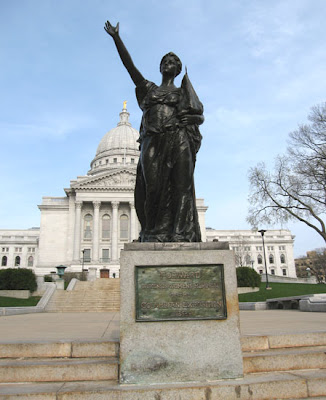
1967 – Sculptor Jean Pond Miner
On this date Jean Pond Miner Coburn died at the age of 101. A well-known sculptress during her time, Jean Pond Miner’s statue “Forward” was placed at the north corner of Capitol Park in Madison in 1895. At the time of the World’s Columbian Exposition, the Janesville Ladies Afternoon Club recommended Miner as a Wisconsin sculptress who might be featured at the Exposition’s Wisconsin building. $8,000 was raised by Wisconsin women for this exhibit featuring local talent. The statue is now in the first floor lobby of the Wisconsin Historical Society headquarters in Madison. [Source: Famous Wisconsin Women, Vol. 6, SHSW Women’s Auxiliary, 1976, pg. 4]