FREE WHITEWATER

Daily Bread for Whitewater, Wisconsin: 3-30-10

Good morning,

Whitewater’s forecast for today is for a breezy day, with a high of sixty-three degrees.

There will be a charter school listening session at the Cravath Lakefront Center this afternoon, from 4 to 6 p.m.

There’s also a district-wide science night tonight, at the high school, from 6:30 – 8 p.m. Here’s my science-oriented contribution, from Wired‘s science news: how elephants run. The story, entitled, ” Video: Elephants Run Like No Other,” describes their unique running technique:

A biomechanical analysis of running elephants has revealed that Earth’s largest land animals do some strange things at high speed.

Unlike every other quadruped, they use all four legs for braking and propulsion, rather than rather dividing those tasks between hind and front legs.

Elephants also prove to be extremely inefficient while running. Compared to animals like horses, they perform quite poorly. Then again, given their size, running itself is quite an achievement.

“It’s pretty cool that they can run at all. And they do it in such a weird way,” said John Hutchinson, an evolutionary biologist at the University of London.

In a study published March 29 in the Proceedings of the National Academy of Sciences, Hutchinson’s team videotaped six Asian elephants as they ran across mechanical plates that measured the force of each stride. By combining gait models distilled from the video with force measurements, they could quantify the elephants’ biomechanics.

Here’s a video of the Hutchinson’s observations:

Link:
http://link.brightcove.com/services/player/bcpid46203255001?bclid=46205328001&bctid=74491839001

On this day in 1867, Secretary of State Seward came to an agreement with Russia to purchase Alaska, at a cost of around seven million dollars. That’s less than a single office building today, and the building would lack reserves of oil, other diverse plants and animals, and a famous former governor. more >>

Reason.tv – Reason Saves Cleveland with Drew Carey: Privatize It (Episode 3)

Here’s episode three of the Reason.tv series on saving Cleveland, and by implication lots of other cities, too. In this episode, viewers see how government doesn’t manage produce markets or golf courses very well.

Should cities be in the business of running businesses ranging from convention centers to farmers markets? Selling off golf courses, contracting out parking concessions, and all manner of public-private partnerships are generating billions of dollars in revenue and dramatically improving city services in places such as Chicago and Indianapolis. Will Cleveland’s elected officials learn the right lessons in time?

Reason Saves Cleveland with Drew Carey is written and produced by Paul Feine; camera and editing by Roger Richards and Alex Manning; narrated by Nick Gillespie; music by the Cleveland band Cats on Holiday.


Link: http://www.youtube.com/watch?v=g9-ozphsuSk more >>

On a Charter School

Whitewater has the chance for approval and funding for a charter school.  Our school district’s website lists the next Charter School listening session as taking place tomorrow, March 30th, at the Cravath Lakefront Center, from 4 to 6 p.m.

Libertarians have long favored charter schools, and a video that I posted last week, from Reason.tv on fixing Cleveland’s schools, gives only a taste of a charter school’s promise.  I have not studied charter schools at any length, and have read about them only tangentially to other libertarian topics.  A few years ago, I visited more frequently the website of a charter schools advocate, Joanne Jacobs ( www.joannejacobs.com), but I have not, sadly, visited her site more recently or frequently.

Charter schools are a good compromise solution in a world of significant funding for public education.  One might hope for more private alternatives, but they won’t happen overnight, and we cannot quickly undo decades of government-sponsored education.  All policy takes place on the margin, with conditions existing that one might not prefer, but cannot easily — and surely not magically — change.  Public spending produces this cumulative result: over time, it drains away private resources until private alternatives prove too anemic to thrive. 

Government first takes the field as merely one player, but quickly occupies the field, taxing the resources on which private competition depends.  

To call charter schools a compromise solution is no back-handed compliment; on the contrary, they may be one of the most practical ways to offer space from burdensome regulation and government intrusion.

A charter school thrives or languishes by its charter, and how that charter is implemented.  I simply don’t know enough about Wisconsin charter schools to tell how Whitewater’s proposed charter seems in relation to existing schools’ charters. Along the same lines, I don’t know the likelihood of a charter school proposal’s success in receiving funding.  Even if one knew generally, one would also have to know how close or far a given proposal was from that of other applicants’ proposals.

There are three things that one can say with confidence.

First, a charter school offers greater locally autonomy, in line with its charter, and that’s a positive circumstance.  That’s especially true in a small community, where private alternatives (other than homeschooling) are unlikely to develop (at least anytime soon).  We’re not a big city, where, for example, a large parochial school system might operate alongside a public one, offering an alternative (really, a competitive choice).  Our district’s larger than the City of Whitewater, but it’s still a smaller, rural public district.   Although parents might send their children from one district to another through open enrollment, distance makes that option slight and limited.  That option is important, but hardly one most parents could practically exercise.

Second, if all charter schools depend on a commitment to a clear, focused charter, then they also depend on equal access for all residents, up to the space available.  Recent revelations about favoritism in school admissions in Chicago (often involving magnet schools, rather than charter schools), shows the risks of any public allocation of limited resources.  Even if an option would produce a fine result, unfair access to the option undermines, rather than advances, a community.  An allocation of penicillin, based on proximity to a public hospital, rather than on greatest medical need (or even on equal distribution), would save some only at the expense of not saving more.

Third, one of the truths of inner-city charter schools is that they succeed, if the charter is sound, across all socio-economic groups.  Many charter schools thrive, and produce excellent results, with students who might otherwise unfairly be written off as disadvantaged, and somehow unsuitable for a charter school program.  No one should be counted out; this community is a multicultural one, and any program can succeed with a heterogeneous student body.

I don’t know how this will turn out; it’s to our credit that we’re considering a less restrictive, more autonomous educational program.


Daily Bread: March 29, 2010

Good morning,

Whitewater’s forecast today calls for a sunny day, with a high of fifty-three degrees.

In the City of Whitewater, there will be a meeting of the Alcohol Licensing Commission at 6 p.m. tonight.

Over at Wired, there’s a story about how purchasing groceries (and tracking inventory) may become much easier. In “New RFID Tag Could Mean the End of Bar Codes,” Lisa Grossman writes that

Lines at the grocery store might become as obsolete as milkmen, if a new tag that seeks to replace bar codes becomes commonplace.

Researchers from Sunchon National University in Suncheon, South Korea, and Rice University in Houston have built a radio frequency identification tag that can be printed directly onto cereal boxes and potato chip bags. The tag uses ink laced with carbon nanotubes to print electronics on paper or plastic that could instantly transmit information about a cart full of groceries.

“You could run your cart by a detector and it tells you instantly what’s in the cart,” says James M. Tour of Rice University, whose research group invented the ink. “No more lines, you just walk out with your stuff.”

RFID tags are already used widely in passports, library books and gadgets that let cars fly through tollbooths without cash. But those tags are made from silicon, which is more expensive than paper and has to be stuck onto the product as a second step.

“It’s potentially much cheaper, printing it as part of the package,” Tour says.

There’s a long way to go, and this research isn’t store-ready; it’s still a proof-of-concept effort. There’s also been talk before about RFID tags in stores, but it’s remained only talk. Still, this has come so far not by government mandate, but through the discoveries of scientists that cannot be assured through regulation or business pressure.

(Photo of a currently-used RFID tag.)

Recent Tweets, 3-21 to 3-27


FREE WHITEWATER on Twitter

Reason.tv: Reason Saves Cleveland With Drew Carey, Ep. 2 (Fix the Schools)

I’ve posted before on the Reason.tv series from Drew Carey, entitled, “Reason Saves Cleveland with Drew Carey.”  Today, I’m posting Episode Two from that series, about the Cleveland public schools.

I’ve not posted recently on our schools, and for that lack of attention, I’m surely culpable.  (There are no column-inch limitations in cyberspace — there are plenty of electrons to go around, for all kinds of topics.) Where I have posted on education most recently, it was about an incident and its aftermath (the Minett case), that was an educational issue only in part.  In fact, I think that case was best understood apart from more conventional school law concerns.

Most educational issues, fortunately, are genuinely school matters, and involve a curriculum, the teaching of it, and students’ responses to that teaching.

Although we’re a small town, only a fraction of the size of Cleveland, we have some attributes of a much larger city.  We are ethnically diverse, as Cleveland is, for example.  I’m convinced that the last census count under-represented some ethnic groups within town, and in any event, there’s been even more demographic change since the 2000 census.

Sadly, we also have a problem that large cities have: a significant number of Whitewater families with children in poverty.  That condition is more common to rural America than brochures, press releases, or marketing campaigns will ever acknowledge.  I’ve yet to see a marketing effort, for any city, along the lines of “You may not have known, but we have a lot of indigent families in town, and we think it’s time to mention the fact.”

Perhaps, just perhaps, there are lessons that we could learn from places like Cleveland, or rising-star programs like the one in Oakland, California.

I’ll follow up, tomorrow, with a post on the possibility of a charter school in Whitewater.  Libertarians have long-favored charter schools, and I’ll write about the possibility, and aspects of its proposed implementation, for our town.

Here’s the description accompanying the video:

Cleveland’s public schools are failing to prepare students for their futures and as a result, all parents who can afford to have been fleeing to the suburbs for decades.

Yet some urban schools, like Think College Now in Oakland, California are finding out that a combination of administrative autonomy and accountability can lead to amazing results.

Within Cleveland’s own boundaries, charter schools are booming and delivering quality education at a fraction of the cost of traditional public schools. Does Cleveland have what it takes to fundamentally reform its K-12 education system and become a leader in 21st-century education?

Reason Saves Cleveland with Drew Carey is written and produced by Paul Feine; camera and editing by Roger Richards and Alex Manning; narrated by Nick Gillespie; music by the Cleveland band Cats on Holiday.


Video Link:
http://www.youtube.com/watch?v=Mvzh82EpWBU&feature=player_embedded

Related Links —

Proven Policies to Fix Schools.

Reason.com on Education. more >>

Daily Bread for Whitewater, Wisconsin: 3-26-10

Good morning,

Whitewater’s forecast for Friday calls for a sunny day, with a high of forty-one degrees.

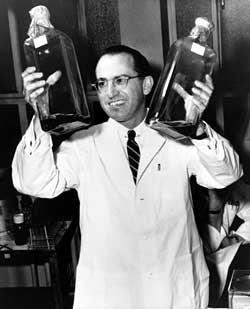
On this day in 1953, Dr. Jonas Salk announced that he had tested (successfully) a vaccine against polio. The History Channel has the details:

In 1952–an epidemic year for polio–there were 58,000 new cases reported in the United States, and more than 3,000 died from the disease. For promising eventually to eradicate the disease, which is known as “infant paralysis” because it mainly affects children, Dr. Salk was celebrated as the great doctor-benefactor of his time…

Salk, born in New York City in 1914, first conducted research on viruses in the 1930s when he was a medical student at New York University, and during World War II helped develop flu vaccines. In 1947, he became head of a research laboratory at the University of Pittsburgh and in 1948 was awarded a grant to study the polio virus and develop a possible vaccine. By 1950, he had an early version of his polio vaccine.

Salk’s procedure, first attempted unsuccessfully by American Maurice Brodie in the 1930s, was to kill several strains of the virus and then inject the benign viruses into a healthy person’s bloodstream. The person’s immune system would then create antibodies designed to resist future exposure to poliomyelitis. Salk conducted the first human trials on former polio patients and on himself and his family, and by 1953 was ready to announce his findings. This occurred on the CBS national radio network on the evening of March 25 and two days later in an article published in the Journal of the American Medical Association. Dr. Salk became an immediate celebrity.

In 1954, clinical trials using the Salk vaccine and a placebo began on nearly two million American schoolchildren. In April 1955, it was announced that the vaccine was effective and safe, and a nationwide inoculation campaign began. New polio cases dropped to under 6,000 in 1957, the first year after the vaccine was widely available. In 1962, an oral vaccine developed by Polish-American researcher Albert Sabin became available, greatly facilitating distribution of the polio vaccine. Today, there are just a handful of polio cases in the United States every year, and most of these are “imported” by Americans from developing nations where polio is still a problem. Among other honors, Jonas Salk was awarded the Presidential Medal of Freedom in 1977. He died in La Jolla, California, in 1995.

Daily Bread for Whitewater, Wisconsin: 3-25-10

Good morning,

The forecast for Whitewater calls for a breezy day, with a high of forty-four degrees.

Yesterday Wired published about a fascinating, and apparently paradoxical, phenomenon: the contention that, sometimes, hot water will freeze faster than cold water. Over at Wired‘s science column, there’s a post entitled, “It’s True: Hot Water Really Can Freeze Faster Than Cold Water.”

Hot water really can freeze faster than cold water, a new study finds. Sometimes. Under extremely specific conditions. With carefully chosen samples of water.

New experiments provide support for a special case of the counterintuitive Mpemba effect, which holds that water at a higher temperature turns to ice faster than cooler water.

The Mpemba effect is named for a Tanzanian schoolboy, Erasto B. Mpemba, who noticed while making ice cream with his classmates that warm milk froze sooner than chilled milk. Mpemba and physicist Denis Osborne published a report of the phenomenon in Physics Education in 1969. Mpemba joined a distinguished group of people who had also noticed the effect: Aristotle, Francis Bacon and René Descartes had all made the same claim.

On the surface, the notion seems to defy reason. A container of hot water should take longer to turn into ice than a container of cold water, because the cold water has a head start in the race to zero degrees Celsius.

But under scientific scrutiny, the issue becomes murky. The new study doesn’t explain the phenomenon, but it does identify special conditions under which the Mpemba effect can be seen, if it truly exists….

Papers published over the last decade, including several by Auerbach, who performed his research while at the Max Planck Institute for Flow Research in Göttingen, Germany, have documented instances of hot water freezing faster than cold, but not reproducibly, says study author James Brownridge of State University of New York at Binghamton. “No one has been able to get reproducible results on command.”

That’s what Brownridge has done. One of his experiments, presented online, repeatedly froze a sample of hot water faster than a similar sample of cool water.

Note the word similar. In order for the experiment to work, the cool water had to be distilled, and the hot water had to come from the tap.

In the experiment, about two teaspoons of each sample were held in a copper device that completely surrounded the water, preventing evaporation and setting reasonably even temperatures. Freezing was official when sensors picked up an electrical signal created by ice formation.

Brownridge heated the tap water to about 100° C, while the distilled water was cooled to 25° C or lower. When both samples were put into the freezer, the hot water froze before the cold water. Brownridge then thawed the samples and repeated the experiment 27 times. Each time, the hot tap water froze first.

The experiment worked because the two types of water have different freezing points, Brownridge says. Differences in the shape, location and composition of impurities can all cause water’s freezing temperature — which in many cases is below zero degrees C — to vary widely. With a higher freezing point, the tap water had an edge that outweighed the distilled water’s lower temperature.

Because the experiment didn’t compare two identical samples of water, the mystery of the Mpemba effect is not really solved. “I’m not arrogant enough to say I’ve solved this,” Brownridge says. But he has set some guidelines about when the effect can be seen.

There’s still doubt about the effect, but it’s a fascinating possibility, and in a large group of people, one’s almost certain to find someone who insists it’s true. Here’s the reply to a person who insists as much: Well, perhaps, but it all depends on….

Study: Markets Increase Fairness Between People

There are two posts over at Reason, about a study published in the journal Science.  The study, entitled, “Markets, Religion, Community Size, and the Evolution of Fairness and Punishment,” finds that ” market institutions cause people to treat each other, especially, strangers more fairly.” Reason has two posts about the study, one from last week, and another from this week.

I have not yet read the study, but I surely will.  I find the reported results unsurprising, for three reasons.  First, market principles ask people to treat each other objectively, based on cooperative, voluntary advantage, without prejudice or coercion.  It makes sense that principles like these would encourage fair-dealing.  Second,  market principles of cooperative exchange reflect an underlying moral and religious conviction that, in fundamentals, are people are created equal (and so cooperation between people isn’t bound by location, race, or ethnicity.)  Third, one can see historically that commercial societies where all adults may transact freely with each other are more fair and peaceful than coercive fascist or socialist alternatives.

Ron Bailey, writing in Reason, offers his remarks on the study’s findings.

Are people innately fair-minded or is it learned behavior? A fascinating new study, “Markets, Religion, Community Size, and the Evolution of Fairness and Punishment,” that is a big step toward resolving this question is being published toward resolving this question is being published today in the journal  Science  [subscription required]. The researchers find strong evidence that market institutions cause people to treat each other, especially, strangers more fairly. The research is based on the results of behavioral experiments in 15 different societies which have varying amounts of integration into markets….

This is exactly the sort of argument that libertarian thinker and economics Nobelist Friedrich Hayek made, especially in his last book, The Fatal Conceit: The Errors of Socialism. Successful societies are those that adopt market norms and they tend over time to outcompete societies organized in more primitive top-down ways. The upshot is that efforts to extract people from markets (e.g., communism, socialism, fascism) encourage them to revert to the innate savagery of dealing fairly only with kin and fellow tribespeople.

I’ll read and review the full study as soon as I can, considering both its underlying strength and how it has been reported.

Daily Bread for Whitewater, Wisconsin: 3-24-10

Good morning,

The forecast for Whitewater calls for a mostly sunny day with a high of fifty-seven degrees.

In Wisconsin history, the Wisconsin Historical Society reports that Wisconsin resident Harry Houdini was born on this day, in 1874:

1874 – Harry Houdini Born

On this date magician Harry Houdini was born in Budapest, though he later claimed to have been born on April 6, 1874, in Appleton, Wisconsin. At the age of 13 he left Appleton, where his family had emigrated, for New York City, and began his career as an escape artist and magician. [Source: Outagamie County Historical Society].

GazetteXtra.com: Unemployment increases in all major Wisconsin cities

MADISON, Wis. (AP) – Unemployment is up in all 72 Wisconsin counties and in all of the largest cities. The state Department of Workforce Development on Wednesday [3/17] reported local unemployment figures for January.

Rusk County had the highest unemployment at 14.3 percent followed by Iron County at 13.8 percent. More than half of the state’s counties, 44, had double-digit unemployment for the month.

Beloit had the highest unemployment for any city at 18.3 percent, followed by Racine at 16.4 percent and Manitowoc at 14.4 percent.

The seasonally adjusted unemployment rate for Wisconsin in January was 8.7 percent. The national rate was 9.7 percent.

The local figures released on Wednesday are not seasonally adjusted.

See, Unemployment increases in all major Wisconsin cities.