
Public Meetings
Indian Mounds Park Committee
by JOHN ADAMS •
Public Meetings
Parks & Rec Meeting
by JOHN ADAMS •
Uncategorized
Spoof of Hitchcock’s The Birds: The Peeps
by JOHN ADAMS •
Holiday
Happy Easter
by JOHN ADAMS •
But the angel said to the women, “Do not be afraid, for I know that you seek Jesus who was crucified. He is not here, for he has risen, as he said. Come, see the place where he lay. Then go quickly and tell his disciples that he has risen from the dead, and behold, he is going before you to Galilee; there you will see him. See, I have told you.” So they departed quickly from the tomb with fear and great joy, and ran to tell his disciples.
Matthew 28:5-8
Freedom of Speech, Law, Liberty
Town of Whitewater Resident Challenges Wisconsin Campaign Finance Laws, Wins Federal Injunction
by JOHN ADAMS •
If a citizen and resident wants to mail postcards about an upcoming referendum in his town, must he register (as Wisconsin law requires) before doing so? If he doesn’t register, will he be prosecuted, as others have been in the past?
Here’s a press release about the federal lawsuit against several defendants from the James Madison Center for Free Speech:
James Madison Center for Free Speech
1 South 6th Street
Terre Haute, IN 47807
www.jamesmadisoncenter.org
PRESS RELEASE March 28, 2010 Contact: James Bopp, Jr. Phone: 812-232-2434; Fax 812-235-3685 jboppjr@aol.com
Whitewater Resident Challenges Wisconsin Campaign Finance Laws
A lawsuit was filed Friday in federal court in Wisconsin challenging the same portions of that state’s campaign finance laws that a federal judge ruled unconstitutional in similar circumstances in 2009. The suit surrounds a another local referendum in the town of Whitewater that will be voted on April 6. The plaintiff, Charles G. Hatchett, a resident of Whitewater, wants to send postcards and flyers urging his fellow residents to vote against the referendum.
Under Wisconsin law, Mr. Hatchett cannot participate in these activities without first registering and including a disclaimer on his materials. Mr. Hatchett filed suit arguing that these laws violate his First Amendment right to free speech.
James Bopp, Jr., an attorney representing Mr. [Hatchett] states: “these overreaching campaign finance laws remain in force even after a federal judge has ruled that they are unconstitutional in situations like this. Individuals in Wisconsin still can’t send a post card concerning a referendum in their own town without registering and filing reports with the state.”
The case is titled Hatchett v. Eich. Mr. Hatchett has asked for a temporary restraining order that would allow him to immediately undertake his activities without complying with the challenged laws.
A copy of the Complaint and Motion for Preliminary Injunction will be available at the James Madison Center’s website www.jamesmadisoncenter.org.
James Bopp, Jr. has a national campaign finance and election law practice with Bopp, Coleson & Bostrom. He is General Counsel for the James Madison Center for Free Speech.
Here’s a copy of the federal complaint: Hatchett v. Eich, et al.
Here’s a copy of the court’s temporary restraining order/preliminary injunction: Decision and Order.
From the Decision and Order:
…the renewed motion seems unnecessary in light of the defendants’ concession that the laws are unconstitutional as applied to Mr. Hatchett and that they will not be enforced. However, Mr. Hatchett insists that he wants legal relief to ensure that he will not be prosecuted. Under the unique circumstances presented here, injunctive relief can be entered to ensure that the laws are not enforced. The standards for injunctive relief are satisfied. Judge Stadtmueller’s ruling in Swaffer illustrates that Hatchett is likely to succeed on the merits. 610 F. Supp. 2d at 969-70 (finding §§ 11.23 and 11.30, Wis. Stats., unconstitutional as applied to plaintiff’s use of postcards and yardsigns in opposition to referendum regarding liquor sales in Whitewater).
NOW, THEREFORE, BASED ON THE FOREGOING, IT IS HEREBY ORDERED THAT:
1. Hatchett’s motion for a preliminary injunction [D. 8] is GRANTED; and
2. The defendants are ENJOINED from enforcing the provisions of §§ 11.23 and 11.30, Wis. Stats., against Hatchett in relation to his advocacy regarding the April 6 referendum in the Town of Whitewater.Dated at Milwaukee, Wisconsin, this 31st day of March, 2010.
SO ORDERED,
s/ Rudolph T. Randa
HON. RUDOLPH T. RANDA U.S. District Judge
For more on the Swaffer case, also involving the Town of Whitewater, see Free Speech for the Town of Whitewater.
School District
On Science Night at Whitewater High School
by JOHN ADAMS •
On Tuesday evening, from 6:30 to 8 p.m., there was a science exhibit night at Whitewater’s high school, at which hundreds of people watched dozens of science experiments and demonstrations. For the student volunteers, and the teachers who staffed the event, the story of the evening might have been the wide number of exhibits. Anyone walking though the area found stations for optical illusions, rocket launching, insect collections, a Rube Goldberg contraption, animal tracks, hydrodynamics, electrical circuits, hovercraft, and the ever-fascinating combination of pop and Mentos. There were other stations beyond these; my list is a partial one. Those who created and demonstrated these exhibits have every reason to be proud of their work.
These many exhibits did not sit unremarked; hundreds came to see them. The attendance, I think, is an equally important story of the evening. Walking from room to room, among so many people, one saw Whitewater as she is, at her very best. No small number of insiders, beyond the few chattering magpies of the city: Whitewater’s many, a better group than all of our governing officials combined.
The attendees were of all ages, and representative of the city’s population, I’d guess. Their interest in science, in discovery of the natural world, was characteristic of an American community. We are an inquisitive people, given to experimentation and hands-on examination of the world around us. We’re not a place for Cambridge Platonists, a clique of dons speculating on the meaning of it all. We’re fortunate that we’re not; we fall short, and fail ourselves, whenever we undertake the mannered, airy musings of less productive elites.
Our science and achievements — the envy of all the world — have not come from a few fancy people (or those who’d like to think that they’re fancy, and like you to think so, too).
Our achievements come from the hands of ordinary and common people, who do extraordinary things, free of pretension. From among the crowd Tuesday evening, Whitewater, and America, will find what they need for our future. They’ll need no guiding hand of supposed dignitaries; no self-important vanguard will direct them. Talent and accomplishment will spring from the crowd, simply and humbly discovering great things.
Science Night was both an interesting and pleasant evening, and a match for any other.
Daily Bread
Daily Bread for Whitewater, Wisconsin: 4-1-10
by JOHN ADAMS •
Good morning,
It’s another mild day for Whitewater, with a predicated high of seventy-eight degrees, and breezy conditions.
It’s VIP Day at Lakeview School. Today is also the end of the academic quarter, with one quarter yet to go in this school year.
On this day in 1945, the United States began the invasion of Okinawa. The New York TImes reported on the landing:
Guam, Monday, April 2 — The United States Tenth Army landed yesterday morning on Okinawa, main island of the Ryukyus, 362 miles from the Japanese home islands. This morning found the invaders three miles inland and holding two airfields, with the defenders retreating all along the eight-mile landing line.
The veteran doughboys and marines met amazingly light resistance from the minute they landed yesterday at 8:30 A.M. They pushed up the steep slopes from the landing beaches with ease, although the shore was dominated by enemy guns on high ground.
Marines took the Yontan airfield at the northern end of the beachhead while Army troops captured the Katena airdrome in the southern area.
Action in Okinawa was to last for nearly three months, until defeat of the Japanese on the island in June.
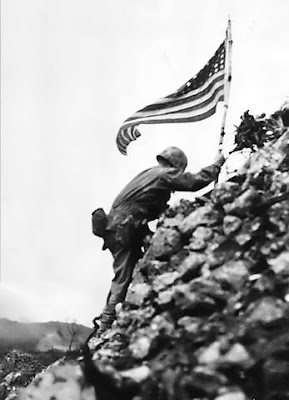
US Flag raised over Shuri castle on Okinawa. Braving Japanese sniper fire, US Marine Lieutenant Colonel R.P. Ross, Jr. places on American flag on a parapet of Shuri castle on May 29, 1945.
Development, Free Markets, Libertarians
Reason.tv: Encourage Bottom-Up Redevelopment – Reason Saves Cleveland With Drew Carey, Ep. 5
by JOHN ADAMS •
Here’s the next episode of Drew Carey’s series on ideas to save Cleveland, and by implication lots of other places, too.
Cleveland has spent billions on big-ticket urban redevelopment efforts including heavily subsidized sports stadiums and convention centers that have utterly failed to revitalize the city’s economy. Should the city be pouring even more money into and pinning yet higher hopes on long-odds mega-projects? Or should they realize that bottom-up projects driven by the actual residents and private-sector investors are the best was to build a vibrant city for the long haul?
Reason Saves Cleveland with Drew Carey is written and produced by Paul Feine; camera and editing by Roger Richards and Alex Manning; narrated by Nick Gillespie; music by the Cleveland band Cats on Holiday.
Daily Bread
Daily Bread for Whitewater, Wisconsin: 3-31-10
by JOHN ADAMS •
Good morning,
Whitewater, Wisconsin’s forecast calls for a breezy day, with a high of seventy-two degrees.
There will be a joint Common Council and Whitewater Aquatic Board meeting tonight at 7 p.m. The agenda is available online.
On this day in history, in 1991, the Warsaw Pact came to an end. The History Channel has the details about its origins, use, and eventual collapse, a collapse that portended the end of Soviet domination and oppression of millions of eastern Europeans:
After 36 years in existence, the Warsaw Pact-the military alliance between the Soviet Union and its eastern European satellites-comes to an end. The action was yet another sign that the Soviet Union was losing control over its former allies and that the Cold War was falling apart.
The Warsaw Pact was formed in 1955, primarily as a response to the decision by the United States and its western European allies to include a rearmed West Germany in the North Atlantic Treaty Organization (NATO). NATO had begun in 1949 as a defensive military alliance between the United States, Canada, and several European nations to thwart possible Soviet expansion into Western Europe. In 1954, NATO nations voted to allow a rearmed West Germany into the organization. The Soviets responded with the establishment of the Warsaw Pact. The original members included the Soviet Union, East Germany, Poland, Hungary, Romania, Bulgaria, Czechoslovakia, and Albania. Although the Soviets claimed that the organization was a defensive alliance, it soon became clear that the primary purpose of the pact was to reinforce communist dominance in Eastern Europe. In Hungary in 1956, and then again in Czechoslovakia in 1968, the Soviets invoked the pact to legitimize its interventions in squelching anticommunist revolutions.
By the late-1980s, however, anti-Soviet and anticommunist movements throughout Eastern Europe began to crack the Warsaw Pact. In 1990, East Germany left the Warsaw Pact in preparation for its reunification with West Germany. Poland and Czechoslovakia also indicated their strong desire to withdraw. Faced with these protests–and suffering from a faltering economy and unstable political situation–the Soviet Union bowed to the inevitable. In March 1991, Soviet military commanders relinquished their control of Warsaw Pact forces. A few months later, the pact’s Political Consultative Committee met for one final time and formally recognized what had already effectively occurred-the Warsaw Pact was no more.
Laws/Regulations
GazetteXtra.com: Wis. committee approves raw milk bill
by JOHN ADAMS •
There’s an AP story today about the progress of a bill allowing raw milk sales in Wisconsin; Raw milk sales should never have been banned in America’s Dairyland, or anywhere else. Adults should be able to decide for themselves if they wish to drink raw milk. The bill still has significant restrictions, but at least it’s a step in the right direction, toward individual choice.
A bill that would allow farmers to sell raw milk moved out of an Assembly committee….Under the measure, farmers who register with state agriculture officials could sell raw milk through the end of next year.
Farmers would have to record each sale and test the milk for disease-causing each sale and test the milk for disease-causing microbes. They would not be allowed to advertise beyond signs on their farms. The signs would include warnings bacteria in the milk could cause disease. The state Senate’s agriculture committee approved an identical bill earlier this month on a 5-0 vote.
Free Markets, Laws/Regulations, Libertarians
Reason.tv: Reason Saves Cleveland with Drew Carey (Take Care of Business), Episode 4
by JOHN ADAMS •
Here’s a discussion of how hard it can be to use one’s own money profitably to establish a business. In the video below, many business owners are even unwilling to discuss their frustrations on camera, from concern that spiteful bureaucrats will retaliate against them.
Unfortunately, that’s a problem in many cities, including ones far smaller than Cleveland.
After World War II, Cleveland was booming, thanks to its leadership role in heavy industry and a business-friendly climate. Today, the city’s high taxes and onerous regulatory demands make it nearly impossible for new businesses to set up shop while choking the life out of existing companies. While relatively laissez-faire cities such as Houston are growing even during the current recession, Cleveland remains stuck in a rut. How can city officials make the city a more welcoming place for entrepreneurs to thrive?
Reason Saves Cleveland with Drew Carey is written and produced by Paul Feine; camera and editing by Roger Richards and Alex Manning; narrated by Nick Gillespie; music by the Cleveland band Cats on Holiday.
Link:
http://www.youtube.com/watch?v=9xSesnJlFr0&feature=player_embedded more >>
Daily Bread
Daily Bread for Whitewater, Wisconsin: 3-30-10
by JOHN ADAMS •
Good morning,
Whitewater’s forecast for today is for a breezy day, with a high of sixty-three degrees.
There will be a charter school listening session at the Cravath Lakefront Center this afternoon, from 4 to 6 p.m.
There’s also a district-wide science night tonight, at the high school, from 6:30 – 8 p.m. Here’s my science-oriented contribution, from Wired‘s science news: how elephants run. The story, entitled, ” Video: Elephants Run Like No Other,” describes their unique running technique:
A biomechanical analysis of running elephants has revealed that Earth’s largest land animals do some strange things at high speed.
Unlike every other quadruped, they use all four legs for braking and propulsion, rather than rather dividing those tasks between hind and front legs.
Elephants also prove to be extremely inefficient while running. Compared to animals like horses, they perform quite poorly. Then again, given their size, running itself is quite an achievement.
“It’s pretty cool that they can run at all. And they do it in such a weird way,” said John Hutchinson, an evolutionary biologist at the University of London.
In a study published March 29 in the Proceedings of the National Academy of Sciences, Hutchinson’s team videotaped six Asian elephants as they ran across mechanical plates that measured the force of each stride. By combining gait models distilled from the video with force measurements, they could quantify the elephants’ biomechanics.
Here’s a video of the Hutchinson’s observations:
Link:
http://link.brightcove.com/services/player/bcpid46203255001?bclid=46205328001&bctid=74491839001
On this day in 1867, Secretary of State Seward came to an agreement with Russia to purchase Alaska, at a cost of around seven million dollars. That’s less than a single office building today, and the building would lack reserves of oil, other diverse plants and animals, and a famous former governor. more >>
Free Markets, Government Spending, Laws/Regulations, Libertarians, Planning
Reason.tv – Reason Saves Cleveland with Drew Carey: Privatize It (Episode 3)
by JOHN ADAMS •
Here’s episode three of the Reason.tv series on saving Cleveland, and by implication lots of other cities, too. In this episode, viewers see how government doesn’t manage produce markets or golf courses very well.
Should cities be in the business of running businesses ranging from convention centers to farmers markets? Selling off golf courses, contracting out parking concessions, and all manner of public-private partnerships are generating billions of dollars in revenue and dramatically improving city services in places such as Chicago and Indianapolis. Will Cleveland’s elected officials learn the right lessons in time?
Reason Saves Cleveland with Drew Carey is written and produced by Paul Feine; camera and editing by Roger Richards and Alex Manning; narrated by Nick Gillespie; music by the Cleveland band Cats on Holiday.