
Over at Liberty Maven, they ask: Are free market prices and government rationing the same thing?
The answer’s No.
Over at Liberty Maven, they ask: Are free market prices and government rationing the same thing?
The answer’s No.
The Journal Sentinel has a story this morning that shows how incumbents of both parties use maps printed at state expense to promote themselves. In 2009 alone, some legislators have distributed tens of thousands of the maps.
Lawmakers get 500 per year – and that should be enough, really – but can request more. As it turns out, some have requested tens of thousands more.
Too funny and too predictable.
(Quick note: This is no right wing complaint. The Journal Sentinel quotes two public policy critics of the practice, neither of whom is remotely conservative.)
See, Incumbents Use Map Giveaways at Taxpayer Expense, Critics Say.
Here’s the sixth installment of cat blogging.
The Cat Fanciers’ Association of America recognizes about forty breeds of domestic cats, but all cats, single or mixed-breed, are admirable.
Cats have an independent spirit that’s a fine reminder of the individualism which Americans — at their best — so abundantly possess.
Today, I’ve posted a video with TONKINESE kittens, a recognized CFA breed. Cute, aren’t they?
Here’s a clever, satirical video from Kelly Reeves (of urlesque), who feels there have been too many cat videos on the web. She’s promoting a September 9th boycott called a Day without Cats on the Internet. In Wired, she’s interviewed for a story entitled, “Web Boycott: Just Say No to Viral Videos Starring Cats.” Enjoy.
Good morning, Whitewater
There are no municipal, public meetings scheduled for today for the City of Whitewater. Your holiday weekend is unobstructed.
It’s Spirit Day at Whitewater Middle School.
Here’s today’s almanac:
| Almanac | ||
|---|---|---|
| Friday, September 4, 2009 | Sunrise | Sunset |
| Official Time | 06:22 AM | 07:24 PM |
| Civil Twilight | 05:53 AM | 07:53 PM |
| Tomorrow | 06:23 AM | 07:22 PM |
| Tomorrow will be: | 3 minutes shorter | |
| Amount of sunlight: | 13h 02 m | |
| Amount of daylight: | 14h 0 m | |
| Moon phase: | Full Moon | |
Over at Reason.tv, there’s a video from foundingbloggers.com, revealing what really goes at a Tea Party protest.
Learn the truth about these so-called “anti-government radicals.” You’ll find that they’re similar to each other in some ways, yet different in others.
In a Janesville Gazette interview, Whitewater City Manager Kevin M. Brunner reveals how unaccountable is the city’s position involving property damage to a resident, how quickly he’ll hide behind someone else, and how shameless is his self-righteous posturing.
Over at the Janesville Gazette, there’s a story about Lt. Joseph Cull, a Whitewater resident and citizen who experienced tens of thousands of dollars damage to his home from a Whitewater sewer backup. See, Marine Fighting Whitewater for Repair Costs.
(I have no connection to Lt. Cull, and my remarks are wholly my own.)
I’ve posted before on the story, first reported at WISC-TV in Madison. See, Accountability Begins….Somewhere Other than in Whitewater, Wisconsin, Inside (Whitewater) and Outside (America), and Anatomy of a Municipal Bureaucrat’s Explanation.
Brunner’s position in the interview shifts, but only to the detriment of his reputation and that of the city he manages.
Consider his latest remarks:
Brunner said the problem now is out of the city’s hands.
“We feel terrible when this happens to anyone – and doubly so with this poor property owner who is serving his country thousands of miles from home – but the plain fact of the matter is it doesn’t make any difference who the person is; we have to look at the circumstances of the claim, he said.
“It comes down to, ‘Did we know anything about this? Was it due to negligence on our part?’ and our insurance company has said, ‘No.’ ”
Local service groups are working on ideas to help Cull pay for the damage at his home, and city officials said they will cooperate with anyone who comes forward to help with fundraising.
Unaccountability. Brunner manages this city, but he won’t take responsibility for a decision about the actual operation of city services.
He declares, “It comes down to, ‘Did we know anything about this? Was it due to negligence on our part?’ and our insurance company has said, ‘No.’ ”
Who really manages this town? When Brunner asks if anyone knew anything, or if it was negligence, he doesn’t provide his own answer. He says that “our insurance company has said, ‘No.’ ”
Is this a joke?
Here’s a man who — no matter what he thinks of himself — is not press-ready. He’s not even ordinary person-ready. Someone answering this way just makes himself look ridiculous.
Brunner discards the expression, “I’ll get to the bottom of this,” and replaces it with “Umm…ah…let me ask…ah…my insurance company.”
Hand-washing. Is anyone surprised that Brunner would contend that it’s not his — or the City of Whitewater’s — problem? Of course not. In fact, he puts a new cast on an old expression: When the news gets tough, Brunner gets going. Somewhere, anywhere.
(As Oshkosh and Janesville wouldn’t have him, he’s still our problem bureaucrat.)
There’s a City of Whitewater task force for every problem under the sun, and regulation for almost every aspect of life, but now, Brunner cannot be troubled.
When it’s not his gain, it’s your pain.
The Appearance of Sympathy. Brunner contends that he feels sorry for “this poor property owner.” Please. Brunner’s supposed sympathy repairs…. absolutely nothing.
In his August 28th Weekly Report, Brunner tried — laughably — to identify with the injured property owner. By suggesting that since he once had a much smaller version of this problem, a resident should lump it, too, Brunner shows his community betterment rhetoric is rhetoric alone.
Sham Charity. What’s Brunner’s idea of charity, of helping a resident, as part of a better community? In his Weekly Report, Brunner wrote that “We have been in touch with some community groups that are interested in possibly raising money for him….”
I thought that was tentative and unworthy.
Oh, but look what he says now. The Gazette reports that “Local service groups are working on ideas to help Cull pay for the damage at his home, and city officials said they will cooperate with anyone who comes forward to help with fundraising.”
In his Weekly Report, Brunner wrote that “we [the Administration] have been in touch with some community groups,” but now one sees what that means. His administration is taking a passive role and they’ll cooperate with anyone who comes forward.
Cooperate.
So when private citizens do all the work, Brunner will stand with them, or write about it, to get some credit for himself.
Shameless, Self-righteous Posturing. Worst of all, far worse than washing his hands of the damage, is Brunner’s feeble attempt to position himself as — wait for it — above favoritism or partiality. The City Manager contends that “…but the plain fact of the matter is it doesn’t make any difference who the person is; we have to look at the circumstances of the claim.”
Brunner ignores what Lt. Cull himself said — on camera and published in print and online — about why he wants compensation.
Here’s what Lt. Cull said: “My service over here is strictly voluntary and I don’t think the city of Whitewater owes me anything for it. But what I do think they owe me for is the fact that I pay taxes, just like everybody else who lives on my street.”
Cull isn’t claiming preferential treatment — he’s asking for ordinary respect and municipal accountability.
Brunner is shameless — all self-righteousness — preening as though the refusal to compensate was a step against favoritism. (That’s temerity — Brunner posturing against favoritism as leader of a city lousy with complaints about unfair and unequal enforcement.)
Unpersuasive, too, is Brunner’s attempt to contend that “…we have to look at the circumstances of the claim.”
What does he mean, we?
He told the Gazette that “our insurance company has said, ‘No’ to questions of liability.
Not Brunner, not one of the task forces he may have created, not even a PowerPoint he once saw — no, the insurance company.
That’s not a “we.” That’s an “it.”
Unless, of course, Brunner’s forgotten for whom he works.
Here’s a gentleman who cannot offer a coherent, consistent explanation in his own Weekly Report, or an interview thereafter.
Good morning, Whitewater
There are no municipal, public meetings scheduled for today for the City of Whitewater.
The Wisconsin Historical Society recalls that today is the anniversary of Britain’s formal surrender to America, ending her war against American independence:
1783 – Paris Peace Treaty Signed
On this date the Paris Peace Treaty was signed. The treaty demanded land, including Wisconsin, be ceded from Britain to the United States. Two years after the conclusion of the Revolutionary War, American and British delegations met in Paris to formalize Britain’s recognition of the United States of America. The treaty articles were drawn up on November 30, 1782 and formally agreed upon on September 3, 1783. [Source: University of Oklahoma, College of Law]
Here’s today’s almanac:
| Almanac | ||
|---|---|---|
| Thursday, September 3, 2009 | Sunrise | Sunset |
| Official Time | 06:21 AM | 07:26 PM |
| Civil Twilight | 05:52 AM | 07:55 PM |
| Tomorrow | 06:22 AM | 07:24 PM |
| Tomorrow will be: | 3 minutes shorter | |
| Amount of sunlight: | 13h 05 m | |
| Amount of daylight: | 14h 03 m | |
| Moon phase: | Waxing gibbous | |
One true means to a better community is a strong and inquisitive press. Some of the most reasonable Americans are those in their twenties, having grown up with a healthy individualism and natural skepticism of hide bound institutions.
That’s why it’s troubling that many newsrooms may be losing a generation of journalists well-suited to defend a free press, and free society.
It’s in Romeo and Juliet that Shakespeare gave the world the observation, from Juliet’s lips, “What’s in a name? That which we call a rose, By any other name would smell as sweet.”
Well, it’s time to brush up your Shakespeare, because Whitewater’s renamed Corporate Drive as ‘Innovation Drive’ for the new technology park to be built there.
Changing a name is the last thing most would care about, but, I don’t know, it may be a vital step to someone here.
I think we fall short when we substitute the superficial for true reform.
If Shakespeare’s wrong, and names and name changes do have such power, then how about a few other changes?
Center Street could become Center of Opportunity Street. Once renamed, lucrative offers would roll in to residents there. For example, super-smart, highly-evolved people already contend that if you take a place named Whitewater, Wisconsin, and simply start calling it the Center of Opportunity (with no other changes), well, it’s sure to become a gold mine.
We could change Whitewater Street to Accountability Avenue. I’d go with Accountability Avenue if reform were the goal, and simply saying (or accrediting) something would make it so.
Alternatively, those who are already smugly complacent could cement their grandiose and self-important views with Pinnacle of the Known Universe Boulevard. That way, when some bureaucrat insists that he’s so significant, he could just point to the street sign for confirmation. If it says so on an official City of Whitewater street sign, then it must be true.
For everyone else, time to brush up your Shakespeare. While reading away through histories, comedies, tragedies, and sonnets, how ’bout a song from Kiss Me Kate, aptly entitled, “Brush Up Your Shakespeare.” These two guys, in their own way, are too literal, also.
Enjoy.
I received the following press release that I am happy to post —
The Taste of Whitewater will be held on September 11th and 12th 2009 at the beautiful Cravath Lakefront Park in downtown Whitewater, WI. Featuring food and specialty drinks from local restaurants, Wisconsin-made beer & wine, live music and entertainment for all ages: this is the can’t miss event of the year.
Friday Night is Pizza Night
Pizza from various restaurants will be served from 5pm to 11pm. The full lineup of participating restaurants will be serving food on Saturday, September 12. Wisconsin-made beer & wine will be served both days’ entire festival hours.
Schedule of Events
Friday, September 11
5pm to 7pm – Spirit Rally
7pm to 9pm – Karaoke
9pm to 11pm – DJ Mixit Top 40
Saturday, September 12
All Day – Inflatable Playland
All Day – Arts & Crafts
All Day – Civil War Demo
11:30am to 12:00pm – DJ Mixit (Oldies)
12:00pm to 12:30pm – X-Treme Trampoline Show
12:20pm to 1:30pm – Arts Alliance Show
1:30pm to 2:15pm – Jo Don Farms Animal Show
1:30pm to 2:15pm – DJ Mixit (Country)
2:00pm to 2:30pm – X-Treme Trampoline Show
2:30pm to 3:15pm – Jo Don Farms Animal Show
2:30pm to 3:15pm – DJ Mixit
3:00pm to 4:00pm – TIFU / ALMA Dance Show
4:00pm to 4:45pm – Jo Don Farms Animal Show
4:00pm to 4:45pm – DJ Mixit
4:30pm to 5:00pm – X-Treme Trampoline Show
5:00pm to 6:00pm – New Tradition Band (Brass Band with a New Orleans Twist)
6:00pm to 7:00pm – Piano Performance by Will Krieger
7:00pm to 8:30pm – Step Show
8:30pm to 9:30pm – SafetySuit Concert (Alternative Rock Band that has rocked its ways to #1 on VH1)
9:30pm to 11:00pm – DJ Mixit (Top 40)
SafetySuit Plays Whitewater
Check out VH1 to see the #1 Video Stay from SafetySuit, an alternative rock band that recently topped out at #1 on VH1’s Top 20 countdown.
They will also join Collective Soul and 3 Doors Down on selected dates this year.
Members include Doug Brown, Dave Garofalo, Jeremy Henshaw, and Tate Cunningham.

I received the following press release that I am happy to post —
The Taste of Whitewater will be held on September 11th and 12th 2009 at the beautiful Cravath Lakefront Park in downtown Whitewater, WI. Featuring food and specialty drinks from local restaurants, Wisconsin-made beer & wine, live music and entertainment for all ages: this is the can’t miss event of the year.
5pm to 7pm – Spirit Rally
7pm to 9pm – Karaoke
9pm to 11pm – DJ Mixit Top 40
All Day – Inflatable Playland
All Day – Arts & Crafts
All Day – Civil War Demo
11:30am to 12:00pm – DJ Mixit (Oldies)
12:00pm to 12:30pm – X-Treme Trampoline Show
12:20pm to 1:30pm – Arts Alliance Show
1:30pm to 2:15pm – Jo Don Farms Animal Show
1:30pm to 2:15pm – DJ Mixit (Country)
2:00pm to 2:30pm – X-Treme Trampoline Show
2:30pm to 3:15pm – Jo Don Farms Animal Show
2:30pm to 3:15pm – DJ Mixit
3:00pm to 4:00pm – TIFU / ALMA Dance Show
4:00pm to 4:45pm – Jo Don Farms Animal Show
4:00pm to 4:45pm – DJ Mixit
4:30pm to 5:00pm – X-Treme Trampoline Show
5:00pm to 6:00pm – New Tradition Band (Brass Band with a New Orleans Twist)
6:00pm to 7:00pm – Piano Performance by Will Krieger
7:00pm to 8:30pm – Step Show
8:30pm to 9:30pm – SafetySuit Concert (Alternative Rock Band that has rocked its ways to #1 on VH1)
9:30pm to 11:00pm – DJ Mixit (Top 40)
Check out VH1 to see the #1 Video Stay from SafetySuit, an alternative rock band that recently topped out at #1 on VH1’s Top 20 countdown.
They will also join Collective Soul and 3 Doors Down on selected dates this year.
Members include Doug Brown, Dave Garofalo, Jeremy Henshaw, and Tate Cunningham.
Thank you to all of our 2009 Sponsors — Downtown Whitewater, Inc., SEAL, Ketterhagen Ford, First Citizens State Bank, Dales Bootery, and Whitewater Tourism Council.
For more information please checkout our website, www.tasteofwhitewater.com more >>
Good morning, Whitewater
There are no municipal, public meetings scheduled for today for the City of Whitewater.
Yesterday was the anniversary of the beginning of the Second World War. Today is the anniversary of its end — the surrender of the Japanese Empire to the Allies aboard the U.S.S. Missouri.
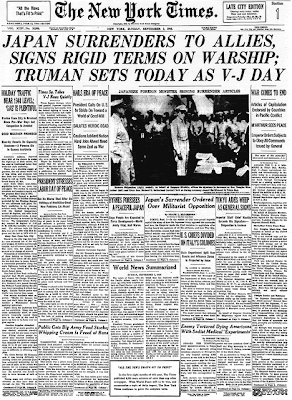
The Associated Press reported on the ceremony:
Aboard The U.S.S. Missouri in Tokyo Bay, Sunday, Sept. 2–Japan surrendered formally and unconditionally to the Allies today in a twenty-minute ceremony which ended just as the sun burst through low-hanging clouds as a shining symbol to a ravaged world now done with war.
[A United Press dispatch said the leading Japanese delegate signed the articles at 9:03 A.M. Sunday, Tokyo time, and that General MacArthur signed them at 9:07 A.M.]Twelve signatures, requiring only a few minutes to inscribe on the articles of surrender, ended the bloody Pacific conflict.
On behalf of Emperor Hirohito, Foreign Minister Mamoru Shigemitsu signed for the Government and Gen. Yoshijiro Umezu for the Imperial General Staff.
MacArthur Voices Peace Hope
Gen. Douglas MacArthur then accepted in behalf of the United Nations, declaring:
“It is my earnest hope and indeed the hope of all mankind that from this solemn occasion a better world shall emerge out of the blood and carnage of the past.”
One by one the Allied representatives stepped forward and signed the document that blighted Japan’s dream of empire built on bloodshed and tyranny.
First was Admiral Chester W. Nimitz for the United States, then the representatives of China, the United Kingdom, the Soviet, Australia, Canada, France, the Netherlands and New Zealand.
The flags of the United States, Britain, the Soviet and China fluttered from the veranda deck of the famed superdreadnaught, polished and scrubbed as never before. More than 100 high-ranking military and naval officers watched.
Pledges Justice and Tolerance
“As Supreme Commander for the Allied powers,” General MacArthur told the Japanese, “I announce it my firm purpose, in the tradition of the countries I represent, to proceed in the discharge of my responsibilities with justice and tolerance, while taking all necessary dispositions to insure that the terms of surrender are fully, promptly and faithfully complied with.”
All through this dramatic half hour, only those aboard the battleship knew of what was taking place, because the Missouri has no broadcasting facilities.
But recordings were rushed to the near-by communications ship Ancon, and the solemn words of General MacArthur beginning the ceremony–“We are gathered here, representatives of the major warring powers”–were flashed around the world.
The Japanese representatives were present at the command of Emperor Hirohito contained in a proclamation issued by order of the Supreme Allied Commander.
The Emperor further commanded his officials “to issue general order to the military and naval forces in accordance with the direction of the Supreme Commander of the Allied Powers.” The Imperial General Headquarters issued the order later.
Thus Emperor Hirohito formally acknowledged that General MacArthur’s word in Japan would come foremost of all Japanese officialdom during the Allies’ occupation of the country, which never before had been occupied by an alien force.
“I command all my people forthwith to cease hostilities,” the Emperor said, “to lay down their arms and faithfully to carry out all the provisions of the instrument of surrender and the general orders issued by the Imperial General Headquarters hereunder.”
All issues have been “determined on the battlefields of the world and hence are not for our discussion or debate,” General MacArthur said before he invited all representatives to sign the surrender instrument.
“Nor is it for us here to meet, representing as we do the majority of the peoples of the earth, in a spirit of distrust, malice or hatred,” he added. “But rather it is for us, both victors and vanquished, to rise to that higher dignity which alone benefits the sacred purposes we are about to serve. * * *”
General MacArthur and Admiral Nimitz paid deep tribute to Allied dead and to the people of all Allied nations whose blood, work and sacrifices helped bring victory.
Admiral Nimitz said he took “great pride in the American forces which have helped to win this victory,” and declared that “America can be proud of them.”
“The officers and men of the United States Army, Navy, Marine Corps, Coast Guard and Merchant Marine who fought in the Pacific have written heroic new chapters in this nation’s military history,” Admiral Nimitz said. “I have infinite respect for their courage, resourcefulness and devotion to duty. We also acknowledge the great contribution to this victory made by our valiant allies. United we fought and united we prevail.”
Admiral Nimitz observed that “the long and bitter struggle, which Japan started so treacherously on the seventh of December, 1941,” was at an end….
Here’s today’s almanac:
| Almanac | ||
|---|---|---|
| Wednesday, September 2, 2009 | Sunrise | Sunset |
| Official Time | 06:20 AM | 07:28 PM |
| Civil Twilight | 05:51 AM | 07:57 PM |
| Tomorrow | 06:21 AM | 07:26 PM |
| Tomorrow will be: | 3 minutes shorter | |
| Amount of sunlight: | 13h 08 m | |
| Amount of daylight: | 14h 06 m | |
| Moon phase: | Waxing gibbous | |
Leaves fall on dry ground
Bureaucrats’ tactics wither
Time erodes facades
Good morning, Whitewater
School begings today.
There’s one public, municipal meeting scheduled for today in Whitewater. At 6: 30 p.m., Common Council meets. The agenda is available online.
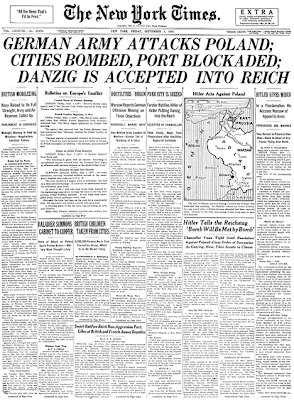
On this day in 1939, the Second World War began.
Here’s today’s almanac:
| Almanac | ||
|---|---|---|
| Tuesday, September 1, 2009 | Sunrise | Sunset |
| Official Time | 06:19 AM | 07:29 PM |
| Civil Twilight | 05:50 AM | 07:58 PM |
| Tomorrow | 06:20 AM | 07:28 PM |
| Tomorrow will be: | 2 minutes shorter | |
| Amount of sunlight: | 13h 10 m | |
| Amount of daylight: | 14h 08 m | |
| Moon phase: | Waxing gibbous | |