FREE WHITEWATER

Observations on Libertarian Party Candidate Bob Barr, Early October

1.       Barr was a right of center choice, with prosecutorial and congressional experience.  He’s a nominee that left-of-center libertarians did not trust.  They still don’t.
 
2.       Some leading LP members backed Barr because they believed he could increase the historical LP share of the vote from around 1% nationally to far higher, especially in a few critical states.

3.       Barr was expected to raise as much as 20 million dollars for his campaign – he’s only raised around one million. 
 
4.       Ron Paul’s insurgent run within the GOP primaries gave leaders of the LP confidence that Barr would play a similar role in the general election.     
 
5.       Barr has not captured the enthusiasm Paul generated, and has spurned Paul in ways that some LP members have found counter-productive.  (Note: I was never a Paul supporter – the newsletter that went out under his name contained far too many objectionable views.  Anyone who’s been part of our movement knew about the content, and many sensible, serious libertarians kept Paul at arm’s length.) 
 
6.       There is a huge difference between being a libertarian (millions, in all walks of life) and a member of the LP.  Many libertarians are wary of the small and idiosyncratic internal politics of the LP, no matter how fascinating from a distance.  Often it’s not a ready-for-primetime party.
 
7.       The LP’s vice-presidential nominee, Wayne Allyn Root, is eccentric, and prone to odd gaffes.  Some of those gaffes have been noted most by libertarians at Cato and Reason – much to their credit.  Cato and Reason have been honest about the limitations of the LP, and willing to point them out.  They are libertarians rather than Libertarians, as they should be.  The LP calls itself the party of principle, but sometimes principle and party don’t mix. 
 
8.       Right-of-center Barr was strongest – as one would expect – when McCain was weakest, in the summer.  Now that McCain seems down again, will Barr siphon off votes from those who see no hope for the Republican candidate?  I don’t know – more money for October would have helped Barr.
Libertarian Barr (Halfway) in the Presidential Debates

Last Friday, September 26th, the Libertarian Presidential nominee, Bob Barr, appeared at Reason’s Headquarters to participate on a live streaming video of the debate, and answer questions afterward.

(The live stream allowed Barr to answer questions as though he were in the debate.)

In the clip below, Barr offers what would have been a closing statement had he been in the debate, and answers questions from the audience. Matt Welch moderates.


more >>

Daily Bread: October 2, 2008

Good morning, Whitewater

In the city today, from 4 p.m. to 6 p.m., there will be a Downtown Eastgate project neighborhood meeting and final design presentation in the municipal building.

The National Weather Service predicts today will bring a slight chance of showers and a high of 60 degrees. The Farmers’ Almanac predicts today will be “fair and cold.”

Yesterday’s better prediction: NWS.

On this day in Wisconsin history, from 1957, the Wisconsin Historical Society offers a reminder of the historical size and importance of the auto industry to Janesville, Wisconsin:

On this date 4,000 members of United Auto Workers Locals 95 (Fisher Body) and 121 (Chevrolet) at Janesville’s two GM plants walked off the job as part of a national strike over GM’s refusal to agree to a contract patterned after those reached with Ford and Chrysler. The desired contract demanded pay increases of 24 to 30 cents an hour and raises in supplemental unemployment benefits and severance pay.

The Orange Salamander for 10/1/08

I live downtown, above the Agneau Grille, a Tunisian restaurant. Tasty lamb requires no passport.

Restaurants, bars, small shops behind aging facades. Banners welcoming returning students, faded flyers in windows.

Outside, cool autumn air. Cigarette butts on sidewalk – tokens of indifference, rebellion. I smile, lighting a Lucky Strike.

A fat man walks by, eyeing a bakery’s cherry pie. The bakers are brothers, nicknamed the Pie Men. They do everything together.

A scone and a cup of kona to go. Real kona, but Hawaiian means something else to the Pie Men, Ronnie and Donnie. They seem almost sober.

Tired of Failure? Mandate Success!

The Pittsburgh Post-Gazette reports that public school officials in that city have a policy “that sets 50 percent as the minimum score a student can receive for assignments, tests and other work.” The policy has been around for a while; it’s drawn recent attention only because of efforts to reduce it to writing and make it mandatory for all schools in the Pittsburgh district.

Unsurprisingly, the “district and teachers union last week issued a joint memo to ensure staff members’ compliance with the policy, which was already on the books but enforced only at some schools. Pittsburgh Federation of Teachers President John Tarka said the policy is several years old.” (Emphasis added.)

This is the best possible policy for a lazy administrators and teachers — abolition of failing grades makes their work far easier – one doesn’t have to lift students so far toward average competency.

I’d say all of this is an aberration, but similar policies exist or are considered seriously elsewhere.

In our own city — apart from our schools — our municipal administration is one step away from a version of this approach. While Pittsburgh schools do not recognize failing grades, we do not recognize failed policies. It’s all happy and good, all the time.

I have teased that this administration’s slogan should be Whitewater: Where the Only News is Good News. (Whether leaders of the city were educated in Pittsburgh, I cannot say.)

This is where self-interest leads, treacly claims of public service notwithstanding — to a cheerleader’s view that ignores actual conditions, making it easier for political leaders and incumbents to do less while boasting more.

Daily Bread: October 1, 2008

Good morning, Whitewater

In the city today, the Landmarks Commission meets from 7 – 9 p.m. in the municipal building.

The National Weather Service predicts today will be partly sunny with a high of 58 degrees. The Farmers’ Almanac predicts today will be “fair and cold.”

Yesterday’s better prediction: NWS.

There is no school today for students in the district. Play and relax responsibly while teachers commit to a day of staff development.

In Wisconsin history on this date, in 1851, as reported at the website of the Wisconsin Historical Society, Wisconsin held its first state fair. (The fair began a day earlier; Lincoln spoke on the first day of the two-day event.)

Wired reports that on this day in 1957,

Thalidomide, a drug developed to help women overcome the symptoms of morning sickness during pregnancy, is first marketed in West Germany. Forty-six countries approve its use before thalidomide’s terrible side effects become apparent.

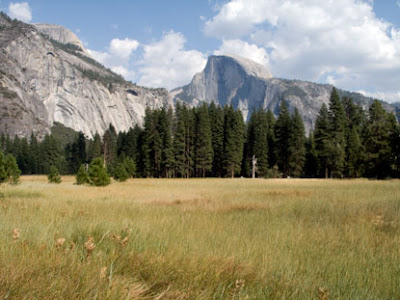
Nationally, on October 1st, 1890, Yosemite National Park was established.

A private alternative to advance conservation without national purchases is available from the Nature Conservancy.

Here is a video from the Nature Conservancy on using dogs to locate rare plant species.

more >>

The Orange Salamander for 9/30/08

The sound of waves crashing against the beach repeats every 42 seconds. Less than a minute and a seagull squawks again.

I could measure time easily if the pattern repeated every 60 seconds. Instead: 42, 84, 126. Two minutes gone. Forever.

I reach up, turn off the machine. Without ocean sounds, I can’t sleep. Is my conscience heavy? No, I’m just masking the sounds of town.

No ocean nearby. No seagulls. Just students, dogs, drunks. I like the first two, tolerate the third. It’s my sensitive side.

Millhaven: rural college town, miles from the big city. Locals, immigrants, newcomers, students. Four towns: unshaken, unstirred.

The Ever-Expanding Security State

The current federal administration is in its last months, but its efforts to expand powers of surveillance is unslaked. The ACLU reports on the latest federal power grab:

Under far-reaching new guidelines proposed by Attorney General Michael Mukasey…[a]ll the FBI has to do to put you or any American under prolonged physical surveillance is assert an “authorized purpose” such as detecting or preventing crime or protecting “national security.”

….In fact, we have good reason to suspect that the FBI has been violating its own internal guidelines all along and is now pushing these new guidelines to cover up past wrongdoing.

That’s why we need to demand an investigation now, before these outrageous guidelines are implemented. The Inspector General’s office at the Department of Justice has proven to be an unbiased, internal watchdog that has consistently exposed wrongdoing. We need to urge the IG to do it again….

These new guidelines would allow the FBI to interview you, your friends and your family under a false pretext. The FBI could recruit secret informants and have them infiltrate peaceful protest groups. And the FBI could initiate investigations based on little more than race, ethnicity or religion.

The FBI could also search commercial databases for personal details about your life with no real reason.

And all of this would be allowed without an ounce of evidence that you or anyone else has done anything wrong.

The Orange Salamander

The Orange Salamander describes a small-town mystery, but ‘small-town mystery’ is as conventional as the story’s description gets. If you mixed a hard-boiled crime story with a cyberpunk novel, and asked a non-writer to write it, The Orange Salamander is what you might get.


The story is a twiller, a thriller told in small bits, through posts on Twitter.com. Posts on Twitter may be no more than 140 characters, and a single post is called a tweet. I certainly did not invent this constrained form; it has both American and Japanese inspirations.

I thought that I’d play around with the format, though. Play, not experiment: I take none of this seriously, and have no pretensions to literature: it’s all fun, and silly, and nothing more. It’s meant to be ridiculous and a parody, confined within a small space.

At least one person will wonder what all of this means. Since I’ve been posting at this website, two things have surprised me: the number of times that people erroneously speculate on the meaning of something I’ve posted, and the risible excuses that municipal officials often make for their actions and policies. (I see more clearly now how people get caught up with fortune tellers after considering the stodgy minority’s depth of reasoning.)

Any resemblance to actual persons or serious matters, in Whitewater, Wisconsin or environs is unintentional and coincidental. If you see yourself in any of these characters you are mistaken; if you’re convinced of it, you’re mistaken and deluded.

I will collect and post each day’s, and week’s, twiller tweets on this website. Tweets will also appear, individually, on the right sidebar of the website.

Daily Bread: September 30, 2008

Good morning, Whitewater

The National Weather Service predicts today will be mostly cloudy with a high of 59 degrees. The Farmers’ Almanac predicts today will be “wet, especially over the Great Lakes.”

Yesterday’s better prediction: NWS — greater detail trumps a vague long-range forecast written a year ago.

A Canned Food Drive continues in our school district today.

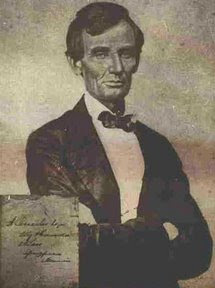
In Wisconsin history on this date, in 1859, as reported at the website of the Wisconsin Historical Society, the Abraham Lincoln visited and spoke in Wisconsin:

On this date Abraham Lincoln delivered an address at the Wisconsin State Fair. In his speech, he connected agriculture to education: “Every blade of grass is a study; and to produce two, where there was but one, is both a profit and a pleasure.” The rising political star (who was elected the following year), also stressed the importance of free labor. This was Lincoln’s last visit to Wisconsin. In 1861, after winning the presidential election, Lincoln signed the bill establishing the U.S. Department of Agriculture.

The final lines of Lincoln’s address in Wisconsin are cautionary yet hopeful:

It is said an Eastern monarch once charged his wise men to invent him a sentence, to be ever in view, and which should be true and appropriate in all times and situations. They presented him the words: “And this, too, shall pass away.”

How much it expresses! How chastening in the hour of pride! — how consoling in the depths of affliction! “And this, too, shall pass away.”

And yet let us hope it is not quite true. Let us hope, rather, that by the best cultivation of the physical world, beneath and around us; and the intellectual and moral world within us, we shall secure an individual, social, and political prosperity and happiness, whose course shall be onward and upward, and which, while the earth endures, shall not pass away.

Chicago Tribune: “Scapegoating Markets”

The Chicago Tribune offers a solid editorial against the scapegoating of markets during the current financial crisis.

Although capitalism has shown its superiority to other systems, it has always had plenty of detractors. The meltdown in the financial sector is their latest excuse to assert the dangers of greed, the need for greater government regulation and the folly of unfettered commerce….

Markets, of course, consist of interactions among human beings, and any institution featuring people is bound to suffer from human fallibility. No one ever said markets were perfect at the tasks required for a functioning economy—only that they are generally superior to the alternative….

Focusing on greed is a mistake. As economist Lawrence White of the University of Missouri-St. Louis puts it, blaming greed for economic dislocations is like blaming gravity for airplane crashes: Greed and gravity are both ever-present. Wall Street traders are not more or less avaricious today than they were 10, 20 or 50 years ago.

Nor is lack of regulation the root of the problem. Among the alleged lapses is the 1999 repeal of the Depression-era Glass-Steagall Act, which forbade the mixing of commercial and investment banking. Removing that barrier, we are told, spurred commercial banks to get into such risky investments as subprime mortgages….

The demise of Glass-Steagall turns out to be a boon. Were it still around, Bank of America would not have been allowed to buy Merrill Lynch..
..

Then there was the big role played by mortgage giants Fannie Mae and Freddie Mac, government-sponsored entities whose failure is a testament to the dangers of mixing public and private enterprise. Conservatives had long warned that the government’s implicit backing of these companies would someday mean a big bill for taxpayers. Guess what? They were right.

When this crisis has settled down, Congress and the president are welcome to consider if the experience indicates the need for some precise and prudent changes in the law governing financial institutions. But it’s more likely a careful examination will prove that the biggest failures were ones of too much government, not too little.

Locally, there’s already too much demonization of markets, and an unwillingness to admit that unrealistic regulations and impractical zoning restrictions have made life here worse. We are poorer, more backward, and less free because of failed local government policies.

Neighboring cities have less poverty; we are exceptional for a town of our resources in how much poverty we have.

Draconian enforcement is a bad idea and false promise.

It’s also a example of ignorance that some confuse specific businesses with markets. Government tries to pick winners by excluding presumed losers. Taxpayers are the true losers – subsidizing special-pleading companies is not a winning game for anyone except the companies.

Expect to hear some argue that national events justify greater regulation locally.

Calls for increased government intrusion into commerce do, in a way, unite national and local policy: it’s a bad idea in both cases.

Banned Books Week

Over at the Janesville Gazette, there’s a blog entry entitled, “Blacklisted” on Stacy Vogel’s Cover to Cover blog.

Vogel ably lists some of the books that have been the target of book banners, including, impossibly, a book by Shel Silverstein, as she recounts:

And if you’re worried the works will be dirty or violent, fear not. Readings will include selections from Shel Silverstein’s “A Light in the Attic,” which was challenged at the Cunningham Elementary School in Beloit in 1985 because the book “encourages children to break dishes so they won’t have to dry them,” according to the UW-Rock news release.

A few parents may find nothing wonderful and charming in Silverstein, and here I would disagree. A smaller number might petition their schools and public libraries to remove the book, and here I would be compelled to resist and defend.

There are two solutions to all this — (1) the right of parents to opt out for their children without banning the book for all, and (2) private school alternatives where book banners would, alternatively, have either great influence or none.

A public institution, however, should not have its reading list comprehensively censored to the restriction of all.

Daily Bread: September 29, 2008

Good morning, Whitewater

There will be a 7 p.m. meeting of the Cable TV Committee today in Whitewater. The agenda is available online, and the meeting will be held at 402 West Main Street.

The National Weather Service forecasts likely thunderstorms with a high of 65 degrees. The Farmers’ Almanac predicts today will be “wet, especially over the Great Lakes.”

Last week’s better predictions: NWS.

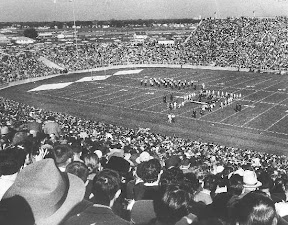
In Wisconsin history on this date, in 1957, from the Wisconsin Historical Society, the Packers dedicated a new stadium:

On this date the Green Bay Packers dedicated City Stadium, now known as Lambeau Field, and defeated the Chicago Bears, 21-17. In the capacity crowd of 32,132 was Vice President Richard Nixon.

Here’s a link to a Milwaukee Journal story covering the game and dedication.

I Am a Constitution Voter

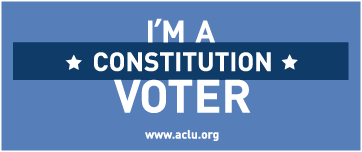
The American Civil Liberties Union has an election season initiative called, I Am a Constitution Voter.

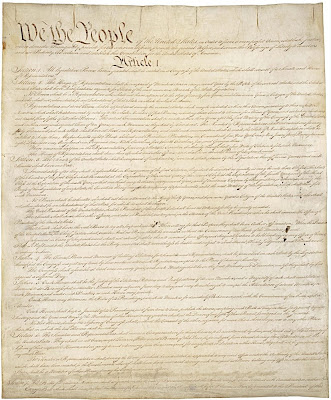
It’s a fine campaign, and just the antidote to a season of partisan campaigning. Here are the principles of the I Am a Constitution Voter pledge:

  • I believe that no one — including the President — is above the law.
  • I oppose all forms of torture, and I support both closing the Guantánamo Bay prison and ending indefinite detention.
  • I oppose warrantless spying.
  • I believe that government officials, no matter how high-ranking, should be held accountable for breaking the law and violating the Constitution.
  • I believe that the Constitution protects every person’s rights equally — no matter what they believe, how they live, where or if they worship, and whom they love.
  • I reject the notion that we have to tolerate violations of our most fundamental rights in the name of fighting terrorism.
  • I am deeply committed to the Constitution and expect our country’s leaders to share and act on that commitment — every day, without fail.

The ACLU website has a link where one can take the pledge. Those who do so have the option of receiving a free bumper sticker.

There’s much more at the website, though — a visit offers many ways to preserve American liberties. These efforts have one goal in mind — the preservation of America as a free republic.