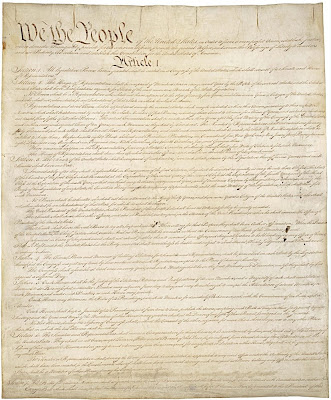
The American Civil Liberties Union has an election season initiative called, I Am a Constitution Voter.
It’s a fine campaign, and just the antidote to a season of partisan campaigning. Here are the principles of the I Am a Constitution Voter pledge:
I believe that no one — including the President — is above the law.
I oppose all forms of torture, and I support both closing the Guantánamo Bay prison and ending indefinite detention.
I oppose warrantless spying.
I believe that government officials, no matter how high-ranking, should be held accountable for breaking the law and violating the Constitution.
I believe that the Constitution protects every person’s rights equally — no matter what they believe, how they live, where or if they worship, and whom they love.
I reject the notion that we have to tolerate violations of our most fundamental rights in the name of fighting terrorism.
I am deeply committed to the Constitution and expect our country’s leaders to share and act on that commitment — every day, without fail.
The ACLU website has a link where one can take the pledge. Those who do so have the option of receiving a free bumper sticker.
There’s much more at the website, though — a visit offers many ways to preserve American liberties. These efforts have one goal in mind — the preservation of America as a free republic.
It’s easy to see that Register, Whitewater’s local paper for 152 years, is in a period of transition. In all of this, there’s a different type of newsprint, less likely to leave ink on a reader’s hands. So much has been said about lipstick on pigs, that there’s nothing left to say on the newsprint for the paper.
Inside. There’s information about the October 3rd Make a Difference Day in Whitewater. It’s a fine effort, and registration may be completed at http://www.uww.edu/involve/forms/mad.php . The registration deadline is Monday, September 29th. There will be charitable projects taking place throughout the city.
Front Page. There are four front page stories in the Register this week: A donation to the local food pantry, the retirement of local physician Dr. Anne Griffiths, a story on disaster aid provided to Walworth County residents, and a story of the increase in Walworth County’s population.
(One sees that Walworth County has a population of over 101,000 – just enough for a dream town, I’d guess. Congratulations. Just don’t let La Grange take all the credit.)
Two of the stories are serious, and two are local human interest stories particular to Whitewater.
The four stories represent legitimate coverage options for the Register: local human interest, stories on county government without a transparent political angle, or serious scrutiny of local government, corporations, and organizations.
The Register has mixed local human interest stories and straightforward county government coverage with local political bias.
Cover human interests stories, especially from a benign but ironic angle, and the Register would have something interesting, and a paper that might appeal to a more upscale reader. There might be initial subscriber loss, but the paper would develop a devoted readership and a reputation for wit.
Cover local government in a straightforward way, and the paper would collect another group of devoted readers who would feel that they were offered insightful analysis. Again, some readers would walk away, but those who remained would be worth having. The paper would develop a reputation for serious analysis.
The paper has a third option, one that it will – here I am sure – never take: a serious muckraking paper, confronting political incumbents and their career appointees. The paper would have a rich field of targets: flimsy excuses, mediocre work, parochial views, and the laughable conviction that a few and their friends represent a special class whose needs and views trump those of others.
The Register can continue along its present course, so long as a publishing chain pays for that course. I think it’s probably the worst course the paper could take, as journalism or prudence. It’s easily maintained, though, as long as out-of-town advertisers think ads in the Register are valuable to them.
There are no public meetings scheduled for today in Whitewater.
The National Weather Service forecasts patchy fog with a high of 80 degrees. The Farmers’ Almanac predicts, continuing its multi-day series, “fair and cold weather.” It hasn’t been cold all week.
Yesterday’s better prediction: NWS.
In Wisconsin history on this date, in 1833, from the Wisconsin Historical Society, there is an account of how several tribes living in Wisconsin ceded land to the government:
Indian tribes including the Ojibwe, Menominee, Potawatomi, Ho-Chunk, Ottawa, and Sauk ceded land to the government, including areas around Milwaukee, especially to the south and east of the city. The ceded land included much of what is today John Michael Kohler and Terry Andrae State Parks. The Potawatomi continued to live along the Black River until the 1870’s, despite the treaty.
On this date in American history, in 1960, the first Kennedy-Nixon debate took place.
Here’s a short video clip describing background on the Kennedy-Nixon debates.
Here’s my (mostly) weekly post, Register Watch™, on our local weekly newspaper, the Whitewater Register.
Frontpage. There are three front page stories.
Taste of Whitewater. The first is a recap of the September 12 and 13th events at the Cravath Lakefront. The three accompanying color photographs ably depict the variety of events at the Taste.
Two other stories are more serious.
Lakeland School. There’s a below-the-fold discussion of an amendment to a Walworth County ordinance to allow non-resident students (outside the district of the Children with Disabilities Education Board) to enroll in Lakeland School. Walworth County’s Board of Supervisors voted unanimously to permit the enrollment of non-residents.
Lakeland School serves special-needs students.
The story’s author notes that the new school can accommodate up to 370 students. The program has about 100 fewer students now. I do not know how many students the new Lakeland School can optimally accommodate – that might be 370, or it might be a lower number.
(I understand it’s possible to say that there’s no fixed optimal number, but the cost of the building and its maintenance would require some estimate of how many students those expenses were meant to cover.)
It’s fair to infer from the story that there are fewer students than the building can handle, but are there fewer students than the building was meant to handle now?
More important, of course, is how the thousands of special needs students in Walworth County and its environs should best be educated. The cost of the facility, and its unused capacity, hardly drive a school choice. Lakeland School is merely one choice out of several possible settings.
It would be better to let Lakeland sit with unused capacity than to fill merely to fill it, however tempting that option may be, with those unsuited to schooling there.
Bilking the Elderly. The third story involves a crime against an elderly woman, who was tricked into wiring money to someone she thought was a relative. It was a phone scam, but there are similar scams, targeted more to other age groups, through email, too. We are a small town far from other nations, but both phone calls and email messages are easy ways to trick someone across long distances.
Inside. I would ordinarily be reluctant to call attention to out-of-town merchants, as we are too insular in Whitewater as it is. It’s an irony of our situation, though, that the closest that our local publication comes to a cosmopolitan outlook is in the print advertisements that it publishes for Burlington, Lake Geneva, Elkhorn, and Delavan businesses.
There could be a travelogue for the Register in all this, if anyone at the paper had a sense of humor:
I posted previously about the Iowa Electronic Political Markets, where traders can purchase political futures contracts. I have visited the Iowa Markets over the last few elections.
Recently, I’ve followed the political market at Intrade. Here’s a graph of 2008 Presidential Election Winner (Individual), for Barack Obama to win 2008 US Presidential Election —
At 8:30 a.m. this morning, there will be a meeting of the Ad Hoc Whitewater Technology Park Planning Committee at the municipal building.
The National Weather Service forecasts dense fog with a high of 78 degrees. The Farmers’ Almanac predicts, continuing its multi-day series, “fair and cold weather.”
Yesterday’s better prediction: NWS.
In Wisconsin history on this date, in 1961, Wisconsin established a requirement that new cars, beginning with the 1962 model year, have seat belts.
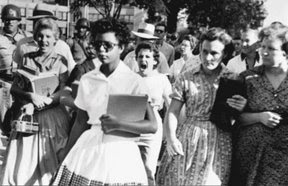
On this date in American history, in 1957, Central High School of Little Rock Arkansas was integrated with escort from the members of the 101st Airborne Division.
Over at the Wall Street Journal, Barry Ritholtz, the blogger who publishes the economics blog entitled, “The Big Picture,” talks about the risks of a government bailout of large, failing financial firms.
This has been an odd election year, with unexpected winners and losers along the way. We’ve still six weeks’ worth of possible surprises ahead.
It is a sad end to the current Administration that it leaves its nation and party downcast and frustrated. George W. Bush has done more to squander the positive accomplishments of Goldwater and Reagan than any Republican of our time. Only Nixon equals Bush in fiscal failure, interference with individual liberties, and political disarray. Bush leaves his party with no one who can confidently reject government meddling. He has assured his fellow citizens only diminished opportunities in a society where government is more important than ever before.
The Whitewater Tree Commission will meet at 4:00 p.m. today.
The National Weather Service forecasts a temperature of 80 degrees with a slight chance of thunderstorms. The Farmers’ Almanac predicts “fair and cold weather.”
Yesterday’s better prediction: NWS.
In Wisconsin history on this date, in 1857, the Wisconsin Historical Society entry indicates either a slow day in our history, or a great event in Badger State cuisine: today marks the anniversary of the First Sheboygan County Cheese Award. Here are the details that make this a memorable date:
On this date N.C. Harmon of Lyman was awarded the first premium prize for cheese made in Sheboygan County. The award was given at the Sheboygan Agricultural Society fair held in Sheboygan Falls. The next year saw John J. Smith procure the first cheese vat in Sheboygan County. He manufactured cheese on a cooperative plan, collecting curd from his neighbors. Both are early events in the long and important history of cheesemaking in Sheboygan
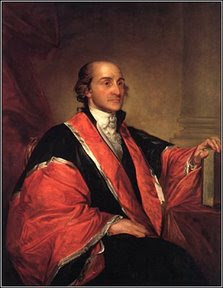
On this date in American history, in 1789, President Washington signed the Judiciary Act of 1789, establishing the United States Supreme Court. John Jay of New York served as our first chief justice, later leaving the court to become governor of New York. (Jay is depicted below either in the judicial robes of the era, or his bedspread.)
Last week, I posted on a failing Microsoft ad campaign, and Microsoft’s abandonment of Jerry Seinfeld as a pitchman. Microsoft decided to respond directly to Apple’s “I’m a Mac, I’m a PC” campaign with an “I’m a PC” reply ad.
Ready?
When Microsoft created their reply ad, they used Apple hardware and Adobe software to create it.
Microsoft employees may later have tried to conceal evidence that they used Apple and Adobe products.
Too funny, but predictable – Apple makes better products, and so does Adobe.
No one is surprised when ordinary people who work in a business sometimes behave in a self-interested and dishonest way. Yet, when people no different assume public office, they ask and expect that others will see them as selfless public servants, above possible reproach.
We also have reason to doubt a Microsoft-only reliance in our schools when Microsoft forgoes a Microsoft-only approach in the marketplace.
See Apple Insider at http://www.appleinsider.com/articles/08/09/19/
microsofts_im_a_pc_campaign_created_with_macs.html
There are no public municipal meetings scheduled for the City of Whitewater.
The National Weather Service patchy fog in the early morning, and then sunny with a high temperature of 80 degrees. The Farmers’ Almanac predicts “pleasant initially, then showers spread east into Ohio.”
Yesterday’s better prediction: NWS.
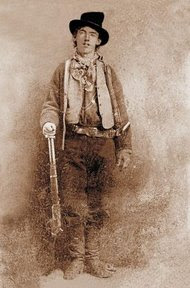
On this date in American history, in 1875, Billy the Kid was arrested for the first time, for stealing a basket of laundry. His life of crime ended — along with his life, itself — six years later, when Sheriff Pat Garrett fatally shot him on July 14, 1881.
America is an extraordinary place, but there’s much sadness in the fact. We are extraordinary in part because we are a free people, yet that condition is one that should be universal. It’s not — much of the world lives and dies under selfish, oppressive dictatorship.
Our freedoms depend on the respect and deference to the rights of the individual, and the utter dependence of government as an instrumentality of a free people. On the power of citizens as voters to elect their representatives for discrete times and duties rests our security from pernicious authority.
The right to vote is not a gift or entitlement to government; it is a bulwark against oppressive government, and a reminder that all legitimate authority derives from the consent of the governed.
America has had more than one recent election controversy. The close partisan divide between her two major parties — and the spoils that a victorious party comes to control — make additional controversies likely.
Locally, there are three things that are essential to our political integrity.
First, we must offer all those who can lawfully vote a place and convenient opportunity to do so. We were right to establish a second polling place in town; cities have several or dozens of polling places.
Second, we must treat each and every citizen who may lawfully vote in the same manner, making special allowance for those who are disabled. The are no categories of ‘senior’ and ‘junior’ voters: there are merely those who are eligible to vote.
I know, and you know, too, that sometimes older residents look upon younger voters as lesser voters. There is no such category at law, and the social prejudice that sees this distinction is both legally wrong and laughable. A legitimate voter is a legitimate voter is a legitimate voter. There is no reason to respect a social prejudice that stands in the way of lawful rights. Self-appointed town fathers and aging matrons have no authority to trump the law because of their cramped, narrow view of the world.
I would as soon ask a drunk his opinion of sobriety as our town fathers their opinion of propriety.
Third, I believe that we should enforce respectfully and politely the full measure of our election laws on registration and voting.
(There is a recent effort of Wisconsin Attorney General J.B. Van Hollen to require election officials to conform to 2006 federal elections requirements. See, for example, Van Hollen Files Lawsuit On Voter Identity. His lawsuit stems from a state board’s decision not to check voter registration between Jan. 1, 2006 and Aug. 6, 2008 as required by the Help America Vote Act of 2006. Democrats charge Van Hollen’s action is politically motivated; they have filed an open records request to learn more about the motivation of his actions. I will set aside the merits of Van Hollen’s effort, and speak generally.)
There is far too much concern about election laws in America, and the best course is to comply fairly, politely, and closely. If our existing federal laws should prove too burdensome, a future Congress may repeal or amend them. Until that time, cities and counties should not be in the position to pick and choose.
We, in Whitewater, should comply with all applicable federal laws, as we should with state law. We should not, and must not, disregard either federal or state law for local considerations. Other communities may take a different course, but our best course is full compliance with state and federal law.
There is one public meeting scheduled for today: a Community Development Board of Directors meeting scheduled for 4:30 p.m.
At 7 p.m., there will be a meeting of our district’s school board.
Quick note: Posts on the settlement of a civil right suit against the city are yet a few days away.
The National Weather Service forecasts dense fog in the early morning, and then sunny with a high of 79 degrees. The Farmers’ Almanac predicts “pleasant initially, then showers spread east into Ohio.” ‘Then’ refers, I think, to the end of their multi-day series, on September 23rd.
Last week’s better prediction: Basically even. Sometimes a general prediction like pleasant weather is right even if there is more specific information that’s right, too. There’s a difference in measurement between 10 and 10.00, but at a high level, both describe a number between 9 and 11.
In Wisconsin history on this date, in 1788, the Wisconsin Historical Society reports that J. Dubuque was allowed to mine in Wisconsin. He didn’t get his permission from the American government, but from a more local authority:
On this day in 1788, Julien Dubuque, a French trapper from Quebec, was granted permission by a council of Sauk and Fox Indians of the area to work the lead mines. Using the Sauk and Fox as a labor force, Dubuque found the Upper Mississippi Valley to be rich in lead, which was used in the production of firearms. Dubuque had the most success in what is now the area of Dubuque, Iowa.
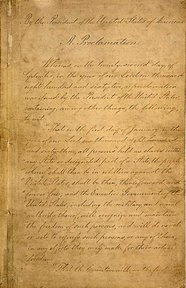
On this date in American history, in 1862, President Lincoln issued the Emancipation Proclamation. The History Channel has a video with information on this and other events that took place on this date:
Whitewater, Wisconsin’s latest Common Council meeting was held this last Tuesday, September 16, 2008.
Whitewater recently experienced a traffic fatality along its principal roadway through town. There was an extended discussion of which changes to traffic signals might be prudent. It might seem like an easy decision, but risk-reduction of this kind is seldom easy. There are no sure decisions, and that was evident in the discussion.
Later in the meeting, there was a discussion of a proposed amendment to a current city ordinance about the screening of dumpsters. That discussion drifted into an extended discussion, and that’s about all one needs to know about the state of affairs in our small city.
There was a past Council session when Council members tried to find ways to work together more congenially. I remarked at the time, in a post entitled, “The October 16th Common Council Meeting,” that
I have never heard or seen a session like this for politicians. I’m sure Whitewater’s not the first city to try this; I’ve just never heard of it elsewhere. I wish the effort well, and the first council meeting after the on boarding seems to have gone well. There is a difference with modern business or professional life, though. In a business or professional setting, typically the team leader will be able to hold others accountable for not living up to the standards set at the session. For a legislative body, elected representatives have — rather than a single hiring-and-firing manager — different constituencies and legislative districts. Over time, they may decide that it matters more to them to please their districts and constituents than it matters to maintain the common standards of the on-boarding session.
We’ll see.
In a political environment, harmony may prove illusive, as it did during the dumpster discussion. Perhaps recurring on-boarding sessions would have been more prudent, but I doubt it.
That a dumpster debate produces discord suggests little progress has been made in the last year, and that, from one from one set of Council leaders to another, the more things change, the more they stay the same.
Whitewater, Wisconsin’s monthly Planning Commission meeting took place on Monday, September 15th.
Part of the meeting — the principal part, I think — involved a discussion of re-zoning a neighborhood near our local college campus. Much of the neighborhood has evolved from single family homes into multi-unit student apartments, and our community faced the question: Should the neighborhood be re-zoned to reflect the change in use, and permit additional transformation without regulatory interference?
I thought that the meeting went very well, especially considering how angry some residents and their political champions are about any transition of any neighborhood at any time to student housing in our college town.
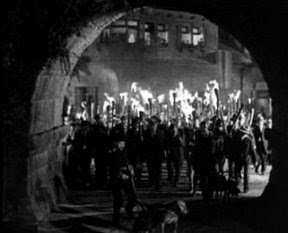
One often expects to see an angry mob, furious at an economy that they cannot control, but that government must, just must, control for them.
Something like this —
Some are so worked up that they’re convinced natural change to a neighborhood is pestilence and plague.
It’s all ‘death’ of a neighborhood now.
It cannot be dead if people still live there. It’s still a neighborhood; it’s just not what some might have wanted, but that others — residents just as much — do want.
So when students move in, it becomes a dead neighborhood, a desert, or (to use a term from Judge Dredd) the curséd earth. I’ve remarked before that some speak of students as though they were rats, and at the time I though that no stronger manner of description would be available. I was wrong; opponents of student housing anywhere off campus had depths yet to plumb.
Something like this —
The initial re-zoning proposal from a consulting firm that our city retains was amended before the evening was over; the proposal as the evening began called for the preservation of a small pocket of single family homes in the proposed multi-unit area.
I understand why: the residents once asked for it. Later, seeing that it might limit their re-sale options, they came to oppose a limited single-family pocket at the meeting. They had the same problem as that of Sen. Kerry on another matter: they were for it before they were against it.
Part of good planning for the consultant would have been to see that a single-family pocket was a bad idea, no matter how much some might have initially wanted it. Part of leadership would have been for this city administration to say that although residents once asked for it, it was a bad idea, both for them and the neighborhood.
The re-zoning (including an amendment that removed the single-family pocket from the proposed multi-unit rezoning) passed on a vote of 7-0.
Where was the city administration in all this?
Hedging and equivocating.
Even the city manager’s endorsement of this re-zoning proposal was tepid and pandering. It was tepid because he never declared for the proposal in a simple, straightforward way. He might just declare: I support this change, or I oppose it.
Most people understand that his hesitant manner indicates support, but it’s hardly inspiring.
What’s pandering though, both intellectually and practically, is the suggestion that if the Tratt Street neighborhood becomes higher density, then as matter of balance other neighborhoods should be enforced to lower density.
Practically, this administration will be unlikely to enforce zoning requirements elsewhere in the city effectively. It’s just an attempt to placate a few angry people. This administration has had little appreciable success anywhere in the city with enforcement — it’s been an over and under-enforcement problem. (See, Whitewater Common Council Meeting for 9/2: Student Housing (Part 1).)
Intellectually, even if it’s true that the housing imbalance between single family and multi-dwelling units is the biggest problem in the city, the administration cannot redress that imbalance appreciably through zoning restrictions elsewhere in the city.
Only additional single-family homes, perhaps on the periphery of the city, will appreciably shift the proportional balance (one that is now in favor of apartments).
We have a black market in rental units because a few politicians and their angry supporters will not allow a free, open market to permit more apartment options. I have argued in favor of those options. (See, Student Housing in Whitewater: Our Mistaken and Repetitive Approach.)
Some want to illustrate how markets are dishonest, but the real dishonesty is pretending that we haven’t limited selfishly the opportunities for an entire community.
Let someone build modern multi-unit apartment buildings and these ‘transition’ and ‘conversion’ fears will go away. Otherwise, consign yourself to a perpetual enforcement war against student apartments in every neighborhood of the city, without end.
The Planning Commission made the right choice Monday night, but this matter is unresolved.