FREE WHITEWATER

Tax Incremental Financing, Part 3: The Mood of It All

It was, last night, a quiet and somnolent setting in which our Common Council recommended to the Joint Review Board five new TIDs. I’ll give the atmosphere of the meeting some attention.

Often, a public meeting takes place in early evening, so that citizen-representatives can attend without missing work. They’ve worked all day, under conditions that have been hectic and demanding, and afterward they find themselves in a new arena, that requires as much energy and vigor as their working conditions. It’s no easy task to be as ready and energized at seven in the evening as seven in the morning.

Those who work for the city have an advantage over those who work elsewhere, and then merely visit, so to speak, the municipal arena. Ordinary citizens are not as fresh and ready to go. It showed last night, and I have sympathy for those who have to gear up for another round of intense work after a day of intense work.

The City Manager, and the Police Chief who sat at his right rand, had no such dual roles with which to contend. Their days might have been hectic, but they were not, certainly, as different from their evenings as those who came to the meeting after a full day of private work.

That’s one reason it’s easy for a public official to meet citizen objections at a legislative meeting – the official is fresher for the meeting, and has likely spent more time preparing for it.

Sometimes replies to objections are silly. Consider, for example, Kevin Brunner’s contention, in reply to a concern about notice of the TIF plan, that the city manager’s weekly report had provided ample notice about TIF, for weekly issue after weekly issue. That’s hardly notice, in a popular way. A message in a bottle floating in the Indian Ocean would be more widely read than the city’s manager’s report. (No one at last night’s meeting would say so, however, because the reply would be that both council members, and citizens, were notified. That’s truer with council members than the citizens they represent. There’s notice, and then there’s popular notice, literally and figuratively)

Initiatives or proposals from citizen commissions or bodies like the CDA often have a momentum that’s difficult for a citizen-legislator to stop. The commission claims exhaustive research, careful consideration, and thorough analysis, and so the presumption is that the citizen-legislator should approve it all. Even simple questions are easily portrayed as unwelcome objections, or ignorant and ill-informed second-guessing.

(That’s the none-too-subtle implication of Kevin Brunner’s remark to a council member that the member was new to council, and so not up-to-speed on all the many deliberations over the months preceding. Too funny: if it’s really a well-discussed issue, then it should be a community issue where awareness does not depend on legislative office.)

It’s hard, though, for a citizen, or citizen-legislator, to challenge a polished, full-time professional in that situation. Hard, mostly, because it’s so easy for the full-time manager to make someone else look and feel like an obstructionist, and to do it delicately. Our city manager has surely played this role – in one arena or another – for much of his life.

The answer, of course, is to match delicacy with delicacy, subtlety with subtlety. That’s hard to do after a day working somewhere else. The citizen-volunteer tends, from weariness and lack of rehearsal, to be blunt; the polished manager tends typically between being overly-solicitous and condescending by way of reply. (That professional technique works well, after all; some of those who spoke scarcely ventured their own opinions, but instead deferred to City Manager Brunner and how much thought he – rather than they — had put into the matter.)

Tax Incremental Financing, Part 2

What are the challenges of a TID, or sometimes of planning generally?

Retail cannibalization. It’s a big problem in many communities, with or without a TID. There’s no retail gain, under this scenario, just businesses – the same or new – locating in newer areas while others fold or move. Oshkosh, for example, is a city with this sort of retail problem, wholly apart from a TID.

Market-Like Deals with Only Half a Market. TIF is a municipal development mechanism that takes the form – superficially – of the market. In a private market, buyers and sellers freely engage in transactions for profit. A buyer might have dozens of prospective sellers, each different on any given day. After he buys, be becomes a prospective seller himself. Look back a few months later, and the people who are buyer and seller may be wholly different from those you knew before.

That’s not true at all in the TIF scenario. The city, the CDA, or some entity representing the municipality is one half of the exchange. There are huge risks in this situation. First, it places municipal officials or their delegates into the role of buyers, sellers, or dealmakers. No matter how experienced they imagine themselves to be, they will typically lack the skill of a successful private broker of goods and services. The private broker will engage in more deals, under greater pressure, and often for greater amounts, than even a small municipality. (I am not, buy the way, such a broker, so I am not describing my own work.)

It’s not a private market transaction, both by definition and by experience and skill. I will have far less confidence in development deals negotiated under a TID than those between two private parties. The private parties bear the risk more keenly, than any number of municipal negotiators who distribute the city’s risk – debt — to the general population rather than themselves.

When a Common Council member, at least night’s meeting, tried to be reassuring by declaring that the city could dictate which businesses might go in a given TID, one has to steady oneself. There’s nothing at all reassuring about the idea of the city or CDA members trying to ‘dictate’ market development. It’s a case of not knowing what they don’t know. A little more humility would be in order – it’s easy to push this matter forward, but the skill and insight to pick wisely will tax even the best our city has to offer. The brusque declaration that it will all be determined or dictated is hardly reassuring. (It’s difficult to tell if this attitude stems from a lack of self-awareness or an excess of self-importance.)

A TID is a matter of last resort, and should be used when ordinary private transactions are too few to sustain a healthy economy. There should be no rush to use public debt as a last ditch effort to preserve an economy. Whitewater stakes these projects upfront, a poor practice. We are here as a consequence of challenges unmet, unresolved.

All of this is potential only; no TID will make new factories sprout from the ground like clover.

This is quite a ‘Hail Mary,’ pass, however. More TIDs than previously, with two decades of life, and when we have one TID now that does not pay for itself. It’s a long-range idea, with no clear certainties, that has one public-relations advantage: officials can claim that they did all they could. Many involved in this effort, including our current city manager, will be long-gone and retired before those remaining in the city will know if this five-TID plan was sound.

We should know, however — now and forever — that public solutions with the look of private ones are less advantageous than wholly private arrangements.

Tax Incremental Financing, Part 1

Last night, Whitewater’s Common Council recommended to a Joint Review Board five new Tax Incremental Districts for the city. There is common agreement that Whitewater faces significant economic challenges, and that an increase in private economic activity, and development, would be welcome. (There are, in our town, few if any ‘no growth’ advocates of the kind one would encounter in a prosperous suburb.)

One way to encourage additional private development is through the now-ubiquitous municipal financing arrangement known as Tax Incremental Financing. Virtually all states have statutes that allow municipalities to finance public works in this way. Tax Incremental Financing is a mechanism by which a municipality designates tax revenues from growth in property values within a specified area to finance public works development in that same area. The municipality may undertake any number of public expenditures for roads, sewers, etc., within the designated area, and repayment of financing for those public expenditures comes from the increased (incremental) tax receipts that the city receives from additional private investments within the district.

The mechanism is Tax Incremental Financing (TIF) and the area is a Tax Incremental District (TID).

It’s not, of course, the only way to raise money for new public works in a designated area. The other options, however, are often more painful, uncertain, or undesirable. A city could, after all, increase taxes wherever possible, to finance new roads and street lights in a blighted area. The cost, however, might be borne disproportionately by areas of the city that don’t need or want additional public works, and both affluent residents and prospering businesses might rethink staying in town.

A second alternative might be to issue bonds to raise the money for new streets, etc., in the designated area, even if new business prospects were not yet available. There are limits both legal and practical on this approach, the practical being – ultimately – the more decisive. Will you spend publicly with no clear private prospect in mind? Some might do so, in the hope that new roads, etc., in a blighted area would attract businesses looking for a new market. This sort of “if you build it, they will come approach” is, however, better left to novels about baseball than the public finances of our small town. There is only so much that we could bear, and risk, in any event. Without a clear private gain, spending merely to spend would be the riskiest of ideas for us.

That brings us to TIF – an authorization to commit up to a specific amount of municipal obligation, from which we would build public works in a specific area, and an obligation that we would satisfy through the additional tax revenues that increased private activity made possible.

(In the Common Council discussion, City Manager Brunner remarked that Wisconsin statutes afford only one development tool, while other states have several. It’s a narrow way of seeing the world; no one thinks that cities did not undertake development projects long before the first tax incremental scheme was instituted. TIF is a post-war development, yet cities undertook both urban planning and development without it. Spend too much time inside, and you no longer imagine the scenery outside, as it were.)

Some have written as though Tax Incremental Financing (TIF) and the designated Tax Incremental Districts (TIDs) where it takes place are identical. Our city has five proposed TIF districts, designated 5 through 9. Tax Incremental Financing is a municipal redevelopment mechanism that may be more or less reasonable as applied to a specific TID. The selection of the right area – the right TID – will render the entire TIF mechanism either sensible or foolish. It’s not wholly different from the distinction between the concept of a thirty-year fixed-rate mortgage and the suitability of a given property and borrower for that arrangement. For Tax Incremental Financing, all the real action is in the districts, so to speak. One may be a good idea, others foolish.

So, what’s a community to look for in a TID?

1. Limits on new retail space, to avoid cannibalization from existing locations. (It’s not that there should be no new retail, but merely that one needs to be mindful of merely cannibalizing existing retail locations. This is a problem apart from a TID, too.)

2. Limits on use for completely open agricultural land. Why? Because valuation for open ag land is different from valuation for other land, and the base value of the TID derives not on the potential for the farm land for development, but on the value as existing crop land.

3. Areas for a TID should ideally be blighted or struggling. Creating a TID in a place that doesn’t need one restricts otherwise useful tax gains only to a TID that doesn’t need it, away from general tax coffers where they would be more useful. Saying that statutes determine selection is unpersuasive, as there is flexibility in selection of TID boundaries.

4. Minimum amount of public works possible. A TID will have a legally defined amount of public spending possible, but less is more in public works expenditures.

5. A transparent, responsible community body to carry out TID administration. (A critical study of TIDs in Chicago found that many TIDs are poorly administered, of limited accountability, and that administrators voted ‘yes’ on proposals before them over 99% of the time.)

Star Packaging — One Year On

I checked my email this afternoon, and found a press release from a group called Voces de la Frontera. I am not affiliated with the group, know none of its members, and have no idea what their event will be like tomorrow, with the exception of the news that’s contained in a press release that the group emailed to adams@freewhitewater.com. (I did some quick checking, and they have spoken at different immigration reform meetings, sometimes in a local Catholic church, for example, with representatives of different labor unions, and on at least one occasion, with representatives from the offices of U.S. Senators Kohl and Feingold, attending.)

Here’s an an excerpt from the group’s press release:

VOCES DE LA FRONTERA

***For Immediate Release*** 8/7/2007

Contact: Dave Moore, Voces de la Frontera, (414) 643-1620

WHITEWATER IMMIGRATION RAID: ONE YEAR LATER

GROUPS TO UNVEIL STAR PACKAGING ‘MONUMENT’ WEDNESDAY

On August 8, a first anniversary commemoration of the raid at Star Packaging will unveil a mock Wisconsin Historical Marker at the site and formally declare the factory’s empty shell “a monument to the nation’s broken immigration system”.

Wednesday’s 10am press conference, to be held outside the factory, will begin with the unveiling and be followed by brief addresses from speakers including Executive Director of Voces de la Frontera, Christine Neumann-Ortiz, Jorge Islas, Vice President of Sigma America, and workers affected by the raid….In addition to the press conference, a vigil will be held at the factory site from 8am-10am and 5pm-8pm. A delegation will also attend the 11am sentencing of a former Star Packaging worker.

PRESS CONFERENCE WHEN / WHERE

10.00am-10.15am, August 8, 2007
Star Packaging, 960 E. Milwaukee St, Whitewater, WI 53190

In part of the release I’ve not included, the group asks for comprehensive immigration reform. From the point of view of the Whitewater police, of course, this was never an immigration matter – it was a matter of identity theft. (I’ve called that an excuse, as I’ve detailed previously.) As for immigration reform, well, I that’s no easy matter, and I know of no wholly satisfactory solution.

I am not a representative of the group, and I do not speak for them (as, of course, they do not for me). I am confirmed in my view, however, that all of this was a tragedy for which there has been no police honesty and accountability. Our community would have been better off had the raid not taken place, had no one been arrested or deported, and we had not had to endure a year of duplicitous statements about why it took place at all.

Inbox: Reader Mail — Downtown

From a reader in town:

Your observations about entering Whitewater from the east or west on highway 12 focus on some true, although unpleasant, facts that suggest inadequate planning may have been a factor. Equally disturbing is the short glimpse of the UWW without a hint of the huge and sprawling Campus north of Highway 12 that could be an image enhancing factor for the City. However, the downtown problem (Main, Center and Whitewater) remains as a major issue.

It is somewhat naïve to think that improving the appearance of downtown store fronts will hasten the return of retail or commercial enterprises when it is continuously demonstrated elsewhere that it won’t. However, that is scarcely a reason to abandon proceeding with restoration projects that, as a matter of civic pride, will make the area somewhat more attractive.

Experience establishes that an enterprise most likely to succeed in a decaying downtown environment is a “niche” business provided, of course, that the costs of purchase or tenancy are reasonable. A conclusion that may be readily drawn is that downtown property, with restoration included, may not be as valuable as many are disposed to think it is! This is primarily a problem of economics, that opens a broad range of possibilities, and perhaps it is a factor that should, for obvious reasons, be brought to the attention of the community.

Adams: Well said, and much appreciated — something to think about when thinking about both the university and downtown.

Inbox: Reader Mail — Thanks and Suggestions

From a kind reader in town:

Dear John Adams,

I just ran across your site today, and it is very impressive. A bright
spotlight is exactly what this town needs.

Adams: Thanks much!

From a former member of the Whitewater Unified School District Board:

I have no idea who you are, but I love your blog. Keep it up!

Adams: Thanks for your kind words, and thoughts on education in Whitewater. Much appreciated!

Inbox: Reader Mail — On the Banner

From a reader who identified himself as ‘Aaron Burr’ — his remarks in black, my replies thereafter in blue.

John,

I couldn’t agree with you more concerning Steve Spear. If you are
correct that he has applied to get his old job as municipal judge back,
that is appalling. Under no circumstances should he be placed back in
this position.

I take strong exception to some of your comments about Jim Stewart and
the whitewaterbanner.com. Of course, it is more of an information
source, rather than a true journalistic source, and yes, having an
archive and some stronger navigational tools would make that site
stronger. However, it is unnecessary to take aim at him for his
cheerfulness or optimism. It is nasty to compare him to the boy
searching for a pony in a pile of manure. You insult all of us with
that comparison. I ask that you retract this portion of your blog
immediately. The civil thing to do would be to then privately apologize
to Jim for such an offensive comparison. That, obviously, is your
choice.

Most sincerely yours,

“Aaron Burr”

P.S. I have no problem with you knowing my name, as that is easily
ascertained from my e-mail address. However, I am most serious that you
have crossed the line in your attack on Jim Stewart. Please pull this
back! (And no, despite my pen name, this is not a challenge to a duel).

Adams: Spear’s an example of much that’s wrong with our small town, and the unwillingness of officeholders to speak against him — while they always had every legal right to do so — is one of the sad failures of nerve in our small town.

On the Banner, I’ll offer a few remarks. Neither a retraction nor apology is in order. You very much misunderstand the quotation from Reagan. Reagan used the anecdote throughout his career, in different versions, and often applied the story of the boy as optimist not only to others, but also to himself, sometimes favorably, sometimes self-deprecatingly. It was, by many accounts, his favorite anecdote. Your request is overwrought. If my slight remarks on Stewart lead you to expect an apology, I can scarcely imagine that you’re able to pick up a daily newspaper anywhere in America without demanding daily at least several public (or private) apologies.

I would be the first to say that Stewart, as publisher, has a First Amendment right to publish his perspective as he wishes. I don’t doubt that he loves Whitewater, as in my way I do (no less than he does).

His optimism, though, is hardly an unalloyed good, or a pure benefit to the town. You write of Stewart as though he were the actor Jimmy Stewart: a community treasure above reproach. I see him differently — as a publisher and politician, whose website is as legitimate a subject of criticism as a newspaper would be. A disposition to optimism is beneficial only when the fundamental conditions of a place are sound. If one believes, as I do, that there are fundamental challenges facing Whitewater — beautiful thought it is — then Stewart’s optimism is both an occasional distraction and impediment to problem-solving and reform.

Stewart’s not just a publisher, after all; he’s a member of the Common Council, too. There’s a way in which his ultra-optimistic website is an extended campaign advertisement for the status quo, and an endorsement of his incumbency, and that of others. Stewart is free to publish as he wishes, but he can hardly hold himself out as an apolitical, unaffected citizen. He’s involved in many of the subjects that he covers, and his news items often include topics on which he has, or will, vote as a Council member. (Most readers likely know of his political role, and he includes his own name in many stories about Council votes, etc., of course.) Still, he’s often writing about himself when he writes about city government, as it were.

Stewart’s not unwilling, now and then, to venture from innocuous descriptions of local charity events and high school sports into more controversial topics. Recently, he trumpeted the conviction of a local businessman in a controversial police action by hyper-linking to a story using the words of the businessman’s plea. Nice touch, for those who saw the plea as vindication. (I would have respected Stewart more if he just wrote that he believed the effort was justified, but he was willing to send that same message without writing so in his own words.) His coverage of the proposed creation of new Tax Incremental Districts — on which he will vote — had been occasionally sloppy and uninsightful. (I’ll write more on the Tax Incremental Financing and TIF districts this week.) His optimism, such as it is, wanders into endorsements of incumbency — his and others.

You take exception to my application of Reagan’s remark for Stewart, but I thought that it was, on balance, less critical than my comment that the city might just as well adopt Stewart’s website as its own. That latter comment cuts — as it was meant to — two ways. The city’s website’s not that good, and Stewart’s publication is sometimes a valentine to incumbency and the status quo.

As for dueling, I am fortunate that I did not choose the pseudonym Hamilton, as I would have been a better and easier target for you.

Who Can Stop Steve Spear? Only One Man!

Steve Spear, perpetual vulgarian, disgraced, former municipal judge, still persists in the notion that his former office belongs to him — he’s submitted an application to be appointed to the office from which he resigned in July. (That’s this July.) Perhaps you’ve seen Spear walking around town these past few weeks, plotting his comeback:

Who will stand against this menace? We will need to fight fire with fire.

The best candidate to stand against a vulgar, little nothing is a vulgar celebrity:

Who else to rival Spear except Pee Wee Herman?

If, as some may believe, Spear’s an astute judge, or a family man, or perhaps someone who has a history of working with youth, then Pee Wee’s even better! Herman — Paul Reubens — is more than good with youth — he had his own children’s show, after all. Where Spear has been covered only in small town papers, Pee Wee’s scandal was national — dare I say, international — news.

Why settle for a two-bit disgrace when we could have a celebrity disgrace?

On the Whitewater Banner

I’ve written about the Whitewater Banner before, and I thought that I’d post more about that website.

The Banner’s greatest strength is that it posts more Whitewater information online, more quickly, than any other website. Some newspapers post less (e.g., Daily Union, Janesville Gazette, The Week), or nothing at all (Whitewater Register).

I’ve called the Banner a bulletin board, and have not covered it critically, as I have with the no-journalism-at-all approach of the Whitewater Register.

I’ll address the ever-cheerful tone of the Banner in a moment, but first a few matters on format.

As far as I can tell, the Banner has no news archive, and no way to link to individual stories. (Without an archive, linking would be temporary in any event.) Many websites have both of these things, but I don’t know why Stewart’s Banner takes a different approach. Navigation is also sometimes awkward, as stories on sports appear at the bottom of the screen, without a quick way to reach them. (A navigation bar near the top of the page would be helpful.)

Otherwise, it’s a bright, bold format, with strong use of photographs.

Jim Stewart’s on Common Council, and simultaneously a news publisher, but I have met few who seem to mind. One reason might be that readers consider Stewart scrupulously fair; the alternative is that his consistent cheerfulness is easily ignored in the search for basic facts about Whitewater.

Stewart’s Banner reminds me of an anecdote that Reagan told, about a boy who wanted a pony. The boy expected a pony from his parents, but instead discovers only a pile of horse manure in his backyard. Upon seeing the large pile of manure, the boy starts digging furiously, and squeals with delight, “Gosh! I know that there has to be a pony in there somewhere!”

Stewart’s Banner is that small boy from Reagan’s tale.

That’s also why the Banner is not a true journalism site; it would not likely investigate, question, or probe for the truth and deeper meaning of something. I cannot imagine that Stewart would present a contrary opinion on many issues.

The City of Whitewater should not have troubled itself to create a new website — adopting Stewart’s Banner would have been faster.

In fairness, if Stewart started questioning life around here in print, he’d trade one conflict (politician and publisher covering city life) for another (politician and genuine journalist covering city life). I would guess that Stewart will continue as he has, without significant changes, and will publish the most optimistic perspective on life since that of the boy in Reagan’s story.

Parsing Jim Coan’s interview with The Week on the Star Packaging Raid

Over at The Week, Mike Heine has an interview with Jim Coan, Whitewater Police Chief, about the Star Packaging Raid, and the plea of Star Packaging’s owner, Alan Petrie. I’ll leave Coan’s comments, and Heine’s text, in black, and my replies in blue, for easy distinction.

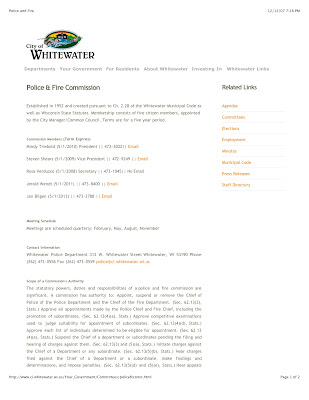
Pending a sentencing hearing, a dark chapter in Whitewater’s police history should be closed.

Monday’s plea hearing for Allen L. Petrie, the 48-year-old owner of Star Packaging, is vindication for the department and a now-retired investigator once accused of racial profiling, Chief James Coan said.

Coan shed light on the investigation by his department in an interview with The Week after Petrie’s plea hearing.

Q: What is the department’s reaction to the plea?

A: “We feel completely vindicated with the plea agreement that was reached today. It’s vindication for not only (investigator) Larry Meyer and his investigation but for our department, also. I think it will demonstrate to the public that there were in fact victims here and (they were) not the people who were working at Star Packaging.

Adams: He’s not completely vindicated; he just wants to crow that he is. Coan’s actions led to family hardship, and that makes those who were treated too harshly, leading to their deportation, victims, too.

By the way, why is Coan’s speech always a torrent of adverbs? He’s never just right, or vindicated, or correct, in his own mind. He’s always completely, totally, entirely, so. It’s an adolescent’s way of speaking. Most things in life, as seen by mature men, are not so clear-cut.

Nonetheless, Coan commonly speaks, and writes, in this overly-certain way. Hard to say if he’s just desperate to be right about everything, desperate not to appear wrong about anything, or just convinced that if he speaks categorically, no one will object.

Petrie’s plea does not address whether (1) the initial motivation was investigating Petrie or intimidating Mexicans, or both, (2) and does not address — does not express any sympathy — for any consequences of immigration enforcement as a result of a Whitewater Police Department telephone call. Is Coan too insecure to acknowledge that his actions caused hardship, or too arrogant, or too inflexible? Hard to say.

I find it nearly impossible, however, that a mature and educated man would have any confidence in someone like him.

Q: For all the effort put into this case, and the aftermath that followed, was the investigation worth it?

A: For the people whose identities and Social Security numbers were falsely used, it was. It sends a message that it is a crime and hopefully it will act as a deterrent for people who are trying to do that. From that standpoint, it was worth it.

Adams: Notice how Coan says nothing about deportations, etc. You say it was worth it for a few, but it was bad for the community, and you’re too rigid to acknowledge that.

Q: Will Whitewater police investigate employers in similar cases in the future?

A: We’re not actively investigating anybody else. It’s not a situation where we were out actively seeking these crimes. When it’s brought to our attention, we do have an obligation to investigate. We will do these on a case-by-case basis.

In the case of Mr. Petrie, we did it. There were warnings given (to him) in the past. There was ample opportunity for Mr. Petrie to cease what was going on there.

With regard to other businesses, other companies, other cases that might come to our attention, we will treat each on a case-by-case basis. I can’t make any broad or sweeping comment as to what we would do other than to remind people that it is a crime.

Adams: If Coan were a tech leader, this technique would be called FUD (spreading fear, uncertainty, and doubt). He holds out the possibility that he might do all of this again, and again, at his discretion. For a while, his technique will keep Mexican families on edge, and might lead some to relocate rather than stay in a state of anxiety. There are some people in this town who would welcome a limit on Mexican families here, or a departure of some, and Coan’s effort to appear strong will please those people. At some point, without further raids on other businesses, the anxiety will lessen. Coan will have to ask himself — should I raid another businesses, on spurious identity theft grounds, to keep the anxiety level high? Hard to say — he’s a weak leader, but he’ll do what the town elites — middle and working class –want. If they’ll back him, he’ll raid again.

He won’t investigate across the board, however, because some businesses will always be off limits (regardless of the immigration status of the workforce). Petrie didn’t have clout within the city, in the way it counts here.

Q: Did you learn anything in hindsight about how the case was handled?

A: In retrospect, we did what we felt was right at the time. I’m not going to say that we would do it one way or another the next time.

All situations are different and have different factors, different variables. But we treat matters on a case-by-case basis. I can’t predict what the future might hold in other operations we might be called upon to assist in.

Adams: Nothing, not a single admission that it might have been handled better. Nothing. The rigidity of weakness.

Q: What caused the negative view of the Whitewater Police Department after the raid at Star Packaging?

A: What transpired is a microcosm of what’s taking place elsewhere in the country. We were investigating identity theft. ICE (Immigration and Customs Enforcement), their responsibility is that of illegal immigration. It got inter-wound and I think people viewed us as the agency that was going after illegal immigrants in the case. That was not our responsibility. That was the responsibility of ICE. Ours was to focus on identity theft, which we did.

Q: Did the investigation cause the social or economic hardship on the community because the business has virtually closed, leaving dozens without jobs?

A: We can’t forecast the social or economic consequences of something like this that we undertake. There was a crime committed. We investigate crime. The district attorney’s office prosecutes the crime. The consequences from all of this are not our responsibility. It is those who commit crime.

Mr. Petrie admitted he committed crimes. There was a plea agreement to that effect. It’s not the police department or the city’s responsibility… I would put it upon those who have committed, in one way or another, illegal activity.

Adams: Coan’s force exercises police discretion every day, in what to undertake or not, but then he turns around and disclaims responsibility for the consequences of his actions. He either pawns the blame on the Immigrations and Customs Enforcement Agency (whom his own officer brought into the case), or denies that any consequences are his.

Adams: Those are his words: the consequences of all of this are not our responsibility. All of this.

By this line of reasoning, any action Coan takes to fight crime is legitimate, and he is incapable of a disproportionate response. As long as it was a crime, all consequences belong to the alleged criminal.

No normal person believes this, and Coan would not himself contend that police officers could beat a person, for example, for jaywalking. But listen to how he speaks, and replies — they’re never consequences he has to consider.

That’s just amoral hand-washing. Coan should always be accountable for the consequences of a disproportionate response in a criminal investigation, even if he insists he would not be. He has the advantage, however, of running a department in a city with a lapdog Police and Fire Commission.

Q: What will people think now that there has been a plea?

A: Hopefully there will be an understanding. They’ll see the details of this. They’ll have an understanding of those who were victimized as a result of this and that there were in fact crimes committed. I hope people take a different view of this whole issue and whole case and know it’s not an issue of racial profiling from our standpoint.

Q: Will everyone see it that way?

A: I think there are some in the community who are still using this for whatever personal or political gain. I can only tell you that from our standpoint, we continue to provide, I believe, the utmost professional police service to all members of our community regardless of their immigration status. When someone calls the Whitewater Police Department, we respond and we do everything we can to help the person regardless of their race, gender, age or immigration status.

Adams: Political gain? Who is he talking about? Those who hold office in this city — and expect all the honor that comes with official rank — will not take a firm stand against Coan. Either they support him, or they are unwilling to criticize because to do so might make them seem weak on crime. It says something about how troubled our community is that he speaks and writes unchallenged by some — in office — who know better. As I wrote of Coan before, he’s a “Mynah bird of excuses, rationalizations, and self-praise, of himself, and the Whitewater police.”

Coan has no political opponents. Senators, presidents, and the jackass who runs Zimbabwe have political opponents. Coan doesn’t have political critics. He flatters himself to think so. I might be critical of Coan because he’s a mediocre manager. Alternatively, I might be critical of Coan because what he says is impossible to believe. Perhaps I might doubt him because he advocates a consequence-free authority for his force. Those are not political objections, so to speak — they’re simple expectations to hold Coan to a normal ethical standard.

Q: How do you feel about the plea agreement and that prison time will not be sought?

A: Our job is to enforce the law. As far as the court aspect of things, the trial, the sentence, that’s the responsibility of the courts. It’s up to them to decide on an appropriate sentence in this matter. We are not advocating for any jail time. That is up to the DA’s office and for the courts to decide.

We hope the strong message that it sends to (Petrie) is that this is against the law and that it’s unacceptable.

Adams: All this, for probation. That’s it — jail, deportation, a business ruined, so Coan could make a point. Are you kidding? He speaks like a little god, not a humble public servant. If there’s anyone foolish enough to trust Coan’s moral judgment, then those trusting people deserve the damage he does. For us, however, who wouldn’t trust or rely on his faulty judgment, and excuse-making, and dissembling anymore than we would trust a confidence man, we deserve better.

Thanks for a Great July

Thanks much to so many new readers, and to those who were correspondents, this past month. This humble site started in May, and it has had solid growth again over the last month.

I will try to include more photographs and pictures, along with my posts, to make the site more visually appealing.

I will also continue with a “Coming Attractions” post at the beginning of the week, so that readers will know what’s on deck for the week ahead. Additional, breaking-story posts can be added to the lineup as events suggest.

As always, for those who have written and thanked me for publishing an independent point of view for Whitewater, the pleasure is mine.

Public Art, John Adams Replies

As readers know, I posted yesterday an email from Bill Bowen, owner of the Double Dip Deli, in which he criticized two of my posts that made mention of public art in Whitewater. Yesterday, I printed his letter in full, and today I’ll respond. I gave him the benefit of being able to tell his friends and patrons that he was the one who gave me a piece of his mind. (Including his name may slake his desire for notice, and it doesn’t bother me, so I identified him.)

Below, I reproduce Mr. Bowen’s remarks in black, and my replies in blue, for easy distinction.

BB: Dear Mr. Adams,

I fail to understand how you can be for a “Free Whitewater” and yet be so cynical and belittling.

JA: Part of standing for a Free Whitewater means exercising my free speech rights. Your belittling is my artistic criticism. It’s not a free city, state, or republic if I cannot comment merely because someone else might be offended. That’s the problem with your analysis. If you feel someone is belittled, presumably, I’m supposed to stop writing, or I’m supposed to write only what does not offend you, your customers, etc. I will write freely, and I will not stop because someone might be offended. If writers stopped writing because someone might be offended, no one would write.

That’s a challenge in our small town: group-think requires people to be positive, sweep criticism under the rug, and defend whatever project or program the city or some civic group proposes. Why? What if they’re foolish, or empty, or ineffective ideas? They can’t all be great ideas, unless everyone behind every project is a visionary. I think people are sometimes making mistakes, and I’ll write that I think they’re sometimes making mistakes.

No one can say that this website is from one of the lemmings of Whitewater — those who follow along because they think that’s what they’re supposed to do.

I’m not cynical — literally, distrustful of human sincerity — about public life; I’m skeptical — literally, not easily convinced, having doubts or reservations. (About private life and faith I have no such doubts or reservations.)

BB: For example, in the following two excerpts, I am astounded that you would disparage the efforts of a group of people who want nothing more than to be proud of and enjoy their community. They have worked very hard on these public art projects, some tirelessly, and have given a part of themselves to the community. Yet you state that they are “empty municipal gestures”

First excerpt: Our economic development is less about a free market economy than about any number of empty municipal gestures. We could hang birdhouses, or painted chairs and wooden fish, from our lampposts forever and still businesses would close and go elsewhere.

JA: But, sadly, I’m right — we do hang these projects on lampposts, and stores still close. That was the point of my Vacant Whitewater post. Perhaps your point is that more stores would close if people did not expend their time painting wooden fish and chairs and hanging them on lampposts. Even so, is this the best use of our efforts? There is something that we could do that would be more effective? If we’re down to the fish-and-chair-and birdhouse plan to save the economy, we’re cooked. That was the point of the James Lileks post to which I linked. These projects are, as he noted, often matters of municipal desperation. (More about the municipal connection in a bit.) It should not be astounding, to an astute businessman, that someone might question whether any given effort is the best use of time and resources.

I am not sure if you’re truly astounded, or if it’s just a pose. If it’s a pose, then at least I see the practicality of it: you may gain more patrons, admirers, and profits. If you are truly astounded, then you are too easily shocked or surprised.


BB: Second excerpt: Q: Why do you want to embarrass/criticize the town? A: Reform and growth begin with honesty, not whitewash and Potemkin villages. We have some great possibilities before us, but some of our fellow residents have been treated with outrageous cruelty and official indifference, lies, and excuses. All the birdhouses hanging from lampposts will not undo the damage that, for example, our police force has recently inflicted on hardworking people. I am even more surprised that as a self professed expert on our city, you apparently don’t understand the difference between a “municipal gesture” and the commitment this group of individuals has shown toward making our city just a little bit nicer place to live. Creativity and commitment is something to be regarded and respected. It can provide innovative solutions to real problems. It certainly does not deserve the irreverence you have shown it.

JA: Where to begin? First, in my post, it’s clear that I refer to the deportation of industrious Mexican workers. (I know that Coan will caw endlessly that the federal government actually deported them, or jailed them, but that’s just his futile exercise in hand-washing.) You make no mention of them at all, except when citing my remarks.

What nonsense to say that I am a “self professed expert.” That’s completely false — nowhere have I declared myself an expert. Nowhere. Your rhetoric runs ahead of your argument. It’s a wasted line, as it’s so easily refuted.

I have been very clear that I am a common man, citizen, resident, and property owner, who is skeptical of much of what goes on around here. You ask: Who am I to criticize others? I am a common man, a citizen, resident, and property owner, who is skeptical of much of what goes on around here — that’s who I am to criticize. It’s a free society where anyone has a right to criticize. My rights are not limited by what others decide is offensive. I have every right to offer my opinions, and publish them, even if it offends a few artists and their champion.

BB: These projects were created not only by accomplished artists, but also by everyday individuals and some even as family projects. Who are you to belittle them? Even if this was not your original intention, the connotation is certainly there. Talk about cruelty.

JA: “Talk about cruelty.” When I read that line, I thought the entire message might be a joke, or spoof.

Review your comparison: people were removed from this community, and jailed, and deported, you think mere words of criticism of a few bird-house builders is similarly cruel? That’s a false moral equivalence and a bankrupt comparison. Do you really think that’s the same? If you do, your position is not morally serious; if you don’t think it’s the same, then your position amounts to no more than a grandstanding pose, or sloppy rhetoric.

Why should all creativity be embraced? Creativity can lead to good, mediocre, or empty ends. I can and will make the distinction. In the case of the fish/chair/birdhouse effort, I believe it’s an empty effort that leads me to think the work amounts to less than meets the eye. They’re all created — that its, acts of creativity — but why should I admire them all just because someone made them? What if I think some of them are unattractive, or without merit? By your reasoning, I would have to praise all art simply because someone created it. (By the way, I would not revere art, or other human things; I will save reverence for higher things, not the work of someone who painted a wooden chair and put it on a lamppost.)

Suppose I painted a picture, and placed it on display. Some people would praise it, some would be indifferent, and some would say it was ugly. I would hope that if I displayed something publicly, I would have the maturity to accept diverse opinions, including critical ones, without hyper-sensitively decrying negative reviews as cruelty. If the people you defend are true artists, then they should be mature enough to handle, and shrug off, the comments of someone who writes that their efforts are empty. Are all these artists of Whitewater made of sugar, that they melt after a few words, or falsely equate those few words with the hardship of deportation?

BB: The only part of the entire project that could be considered a “municipal gesture” would be 1) the fact that permission was granted to do these projects and 2) the city crews, which I have read you don’t have any respect for either, assisted in securing the works to the lamp posts. By the way, you should try some of the jobs they do on a daily basis.

JA: Two quick replies. First, if you need city permission, it’s not a truly private effort. I don’t need the city’s permission to hang a painting in my house, but if I did the same on a genuine City of Whitewater lamppost without asking permission, some Whitewater police officer not otherwise engaged in a keeping our city safe from marauding immigrants would ask me to take it down.

Second, about some of those city workers: I did not know the owner of the Double Dip Deli to be a champion of the working class. By the way, as you surely know, I was referring only to those city workers who were committed to a small town orthodoxy, not all workers. Fortunately, not everyone around here shares that orthodoxy. Those who work at public expense have it far easier that people who work difficult private jobs in factories, shipyards, etc. That includes those now deported Mexicans who were working in private industry, until recently. Those who get salaries, benefits, etc. at public expense — with the tax dollars of those who work laboriously in private industry — have more stability than those who face the vicissitudes of the private market. A lamprey might contend that it does hard work by feeding parasitically, but I would think that it’s not as hard as being the larger fish from which the lamprey drains blood.


BB: I will also tell you that these types of projects have helped me stay in business in Whitewater. Aside from the additional foot traffic downtown, which translates to additional sales, it sometimes is just to nice know that people are willing to try, which helps me hang in there and try a little harder.


JA: So which is it: is your support of a matter of defending the artistic community, or making money? If it’s money, then the motivation that you’re defending the artistic community from my supposed cruelty is less altruistic and more self-interested. If it’s money, then I will leave it up to you if it’s the best value for your money, knowing that it may not be the best expenditure of effort for the entire city — that is, it may not accomplish as much as you think.

I want to be helpful; I can suggest a way to increase cooperation between the City of Whitewater and the artists that you champion. Next year, I suggest that private citizens paint and display painted wooden shovels on the city’s lampposts. The artists can paint them, and decorate them wherever their creativity — to be revered, by your account — leads them. The city will get something out of it, too. From this effort will come a new motto for Whitewater’s city government:

Whitewater City Government — No One Shovels It Like We Do.™

BB: I doubt you will actually post this publicly, but if you do I would very much appreciate 1) you do include my name, I am proud of my viewpoints and welcome direct discourse on differing opinions and 2) post it's entirety, paraphrases can often be misleading. I expect though that the name will be withheld because "e;Our policy is…blah, blah"e; or "It is not our mission to…blah, blah, blah" etc, etc. more >>

Public Art, Bill Bowen Writes

I received a message from Bill Bowen, of the Double Dip Deli. You’ll see that he wonders if I will post his full message, attributed to him. Of course I will, thereby giving his friends, patrons, etc., the opportunity to know that he spoke his mind, as it were. (What he writes would mean no more or less if he wrote without attribution, but if he wants the notice, so be it.)

I will post his full message now, and post my reply tomorrow, Wednesday, morning. Mr. Bowen will not be able to say that his message wasn’t published in full.

Dear Mr. Adams,

I fail to understand how you can be for a “Free Whitewater” and yet be so cynical and belittling.

For example, in the following two excerpts, I am astounded that you would disparage the efforts of a group of people who want nothing more than to be proud of and enjoy their community. They have worked very hard on these public art projects, some tirelessly, and have given a part of themselves to the community. Yet you state that they are “empty municipal gestures”.

First excerpt:
“Our economic development is less about a free market economy than about any number of empty municipal gestures. We could hang birdhouses, or painted chairs and wooden fish, from our lampposts forever and still businesses would close and go elsewhere.”

Second excerpt:
Q: Why do you want to embarrass/criticize the town?
A: Reform and growth begin with honesty, not whitewash and Potemkin villages. We have some great possibilities before us, but some of our fellow residents have been treated with outrageous cruelty and official indifference, lies, and excuses. All the birdhouses hanging from lampposts will not undo the damage that, for example, our police force has recently inflicted on hardworking people.
I am even more surprised that as a self professed expert on our city, you apparently don’t understand the difference between a “municipal gesture” and the commitment this group of individuals has shown toward making our city just a little bit nicer place to live. Creativity and commitment is something to be regarded and respected. It can provide innovative solutions to real problems. It certainly does not deserve the irreverence you have shown it.

These projects were created not only by accomplished artists, but also by everyday individuals and some even as family projects. Who are you to belittle them? Even if this was not your original intention, the connotation is certainly there. Talk about cruelty.

The only part of the entire project that could be considered a “municipal gesture” would be 1) the fact that permission was granted to do these projects and 2) the city crews, which I have read you don’t have any respect for either, assisted in securing the works to the lamp posts. By the way, you should try some of the jobs they do on a daily basis.

I will also tell you that these types of projects have helped me stay in business in Whitewater. Aside from the additional foot traffic downtown, which translates to additional sales, it sometimes is just to nice know that people are willing to try, which helps me hang in there and try a little harder.

I doubt you will actually post this publicly, but if you do I would very much appreciate 1) you do include my name, I am proud of my viewpoints and welcome direct discourse on differing opinions and 2) post it’s entirety, paraphrases can often be misleading. I expect though that the name will be withheld because “Our policy is…blah, blah” or “It is not our mission to…blah, blah, blah” etc, etc.

Speaking honestly,
Bill Bowen
The Double Dip Deli

Wednesday: Adams replies.