FREE WHITEWATER

Film: Tuesday, May 9th, 12:30 PM @ Seniors in the Park: La La Land

This Tuesday, May 9th at 12:30 PM, there will be a showing of La La Land @ Seniors in the Park, in the Starin community building.

La La Land (2016) is a romantic musical comedy-drama about a jazz musician and an aspiring actress who meet and fall in love in Los Angeles. Damien Chazelle directs the two hour, eight minute film, starring Ryan Gosling, Emma Stone, and Rosemarie DeWitt. La La Land won six 2017 Academy Awards (Best Performance by an Actress in a Leading Role for Emma Stone, Best Achievement in Directing for Damien Chazelle, Best Achievement in Cinematography, Best Achievement in Music Written for Motion Pictures Original Score, Best Achievement in Music Written for Motion Pictures Original Song, and Best Achievement in Production Design). The film carries a PG-13 rating from the MPAA.

One can find more information about La La Land at the Internet Movie Database.

Enjoy.

Daily Bread for 5.8.17

Good morning.

Monday in Whitewater will be sunny with a high of sixty-two. Sunrise is 5:38 AM and sunset 8:04 PM, for 14h 25m 46s of daytime. The moon is a waxing gibbous with 95.1% of its visible disk illuminated. Today is the {tooltip}one hundred eighty-first day.{end-texte}Days since Trump’s election, with 11.9.16 as the first day.{end-tooltip}

Whitewater’s Planning Commission meets at 6:30 PM.

Harry S. Truman is born on this day in 1884. On this day in 1864, the 1st, 15th, 21st, 22nd, 24th and 26th Wisconsin Infantry regiments along with the 1st Wisconsin Cavalry take part in Battle of Rocky Face Ridge, Georgia.

Recommended for reading in full —

Cynthia Littleton reports that Sinclair Sets $3.9 Billion Deal to Acquire Tribune Media: “For Sinclair, the expansion with Tribune will increase its market clout in TV but it will also extend its geographic footprint in a way that is vital to the company’s vision of using the broadcast TV bandwidth of its stations to provide data services and interactivity on a scale designed to compete with wireless and digital media heavyweights. Sinclair chairman David Smith, son of company founder Julian Sinclair Smith, is known for his engineering acumen. He’s long had a vision of revamping the technical architecture of broadcast TV to make local stations more competitive. “Television broadcasting is even more relevant today, especially when it comes to serving our local communities,” Smith said. “Tribune’s stations allow Sinclair to strengthen our commitment to serving local communities and to advance the Next Generation Broadcast Platform.  This acquisition will be a turning point for Sinclair, allowing us to better serve our viewers and advertisers while creating value for our shareholders.”

Carolyn Y. Johnson reports that Free-standing ERs offer care without the wait. But patients can still pay $6,800 to treat a cut: “Across 32 states, more than 400 free-standing ERs provide quick and easy access to care. But they also are prompting complaints from a growing number of people who feel burned by ­hospital-size bills, like $6,856 for a cut that didn’t require a stitch or $4,025 for an antibiotic for a sinus infection. Emergency care requires costly imaging and laboratory equipment and facilities that are open 24 hours a day and staffed round the clock by a physician — and the costs reflect that. Prices for an average free-standing ER visit have grown and are now similar to hospital ERs, but patients with the same diagnosis rack up bills 10 times higher than at an urgent care, according to an analysis of one insurer’s Texas data by Rice University economist Vivian Ho. She found use of the facilities in Texas more than tripled between 2012 and 2015.”

Matt Apuzzo and Emmarie Huetteman report that today a Hearing May Shed Light on What White House Knew About Flynn: “WASHINGTON — Sally Q. Yates, the former acting attorney general, is scheduled to testify at 2:30 p.m. Monday before a Senate subcommittee. Here’s what to watch for:

Her testimony could raise new questions about how President Trump responded to concerns that his first national security adviser, Michael T. Flynn, had lied.

Mr. Trump pre-empted the hearing with Twitter posts suggesting that Ms. Yates leaked information to reporters and that the Obama administration was to blame for the troubles surrounding Mr. Flynn.

Ms. Yates can tell a dramatic story — a rarity in congressional hearings — of a brewing crisis in the early days of the Trump administration.

Democrats who hope Ms. Yates will reveal new information about the investigation into Mr. Trump’s campaign and Russia are likely to be disappointed.

James R. Clapper Jr., the former director of national intelligence, is also testifying and is likely to be asked whether he stands by his prior statements on wiretapping.”

Krishnadev Calamur explains What Macron’s Victory in France Means for the European Union: “Three elections across Europe in the past week have given the European Union reasons for joy, optimism, schadenfreude—and also plenty of cause for worry. The joy came from Emmanuel Macron’s victory in Sunday’s second round presidential election in France. Although the independent centrist’s win was never really in doubt, the margin of victory—65 percent versus 35 percent for Marine Le Pen, the candidate of the far right—will buoy an EU that has been buffeted by waves of populism since the 2008 economic crisis, culminating last summer with Brexit, the U.K.’s stunning decision to leave the bloc. The EU establishment had all but publicly endorsed Macron over his rival, who had vowed a Brexit-style referendum should she win; nor did a hack late Friday of documents purportedly from Macron’s campaign—some genuine, others not—derail his campaign….”

Great Big Story looks at Spying on Wildlife With Animal Robots:

Spying on Wildlife With Animal Robots from Great Big Story on Vimeo.

How do you record the most intimate moments in the animal kingdom? If you’re a clever English bloke, you build lookalike “spy creatures.” Filmmaker John Downer has spent much of his life capturing footage of wildlife, but it wasn’t until he and his team created robotic animals with built-in spy cameras that he was able to record rare footage of animal behavior in the wild, essentially from the perspective of the animal. Step inside his workshop to see how his mechanical menagerie spies on nature’s actors.

Considering Janesville: An American Story (Part 7 of 14)

This is the seventh in a series of posts considering Amy Goldstein’s Janesville: An American Story. In this post, I’ll cover five chapters from Part Three (2010) of Janesville (Labor Fest 2010, Project 16:49, Figuring It Out, and Bags of Hope).

Goldstein describes the year’s Labor Day parade in Janesville through three politicians’ public personas:

Since this is an election year, political candidates are out marching in full force. In his trademark Kelly green polo shirt, with his wife and blond kids in tow, Paul Ryan is a familiar figure, running for a seventh term as his hometown’s congressman….

If Paul’s conservatism, his distaste for Obama’s ideas, is cloaked back home in Janesville in a genial demeanor, Scott Walker is emerging as a firebrand. His campaign issues a statement today that derides, with stinging rhetoric, what the president is saying in Milwaukee: “Obama’s spend-o-rama stimulus-fueled $810 million boondoggle train . . . It seems like every time the president opens his mouth, he spends another $50 billion of our money to ‘create jobs’ but instead we continue to see spiraling unemployment….

In this gathering political storm, on this sunniest of days along Main Street, another figure marches in the parade, too. He is wearing a white polo shirt and khakis, a baseball cap over his gray hair. And he is being trailed by two guys holding up each side of a large campaign sign whose slogan is devoid of pizzazz: “Tim Cullen. Effective for Us.”

Poverty produces homelessness, and homeless adults mean homeless children. Janesville develops a program to address growing dislocation affecting young people:

some well-meaning people in town and in Beloit formed a Homeless Education Action Team. And the team thought up Project 16:49. The name comes from Beloit, where 16:49 is the number of hours and minutes between the end of one school day and the start of the next. The point is that these hours and minutes can feel like an eternity to kids without a safe, steady place to do homework, eat supper, or go to sleep. Sixteen Forty-Nine is also the name of a documentary that has just been finished by an aspiring local filmmaker. It is a work of art and advocacy. Its purpose is to smash through the community’s denial about the homeless kids in their midst. And on a Thursday evening in mid-September, the documentary is having its premiere….

The school system has more than four hundred homeless kids this year, many more than before GM closed. The hardest cases are the “unaccompanied youth,” the government’s polite term for homeless kids trying to fend somehow for themselves.

(More information about the Project 16:49 documentary may be found online.)

For a successful tech school graduate, placed into a job in corrections, there are second thoughts:

Some days during those six weeks, Barb had to tamp down a question in her mind: “Is this really what I want to do?” Still, rough as some of it was, the academy was school. The academy classes were even held at Blackhawk. And Barb knows by now how to be in school. She came out the far side of the criminal justice academy with a state certificate that made her a full-fledged correctional officer….

one day, with Christmas coming soon, she suddenly sees her life in a new way. She sees that she spent fifteen years at Lear playing the game, staying somewhere she wasn’t happy, just because the money was too good to leave. Maybe she is too intelligent, too educated now, to play the same game again. Maybe toughness is recognizing what isn’t working in your life and fixing it. Scared though she is, Barb does something she has never done at any job since her very first job as a teenager. Without any work in sight or a clue what will happen next, she decides to leave. Barb turns in her Sheriff’s Department badge.

Toward the end of 2010, a family that had not previously received charity, but formerly had offered it, finds that necessity alters one’s outlook when the charity program Bags of Hope delivers food to their door:

Tammy doesn’t know who put her family’s name on the school system’s food drive list. But on this December morning, gazing upon her twelve Bags of Hope, she decides that any day when groceries show up at their house is a good day.

Previously: Parts 1, 2, 3, 4, 5, and 6.

Tomorrow: Considering Janesville: An American Story (Part 8 of 14).

Daily Bread for 5.7.17

Good morning.

Sunday in Whitewater will be sunny with a high of sixty. Sunrise is 5:39 AM and sunset 8:03 PM, for 14h 23m 28s of daytime. The moon is a waxing gibbous with 89% of its visible disk illuminated. Today is the {tooltip}one hundred eightieth day.{end-texte}Days since Trump’s election, with 11.9.16 as the first day.{end-tooltip}

On this day in 1864, the Battle of the Wilderness ends: “the fighting on May 5-7, 1864, produced nearly 30,000 casualties without giving either side a clear victory. The 2nd, 5th, 6th and 7th Wisconsin Infantry regiments fought at the Battle of the Wilderness.”

Recommended for reading in full — 

Adam Ozimek, in Sorry Nerds, But Colonizing Other Planets Is Not A Good Plan, contends that whatever benefits of colonizing  other planets, it will always be cheaper to maintain this one properly: “In November, Stephen Hawking warned that humans needed to colonize another planet within 1,000 years. Now, six months later, he’s saying we have to do it within 100 years in order to avoid extinction. There’s a problem with this plan: under almost no circumstances is colonizing another planet the best way to adapt to a problem on earth….We also worry about the level of carbon dioxide we humans are creating. But there’s nothing we could do to earth’s atmosphere to make it as bad as Mars, which is both extremely thin and also 96% carbon dioxide. Not to mention a significantly lower level of gravity. Whatever we’d have to do on Mars to make the atmosphere habitable would be more easily done on a very very ruined earth. Even if an asteroid were to strike earth it would very likely remain more habitable than Mars. For example, consider the asteroid that struck the earth 66 million years ago creating the Chicxulub crater and wiping out 75% of plant and animal species on earth, including the dinosaurs. Well that disaster still left 25% of species that survived, all of whom would die instantly on the surface of Mars.”

Jack Ewing reports Inside VW’s Campaign of Trickery: “Media reports on the scandal have usually focused on Volkswagen’s original sin: the company’s decision in 2006 to equip its diesels with illegal software. But the most costly aspect of the wrongdoing for Volkswagen may have been the cover-up that the company orchestrated after regulators first became suspicious. The following reconstruction, based on interviews with dozens of participants and a review of internal Volkswagen documents and communications, shows that the cover-up spanned years and lasted until days before the company’s lies were exposed. Volkswagen employees manipulated not only the engine software, but also generated reams of false or misleading data to hide the fact that millions of vehicles had been purposely engineered to deceive regulators and spew deadly gases into the air.”

Dan Bice reports that Hacked records show Bradley Foundation taking its conservative Wisconsin model national: ” The records make clear the Bradley Foundation no longer simply favors groups promoting its signature issues: taxpayer-funded school choice and increased work requirements for welfare recipients. It now regularly funds nonprofits that are, among other things, hostile to labor unions, skeptical of climate change or critical of the loosening of sexual mores in American culture. More important, the foundation has found success by changing its fundamental approach to putting policies into reality. The Bradley Foundation is paying less attention to Washington, D.C. Instead, it is methodically building a coalition of outside groups aimed at influencing officials in statehouses from Pennsylvania to Arizona.”

Aria Bendix observes that In France, the Predictable [Release of Hacked Emails] Has Finally Happened: “The parallels to the 2016 U.S. election are striking: Both occurred days before an election. Both were carried out by hacking the personal and professional email accounts of campaign staffers. And both were directed at more establishment-friendly candidates—not their conservative opponents. While the perpetrators of the Macron hack haven’t been identified, numerous intelligence agencies have expressed confidence that Russia was behind the hacking of Clinton’s emails during the 2016 U.S. election. Russia is also said to have targeted the French electoral process, as well as elections in other counties where the leading candidates have been critical of Vladimir Putin, the Russian president. Russia denies any such actions. But U.S. intelligence agencies concluded that Putin ordered interference in the U.S. election to favor one candidate—though it said there was no evidence to suggest the interference was successful. Arguably the most important insight from the intelligence report was summed up in a single sentence by The New York Times: “This will happen again.” After witnessing the efficacy of its cyberattack on the U.S., the report said, Russia was preparing for future hacks on U.S. allies…”

Saturday Night Live cold open last night teases about the announcement that MSNBC co-hosts Joe Scarborough & Mika Brzezinski are a couple (and, in fact, engaged):

The point of their MSNBC show, of course, is that Scarborough and Brzezinski represent ideologically different (and presumably unconflicted) points of view. Whether that will continue one cannot say.

In my own case, I’m happily married, but even if it were otherwise, I could yet confidently declare that I hold no romantic feelings for any officials of Whitewater’s municipal building (nor they for me).

Considering Janesville: An American Story (Part 6 of 14)

This is the sixth in a series of posts considering Amy Goldstein’s Janesville: An American Story. In this post, I’ll cover five chapters from Part Three (2010) of Janesville (The Last Days of Parker Pen, Becoming a Gypsy, Family is More Important than GM, Honor Cords, and The Day the White House Comes to Town).

What was left of Parker Pen, by that time a logo-imprinting operation run by Sanford, closed in in 2010. Goldstein recalls however, that decades earlier Parker Pen once made pens in Janesville, and played a key role in the city’s industrial life:

….members of the Parker Pen personnel department chose graduating seniors to hire by coming right into Janesville’s only high school at the time. The Parker personnel people brought along a test of dexterity and speed that it offered to any senior who wanted to try it. Most of the students who took the test were girls, because the understanding in town back then was that young men lucky enough to be offered a General Motors job would go to the assembly plant. And young women lucky enough to be chosen by Parker Pen would go to work at Arrow Park, a clean, friendly factory in which the making and assembling of pen parts required fine motor skills.

If Parker had once meant something to Janesville, then one can be sure that she once many something even to the most prominent in America:

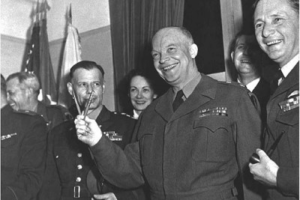
“In May of 1945, the treaty of German surrender that ended World War II in Europe was signed with a pair of Parker 51 fountain pens belonging to General Dwight D. Eisenhower, the Supreme Commander of the Allied Forces, who held up the two pens for the cameras in a V for victory.”

When GM closes in Janesville, with little prospect of comparable wages nearby, some Janesville workers take GM jobs in faraway cities:

By this winter, hundreds of Janesville GM’ers have morphed into GM’ers working far from Janesville. Their UAW contract gave them these transfer rights. Nearly two hundred are working at a General Motors plant in Kansas City—so many that people in town now joke that Kansas City has become Janesville West. Almost 140 are at a plant in Arlington, Texas—Janesville South—which is still turning out the Tahoe SUVs that Janesville had made. So far, fifty-five have transferred to Janesville East—Fort Wayne, Indiana—to assemble Chevy Silverado trucks, which are so popular that the plant is adding a third shift and is sending job offers to sixty-seven more Janesville GM’ers….

They stick with GM jobs farther away because the re-training classes they’re taking can’t get them jobs in the Janesville area:

one day, Matt and a bunch of the GM’ers learning to climb utility poles with him decide that it is time to stay after class and ask their instructor, Mike, a tough, pointed question: If they stay in school to graduate, will linemen’s jobs be waiting for them or not?

….[the re-training instructor] starts by laying out the benefits of electric power distribution. But the more he talks, the more he feels he needs to be a straight shooter with these guys who already have lost so much. The truth is, he has to admit, not many of his Blackhawk graduates got jobs last year. The outlook still isn’t great. Jobs exist in the utility field but not many of them in southern Wisconsin. He tells them they might end up in the Dakotas or Texas or somewhere in the Southwest.

Blackhawk Tech hires a motivational speaker for a graduating class in 2010, a woman who went from making jelly in a factory to making millions selling cosmetics, before using her singular experience to inspire others:

She gives a lot of motivational speeches. When she takes center stage at the Dream Center, in an elegant cream-colored suit with ruffled lapels, she aims her words straight at this morning’s unlikeliest graduates, including Barb and Kristi, who had never expected that a recession would steal their factory jobs. “There were many reactions, I’m sure, to the dire circumstances facing the economy of this community,” she tells the graduates. “Many people complained, many people cried, many people gave up. Some waited for things to go back to the way they were. . . . But there were a vital few that decided to create a new future for themselves and this area. They decided to use the economic obstacles as an economic opportunity. Those people were all of you.”

Goldstein reminds us, though, that all of you were once many more:

Blunt though she is, there is a piece of the story that the American-Dream-in-a-suit commencement speaker leaves unspoken. Many of the former factory workers who turned to Blackhawk veered off course before today. Of the laid-off workers who arrived at the college in the fall of 2008 with Barb and Kristi, nearly half left without finishing what they’d begun. Of the three hundred or so who, like Barb and Kristi, aimed for an associate’s degree—the highest degree that Blackhawk offers—just over one third will stick around to finish within a few years. And of the thirty-one laid-off workers who began to study criminal justice with Barb and Kristi? Just half are collecting diplomas today or will graduate next year. Such bumpy outcomes are not unusual at two-year colleges in general….

In fact, at Blackhawk, more of this first wave of laid-off workers finished their studies than did their classmates who hadn’t lost a job. Still, the point unspoken in the Dream Center [an auditorium] today is that, even when people desperate for a job try to retrain, as the Job Center has been encouraging, they don’t always succeed.

We hear again, in Chapter 23 (The Day the White House Comes to Town), about a visit from a federal official to Janesville’s Bob Borremans, who runs the Job Center in town, with other locals in attendance. Goldstein describes the aftermath of the meeting, from Bob’s vantage:

And Bob? After working so hard to arrange the visit, he soon feels exasperated. Montgomery [the federal official] had a goal of ensuring that each stop on his listening tour got some help from the government. For Janesville, though, it turns out that the supposed red tape cutters have no scissors. As Montgomery is leaving the government, a young man who works in the Labor Department is instructed to add Rock County to the communities for which he is to serve as a liaison. Bob presents this young man with the eleven grant ideas to which Montgomery listened at the UAW union hall. Bob asks for advice on which federal agency would be the best place to pursue each idea, expecting that the liaison can be an advocate and a conduit, shepherding these ideas to the right places to help open fresh spigots of federal money. Except no advice arrives. No money flows.

Whatever happened, by the way, to that federal official, Edward Montgomery, who left his post in 2010 with an unfulfilled goal of each auto-making community getting help?

He’s still at the job that enticed him away, serving as dean and professor of the McCourt School of Public Policy, Georgetown University.

Previously: Parts 1, 2, 3, 4, and 5.

Tomorrow: Considering Janesville: An American Story (Part 7 of 14).

Daily Bread for 5.6.17

Good morning.

Saturday in Whitewater will be mostly sunny with a high of fifty-nine. Sunrise is 5:40 AM and sunset 8:01 PM, for 14h 21m 08s of daytime. The moon is a waxing gibbous with 93% of its visible disk illuminated. Today is the {tooltip}one hundred seventy-ninth day.{end-texte}Days since Trump’s election, with 11.9.16 as the first day.{end-tooltip}

On this day in 1937, the German airship Hindenburg catches fires and is destroyed while  attempting to dock in Lakehurst, New Jersey. On this day in 1915, actor and filmmaker Orson Welles is born in Kenosha.

Recommended for reading in full —

David Frum explains How the Obamacare Repeal Could Cost Republicans the House (and, of all things, make single-payer more likely):

Eliot A. Cohen contends that Rex Tillerson Doesn’t Understand America: “Tillerson’s idea that in foreign policy American interests and American values are two separate things, the first mandatory, the second optional, reflects a misunderstanding of our past (not uncommon in this administration) and of the essence of our national character. The United States is surely the Manhattan skyline, the Kansas plains, the redwood forests, the Mississippi river. But it is, far more importantly, the Declaration of Independence, the Constitution, and the Gettysburg Address. You could cut down the forest or dry up the river and the country would be infinitely the poorer for it, but it would still be the United States of America. If Americans jettison the Bill of Rights and the ideas enshrined in it, they become a different country altogether..”

David Uberti reports that Gannett newspapers are hiding an important local story: “The big news? More reductions in the ranks of journalists at some of the titles owned by the Virginia-based media conglomerate. The scope? Gannett executives refuse to say. Newsroom cuts have long been a fixture among publicly traded newspaper companies, particularly Gannett, which announced in October 2016 that it would trim 2 percent of its total workforce—equivalent to more than 300 employees. But the corporation has foregone such transparency with its latest round of cutbacks, which come a week after a quarterly earnings report in which publishing revenues fell more than 10 percent compared to the same period last year, excluding acquisitions.”

Cleve R. Wootson Jr., Peter Holley, Lindsey Bever and Wesley Lowery report that Texas police officer who killed black teen could spend rest of his life in prison: “Roy Durwood Oliver, a patrol officer in the Dallas suburb of Balch Springs since July 2011, was released on $300,000 bail. While dispatched on complaints about drunk teenagers at a party last weekend, Oliver fired his rifle at a car full of teenagers who were leaving, according to investigators, killing Jordan Edwards….“After reviewing the findings I have made the decision to terminate Roy Oliver’s employment with the Balch Springs Police Department,” Police Chief Jonathan Haber told reporters Tuesday evening. “My department will continue to be responsive, transparent and accountable.”

Ruta Grasyt observes that Neil deGrasse Tyson Tries To Make Fun Of Cats On Twitter, Gets Totally Destroyed By One: “Recently, American astrophysicist, author, and science communicator, Neil deGrasse Tyson just wanted to be funny on Twitter, but things turned the other direction… More specifically, right in his face! Tyson’s supposed-to-be-funny tweet read: “Evidence that Humans are smarter than Cats: We don’t chase Laser dots on the carpet. We’re not afraid of Vacuum Cleaners.” Everything would’ve been all right, but then a cat named Bitches responded to Tyson’s tweet and, we must say, he totally destroyed him! Keep on scrolling to see what Bitches wrote….”

(Bitches the Cat and I follow each other on Twitter, and anyone familiar Bitches could have easily predicted the outcome here: she occupies a deservedly lofty place in the Twitterverse, and was sure to win this exchange.)


Considering Janesville: An American Story (Part 5 of 14)

This is the fifth in a series of posts considering Amy Goldstein’s Janesville: An American Story. In this post, I’ll cover four chapters from Part Two (2009) of Janesville (Blackhawk, Ahead of the Class, A Plan and Distress Signals, and The Holiday Food Drive).

Goldstein’s not polemical, and her descriptions are more subtle than they would be for those who are more acerbic. Yet in these chapters, one finds unmistakable signs of how she feels about the (false) promise of many job training programs:

Training people out of unemployment is a big, popular idea. In fact, it may be the only economic idea on which Republicans such as Paul Ryan and Democrats such as President Obama agree, anchored, as it is, in an abiding cultural myth, going back to America’s founding, of this as a land that offers its people a chance at personal reinvention. The evidence is thin that job training in the United States is an effective way to lead laid-off workers back into solid employment. Still, there is a lack of political consensus that the government should invest in creating jobs, and there is very much a consensus that it should help displaced workers go back to school.

Others might have said this more pointedly, but she says it plainly, and plainly enough.

An anecdote about Matt Wopat, a laid off auto worker and son of a retired auto worker, shows how oddly unfocused job-counseling is:

Matt took a test called JobFit that gauged his learning style (visual/verbal, it turned out), his numerical skill (rapid grasp of numerical information), and his sociability (comfortable working with a group or individually). Matt was then issued a “Career Compatibility Passport,” which told him that he would be equally adept as a database developer, a podiatrist, or a registered nurse—his best fits out of a list of fifty occupations for which he was well suited, with horticulturist and software engineer not far behind.

Next to a box indicating that he was being recommended for a training program, a Job Center caseworker handwrote about Matt: “Currently undecided.”

Wopat wants a job, and both he and society would benefit if he had one, yet a program that recommends wildly disparate occupations as equally suitable will hardly be of much help. There’s something both sad, infuriating, and vacuous in the results the Career Compatibility Passport provides.

Worse is the local conceit, though, that the work of a banker Mary Willmer and billionaire building-supply magnate Diane Hendricks through Rock County 5.0 will be more than a drop in the bucket. Here’s the Willmer and Hendricks effort:

Just before Halloween, they decide the time is right. Rock County 5.0 has not yet reached the goal of $1 million in private support. But it is $400,000 along the path. Respectable. And the project now has five well-defined, five-year strategies to buttress its 5.0 name: persuading local companies to stay and expand, attracting new businesses, offering special help to small businesses and start-ups, preparing real estate for commercial uses, and forging a workforce that employers will want to hire. This is the hopeful vision of Rock County from a business-centric point of view: moving beyond Janesville’s automotive identity.

Remember, though, that to keep the plant, alone, mostly public entities were willing to offer the “biggest incentive package in Wisconsin history” (“The package adds up to $195 million: $115 million in state tax credits and energy-efficiency grants, the $20 million that Marv Wopat pushed through the county board, $15 million from the strapped Janesville city government, and $2 million from Beloit, plus private industry incentives, including from the businesses willing to buy out the tavern in the assembly plant’s parking lot. And that isn’t counting concessions worth $213 million that UAW Local 95 is willing to sacrifice in exchange for retrieving jobs.”)

The point isn’t that government should have offered so much (after all five times the amount left winning bidder Orion, Michigan with much less than that for which she bargained).

The point is that it is hardly credible that Janesville’s private sector was so poorly capitalized that it could only offer 0.5% of what state and local entities offered. (Indeed, at the time of the Rock County 5.0 innaugural announcement, a partial offer of only $400,000, or 0.2%, of hundreds of millions in public offers.)

Goldstein knows as much, that in 2009 Rock County 5.0 isn’t what it’s touted to be:

“It will change the culture within Rock County, long-term,” Mary is quoted as saying….

This is a victory for Mary. And yet, from her perch at M&I Bank, she can’t escape noticing unmistakable signals that some members of her community are having a hard time keeping their lives glued together.”

A hard time, indeed.

Previously: Parts 1, 2, 3, and 4.

Tomorrow: Considering Janesville: An American Story (Part 6 of 14).

Friday Catblogging: Shop Cats of New York

If you’ve not yet done so, I’d recommend picking up Tamar Arslanian’s Shop Cats of New York (with Andrew Marttila, photographer). Hilary Hanson’s post Adorable Portraits Explore The Lives Of Big-City Shop Cats describes the book and the felines it features. (The video above is from the Facebook page for the book.)

If there’s ever been a town that could use lots of shop cats, it’s Whitewater.

(In my own case, there’s almost always a feline nearby when I’m writing, often at the very edge of my notebook or keyboard. I’m a member of the Electronic Frontier Foundation, and one of their banners – the one that I use – sensibly includes a cat in the illustration promoting bloggers’ legal rights.)

Needless to say, I’ve no personal or financial connection to Arslanian; hers is simply a fine book, to read or to give as a gift.

Daily Bread for 5.5.17

Good morning.

Friday in Whitewater will be sunny with a high of sixty-three. Sunrise is 5:42 AM and sunset 8 PM, for 14h 18m 47s of daytime. The moon is a waxing gibbous with 74.9% of its visible disk illuminated. Today is the {tooltip}one hundred seventy-eighth day.{end-texte}Days since Trump’s election, with 11.9.16 as the first day.{end-tooltip}

It’s Cinco de Mayo, commemorating the Mexican Army’s victory over the French at the Battle of Puebla on May 5, 1862, under the leadership of General Ignacio Zaragoza. On this day in 19671, Alan Shepard became the first American to travel in space, reaching an altitude of 116 miles.

Recommended for reading in full —

James B. Nelson reports that Former Chicago Bear Jay Cutler could be calling Packers games for Fox Sports: “Peter Schrager, a senior national writer for FoxSports.com, tweeted that Cutler has been hired by the network and “will join Kevin Burkhardt and Charles Davis in the booth this season.” Cutler, 34, was released by the Bears in March after 11 seasons. He has not been signed by another NFL team.”

Lena H. Sun reports that Anti-vaccine activists spark a state’s worst measles outbreak in decades: “ The young mother started getting advice early on from friends in the close-knit Somali immigrant community here. Don’t let your children get the vaccine for measles, mumps and rubella — it causes autism, they said. Suaado Salah listened. And this spring, her 3-year-old boy and 18-month-old girl contracted measles in Minnesota’s largest outbreak of the highly infectious and potentially deadly disease in nearly three decades. Her daughter, who had a rash, high fever and a cough, was hospitalized for four nights and needed intravenous fluids and oxygen. Salah no longer believes that the MMR vaccine triggers autism, a discredited theory that spread rapidly through the local Somali community, fanned by meetings organized by anti-vaccine groups. The advocates repeatedly invited Andrew Wakefield, the founder of the modern anti-vaccine movement, to talk to worried parents.”

Jacey Fortin writes that In Flint, Overdue Bills for Unsafe Water Could Lead to Foreclosures: “Following a water crisis that saw sky-high levels of lead contamination in Flint, Mich., many homes in the city still do not have access to safe tap water. But that doesn’t mean they’re not being charged for it. And if they can’t pay in time, they may lose their homes. The city has mailed 8,002 letters to residents in an effort to collect about $5.8 million in unpaid bills for water and sewer services. If homeowners do not pay by May 19, property liens are transferred to tax bills, which begins a process that can end with residents losing their homes unless they pay their outstanding bills before March 2018.”

Vann Newkirk observes The American Health Care Act’s Prosperity Gospel: “What’s a religious philosophy mostly pioneered by wealthy televangelists and megachurches got to do with pre-existing conditions and Medicaid reform? The beliefs of some evangelicals connecting wealth to God’s favor became intertwined with faith healing, and both rose to new heights in the television era on the backs of men like Oral Roberts. While it became part of the cults of personality around the generation of Pat Robertsons and Peter Popoffs that followed Roberts’s lead, faith healing was also undeniably a policy statement. It at least partially rejected the role of science in public health and encouraged a view that faith, virtue, and good works could be enough to secure healing. And although the furthest extremes of the prosperity gospel often bring to mind church scandals, thousand-dollar suits, and parish helicopters, the basic idea that a healthy life was also a sign of favor fit right in with the gospel’s defense of riches. Health is wealth. The prosperity gospel sold by televangelists fit—and fits—so well in many American homes because it mirrors the established national secular ethos….”

(Whether religious or secular in origin, the prosperity gospel is a distortion of traditional Christian teaching, and is most easily understood as a Christian heresy. (1* As he passed by he saw a man blind from birth.a2* His disciples asked him,b “Rabbi, who sinned, this man or his parents, that he was born blind?”3Jesus answered, “Neither he nor his parents sinned.” Jn 9:1-3a.)

NASA just got its closest look at Saturn yet — here’s what it saw:

Considering Janesville: An American Story (Part 4 of 14)

This is the fourth in a series of posts considering Amy Goldstein’s Janesville: An American Story. In this post, I’ll cover five chapters from Part Two (2009) of Janesville (Rock County 5.0, The Fourth Last Day, Bidding War, Sonic Speed, and What Does a Union Man Do?).

Goldstein describes the formation of Rock County 5.0 in this section of the book, and it’s generally as favorable as a pro-business conservative could hope or a progressive could scornfully dismiss. But there are parts of the discussion to please no one. Banker Mary Willmer hits upon Rock County 5.0 rather than a Janesville-based effort and it’s a revelation to others in the county:

Then, in a moment of unanticipated clarity, Mary glimpses the answer. The only way this campaign could succeed, she tells John [Beckord of Forward Janesville], “is if we get our arms around this whole county. Not Janesville, not Beloit, but the whole county and really make a bold statement.”

Goldstein’s overly subtle here, but it’s clear: Willmer’s clarity is unanticipated, perhaps for her and for anyone else in the area. The banker hits upon a county-based effort that might not have been so unanticipated elsewhere.

Later readers get a fuller explanation of the organization’s name:

By the time she speaks, the barely born, public-private, Janesville-and-Beloit-together campaign that she and Diane are leading has a name: Rock County 5.0. Five key strategies. A five-year plan to heal the economy. She sketches all this out, placing more emphasis on how critical it is than on how difficult it will be.

We’re well past five years now, and from the our time this plan doesn’t seem so revolutionary, but rather more like far too many other five-year plans, albeit with less state coercion…

Mention of Mike Vaughn, a worker at a GM-dependent Lear plant, says something about the relationship between industrial work and college studies:

At forty-one, Mike is a plainspoken man with close-cropped dark hair and an earnest manner. He had applied to General Motors right out of high school but never got the call, so he went to U-Rock for a year. Feeling unfocused, he left for a cook’s job in the Mercy Hospital kitchen. General Motors still wasn’t hiring, so eventually he followed his brother, DJ, into Lear.

It’s not the first time in the book Goldstein’s observed that UW-Rock County is a place where prospective workers who could not immediately find jobs at GM or Lear attended until something came up at one of those plants. It’s a sign that there’s not a clear divide between the two choices, at least not in the Janesville area. For some students there, the plants were the primary choice; college was a secondary one.

In 2009, in closed session (“[t]his is not a fact that the public will know right away”), Rock County offers millions – twenty million – in a bidding war with other cities (Hill, Tennessee, and Orion Township, Michigan) that have plants for which they’re fighting. GM’s condition, however, is terrible:

It is the first time the [county] supervisors have met in the ten days since General Motors disclosed that Janesville is one of three U.S. assembly plants still in the running to manufacture a next-generation subcompact car, which the company is hoping will help reverse its fortunes. GM’s fortunes have just crashed to a once unimaginable low. At 8 a.m. the day before it disclosed that Janesville is a finalist, and despite $19.4 billion in loans that the U.S. Treasury has ended up pumping into the company, General Motors filed for bankruptcy in a Manhattan court.

GM’s past strength, and 2009 weakness, no doubt makes it worse for bidders: they recall what they once had, and GM will take as much as it can get, without the slightest compunction.

Goldstein recounts that the public package to keep GM is vastly more that one county’s contribution:

When U.S. automakers decide where to manufacture new products, they have come to expect that the states and communities they are considering will present enormous dowries in the form of tax breaks and other financial gifts. So, a few days after the Rock County supervisors quadrupled their offering to General Motors, Wisconsin sends off to the company its final economic incentive package to try to land the new small car for Janesville’s assembly plant. The package adds up to $195 million: $115 million in state tax credits and energy-efficiency grants, the $20 million that Marv Wopat pushed through the county board, $15 million from the strapped Janesville city government, and $2 million from Beloit, plus private industry incentives….

There are also huge labor concessions (“[a]nd that isn’t counting concessions worth $213 million that UAW Local 95 is willing to sacrifice in exchange for retrieving jobs”) adding up to the “The biggest incentive package in Wisconsin history.”

On 6.26.2009, GM chooses to build compacts in Orion, Michigan. Astonishingly, Michigan offered (in total) five times as much as Wisconsin. (Auto workers there, for all the incentives, don’t do as well as they’d hoped: “40 percent of the workers were paid $14 an hour. Many parts were shipped from South Korea. The engines came from Mexico. And in another innovation, some parts suppliers began working right inside the Orion plant. Their average wage: $10 an hour”).

Hard to say which party was the biggest winner in the bidding war, but GM would be among anyone’s top picks.

Previously: Parts 1, 2, and 3.

Tomorrow: Considering Janesville: An American Story (Part 5 of 14).

Daily Bread for 5.4.17

Good morning.

Thursday in Whitewater will be partly cloudy with a high of sixty-two. Sunrise is 5:43 AM and sunset 7:59 PM, for 14h 16m 24s of daytime. The moon is a waxing gibbous with 64.2% of its visible disk illuminated. Today is the {tooltip}one hundred seventy-seventh day.{end-texte}Days since Trump’s election, with 11.9.16 as the first day.{end-tooltip}

On this day in 1864 the Wilderness Campaign opens in Virginia, with the “2nd, 5th, 6th, 7th, 19th, 36th and 38th Wisconsin Infantry regiments and the 4th Wisconsin Light Artillery participated in this series of bloody battles.” On this day in 1873, Wisconsin politician (holding office as governor and later U.S. senator) John James Blaine is born.

Whitewater’s Fire Department has a scheduled business meeting at 5:45 PM, and her Landmarks Commission is scheduled to meet at 6 PM.

Recommended for reading in full —

Jane Chong, Quinta Jurecic, Benjamin Wittes explore Seven Theories of the Case: What Do We Really Know about L’Affaire Russe and What Could it All Mean?: “In this post, we start with an overview of the facts known today, and we then put forth seven different theories of the Russia Connection case that might account for those facts. We present these in ascending order of potential menace, from the most innocent to the most alarming. In doing so, we attempt to narrow the field of discussion—or at least provide a disciplined framework for assessing the possibilities—and give readers guidance as to what to watch for as investigations on both the legislative and executive sides move forward. We’ve confined our overview of the facts to those most directly related to Russia’s interference in the election and the possible links between Trump associates and the Russian government. There are plenty of details we’ve left out—notably statements by Trump associates and the President himself that have had the effect of kicking up dust and confusing the public conversation about L’Affaire Russe….”

Michael J. de la Merced and Nicholas Fandos report on Fox’s Unfamiliar but Powerful Television Rival: Sinclair: “Sinclair, which has little name recognition but beams local television stations into a quarter of American homes, covers plenty of standard local news, including fires, shootings and traffic. But it has also used its 173 television stations to advance a mostly right-leaning agenda since the presidency of George W. Bush. Fox, the media conglomerate controlled by Rupert Murdoch and his sons, has long dominated conservative political discussion with its Fox News cable channel. But Fox News is in disarray after several scandals. In the last weeks alone, Fox News lost its biggest star, Bill O’Reilly, and one of its most senior executives, Bill Shine. With Fox News on the ropes, Sinclair, already the largest owner of local television stations, is looking to expand. Until last week it appeared to be closing in on acquiring Tribune Media, the second-largest owner of such stations. If completed, the deal would expand Sinclair’s footprint from mostly smaller markets to some of the country’s largest cities, including Chicago and New York.”

George Will contends that Trump has a dangerous disability: “It is urgent for Americans to think and speak clearly about President Trump’s inability to do either. This seems to be not a mere disinclination but a disability. It is not merely the result of intellectual sloth but of an untrained mind bereft of information and married to stratospheric self-confidence….As this column has said before, the problem isn’t that he does not know this or that, or that he does not know that he does not know this or that. Rather, the dangerous thing is that he does not know what it is to know something.”

Rick Romell reports that Dollar stores grow as other retailers shrink: “there’s one type of retailer for whom the bell isn’t tolling: Dollar stores – those downscale outlets filled with everything from underwear and laundry detergent to frozen pizza – are thriving. And Wisconsin appears to be targeted for accelerating growth. Dollar General, by far the largest of the three major chains in the sector, recently opened a 1 million-square-foot distribution center in Janesville. The development comes as the company plans 1,000 new stores this year alone, pushing its nationwide count to more than 14,000. That probably will give Dollar General more U.S. locations than McDonald’s. It already has about as many as Starbucks.”

For Star Wars fans, :

Considering Janesville: An American Story (Part 3 of 14)

This is the third in a series of posts considering Amy Goldstein’s Janesville: An American Story. In this post, I’ll write about five chapters of Janesville (Change in August, To the Renaissance Center, Mom, What Are You Going to Do?, When One Door of Happiness Closes, Another Opens, and The Parker Closet).

In chapters 5 through 9, Goldstein gives readers slices of life in Janesville from the summer through fall of 2008 (between when the GM plant’s closure was first announced, but before the last Tahoe rolled off the line in December).

Alyssa and Kayzia Whiteacre are trying to explain why their father is home during the day in August:

All of a sudden, even though they can sleep in a little during these lazy August days, their dad is home for breakfast….whatever is happening, it must be touchy, and if he wanted them to know, he’d have told them. So they take turns asking their mom little questions. “We’re trying to figure this out” is the kind of answer she gives. Not much help. So it is from the news and from a couple of friends that they piece together that their dad must have had a bad enough anniversary date that he’s part of the GM shift that’s already been laid off. What they deduce is correct. He was hired on May 29, 1995, handed a referral by his father. Both their dad and mom grew up in the security of GM wages, in the same way that Alyssa and Kayzia and their brother, until this summer, have been doing.”

Meanwhile, a combination of Democrats and Republicans try to keep the plant open:

In this conference room, each team member presents, in a tidy mosaic, the case they have rehearsed for why GM should continue production in Janesville. Paul [Ryan] knows [GM executive Troy] Clarke well, speaks to him on a weekly basis. Paul’s mosaic piece is a reminder to Clarke that he has fought on Capitol Hill for General Motors’ concerns about its pension costs. Tim[ Cullen]’s pitch is the compelling fact that, at Janesville, the cost of producing each vehicle is lower than at a plant making the same SUVs in Arlington, Texas—a newer plant that no one is talking about closing. Finally, the governor sums up the case: Wisconsin stands committed to preserving its relationship with General Motors. And, to fortify the seriousness of that commitment, the state and Rock County and Janesville and the local business community are honing a large package of economic incentives to induce GM to stay. General Motors is, everyone in the room knows, planning an inexpensive subcompact car model as a corporate coping mechanism in this awful recession. Wisconsin will, the governor [Jim Doyle] says, make it worthwhile for the company to trust its oldest assembly plant to manufacture its newest little car.

Most telling in this part of the book (with a chapter on a local banker and another on a community clothes & supply closet), however, is Goldstein’s account of Bob Borremans, who runs the local job center. Goldstein explains Bob’s work, in the face of thousands of impending layoffs, as he creates a resource guide:

Having long prided himself on staring down problems, though, Bob is pleased with a move he already has made: creating a guide to all the resources in town that can help people who have been thrown out of work, or who will be soon. He felt a take-charge satisfaction as he and some of the Job Center’s staff started contacting the leaders of organizations across Rock County to ask permission to include them in the new guide. Organizations that dispense help with job training, consumer credit, housing, health care, literacy, food, bouts of depression, bouts of addiction, bouts of domestic violence—two hundred far-flung, help-offering organizations in all.

Goldstein describes how Bob adds his own special touch, too:

So on page A8 of the guide was a box with the heading, “What to Do After a Layoff.” The box had fourteen bullet points, the first of which contained a crucial antidote to lost-job paralysis. “Don’t Feel Ashamed,” the heading of this first bullet point said. “Being laid off is not your fault.”

And scattered through the guide were words from Americans renowned for the challenges they confronted….from Helen Keller: “When one door of happiness closes, another opens; but often we look so long at the closed door that we do not see the one which has been opened for us.”

Bob may be well-meaning, but Goldstein applies her blade at the end of chapter 8:

Bob believes, catastrophe might prove to be unbidden opportunity to help people find the work paths that would have suited them all along. Sure, people will need to retrain for this new work, but that’s his specialty, and he can help them go back to school while waiting for jobs to emerge on the far side of this recession.

If only it were so easy…

Previously: Parts 1 and 2.

Tomorrow: Considering Janesville: An American Story (Part 4 of 14).

Waste Hauling Into Whitewater

WGTB logo PNG 112x89 Post 75 in a series. When Green Turns Brown is an examination of a small town’s digester-energy project, in which Whitewater, Wisconsin would import other cities’ waste, claiming that the result would be both profitable and green.

A few years (and seventy-five posts) ago, I began consideration of a local proposal to haul waste into Whitewater. Those posts became a series, with background work and discussions with people from across Wisconsin.

Last night, Whitewater announced publicly the results of a study on whether a supposed initial waste hauling plan might be feasible, using the Baker Tilly firm. The municipal government commissioned the study in March 2016, and the firm returned an opinion to the city in October 2016 that it would be infeasible.

I used the months since last year’s commissioning to read yet more, speak with others outside the city, and simply wait for the next local development. It seemed prudent to use the time patiently and productively.

The single most important result for our city is that this plan to haul waste into Whitewater will not go forward. That’s the right outcome for this community, and today this city is better off for the decision of her common council, and announcement of her city manager, to end the project.

Locally, I’ve sometimes been asked what I think of this city staff’s support for the project. It’s fair to say that there is a fundamental disagreement on the science of the project. Now or ten years from now, the case against waste hauling into Whitewater will rest on sound fiscal, economic, and environmental bases. Should a proposal arise again, as one heard predicted last night, one may be assured that the case against will be as strong, and fought even more vigorously.

I’ll not take the course of the wastewater superintendent and extend the local discussion gracelessly even at its conclusion; pride is a poor foundation for policy.

Each day one meets the world anew.

Many thanks to so many in town who were encouraging. We’ve a lovely town.

To those from across Wisconsin with whom I have productively corresponded & met, and from whom I have received analyses, studies, and sound insight: I am indebted to you. There are visits eagerly to be made, with correspondence and calls until we see each other again. There’s so much good work that you can and will carry out. You’ve your own efforts ongoing in your communities, and of course you’ve an ally here in all that you do.

It’s mild in Whitewater today: a good day, I think, for residents in this small and beautiful city.