FREE WHITEWATER

Daily Bread for 10.14.16

Good morning, Whitewater.

Friday in the Whippet City will be mostly sunny with a high of sixty-four. Sunrise is 7:08 AM and sunset is 6:12 PM, for 11h 03m 47s of daytime. The moon is a waxing gibbous with 95.7% of its visible disk illuminated.

On this day in 1964, Dr. King wins the Nobel Peace Prize. He delivered his acceptance speech on December 10, 1964 in Oslo:

On this day in 1912, Theodore Roosevelt is shot in Milwaukee while campaigning as third-party candidate for president:

On the night of October 14, 1912, Theodore Roosevelt was shot in Milwaukee. Roosevelt was in Wisconsin stumping as the presidential candidate of the new, independent Progressive Party, which had split from the Republican Party earlier that year. Roosevelt already had served two terms as chief executive (1901-1909), but was seeking the office again as the champion of progressive reform. Unbeknownst to Roosevelt, a New York bartender named John Schrank had been stalking him for three weeks through eight states. As Roosevelt left Milwaukee’s Hotel Gilpatrick for a speaking engagement at the Milwaukee Auditorium and stood waving to the gathered crowd, Schrank fired a .38-caliber revolver that he had hidden in his coat.

Roosevelt was hit in the right side of the chest and the bullet lodged in his chest wall. Seeing the blood on his shirt, vest, and coat, his aides pleaded with him to seek medical help, but Roosevelt trivialized the wound and insisted on keeping his commitment. His life was probably saved by the speech, since the contents of his coat pocket — his metal spectacle case and the thick, folded manuscript of his talk — had absorbed much of the force of the bullet. Throughout the evening he made light of the wound, declaring at one point, “It takes more than one bullet to kill a Bull Moose,” but the candidate spend the next week in the hospital and carried the bullet inside him the rest of his life.

Schrank, the would-be assassin, was examined by psychiatrists, who recommended that he be committed to an asylum. A judge concurred and Schrank spent the remainder of his life incarcerated, first at the Northern Hospital for the Insane in Oshkosh, then at Central State Hospital for the criminally insane at the state prison at Waupun. The glass Roosevelt drank from on stage that night was acquired by the Wisconsin Historical Museum. You can read more about the assassination attempt on their Museum Object of Week pages.

JigZone‘s daily puzzle for Friday is of a gramophone:

Daily Bread for 10.13.16

Good morning, Whitewater.

We’ll have a mostly sunny day in Whitewater with a high of fifty-four. Sunrise is 7:07 AM and sunset 6:14 PM, for 11h 06m 36s of daytime. The moon is a waxing gibbous with 89.6% of its visible disk illuminated.

On this day in 1775, the Continental Congress establishes a navy, a date now recognized as the birth of the United States Navy:

On June 12, 1775, the Rhode Island General Assembly, meeting at East Greenwich, passed a resolution creating a navy for the colony of Rhode Island. The same day, Governor Nicholas Cooke signed orders addressed to Captain Abraham Whipple, commander of the sloop Katy and commodore of the armed vessels employed by the government.[2]

The first formal movement for the creation of a Continental navy came from Rhode Island, because its merchants’ widespread shipping activities had been severely harassed by British frigates. On August 26, 1775, Rhode Island General Assembly passed a resolution that there be a single Continental fleet funded by the Continental Congress.[3] The resolution was introduced in the Continental Congress on October 3, 1775 but was tabled. In the meantime, George Washington had begun to acquire ships, starting with the schooner Hannah which was paid for out of Washington’s own pocket.[2]Hannah was commissioned and launched on September 5, 1775 from the port of Beverly, Massachusetts, after being sold by the future General John Glover of Marblehead, Massachusetts.[4]

The United States Navy recognizes October 13, 1775 as the date of its official establishment,[1] the passage of the resolution of the Continental Congress at Philadelphia that created the Continental Navy.[5] On this day, Congress authorized the purchase of two vessels to be armed for a cruise against British merchant ships; these ships became Andrew Doria and Cabot.[1] The first ship in commission was the USS Alfred which was purchased on November 4 and commissioned on December 3 by Captain Dudley Saltonstall.[6] On November 10, 1775, the Continental Congress passed a resolution calling for two battalions of Marines to be raised for service with the fleet.[7]

JigZone‘s daily puzzle for Thursday is of a flower:

Marquette Law Poll Results (Early October ’16 Edition)

The early October Marquette Law School poll results are out, and here are two key findings from the 10.6.16 to 10.9.16 poll (the full results will be available online later this afternoon).


Clinton-Trump-Johnson-Stein, Among LV:

Feingold-Johnson-Anderson, Among LV:


James Fallows on ‘Eleven Signs a City Will Succeed’ (Part 2)

I wrote yesterday about James Fallows‘s ‘Eleven Signs a City Will Succeed.’  Today’s post considers whether his list applies to Whitewater, and how Whitewater fares if items on the list – at least in part – apply to our small city.

One word of caution applies to Fallows’s list: it was compiled after he visited cities larger than Whitewater. In his essay, Fallows writes that “by the time we [Fallows and his wife, Deborah] had been to half a dozen cities, we had developed an informal checklist of the traits that distinguished a place where things seemed to work.”

Those first half-dozen cities from the City Makers: American Futures series were Holland MI (33,000), Rapid City SD (67,000), Sioux Falls SD (153,000), Burlington VT (42,000), Eastport ME (1,300), and Redlands CA (68,000) (using 2010 Census figures).  All except one are larger than Whitewater.  When one reviews list for signs of success, it’s clear that it derives from more populous communities, where greater size has begun to limit coordination of projects.  It’s a limitation on use of the checklist worth remembering.

Here below are the eleven signs, with comments on each.

1. Divisive national politics seem a distant concern.  I’d say that, for the most part, this is true for us: we’re not a place where national controversies matter much.  On the contrary, Whitewater is a place of hyper-locality, where policymakers sometimes act as though all the world ends at Townline Road.  If anything, we’re too locally focused, to the detriment of higher standards.   (See, on the need for a higher standard, What Standards for Whitewater?)

2. You can pick out the local patriots.  Here again, our situation is the opposite of Fallows’ concern: he’s worried about “Who makes this town go?” in cities that are large enough that many people might not know influential residents; Whitewater’s a smaller place where a few town notables are intoxicated with the idea of wrapping the city in a single, neat package to be held in their grasping hands.

Whitewater doesn’t have a problem with too few leaders, she has a problem with too many people in a small town advancing themselves under the guise of being a ‘Whitewater Advocate,’ conflicts of interest or lack of insight notwithstanding their efforts.  (What a sad condition not to see that advocacy requires more than simple-minded boosterism; one truly sees the object of one’s love with clear eyes.)

Whitewater has a same-ten-people-problem because the same ten people can’t see beyond empty boilerplate.

The answer to DYKWIA? should be YMBFKM.

It’s instinctual for libertarians to dislike concentrations of state power (and often other kinds of power more broadly).   Better to be a counterweight to others’ striving, assuring by doing so that there will be a fair equilibrium within one’s community.

3. “Public-private partnerships” are real.  One can guess that I’ve my doubts about this generally, but these doubts are borne out in Whitewater.  Here’s a test: list all the public money that’s been spent here, and then list how many jobs have been created (omitting public employees shifted from nearby, well-paid employees already on the university payroll, work-study students and interns, but including only actual, private, full-time jobs).

When Mr. Clapper produces that table – to supply good data to otherwise bad rhetoric – only then can one begin to evaluate the unctuous claims so often made in this city.

Now you know, and I know, too, that Messrs. Clapper, Reel, and Binnie would like to find a so-called public-private partnership for trash-importation into this tiny city of ours.  Tree City, Bird City, Trash City: one of these doesn’t fit with the others.

That’s not the success that Fallows has in mind, especially in a city of our small population and limited natural area.  It’s not the hoped-for success any reasonable person would have for this city.

4.  People know the civic story.  I think residents could use more of our history, but at least those who’ve grown up here seem to know it well enough.

5.  They have a downtown.  We do, and we’re better for it.  I’m not connected to anyone in Downtown Whitewater, Inc. (and as it’s a WEDC-supported entity I’ll remain distant and detached).  Still, I like our downtown very much, and hope better for it yet to come.

6.  They are near a research university.  We don’t have a research university, but we do have a good undergraduate school in the very center of town.

7.  They have, and care about, a community college.  Fallows means that a community college might substitute for lack of a university; we are not lacking, as we have a comprehensive, four-year university.

8.  They have unusual schools.  We briefly had a charter school, but there’s a deeper point here, about the range of teaching, and the limits of a narrow, traditional approach.  Briefly: fighting over an incremental difference in ACT scores as a marketing tool is futile; one has no comparative advantage when one is indistinct among background static.  (Here I am talking about collective marketing, not individual performance.)  Whatever his ability to keep a general harmony, our last district administrator stuck to the conventional, with the hope of a slightly better showing.

That’s futile as a marketing effort (no one notices among the clutter of other marketing efforts), and is uncompelling to the creative and ambitious families we’d like to attract.

Success comes in great part from an innovative curriculum and an energetic faculty.  One needn’t to go to university to teach the way everyone else has been teaching for the last few decades.  One goes to school – among many other important reasons – to advance learing, not duplicate stale methods.  

9.  They make themselves open.  We’ve made gains in this regard, but there’s much more to do.

10.  They have big plans.  We’re a small town, and sometimes our plans are too big, and often too expensive.  We’ve had our share of ‘come on guys, let’s put on a show’ spenders, including too many big-government conservatives who’ve shoved ineffectual, expensive project after ineffectual, expensive project on a city that cannot easily bear it.

11.  They have craft breweries.  Thankfully, we do.  Private efforts have led to a public gain.  The foundation of our society’s prosperity is private property and private enterprise.

We’ve strengths, but also much to do, in our small and beautiful city.  For it all, we’ve good reason to be optimistic.

Yesterday James Fallows on ‘Eleven Signs a City Will Succeed’ (Part 1)

Daily Bread for 10.12.16

Good morning, Whitewater.

Midweek in town will see an even chance of morning showers and a high of sixty-two.  Sunrise is 7:06 AM and sunset is 6:15 PM, for 11h 09m 25s of daytime.  The moon is a waxing gibbous with 81.7% of its visible disk illuminated.

Whitewater’s Community Development Authority will hold a housing roundtable at 8 AM, the Police and Fire Commission meets at Noon, and the CDA Board will meet at 6:30 PM.

There are lots of small drones in the air, and it was predictable that someone would build a drone to hunt other drones.  Airspace Systems is that someone:

On this day in 1782, Henry Dodge is born:

On this date Territorial Governor Henry Dodge was born in Vincennes, Indiana. The son of Israel Dodge and Nancy Hunter, Henry Dodge was the first Territorial Governor of Wisconsin. Prior to this position, he served as Marshall and Brigadier General of the Missouri Territory, Chief Justice of the Iowa County (Wisconsin) Court. During the Black Hawk War of 1832 he led the Wisconsin militia who ultimately brought the conflict to its tragic end. He served as Territorial Governor from July 3, 1836 to October 5, 1841 and again from May 13, 1845 to June 7, 1848. He also served as U.S. Territorial Senator from 1841 to 1846.

When Wisconsin was admitted to the Union as a State, dodge was elected as a Democrat to the United States Senate; he was reelected in 1851 and served from June 8, 1848, to March 3, 1857. He was also twice nominated for President and once for Vice President, all of which he declined. Henry Dodge died on June 19, 1867 in Burlington, Iowa.

JigZone‘s puzzle for Wednesday is of a candy jar:

James Fallows on ‘Eleven Signs a City Will Succeed’ (Part 1)
Over at The Atlantic, and connected to that publication’s American Futures series, James Fallows writes about ‘Eleven Signs a City Will Succeed.’  Today, I’ll list Fallows’s eleven signs, and tomorrow, I’ll write about whether the list applies to Whitewater, and how Whitewater fares to the extent that the list is applicable.

(The list is sure to excite superficial policymakers, eager to claim credit for headlines that actual conditions belie.  Using a happy headline out of context has been the modus operandi of the Whitewater’s leading exaggerators for many years now. “We’re all those things: Mission Accomplished!”

Where many weak assessments end, the real discussion only begins.

Still, considering the list seriously, rather than superficially, will be useful to see where improvement may be made.  Fallows explains briefly in his essay what he means by each of these signs, and those explanations are useful to consideration our own situation.)

Here’s the list:

1. Divisive national politics seem a distant concern.

2. You can pick out the local patriots.

3. “Public-private partnerships” are real.

4.  People know the civic story.

5.  They have a downtown.

6.  They are near a research university.

7.  They have, and care about, a community college.

8.  They have unusual schools.

9.  They make themselves open.

10.  They have big plans.

11.  They have craft breweries.

See, in full, Eleven Signs a City Will Succeed @ The Atlantic.

Tomorrow : James Fallows on ‘Eleven Signs a City Will Succeed’ (Part 2)

Daily Bread for 10.11.16

Good morning, Whitewater.

Tuesday in town will see an even chance of showers this morning, a sunn afternoon, and a high of seventy-one. Sunrise is 7:05 AM and sunset 6:17 PM, for 11h 12m 15s of daytime. The moon is a waxing gibbous with 72.5% of its visible disk illuminated.

The Landmarks Commission Effigy Mounds Subcommittee will meet this morning at 9 AM.

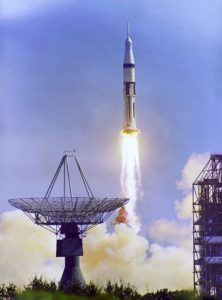
On this day in 1968, NASA launches the first Apollo mission with a crew:

800px-apollo_7_launch_-_gpn-2000-001171Apollo 7 was a 1968 human spaceflight mission carried out by the United States. It was the first mission in the United States’ Apollo program to carry a crew into space. It was also the first U.S. spaceflight to carry astronauts since the flight of Gemini XII in November 1966. The AS-204 mission, also known as “Apollo 1”, was intended to be the first manned flight of the Apollo program. It was scheduled to launch in February 1967, but a fire in the cabin during a January 1967 test killed the crew. Manned flights were then suspended for 21 months, while the cause of the accident was investigated and improvements made to the spacecraft and safety procedures, and unmanned test flights of theSaturn V rocket and Apollo Lunar Module were made. Apollo 7 fulfilled Apollo 1’s mission of testing the Apollo Command/Service Module (CSM) in low Earth orbit.

The Apollo 7 crew was commanded by Walter M. Schirra, with senior pilot / navigator Donn F. Eisele, and pilot / systems engineer R. Walter Cunningham. (Official crew titles were made consistent with those that would be used for the manned lunar landing missions: Eisele was Command Module Pilot and Cunningham was Lunar Module Pilot.) Their mission was Apollo’s ‘C’ mission, an 11-day Earth-orbital test flight to check out the redesigned Block II CSM with a crew on board. It was the first time a Saturn IB vehicle put a crew into space; Apollo 7 was the first three-person American space mission, and the first to include a live TV broadcast from an American spacecraft. It was launched on October 11, 1968, from what was then known as Cape Kennedy Air Force Station, Florida. Despite tension between the crew and ground controllers, the mission was a complete technical success, giving NASA the confidence to sendApollo 8 into orbit around the Moon two months later. The flight would prove to be the final space flight for all of its three crew members — and the only one for both Cunningham and Eisele — when it splashed down in the Atlantic Ocean on October 22, 1968. It was also the final manned launch from Cape Kennedy.

JigZone‘s daily puzzle for Tuesday is of a cow:

Twenty-Five Years On: School Board & City

Alternative title: Culture Advances While Beyond Politics Far Lags Behind.

Over at the Banner, there’s a new feature entitled, “A mini-look at local history – a new Banner Monday project!”  The 10.10.16 entry is about two public actions from twenty-five years ago.

I’m all for history (local or otherwise), but the entry is telling coming from a publisher who’s been in office, on either the School Board or Common Council, for most of the last quarter-century.  In fact, the entry shows how ineffectual Whitewater’s local political class has been for the last generation.  We’ve had significant cultural and demographic change, but government hasn’t kept up.

One reads that on October 10, 1991

[t]he Whitewater School Board is seeking volunteers from the community to serve on a task force charged by the board “to design and implement a student and staff training program to heighten awareness of, and skills responding to, racial, ethnic, and cultural diversity in Whitewater.”

Board members are particularly interested in having strong minority representation on the task force….

These were (and are) good & fair goals, but even a generation later, Whitewater’s political class is still having trouble finding, for example, Hispanic members of the community to take part on municipal political boards.

So much so, that in 2015, twenty-four years later, Whitewater’s City Manager Clapper requested and the city’s common council “authorized forming a community taskforce to investigate possible ways for the city’s Hispanic population to become more active in civic and governmental activities and municipal committees.”  See, Whitewater to seek Hispanic involvement, August 19, 2015.

Whitewater’s Hispanic community has grown considerably during this last generation, as have other groups such as students (of diverse ethnicity), but her political institutions have not kept pace.  Whitewater’s private life during these many years – the demographics and culture of our city – have grown in ways in which a small, insular political class has failed adapt.  (Among that small class, there are some who have even been all-too-evident revanchists.)

The responsibility of successfully encouraging residents to participate rests with the leadership class that governs – especially those who have been in government for decades – in this city. There are some leaders who commendably see this, but too many who’ve not kept pace.

Whitewater is overdue for a politics that matches her community. more >>

Film: Tuesday, 12:30 PM @ Seniors in the Park, Elvis & Nixon

This Tuesday, October 11th at 12:30 PM, there will be a showing of Elvis & Nixon @ Seniors in the Park, in the Starin community building.

Elvis & Nixon is “the untold true story behind the meeting between Elvis Presley, the King of Rock ‘n Roll, and President Richard Nixon, resulting in this revealing, yet humorous moment immortalized in the most requested photograph in the National Archives.”

The film stars Michael Shannon and Kevin Spacey, with a run time of one hour, twenty-six minutes, and carrying an R rating from the MPAA for language.

One can find more information about Elvis & Nixon at the Internet Movie Database.

Enjoy.