
FREE WHITEWATER

Inequality in the ‘Whitewater-Elkhorn’ Area

Over at the Economic Policy Institute, there’s a newly-published study of income inequality in America, and it ranks Walworth County as one of the most income-unequal places in the nation.  The study refers to the ‘Whitewater-Elkhorn’ metropolitan area, but with a population of 102,000, it’s clear that the reference is to Walworth County, using the 2010 Census population count.

(The methodology is that of Piketty and Saez, used years earlier to study income inequality across America.  Their method is not without critics, to be sure.  I find many of those critics compelling.)

Apart from this or other studies, however, it is still evident to anyone visiting Whitewater or Walworth County that pockets of significant poverty are all around.  This poverty surely  produces wide gaps with economically-successful residents.

Accentuating the positive in Whitewater has come at the price of ignoring actual conditions.

A few policymakers in Whitewater are versions of Japanese businessmen in the late ’80s, men who were so proud to proclaim that they had rebounded from the misery of war and thus had then arrived at the pinnacle of world achievement. (They were to find that arrival disappointing, as they’d overlooked actual economic conditions, and arrived only to years of stagnation.)

We would do far better to describe ourselves as we truly are, and invite others to join us not in an imaginary, perfect place, but in this real, beautiful, but work-yet-to-be-done place.
Daily Bread for 6.23.16

Good morning, Whitewater.

Thursday in town will bring an even chance of occasional showers or thunderstorms with a high of seventy-three. Sunrise is 5:17 AM and sunset 8:37 PM, for 15h 19m 59s of daytime. The moon is a waning gibbous with 90.7% of its visible disk illuminated.

There is a Downtown Whitewater Board meeting scheduled for this morning at 8 AM.

On this day in 1868, Wisconsin resident Christopher Latham Sholes and two partners receive a patent for a “Type-Writer”:

The Sholes and Glidden typewriter had its origin in a printing machine designed in 1866 by Christopher Latham Sholes to assist in printing page numbers in books, and serial numbers on tickets and other items.[2] Sholes, a Wisconsin printer, formed a partnership with Samuel W. Soule, also a printer, and together they began development work in Charles F. Kleinsteuber’s machine shop, a converted mill in northern Milwaukee. Carlos S. Glidden, an inventor who frequented the machine shop, became interested in the device and suggested that it might be adapted to print alphabetical characters as well.[3] In July 1867, Glidden read an article in Scientific American describing “the Pterotype”, a writing machine invented by John Pratt and recently featured in an issue of London Engineering. Glidden showed the article to Sholes, who thought the machine “complicated and liable to get out of order”,[4] and was convinced that a better machine could be designed. To that point, several dozen patents for printing devices had been issued in the United States and abroad.[5] None of the machines, however, had been successful or effective products.[5][6]

In November 1866, following their successful collaboration on the numbering machine,[4] Sholes asked Soule to join him and Glidden in developing the new device. Mathias Schwalbach, a German clockmaker, was hired to assist with construction. To test the proposed machine’s feasibility, a key was taken from a telegraph machine and modified to print the letter “W”;[3] by September 1867, a model with a full alphabet, numbers, and rudimentary punctuation had been completed, and it was used to compose letters to acquaintances in the hope of selling the invention, or procuring funds for its manufacture.[7] One recipient, James Densmore, immediately bought a 25% interest for $600, the cost of the machine’s development to that date.[8][9] Densmore saw the machine for the first time in March 1868, and was unimpressed; he thought it clumsy and impractical, and declared it “good for nothing except to show that its underlying principles were sound”.[10] Among other deficiencies, the device held paper in a horizontal frame, which limited the thickness of the paper that could be used and made alignment difficult.[11] A patent for the “Type-Writer” was granted on June 23, 1868, and, despite the device’s flaws, Densmore rented a building in Chicago in which to begin its manufacture. Fifteen units were produced before a lack of funds forced the venture back to Milwaukee.[12]

A Google a Day asks a science question: “As a testament to its adaptability in urban areas, what kind of animal strolled into a popular sandwich shop in the Chicago Loop area in the spring of 2007?”

The Colors of a Rubik’s Cube

image

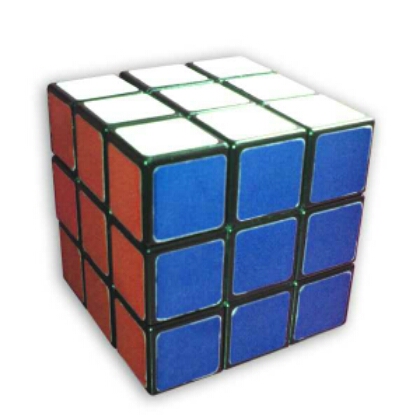
Imagine that one sees a Rubik’s Cube for the first time, on a table nearby.  Three sides of that six-sided object are visible, displaying small squares of red, blue, and white.

Consider this initial puzzle: What colors are the other three sides?  How would one determine, with confidence, the colors on those sides obscured from view?

There’s more than one possibility. 

One could simply deny that there are three other sides: acknowledging what one sees, while simultaneously denying the existence of the unseen.

One could, instead, acknowledge that there are other sides, but that those sides must be the same as the ones on the three visible sides: if one sees red, blue, and white, then that’s all there is (or could be) on the cube.

A third option would be to form a committee, charged with developing an algorithm, by which one could predict what colors the other sides might be, based on what one sees now on the visible sides. The committee would meet dozens of times, to develop a scheme by which cube colors might be predicted. 

A fourth option would be to scour bookstores and toy shops for manuals on Rubik’s Cubes, to see if those publications described the colors of the puzzle.

Alternatively, one might reach out one’s hand, pick up the cube from the table, and rotate it to examine each of its sides.  Doing so would reveal that, for a regular Rubik’s Cube, the six sides showed six colors, one color per side: red, blue, white, green, orange, and yellow. 

The policymakers of Old Whitewater (a state of mind, rather than a person or chronological age) will typically settle on one of the first three merhods: deny it’s a cube, assume that the colors on the unseen sides must be the same as the visible sides, or form a committee to study what the unseen sides’ colors might be.

A few relatively adventuresome people from among this clique would perhaps  go off looking for a manual.

A few others would want to manipulate the cube to learn about its unseen sides, to be sure, but they would be rebuked by a greater number of policymakers, lest the few impermissibly deviate from conventional, collective thinking. 

The overwhelming majority of the city’s residents, however, would likely turn the cube over and around to see all its sides.

Whitewater Chooses a New Administrator

This morning, the Whitewater Unified School District announced the selection of Dr. Mark Elworthy, currently administrator of the Wisconsin Heights School District, as Whitewater’s next district administrator. 

One wishes him truly the very best in our community.  We have proud accomplishments, with some significant challenges ahead, but that work ahead is among the best work anyone in this community might undertake. 

The cities and towns of this district are small and beautiful, if sometimes struggling.  For it all, there is no better place to be; what waits for us, here, is the work of a lifetime.

One should, and happily does, welcome Dr. Elworthy and all those who would join us in this common endeavor. 

Defending a River

At 85 years old, organic raisin farmer and lifelong river advocate Walt Shubin is not slowing down. He has dedicated the last 65 years of his life to restoring California’s once-mighty San Joaquin River to the wild glory he remembers as a young boy. Driven by his passion for the river, and despite worn out knees and joints, he takes us on a journey to help us understand why this river is so important to all of us as well.

Via Vimeo

Two States of Mind in Whitewater

There’s an easy way to see two different states of mind in Whitewater. 

Draft a list of eleven people for an athletic honor.  Make nine of the honorees athletes or coaches, and two of them an administrator and his spouse. 

Now, watch and see which people receive the most prominent attention. 
Some will pick one of the athletes or coaches, on the theory that it’s an athletic award.

By contrast, some will pick the administrator and his spouse, on the theory that a well-placed bureaucrat will always matter more than those who actually competed.

(In any event, whatever this second option may be, as an exercise in political rehabilitation it’s an impossibility.)

There we have the choices and states of mind in present-day Whitewater, although I’d doubt that some would even guess that choosing was possible.

Film: Wednesday, 12:30 PM @ Seniors in the Park, Son of Saul

This Wednesday, June 22nd at 12:30 PM, there will be a showing of Son of Saul @ Seniors in the Park, in the Starin community building.

Son of Saul is the Hungarian story of a prisoner at Auschwitz who tries to arrange a proper burial for the body of a boy that he recognizes from among other victims at the death camp.

The film received both an Academy Award for Best Foreign Language Film (2016) and Golden Globe for Best Motion Picture – Foreign Language (2016). (The trailer above was made when the film was nominated, but had not yet won, an Oscar.)

More information about Son of Saul is available at the Internet Movie Database.

Daily Bread for 6.19.16

Good morning, Whitewater.

Father’s Day in town will be sunny and warm, with a high of eighty-nine. Sunrise is 5:16 AM and sunset is 20:36 PM, for 15h 20m 24s of daytime. We’ve a full moon, with 99.1% of its disk illuminated.

Friday’s FW poll asked about the final NBA game of the season: what did readers think would happen in Game 7 between the Cavs and Warriors? A majority (53.85%) of respondents gave the edge to Golden State.

This has been a time of exciting sports, with the NBA, and both European and Copa America soccer matches. We play the very formidable Argentinian team on Tuesday at 8 PM CT.

On this day in 1944, the Battle of the Philippine Sea begins:

The Battle of the Philippine Sea (June 19–20, 1944) was a decisive naval battle of World War II that eliminated the Imperial Japanese Navy’s ability to conduct large-scale carrier actions. It took place during the United States’ amphibious invasion of the Mariana Islands during the Pacific War. The battle was the last of five major “carrier-versus-carrier” engagements between American and Japanese naval forces, and involved elements of the United States Navy‘s Fifth Fleet as well as ships and land-based aircraft from the Imperial Japanese Navy‘s Mobile Fleetand nearby island garrisons.

The aerial theatre of the battle was nicknamed the Great Marianas Turkey Shoot by American aviators for the severely disproportional loss ratio inflicted upon Japanese aircraft by American pilots and anti-aircraft gunners.[2]During a debriefing after the first two air battles a pilot from USS Lexington remarked “Why, hell, it was just like an old-time turkey shoot down home!”[3] The outcome is generally attributed to American improvements in pilot and crew training and tactics, war technology (including the top-secret anti-aircraft proximity fuze), and ship and aircraft design.[N 1][N 2] Although at the time the battle appeared to be a missed opportunity to destroy the Japanese fleet, the Imperial Japanese Navy had lost the bulk of its carrier air strength and would never recover.[1] During the course of the battle, American submarines torpedoed and sank two of the largest Japanese fleet carriers taking part in the battle.[4]:331–333

This was the largest carrier-to-carrier battle in history.[5]

On this day in 1917, it’s a name change for Britain’s royal family:

…during the third year of World War I, Britain’s King George V orders the British royal family to dispense with the use of German titles and surnames, changing the surname of his own family, the decidedly Germanic Saxe-Coburg-Gotha, to Windsor….

Daily Bread for 6.18.16

Good morning, Whitewater.

Saturday in town will be sunny and warm, with a high of eighty-two. Sunrise is 5:16 AM and sunset 8:36 PM, for 15h 20m 20s of daytime. The moon is a 96.2% of its visible disk illuminated.

A videographer recently recorded a large number of stingrays near Tampa. It’s quite the sight:

On this day in 1815, French imperialist Napoleon meets his Waterloo:

The Battle of Waterloo was fought on Sunday, 18 June 1815, near Waterloo in present-day Belgium, then part of the United Kingdom of the Netherlands. A French army under the command of Napoleon Bonaparte was defeated by two of the armies of the Seventh Coalition: an Anglo-led Allied army under the command of the Duke of Wellington, and a Prussian army under the command of Gebhard Leberecht von Blücher, Prince of Wahlstatt. The battle resulted in the end of Bonaparte’s reign and of the First French Empire, and set a chronological milestone between serial European wars and decades of relative peace….

Waterloo cost Wellington around 15,000 dead or wounded and Blücher some 7,000 (810 of which were suffered by just one unit: the 18th Regiment, which served in Bülow’s 15th Brigade, had fought at both Frichermont and Plancenoit, and won 33 Iron Crosses).[170] Napoleon’s losses were 24,000 to 26,000 killed or wounded and included 6,000 to 7,000 captured with an additional 15,000 deserting subsequent to the battle and over the following days.[7]

22 June. This morning I went to visit the field of battle, which is a little beyond the village of Waterloo, on the plateau of Mont-Saint-Jean; but on arrival there the sight was too horrible to behold. I felt sick in the stomach and was obliged to return. The multitude of carcasses, the heaps of wounded men with mangled limbs unable to move, and perishing from not having their wounds dressed or from hunger, as the Allies were, of course, obliged to take their surgeons and waggons with them, formed a spectacle I shall never forget. The wounded, both of the Allies and the French, remain in an equally deplorable state.

—Major W. E. Frye After Waterloo: Reminiscences of European Travel 1815–1819.[171]