
Retracing the year-long journey of a snowy owl.
CDA, City, Development, Government Spending, Open Government
Informed Residents
by JOHN ADAMS •
One week ago, at a Common Council meeting, one heard that Whitewater’s municipal government would use a software application to increase opportunities for residents’ input on local issues. See, Common Council meeting of 6.21.16, https://vimeo.com/171809282, beginning at 1:28:17.
Assuming that the means are reliable and accessible, more opportunities for collecting opinion are better than fewer. I’ve always supported a community of more voices over fewer.
Any number, however, needs to be informed. Surveys should mean more than merely asking people questions.
They should require, indeed reasonably must require, providing sufficient information for residents to consider a proposal knowledgeably.
One week later, this evening, the same government that seeks to reach greater numbers is itself silent about the principal terms to purchase a former supermarket building. Residents know neither the purchase amount, possible buyers after municipal purchase, or other significant terms. (See, below, the agenda for tonight’s meeting.)
This is no ordinary transaction; municipal governments don’t commonly purchase grocery buildings. Whatever one thinks of the merits of a possible deal, the residents of this community lack basic information to consider the matter.
There one finds a problem for this municipal government greater than a single purchase: in the space of a week, professions of support for residents’ input fade before closed-session deliberations. Last week it was the means of open government; this week it’s the ends of dealmaking. That’s not an enduring expression of open government and residents’ informed opinion; it’s an opportunistic picking and choosing, placing ends over means.
An ardor for open government that fades after a week is no worthy ardor. It’s as though one professed undying love for one’s spouse, unless and until someone better should come along.
There is no better.
Approve or reject, purchase or walk, yes or no: they all require a more open posture than what’s on offer.
Daily Bread
Daily Bread for 6.28.16
by JOHN ADAMS •
Good morning, Whitewater.
Tuesday in town will be partly cloudy with a high of seventy-five. Sunrise is 5:19 AM and sunset 8:37 PM, for 15h 17m 58s of daytime. The moon is a waning crescent with 42.1 percent of its visible disk illuminated.
Whitewater’s Urban Forestry Commission meets at 4:30 PM, and later there will be a joint Common Council and CDA meeting at 6:00 PM.
On this day in 1919, the Germany signs the Treaty of Versailles with the Allied Powers:
The Treaty of Versailles (French: Traité de Versailles) was one of the peace treaties at the end of World War I. It ended the state of war between Germany and the Allied Powers. It was signed on 28 June 1919, exactly five years after theassassination of Archduke Franz Ferdinand. The other Central Powers on the German side of World War I were dealt with in separate treaties.[7] Although the armistice, signed on 11 November 1918, ended the actual fighting, it took six months of negotiations at the Paris Peace Conference to conclude the peace treaty. The treaty was registered by the Secretariat of the League of Nations on 21 October 1919.
Of the many provisions in the treaty, one of the most important and controversial required “Germany [to] accept the responsibility of Germany and her allies for causing all the loss and damage” during the war (the other members of the Central Powers signed treaties containing similar articles). This article, Article 231, later became known as the War Guilt clause. The treaty forced Germany to disarm, make substantial territorial concessions, and pay reparations to certain countries that had formed the Entente powers. In 1921 the total cost of these reparations was assessed at 132 billion Marks (then $31.4 billion or £6.6 billion, roughly equivalent to US $442 billion or UK £284 billion in 2016). At the time economists, notably John Maynard Keynes, predicted that the treaty was too harsh – a “Carthaginian peace” – and said the reparations figure was excessive and counter-productive, views that, since then, have been the subject of ongoing debate by historians and economists from several countries. On the other hand, prominent figures on the Allied side such as French MarshalFerdinand Foch criticized the treaty for treating Germany too leniently.
The result of these competing and sometimes conflicting goals among the victors was a compromise that left no one content: Germany was neither pacified nor conciliated, nor was it permanently weakened. The problems that arose from the treaty would lead to the Locarno Treaties, which improved relations between Germany and the other European Powers, and the re-negotiation of the reparation system resulting in the Dawes Plan, the Young Plan, and the indefinite postponement of reparations at the Lausanne Conference of 1932.
On this day in 1832, Gen. Atkinson heads toward Lake Koshkonong:
1832 – Atkinson starts up Rock River in Black Hawk War
On this date General Henry Atkinson and the Second Army began its trip into the Wisconsin wilderness in a major effort against Black Hawk. The “Army of the Frontier” was formed of 400 U.S. Army Regulars and 2,100 volunteer militiamen in order to participate in the Black Hawk War. The troops were headed toward the Lake Koshkonong area where the main camp of the British Band was rumored to be located. [Source:Along the Black Hawk Trail by William F. Stark, p. 93-94]
A Google a Day ask a geography question: “The castle that sits on top of the volcanic mound, Beblowe Craig, was founded by what 16th century king?”
Nature, Photography
Lightning Storm in Slow Motion
by JOHN ADAMS •
Business, City, Economics, Economy, Free Markets, Government Spending, Politics
The Growth That Uplifts
by JOHN ADAMS •
In a recent interview, Ana Revenga, senior director of the World Bank’s Poverty and Equity Group, talks about ending extreme poverty. See, Ending Extreme Poverty: World Bank Economist Ana Revenga @ The Christian Century.
(The World Bank defines extreme poverty as living on less than $1.90 per person per day, and the article describes how they’ve arrived at that figure.)
Revenga is focused on Third World poverty, but her insights into poverty prevention are relevant even in less dire situations.
Consider her answers to two questions from the interview:
What is the single most important contributor to the decline in world poverty?
The biggest driver of the success is economic growth—but not any kind of economic growth. What’s needed is economic growth that improves the income-generating opportunities of the poor. This kind of growth involves either raising the value of the agricultural products that the poor are producing or generating better jobs. Anywhere between two-thirds and 80 percent of the decline in poverty rates is due to this kind of economic growth….
Are there forms of economic growth that are not good for the poor?
Absolutely. You could have a country where all the growth comes from commodity extraction or from a pipeline. Those funds might generate income, but that money does not go back into the economy to improve the lives of farmers and is rarely invested in building further infrastructure….
Needless to say, Dr. Revenga is more than capable of setting the boundaries of her own views, yet it seems fair to infer that if not all growth should be valuable, then not all spending is valuable.
Whitewater’s conditions are milder than those Ana Revenga faces in her work, yet not so mild that some who experience them would describe them as mild at all.
This leaves us with a question: is it, can it be, a solution merely to buy capital, goods, or the means of their distribution at public expense?
Music
Monday Music: Nat King Cole, Route 66
by JOHN ADAMS •
For a collection of versions of the song, see What is the best version of the “Route 66” song? @ Route 66 News.
Daily Bread
Daily Bread for 6.27.16
by JOHN ADAMS •
Good morning, Whitewater.
Monday in town will be mostly sunny with a high of eighty-two. Sunrise is 5:18 AM and sunset 8:37 PM, for 15h 18m 30s of daytime. The moon is a waning gibbous with 53.7% of its visible disk illuminated.
Whitewater’s School Board meets tonight at 6:45 PM, with the open session of the meeting beginning at 7 PM.
On this day in 1985, Route 66 is decertified:
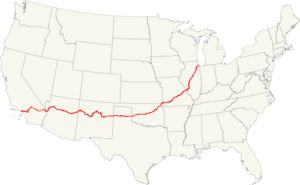
U.S. Route 66 (US 66 or Route 66), also known as the Will Rogers Highway and also known as the Main Street of America or the Mother Road, was one of the original highways within the U.S. Highway System. US 66 was established on November 11, 1926, with road signs erected the following year.[4] The highway, which became one of the most famous roads in America, originally ran from Chicago, Illinois, through Missouri, Kansas, Oklahoma, Texas,New Mexico, and Arizona before ending at Santa Monica, California, covering a total of 2,448 miles (3,940 km).[5] It was recognized in popular culture by both the hit song “(Get Your Kicks on) Route 66” and the Route 66 television show in the 1960s.
US 66 served as a major path for those who migrated west, especially during the Dust Bowl of the 1930s, and the road supported the economies of the communities through which it passed. People doing business along the route became prosperous due to the growing popularity of the highway, and those same people later fought to keep the highway alive in the face of the growing threat of being bypassed by the new Interstate Highway System.
US 66 underwent many improvements and realignments over its lifetime, and it was officially removed from the United States Highway System on June 27, 1985,[6] after it had been replaced in its entirety by segments of the Interstate Highway System. Portions of the road that passed through Illinois, Missouri, New Mexico, and Arizona have been designated a National Scenic Byway of the name “Historic Route 66“, which is returning to some maps.[7][8] Several states have adopted significant bypassed sections of the former US 66 into the state road network as State Route 66.
On this day in 1837, Solomon Juneau founds a newspaper:
On this date the Milwaukee Sentinel, the oldest newspaper in the state, was founded as a weekly publication by Solomon Juneau, who also was Milwaukee’s first mayor. [Source: History Just Ahead: A Guide to Wisconsin’s Historical Markers edited by Sarah Davis McBride, p. 19]
A Google a Day asks a science question: “What was Robert Brown looking at through a microscope when he found evidence of the 1827 scientific concept named in his honor?”
Art, Business, Free Markets
The Art Market (in Four Parts): Auctions
by JOHN ADAMS •
The Art Market (in Four Parts): Auctions from Artsy on Vimeo.
How did the art auctions business become a multi-billion-dollar industry? The first film in a series about the art market explores this question, leading viewers through the complex history of auctions, with specific attention to the last 20 years. The film unpacks record-breaking sales, like last week’s epic Jean-Michel Basquiat painting Untitled (1982), hammering in at $51 million, and anomalies such as Ai Weiwei’s Kui Hua Zi (Sunflower Seeds) (2010), which pop up at auction in countless different quantities, making the connection between the auction price and market value of art. Interviews with auction-house specialists, financial analysts, and art-world influencers like Adam Lindemann, Xin Li, Sarah Thornton, Josh Baer, and Don Thompson add personal insight and shape the narrative.
Auctions launches a four-part documentary series, followed by Galleries, Patrons, and Art Fairs, released weekly through mid-June. Together, the four segments will tell a comprehensive story about the art market’s history and cultural influence, providing an approachable yet nuanced introduction to a extraordinary subject. Visit Artsy.net/art-market-series to watch all the films.
The series is produced in collaboration with UBS and directed by Oscar Boyson.
Daily Bread
Daily Bread for 6.26.16
by JOHN ADAMS •
Good morning, Whitewater.
Morning thunderstorms will give way to partly cloudy afternoon skies with a high of ninety. Sunrise is 5:18 AM and sunset 8:37 PM, for 15h 18m 58s of daytime. The moon is a waxing gibbous with 63.8% of its visible disk illuminated.
Chinese shoppers at the Ginza shopping center in Jinan, beset by recent floods, found that water marred their retail experience:
On this day in 1945, fifty nations sign the United Nations Charter at a ceremony in San Francisco:
The Charter of the United Nations (also known as the UN Charter) of 1945 is the foundational treaty of the United Nations, an intergovernmental organization.[1] It was signed at the San Francisco War Memorial and Performing Arts Center in San Francisco, United States, on 26 June 1945, by 50 of the 51 original member countries. (Poland, the other original member, which was not represented at the conference, signed it two months later.) It entered into force on 24 October 1945, after being ratified by the original five permanent members of the Security Council—the Republic of China (later replaced by the People’s Republic of China), France, the Union of Soviet Socialist Republics (later replaced by the Russian Federation), the United Kingdom, and the United States—and a majority of the other signatories.
As a charter, it is a constituent treaty, and all members are bound by its articles. Furthermore, Article 103 of the Charter states that obligations to the United Nations prevail over all other treaty obligations.[1][2] Most countries in the world have now ratified the Charter.
After the Black Hawk War, Congress creates new land districts, including ones in present-day Wisconsin:
1834 – New Land Districts Created
On this date an Act of Congress created the Green Bay land district (east of a line from the northern boundary of Illinois to the Wisconsin River) and west of this, the Wisconsin Land district. The act followed land cessions by Native Americans defeated in the Black Hawk War. The creation of the land districts opened up much of southeastern Wisconsin for settlement. [Source: Fond du Lac County Local History Web]
Daily Bread
Daily Bread for 6.25.16
by JOHN ADAMS •
Good morning, Whitewater.
Saturday in town will be warm and mostly sunny with a high of ninety. Sunrise is 5:18 AM and sunset 8:37 PM, for 15h 19m 23s of daytime. The moon is a waning gibbous with 74.8% of its visible disk illuminated.
Perhaps, just perhaps, the campaign isn’t genuine anyway:
On this day in 1950, North Korea’s Communist regime begins the Korean War:
The Korean War… began when North Korea invaded South Korea.[36][37] The United Nations, with the United States as the principal force, came to the aid of South Korea. China, with assistance from the Soviet Union, came to the aid of North Korea. The war arose from the division of Korea at the end of World War II and from the global tensions of the Cold War that developed immediately afterwards.
Korea was ruled by Japan from 1910 until the closing days of World War II. In August 1945, the Soviet Union declared war on Japan, as a result of an agreement with the United States, and liberated Korea north of the 38th parallel. U.S. forces subsequently moved into the south. By 1948, as a product of the Cold War between the Soviet Union and the United States, Korea was split in to two separate governments. Both governments claimed to be the legitimate government of Korea, and neither side accepted the border as permanent. The civil war escalated into open warfare when North Korean forces—supported by the Soviet Union and China—moved to the south to unite the country on 25 June 1950.[38] On that day, the United Nations Security Council recognized this North Korean act as invasion and called for an immediate ceasefire.[39] On 27 June, the Security Council adopted S/RES/83: Complaint of aggression upon the Republic of Korea and decided the formation and dispatch of the UN Forces in Korea. Twenty-one countries of the United Nations eventually contributed to the defense of South Korea, with the United States providing 88% of the UN’s military personnel.
After the first two months of the conflict, South Korean forces were on the point of defeat, forced back to thePusan Perimeter. In September 1950, an amphibious UN counter-offensive was launched at Inchon, and cut off many of the North Korean attackers. Those that escaped envelopment and capture were rapidly forced back north all the way to the border with China at the Yalu River, or into the mountainous interior. At this point, in October 1950, Chinese forces crossed the Yalu and entered the war.[38] Chinese intervention triggered a retreat of UN forces which continued until mid-1951. After these dramatic reversals of fortune, which saw Seoul change hands four times, the last two years of conflict became a war of attrition, with the front line close to the 38th parallel. The war in the air, however, was never a stalemate. North Korea was subject to a massive bombing campaign. Jet fighters confronted each other in air-to-air combat for the first time in history, and Soviet pilots covertly flew in defense of their Communist allies.
The fighting ended on 27 July 1953, when an armistice was signed. The agreement created the Korean Demilitarized Zone to separate North and South Korea, and allowed the return of prisoners. However, no peace treaty has been signed, and the two Koreas are technically still at war. Periodic clashes, many of which were deadly, have continued to the present.
On this day in 1863, the 25th Wisconsin heads to Greenville, Mississippi:
The 25th Wisconsin Infantry participated in an expedition from Snyder’s Bluff to Greenville, Mississippi.
Cats
Friday Catblogging: Cats Go Shopping
by JOHN ADAMS •
From a German grocery’s commercial —
Poll, Sports
Friday Poll: Bucks Next Year
by JOHN ADAMS •
The Bucks selected Sudan native Thon Maker as the No. 10 pick in the NBA draft. See, Bucks select 7-foot-1 Thon Maker at No. 10 @ JSOnline. (This year, the Bucks finished 33-49 and fifth in their division.)
Overall, looking at the whole team, do you think the Bucks will make the 2017 playoffs?
Daily Bread
Daily Bread for 6.24.16
by JOHN ADAMS •
Good morning, Whitewater.
Friday in town will be mostly sunny with a high of eighty-four. Sunrise is 5:17 AM and sunset is 8:37 PM, for 15h 19m 44s of daytime. The moon is a waning gibbous, with 83.2% of its visible disk illuminated.
On this day in 1948, the Soviets begin a blockade of West Berlin, in an effort to isolate that part of the city from the West:
The Berlin Blockade (24 June 1948 – 12 May 1949) was one of the first major international crises of the Cold War. During the multinational occupation of post–World War II Germany, the Soviet Union blocked the Western Allies‘ railway, road, and canal access to the sectors of Berlin under Western control. The Soviets offered to drop the blockade if the Western Allies withdrew the newly introduced Deutsche mark from West Berlin.
In response, the Western Allies organized the Berlin airlift to carry supplies to the people of West Berlin, a difficult feat given the city’s population.[1][2] Aircrews from the United States Air Force, the British Royal Air Force, the Royal Canadian Air Force, the Royal Australian Air Force, the Royal New Zealand Air Force, and theSouth African Air Force[3]:338 flew over 200,000 flights in one year, providing to the West Berliners up to 8,893 tons of necessities each day, such as fuel and food.[4] The Soviets did not disrupt the airlift for fear this might lead to open conflict.[5]
By the spring of 1949, the airlift was clearly succeeding, and by April it was delivering more cargo than had previously been transported into the city by rail. On 12 May 1949, the USSR lifted the blockade of West Berlin.
6.26.1946 was a rainy day for Mellen, Wisconsin:
1946 – Most Precipitation in One Day
On this date Mellen, Wisconsin received 11.72 inches of rain within a single day. This set a record for Wisconsin for precipitation received within 24 hours. [Source: National Weather Service]
A Google a Day asks about language: “What is the largest surviving Latin American language reaching from Columbia to Chile?”