
Accidents, Blunders and Calamities from Media Design School on Vimeo.
Daily Bread
Daily Bread for 7.3.16
by JOHN ADAMS •
Good morning, Whitewater.
Sunday in town will be partly sunny with a high of seventy-eight. Sunrise is 5:22 AM and sunset is 8:36 PM, for 15h 14m 19s of daytime. The moon is a waning crescent with 1.3 percent of its visible disk illuminated.
Sometimes an ordinary dive turns into something more —
On this day in 1863, Union forces repulse Confederates on the third day of fighting at Gettybsurg:
Around 3 p.m., the cannon fire subsided, and 12,500 Southern soldiers stepped from the ridgeline and advanced the three-quarters of a mile (1,200 m) to Cemetery Ridge in what is known to history as “Pickett’s Charge“. As the Confederates approached, there was fierce flanking artillery fire from Union positions on Cemetery Hill and north of Little Round Top, and musket and canister fire from Hancock’s II Corps. In the Union center, the commander of artillery had held fire during the Confederate bombardment (in order to save it for the infantry assault, which Meade had correctly predicted the day before), leading Southern commanders to believe the Northern cannon batteries had been knocked out. However, they opened fire on the Confederate infantry during their approach with devastating results. Nearly one half of the attackers did not return to their own lines.
Although the U.S. line wavered and broke temporarily at a jog called the “Angle” in a low stone fence, just north of a patch of vegetation called the Copse of Trees, reinforcements rushed into the breach, and the Confederate attack was repulsed. The farthest advance of Brig. Gen. Lewis A. Armistead‘s brigade of Maj. Gen. George Pickett‘s division at the Angle is referred to as the “High-water mark of the Confederacy“, arguably representing the closest the South ever came to its goal of achieving independence from the Union via military victory.[69] Union and Confederate soldiers locked in hand-to-hand combat, attacking with their rifles, bayonets, rocks and even their bare hands. Armistead ordered his Confederates to turn two captured cannons against Union troops, but discovered that there was no ammunition left, the last double canister shots having been used against the charging Confederates. Armistead was shortly after wounded three times.
Food
A Grilling Guide (with Tips for Cooking Burgers)
by JOHN ADAMS •
Over at the New York Times, Sam Sifton has a comprehensive grilling guide, with tips for charcoal or gas grills, and cooking beef, chicken, seafood, vegetables, corn, fruit, pizza, and bread.
Inside or out, here are tips for cooking a diner or pub-style burger:
Daily Bread
Daily Bread for 7.2.16
by JOHN ADAMS •
Good morning, Whitewater.
Saturday in town will be partly sunny with a high of seventy-eight. Sunrise is 5:21 AM and sunset 8:36 PM, for 15h 15m 10s of daytime. The moon is a waning crescent with 5.3% of its visible disk illuminated.
Yesterday I posted a photo of an aurora on Jupiter, but NASA and the European Space Agency have a video recording, too, of that phenomenon on the solar system’s largest world:
On July 2, South Carolina reversed its position and voted for independence. In the Pennsylvania delegation, Dickinson and Robert Morris abstained, allowing the delegation to vote three-to-two in favor of independence. The tie in the Delaware delegation was broken by the timely arrival of Caesar Rodney, who voted for independence. The New York delegation abstained once again, since they were still not authorized to vote for independence, although they would be allowed to do so by the New York Provincial Congress a week later.[74] The resolution of independence had been adopted with twelve affirmative votes and one abstention. With this, the colonies had officially severed political ties with Great Britain.[75]
On this day in 1863, a lieutenant from Wisconsin records events from the second day of fighting at Gettysburg:
Fighting at Gettysburg began in the afternoon on July 2 and lasted until after dark as Union forces repulsed a series of attacks. That night, Union Major General George Meade held a council of leaders to decide what to do next. Lieutenant Frank Haskell, of Madison, was present when they voted to “allow the Rebel to come up and smash his head against [their position] to any reasonable extent he desired, as he had to-day. After some two hours the council dissolved, and the officers went their several ways.”
Adventure, Cats, Nature
Friday Catblogging: Cats Go Hiking
by JOHN ADAMS •
Holiday, Poll
Friday Poll: Independence Holiday Activities
by JOHN ADAMS •
Here’s a version of a poll first run last year: What will you do this holiday? Multiple poll selections are possible —
Daily Bread
Daily Bread for 7.1.16
by JOHN ADAMS •
Good morning, Whitewater.
A new month begins, on a day with increasing sunshine and a high of seventy-four. Sunrise is 5:20 AM and sunset 8:36 PM, for 15h 15m 58s of daytime. The moon is a waning crescent with 12.1% of its visible disk illuminated.
Using the Hubble Space Telescope, astronomers from NASA and the European Space Agency saw and recorded astonishing auroras on Jupiter:
Jupiter, the largest planet in the Solar System, is best known for its colourful storms, the most famous being the Great Red Spot. Now astronomers have focused on another beautiful feature of the planet, using the ultraviolet capabilities of the NASA/ESA Hubble Space Telescope.
The extraordinary vivid glows shown in the new observations are known as auroras[1]. They are created when high energy particles enter a planet’s atmosphere near its magnetic poles and collide with atoms of gas. As well as producing beautiful images, this programme aims to determine how various components of Jupiter’s auroras respond to different conditions in the solar wind, a stream of charged particles ejected from the Sun.
This observation programme is perfectly timed as NASA’s Juno spacecraft is currently in the solar wind near Jupiter and will enter the orbit of the planet in early July 2016. While Hubble is observing and measuring the auroras on Jupiter, Juno is measuring the properties of the solar wind itself; a perfect collaboration between a telescope and a space probe [2].
On this day in 1863, the Battle of Gettysburg begins:
After his success at Chancellorsville in Virginia in May 1863, Lee led his army through the Shenandoah Valley to begin his second invasion of the North—the Gettysburg Campaign. With his army in high spirits, Lee intended to shift the focus of the summer campaign from war-ravaged northern Virginia and hoped to influence Northern politicians to give up their prosecution of the war by penetrating as far as Harrisburg, Pennsylvania, or even Philadelphia. Prodded by PresidentAbraham Lincoln, Maj. Gen. Joseph Hooker moved his army in pursuit, but was relieved of command just three days before the battle and replaced by Meade.
Elements of the two armies initially collided at Gettysburg on July 1, 1863, as Lee urgently concentrated his forces there, his objective being to engage the Union army and destroy it. Low ridges to the northwest of town were defended initially by a Union cavalry division under Brig. Gen. John Buford, and soon reinforced with two corps of Union infantry. However, two large Confederate corps assaulted them from the northwest and north, collapsing the hastily developed Union lines, sending the defenders retreating through the streets of town to the hills just to the south.
On this day in 1967, it becomes legal to sell margarine in Wisconsin:
1967 – Sale of Oleo Becomes Legal
On this date it became legal to purchase Oleomargarine in Wisconsin. For decades, margarine was considered a contraband spread. Sale of the butter impost0r resulted in fines or possible jail terms. Oleomargarine was sold legally in Illinois and frequently smuggled into Wisconsin.
A Google a Day asks a science question: “What is the atomic weight of the lightest element on the periodic table?”
Games/Puzzles
10 Amazing Paper Stunts
by JOHN ADAMS •
City, Politics
The Search for a Majority in Whitewater (Identity Politics Won’t Get You There)
by JOHN ADAMS •
I posted yesterday about the search for a majority in Whitewater. A political majority, whether temporary or permanent, requires three satisfied conditions: (1) a means of communications, (2) an understanding of the demographics of one’s audience, and (3) an issue around which a majority will form.
More means of communication are better than fewer, but we have ample means already: print, digital, etc. No one need rely on carrier pigeons; we don’t have a broken telephone problem.
Policymakers in the city know its demographics, to be sure. (Of course they do.) Still, with a few obvious exceptions, those policymakers do not follow the implications of those demographics, at least if their aim is a genuine majority within the community.
The largest single age group in the city is residents aged 20-24, a group greater in number than groups aged 25-34, 35-44, 45-54, 55-59, and 60-64 combined.
Add those aged 15-19, and the 15-24 age bracket approaches twice the number of all those aged 25-64.
More critically, these age cohorts are not composed only of a single economic, cultural, or ideological outlook.
And yet, much of Whitewater’s politics is a kind of soft identity politics of the middle aged, resting on the assumption that one draws support from those who look like oneself.
It’s shortsighted and self-limiting: there is no group in the city that represents by itself a stable, effective majority. Still, it’s gratifying to a few to contend otherwise, and they’ll not see things any other way.
Of surveys accurate measurement is key; I’ll write next week about a recent survey whose sample is oddly unrepresentative of the community.
(An obvious point: I don’t claim to speak for any view other than my own. It would never occur to me to claim to be a representative of more than one, so to speak.)
Whitewater’s policymakers face either insisting erroneously that a portion of the city – the portion that looks like them, that is comfortable to them – is the whole community, or doing the much harder work of crafting a message that reaches beyond smaller factions. A few choose the harder way; most choose the lazy way of a soft identity politics.
An issues-oriented, and so ideological, approach could lead to a majority (at least issue by issue), but that’s more demanding than the lazy approach of saying trust-me-because-I-seem-like-you.
(Whatever a compelling issues-oriented, majority message is, one can assume it’s not a program to find ways for government to generate more revenue for itself.)
Until more policymakers adopt a cross-cultural and ideological approach, forming majorities in Whitewater will be more chimerical than real.
Daily Bread
Daily Bread for 6.30.16
by JOHN ADAMS •
Good morning, Whitewater.
Thursday in town will be partly cloudy, with a high of eighty-one, and a forty percent chance of an afternoon thunderstorm. Sunrise is 5:20 AM and sunset 8:37 PM, for 15h 16m 42s of daytime. The moon is a waning crescent with 20.5% of its visible disk illuminated.
Whitewater’s Lock Box Ordinance Committee is scheduled to meet today at 5:30 PM.
On this day in 1775, the Continental Congress establishes Articles of War for a conflict with Britain, beginning with a justification for their adoption:
The consideration of the articles of war being resumed, Congress agreed to the same:
Rules and Regulations
Whereas his Majesty’s most faithful subjects in these Colonies are reduced to a dangerous and critical situation, by the attempts of the British Ministry, to carry into execution, by force of arms, several unconstitutional and oppressive acts of the British parliament for laying taxes in America, to enforce the collection of these taxes, and for altering and changing the constitution and internal police of some of these Colonies, in violation of the natural and civil rights of the Colonies.
And whereas hostilities have been actually commenced in Massachusetts Bay, by the British troops, under the command of General Gage, and the lives of a number of the inhabitants of that Colony destroyed; the town of Boston not only having been long occupied as a garrisoned town in an enemy’s country, but the inhabitants thereof treated with a severity and cruelty not to be justified even towards declared enemies.
And whereas large reinforcements have been ordered, and are soon expected, for the declared purpose of compelling these Colonies to submit to the operation of the said acts, which hath rendered it necessary, and an indispensable duty, for the express purpose of securing and defending these Colonies, and preserving them in safety against all attempts to carry the said acts into execution; that an armed force be raised sufficient to defeat such hostile designs, and preserve and defend the lives, liberties and immunities of the Colonists: for the due regulating and well ordering of which;–
Resolved, That the following Rules and Orders be attended to, and observed by such forces as are or may hereafter be raised for the purposes aforesaid….
On this day in 1951, a Wisconsin rail line goes under:
1951 – Final Line of Milwaukee Electric Railway and Light Co. Abandoned
On this date the final line of the Milwaukee Electric Railway and Light Co. was abandoned. At one time, the company’s system extended west to Madison, north to Sheboygan, and south to Kenosha. [Source:History Just Ahead: A Guide to Wisconsin’s Historical Markers edited by Sarah Davis McBride, p. 29]
A Google a Day asks a history question: “Whose death did the commander of the Confederate forces say was like “losing my right arm”?”
Space, Technology
NASA Tests New Rocket Engine
by JOHN ADAMS •
NASA enjoyed a successful test of a heavy rocket, and both the federal agency and private enterprise are pushing ahead with rockets powerful enough to support a mission to Mars.
A booster for the most powerful rocket in the world, NASA’s Space Launch System (SLS), successfully fired up Tuesday for its second qualification ground test at Orbital ATK’s test facilities in Promontory, Utah. This was the last full-scale test for the booster before SLS’s first uncrewed test flight with NASA’s Orion spacecraft in late 2018, a key milestone on the agency’s Journey to Mars.
Via NASA.
City
The Search for a Majority in Whitewater
by JOHN ADAMS •
It’s right for government to reach – informatively, accurately – as many residents as possible. Efforts in that direction are to the good.
Three conditions have to be fulfilled to achieve a majority opinion on an issue: one needs the means to reach many, one needs to see those many as they actually are, and one needs an issue around which a majority from among the city will form.
This must seem obvious, but it’s only clear to some of the city’s policymakers. Although the technical means of reaching many are easily understood, seeing the community as it actually is, and crafting a message to that actual community, still confounds a few (including some who don’t see that they are, truly, confounded).
Where to begin? One might start with a reliable survey of the community’s demographics.
One can craft a majority in this city, but it’s an understatement to say thay it won’t look demographically like most officeholders, committee members, commentators, etc.
That shouldn’t matter if one cares most about issues as issues, case by case, but if one’s hoping for a demographically-similar, stable majority in Whitewater, one’s sure to be disappointed.
Whitewater isn’t like that, any more than Pleasantville was a real town.
Conservation, Nature
Film – A Ghost in the Making: Searching for the Rusty-Patched Bumble Bee
by JOHN ADAMS •
A small species of bee might not seem like much, but it’s worth recalling that for thousands of years a traditional, interrogative answer to questions about humanity’s place in the world has been a reminder that we are part of a larger, created order.
How can we care about something that we barely see or know? This the question that the photographer Clay Bolt sets out to answer in the documentary A Ghost in the Making: Searching for the Rusty-Patched Bumble Bee. Dwindling bee populations have been highly publicized, but the insects are still not included in the United States Fish and Wildlife Service’s Endangered Species List. By traveling from state to state, Bolt tells the story of the rusty-patched bumblebee—one of 4,000 species of native bees in North America—and the scientists and conservationists working to preserve it.
The film is produced by Day’s Edge Productions and will be released to the public on June 23, 2016. You can learn more about rusty-patched bumblebees and the fight to save them here.
Via The Atlantic.
Daily Bread
Daily Bread for 6.29.16
by JOHN ADAMS •
Good morning, Whitewater.
Midweek in Whitewater will be mostly sunny with a high of eighty. Sunrise is 5:19 AM and sunset 8:37 PM, for 15h 17m 22s of daytime. The moon is a waning crescent with 30.7% of its visible disk illuminated.
Whitewater’s Cable Television Committee meets this morning at 9 AM.
On this day in 1943, Pres. Roosevelt writes to J. Robert Oppenheimer:
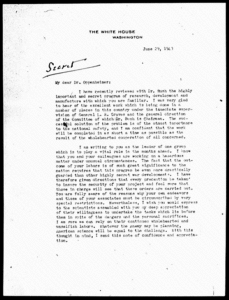
THE WHITE HOUSE
WASHINGTON
June 29, 1943SECRET
My dear Dr. Oppenheimer:
I have recently reviewed with Dr. Bush the highly important and secret program of research, development and manufacture with which you are familiar. I was very glad to hear of the excellent work which is being done in a number of places in this country under the immediate supervision of General L.R. Groves and the general direction of the Committee of which Dr. Bush is Chairman. The successful solution of the problem is of the utmost importance to the national safety, and I am confident that the work will be completed in as short a time as possible as the result of the wholehearted cooperation of all concerned.
I am writing to you as the leader of one group which is to play a vital role in the months ahead. I know that you and your colleagues are working on a hazardous matter under unusual circumstances. The fact that the outcome of your labors is of such great significance to the nation requires that this program be even more drastically guarded than other highly secret war development. I have therefore given directions that every precaution be taken to insure the security of your project and feel sure that those in charge will see that these orders are carried out. You are fully aware of the reasons why your endeavors and those of your associates must be circumscribed by very special restrictions. Nevertheless, I wish you would express to the scientists assembled with you my deep appreciation of their willingness to undertake the tasks which lie before them in spite of the dangers and the personal sacrifices. I am sure that we can rely on their continued wholehearted and unselfish labors. Whatever the enemy may be planning, American science will be equal to the challenge. With this thought in mind, I send this note of confidence and appreciation.
Though there are other important groups at work, I am writing only to you as the leader of one which is operating under very special conditions, and to General Groves. While this letter is secret, the contents of it may be disclosed to your associates under pledge of secrecy.
Very Sincerely Yours
Franklin Delano Roosevelt
Dr. J. R. Oppenheimer
Post Office Box 1663
Santa Fe,
New Mexico
On this day in 1865, Wisconsinites raise money for disabled soldiers:
1865 – First Soldiers’ Home Fair Held
On this date the first Soldiers’ Home Fair was held in Milwaukee. It raised more than $110,000 and allowed the Wisconsin Soldiers’ Home Association to purchase land and establish the hospital which became the National Asylum for Disabled Volunteer Soldiers, Northwestern Branch. This was later renamed the Veterans Administration Medical Center. [Source: History Just Ahead: A Guide to Wisconsin’s Historical Markers edited by Sarah Davis McBride, p. 22]
A Google a Day asks a question on art & architecture: “The north end of what footbridge is very near the magnificent baroque cathedral that is famous for the dome added by restorer Christopher Wren?”