
Via Before They Created Apple, Jobs And Wozniak Hacked The Phone System @ Signals | Five Thirty-Eight.
Daily Bread
Daily Bread for 5.11.16
by JOHN ADAMS •
Good morning, Whitewater.
Midweek in town will be partly sunny with a high of seventy-one. Sunrise is 5:34 AM and sunset 8:07 PM, for 14h 32m 59s of daytime. The moon is a waxing crescent with 27.2% of its visible disk illuminated.
Whitewater’s Urban Forestry Sub-Committee on Landscaping meets today at 4 PM.
On this day in 1947, B.F. Goodrich publicizes a true automotive innovation:
…the B.F. Goodrich Company of Akron, Ohio, announces it has developed a tubeless tire, a technological innovation that would make automobiles safer and more efficient.
Pneumatic tires–or tires filled with pressurized air–were used on motor vehicles beginning in the late 1800s, when the French rubber manufacturer Michelin & Cie became the first company to develop them. For the first 60 years of their use, pneumatic tires generally relied on an inner tube containing the compressed air and an outer casing that protected the tube and provided traction. The disadvantage of this design was that if the inner tube failed–which was always a risk due to excess heat generated by friction between the tube and the tire wall–the tire would blow out immediately, causing the driver to lose control of the vehicle.
The culmination of more than three years of engineering, Goodrich’s tubeless tire effectively eliminated the inner tube, trapping the pressurized air within the tire walls themselves. By reinforcing those walls, the company claimed, they were able to combine the puncture-sealing features of inner tubes with an improved ease of riding, high resistance to bruising and superior retention of air pressure. While Goodrich awaited approval from the U.S. Patent Office, the tubeless tires underwent high-speed road testing, were put in service on a fleet of taxis and were used by Ohio state police cars and a number of privately owned passenger cars.
The testing proved successful, and in 1952, Goodrich won patents for the tire’s various features. Within three years, the tubeless tire came standard on most new automobiles. According to an article published in The New York Times in December 1954, “If the results of tests…prove valid in general use, the owner of a 1955 automobile can count on at least 25 per cent more mileage, easier tire changing if he gets caught on a lonely road with a leaky tire, and almost no blowouts.” The article quoted Howard N. Hawkes, vice president and general manager of the tire division of the United States Rubber Company, as calling the general adoption of the tubeless tire “one of the most far-reaching changes ever to take place in the tire industry.” The radial-ply tire, a tubeless model with walls made of alternating layers–also called plies–of tough rubber cord, was created by Michelin later that decade and is now considered the standard for automobiles in all developed countries.
Despite similar designs, but Goodrich received and successfully defended Patent No. US2859792 A.
On this day in 1955, Milwaukee loses a basketball team:
1955 – Milwaukee Hawks Relocate to St. Louis
On this date the NBA approved transferring the financially strapped Milwaukee Hawks to St. Louis. The Hawks stayed in St. Louis until 1968, then moved to Atlanta. [Source: Milwaukee Journal Sentinel Online]
A Google a Day asks about a person: “Who is known as the “father” of the country whose national drink is a strong alcoholic beverage made from pomace?”
Nature, Space
Mercury’s Transit Across the Sun
by JOHN ADAMS •
NASA’s Solar Dynamic Observatory tracked Mercury making a rare transit across the face of the Sun [on May 9th]. The last time this event happened was in 2006, and NASA predicts it will happen again in 2019.
Via CNN @ YouTube.
Education
Minecraft, Education Edition
by JOHN ADAMS •
 Post 16 in a series.
We often say, and mostly rightly, that work should come before play. That’s true for school, too: study and homework typically comes before play. Sometimes, however, play is a kind of study, and has educational value.
Microsoft’s Minecraft (Education Edition) is a video game that’s more than a game:
A hundred schools will start testing Minecraft Education Edition in May, but more can get it in June when a free early-access program begins, Microsoft and its Mojang game studio said Thursday….
“During the summer months, we are also going to be focused on working with educators on building out lesson plans, sharing learning activity ideas and creating reusable projects,” Microsoft said.
Minecraft players turn trees, animals and minerals resources into tools, weapons and shelter to survive nightly monster onslaughts. It’s a major hit, with more than 70 million copies sold. It’s not just about survival, though. A creative mode lets players build fanciful structures, automate pig farming and even reproduce the complicated internal workings of computer logic circuitry.
This open-endedness has made Minecraft adaptable to everything from computer programming to art history. Especially because kids take the initiative to learn with Minecraft on their own, it’s no wonder schools like it and parents don’t freak out so much when kids get obsessed….
See, School’s out for summer? Not for Minecraft Education Edition @ CNET and Minecraft: Education Edition.
Electronic doesn’t always mean better, but rather sometimes it is advantageous. Most people see this, but not everyone. I am often surprised to meet well-schooled people who are sure that there is one way to approach something, a small number of ways to categorize something, and that approaches and categories are so fixed that they might as well be immutable natural laws.
There is no field of advanced study in America (or elsewhere) that does not have within it competing schools of thought, each advanced by equally talented academics. In fact, we would be surprised to find otherwise: one graduate department might align one way or another, but we’d expect that there would be an acknowledgement and engagement with competing theories elsewhere.
And yet, and yet, regarding teaching young children, one sometimes encounters those who see only one view, one method, one possibility. (I’m speaking generally, not of one person or place.) I’d say, in my experience, most teachers are open to creative options, but when one encounters someone who’s not, it’s quickly apparent, and always disappointing.
Minecraft, other games, electronic presentations, etc. are not the solution to all our educational challenges. They’re not even close. They are, however, partial solutions, and worthy reminders that what we once did isn’t an unalterable impediment against what we may yet do.
Daily Bread
Daily Bread for 5.10.16
by JOHN ADAMS •
Good morning, Whitewater.
Tuesday in town will be rainy with a high of fifty-three. Sunrise is 5:35 AM and sunset 8:06 PM, for 14h 30m 48s of daytime. The moon is a waxing crescent with 18.1% of its visible disk illuminated.
Whitewater’s Tech Park Board Site Committee meets today at 7 AM.
center>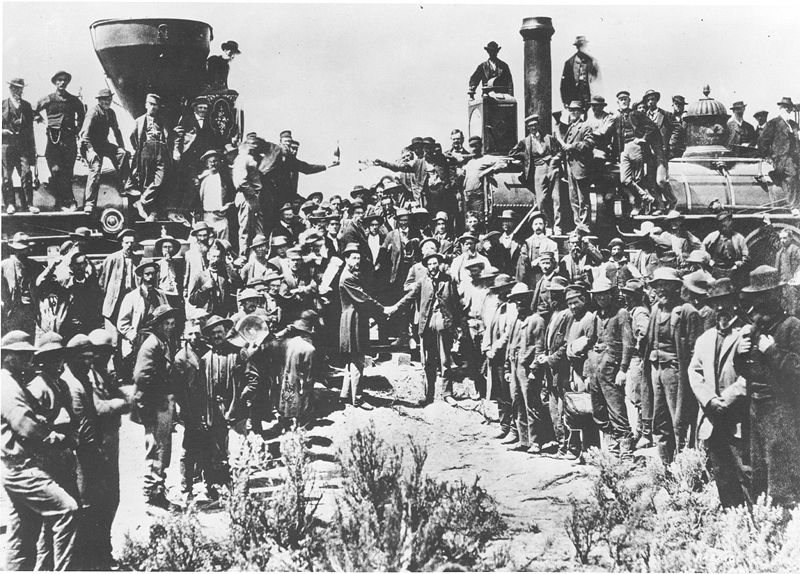
On this day in 1869, America has a transcontinental railroad:
…the presidents of the Union Pacific and Central Pacific railroads meet in Promontory, Utah, and drive a ceremonial last spike into a rail line that connects their railroads. This made transcontinental railroad travel possible for the first time in U.S. history. No longer would western-bound travelers need to take the long and dangerous journey by wagon train, and the West would surely lose some of its wild charm with the new connection to the civilized East.
Since at least 1832, both Eastern and frontier statesmen realized a need to connect the two coasts. It was not until 1853, though, that Congress appropriated funds to survey several routes for the transcontinental railroad. The actual building of the railroad would have to wait even longer, as North-South tensions prevented Congress from reaching an agreement on where the line would begin.
One year into the Civil War, a Republican-controlled Congress passed the Pacific Railroad Act (1862), guaranteeing public land grants and loans to the two railroads it chose to build the transcontinental line, the Union Pacific and the Central Pacific. With these in hand, the railroads began work in 1866 from Omaha and Sacramento, forging a northern route across the country. In their eagerness for land, the two lines built right past each other, and the final meeting place had to be renegotiated….
On this day in 1865, the Wisconsin 1st Cavalry helps capture Jefferson Davis:
1865 – (Civil War) Confederacy President Jefferson Davis Captured
The 1st Wisconsin Cavalry was one of the first units sent to search for Jefferson Davis, the president of the Confederacy, after the surrender of General Robert E. Lee. A Michigan unit, also sent to find Davis, accidentally attacked the cavalry before dawn. A few hours later, both units captured the Confederate president in Irwinville, Georgia.
A Google a Day asks a question about baseball: “What left-handed outfielder, pinch-hitter and first baseman, with a colorful nickname, played his final game in September of 1963?”
Nature, Weather
Tornado Near Wray, Colorado
by JOHN ADAMS •
May 7th —
WGTB, WHEN GREEN TURNS BROWN
Door County
by JOHN ADAMS •
 Post 73 in a series.
The Wisconsin Center for Investigate Journalism has an ongoing series about the condition of Wisconsin’s water supply, with three main topics, one of which is entitled, Failure at the Faucet. I’ve mentioned the full series before. See, Water Watch Wisconsin.
Reading that series – the work of many journalists over many months, is astounding. One would think that the series was describing an undeveloped and impoverished place, far from Wisconsin or America. In fact, the series focuses on conditions in our own state.
Consider their latest story, Human waste pollutes some Wisconsin drinking water. Veteran journalist Ron Seely describes the problem:
Manure has been blamed for much of the bacteria and viruses that pollute Wisconsin drinking water, but contamination from human waste is a problem, too.
Failing septic systems, leaking public sewer pipes and landspreading of septic waste can introduce dangerous pathogens into both rural and urban water systems.
In June 2007, 229 people were sickened by a norovirus in Door County while eating at a restaurant. Seven were hospitalized as a result of a pathogen known for spreading illness on cruise ships. The source: a leaky septic system.
In 2012, a microbiologist published research that linked widespread gastrointestinal illnesses in 14 Wisconsin communities to viruses in the public water systems. Further research showed the contaminants were likely coming from leaking municipal sewage lines….
He doesn’t stop there – his story and the full series are a catalog of statewide pollution.
Now not every community has these problems (any more than every community has Waukesha’s problem of radium contamination in some wells).
These problems are problems, so to speak, when an environment cannot manage safely or cheaply the results of human activity. These environments are more fragile – and thus more expensive to maintain – than initial, overly-optimistic projects assume. Even wealthy communities face these same, physical problems. Door County, for example, is a desirable area with high property values, but that’s no immunity from the risks of contaminants.
Producing more waste, or bringing more waste into an environment, produces costs initially ignored but later impossible to ignore. That’s not speculation: it’s the actual experience of Wisconsin communities.
Music
Monday Music: Leon Bridges, Smooth Sailin’
by JOHN ADAMS •
Daily Bread
Daily Bread for 5.9.16
by JOHN ADAMS •
Good morning, Whitewater.
The week begins with mostly cloudy skies, a likelihood of rain this evening, with a high of sixty. Sunrise is 5:36 AM and sunset 8:05 PM, for 14h 28m 34s of daytime. The moon is a waxing crescent with 9.8% of its visible disk illuminated.
Whitewater’s Planning Commission meets tonight at 6:30 PM.
On this day in 1874, Howard Carter, the British archaeologist who discovered the Egyptian tomb of King Tutankhamen, is born.
On 5.9.1950, a first for then-Milwaukee Arena:
1950 – First Sporting Event Held at Milwaukee Arena
On this date, in the first sporting event at the new Milwaukee Arena, Rocky Graziano scored a fourth-round TKO over Vinnie Cidone in a middleweight fight that drew 12,813 fans. The new Milwaukee Arena actually opened on April 9, 1950, but with a civic celebration rather than a sports event. [Source: Milwaukee Journal]
A Google a Day asks a football question: “What former Baltimore Colt inducted into the Pro Football Hall of Fame in 1968, published an autobiography in 1987?”
Animation
Sunday Animation: A Tale of Momentum & Inertia
by JOHN ADAMS •
Holiday
Happy Mother’s Day
by JOHN ADAMS •
Daily Bread
Daily Bread for 5.8.16
by JOHN ADAMS •
Good morning, Whitewater.
Mother’s Day in town will be sunny with a high of seventy-one. Sunrise is 5:38 AM and sunset is 8:04 PM, for 14h 26m of daytime. The moon is a waxing crescent with 4.1% of its visible disk illuminated.
Friday’s FW poll asked if readers thought an Oklahoma town’s residents should try to tame a wolf in the area. Most respondents (81.82%) thought that the wolf should be returned to the wild.
On this day in 1541, De Soto reaches the Mississippi:
Hernando de Soto reaches the Mississippi River, one of the first European explorers to ever do so. After building flatboats, de Soto and his 400 ragged troops crossed the great river under the cover of night, in order to avoid the armed Native Americans who patrolled the river daily in war canoes. From there the conquistadors headed into present-day Arkansas, continuing their fruitless two-year-old search for gold and silver in the American wilderness.
Born in the last years of the 15th century, de Soto first came to the New World in 1514. By then, the Spanish had established bases in the Caribbean and on the coasts of the American mainland. A fine horseman and a daring adventurer, de Soto explored Central America and accumulated considerable wealth through the Indian slave trade. In 1532, he joined Francisco Pizarro in the conquest of Peru. Pizarro, de Soto, and 167 other Spaniards succeeding in conquering the Inca empire, and de Soto became a rich man. He returned to Spain in 1536 but soon grew restless and jealous of Pizarro and Hernando Cortes, whose fame as conquistadors overshadowed his own. Holy Roman Emperor Charles V responded by making de Soto governor of Cuba with a right to conquer Florida, and thus the North American mainland.
In late May 1539, de Soto landed on the west coast of Florida with 600 troops, servants, and staff, 200 horses, and a pack of bloodhounds. From there, the army set about subduing the natives, seizing any valuables they stumbled upon, and preparing the region for eventual Spanish colonization. Traveling through Florida, Georgia, South Carolina, across the Appalachians, and back to Alabama, de Soto failed to find the gold and silver he desired, but he did seize a valuable collection of pearls at Cofitachequi, in present-day Georgia. Decisive conquest eluded the Spaniards, as what would become the United States lacked the large, centralized civilizations of Mexico and Peru.
On this day in 1891, the ‘father of Social Security’ is born:
On this date Arthur J. Altmeyer, the “father of social security,” was born in DePere. Altmeyer was one of the seminal figures of the Social Security program in America. He was part of the President’s Committee on Economic Security that drafted the original legislative proposal in 1934. He was a member of the three-person Social Security Board created to run the new program, and he was Chairman of the Board or Commissioner for Social Security from 1937-1953. Altmeyer died on October 19, 1972 and is buried in Madison’s Forest Hill Cemetery. [Source: Social Security Adminsitration]
Adventure
Longboard Run in Norway
by JOHN ADAMS •
Daily Bread
Daily Bread for 5.7.16
by JOHN ADAMS •
Good morning, Whitewater.
Saturday in town will be partly sunny with a high of sixty-six. Sunrise is 5:39 AM and sunset 8:03 PM, for 14 hours 24 minutes of daytime. The moon is a waxing crescent with 1% of its visible disk illuminated.
On this day in 1945, war in Europe ends with Nazi Germany’s unconditional surrender.
In London, V-E celebrations swept the city:
1864 – (Civil War) Battle of the Wilderness Ended
he fighting on May 5-7, 1864, produced nearly 30,000 casualties without giving either side a clear victory. The 2nd, 5th, 6th and 7th Wisconsin Infantry regiments fought at the Battle of the Wilderness.