
Here’s why –
City, Culture, Local Government, Politics, School District, University
A, B, and Wrong
by JOHN ADAMS •
Most choices for government, such as an option between Policy Choice A or Policy Choice B, involve choices of ordinary outcomes. One option may be more efficient than the other, or one more aesthetically pleasing than an alternative, but either would be considered a normal, reasonable policy outcome.
Preferences of the Right or Left, of Republican or Democrat, especially for local government, are mostly like this: people may prefer one outcome over another, but few think a community’s future will be damaged significantly and irremediably with the selection of either Choice A or Choice B.
In a well-ordered local politics, there should be few – if any – choices that are not like choices between A and B.
A policy choice that leads one to a wrong outcome – that is an outcome that’s unethical or injurious – should be almost unknown to a community.
There are dozens of ways to build a park, or design a public market, and not one of these would be wrong, not one that would be unethical or gravely injurious.
Most actions of Whitewater’s city government, school district, or university are like the ordinary choices between A and B : perhaps offering advantages one way or another but involving nothing of ethics or injury.
Sadly, there are a small number of policy actions in Whitewater that are extraordinary, and simply wrong. We should not have any; an inferior local politics, beneath the standard that an American community deserves, afflicts us.
Some few actions start out conventionally, but descend into the wrong through exaggeration that becomes mendacity. Whitewater’s town squires have the habit of boosting the town in ways that begin as ordinary (if poorly expressed) public relations, slip into unjustified boasting, and end as outright lies.
There is a second, small class of actions that are, truly, far worse. In this small class, actions begin with indifference to individuals, often with an insistence that the reputations of institutions matter more than the lives of their ordinary members. Whitewater’s worst leaders have an act utilitarianism in them. (These leaders justify their actions as an institutional defense, but that defense against individual rights is objectionable as made, and mostly an effort at their own self-interest in any event.)
Like most communities, we have mostly conventional choices before us. Sadly, unlike many communities, we have some policymakers who have slipped beneath the conventional, into actions that are both unethical and gravely injurious.
Most policy choices are conventional; a few are far less, and far worse, than that.
Those few are simply wrong.
Anderson, Cartoons & Comics
What that looked like
by JOHN ADAMS •

Daily Bread
Daily Bread for 11.4.15
by JOHN ADAMS •
Good morning, Whitewater.
Our midweek in town will be cloudy in the morning, but sunny in the afternoon, with a daytime high of sixty-eight. Sunrise is 6:33 and sunset 4:43, for 10h 09m 33s of daytime. The moon is a waning crescent with 40.1% of its visible disk illuminated.
Weird Al, one of America’s most perceptive artists, once again proves worthy of that praise, with his depiction of Every Post-Game Press Conference:
On this day in 1979, fanatical students storm the United States embassy in Tehran:
Student followers of the Ayatollah Khomeini send shock waves across America when they storm the U.S. embassy in Tehran. The radical Islamic fundamentalists took 90 hostages. The students were enraged that the deposed Shah had been allowed to enter the United States for medical treatment and they threatened to murder hostages if any rescue was attempted. Days later, Iran’s provincial leader resigned, and the Ayatollah Khomeini, the leader of Iran’s fundamentalist revolutionaries, took full control of the country—and the fate of the hostages.
Two weeks after the storming of the embassy, the Ayatollah began to release all non-U.S. captives, and all female and minority Americans, citing these groups as among the people oppressed by the United States government. The remaining 52 captives were left at the mercy of the Ayatollah for the next 14 months.
President Jimmy Carter was unable to diplomatically resolve the crisis, and on April 24, 1980, he ordered a disastrous rescue mission in which eight U.S. military personnel were killed and no hostages rescued. Three months later, the former shah died of cancer in Egypt, but the crisis continued. In November 1980, Carter lost the presidential election to Republican Ronald Reagan. Soon after, with the assistance of Algerian intermediaries, successful negotiations finally began between the United States and Iran.
On January 20, 1981—the day of Reagan’s inauguration—the United States freed almost $3 billion in frozen Iranian assets and promised $5 billion more in financial aid. Minutes after Reagan was sworn in, the hostages flew out of Iran on an Algerian airliner, ending their 444-day ordeal. The next day, Jimmy Carter flew to West Germany to greet them on their way home.
November 4, 1847 marked a first for Beloit College:
1847 – First Class at Beloit College
On this date the first class of Beloit College assembled. [Source: History Just Ahead: A Guide to Wisconsin’s Historical Markers edited by Sarah Davis McBride]
Here’s the midweek puzzle from Puzzability:
|
This Week’s Game — November 2-6
|
|||||
|
All Is Lost
|
|||||
|
This is a week of all or nothing. For each day, we started with a word containing the letter chunk ALL and removed that chunk to get a new word or phrase. The answer phrase, described by each day’s clue, is the longer ALL word followed by the shorter word.
|
|||||
|
Example:
|
|||||
|
Young, inexperienced Holstein
|
|||||
|
Answer:
|
|||||
|
Callow cow
|
|||||
|
What to Submit:
|
|||||
|
Submit the two-word phrase, with the longer one first (as “Callow cow” in the example), for your answer.
|
|||||
 |
|||||
|
Wednesday, November 4
|
|||||
|


Animals, Nature
First-Ever Video of the Rare Omura’s Whale in the Wild
by JOHN ADAMS •
There are, even in the twenty-first century, new discoveries and observations to be made –
Dr. Salvatore Cerchio of the New England Aquarium and Woods Hole Oceanographic Institution (WHOI) and an international team of whale biologists have just released images and detailed descriptions on the first scientific observations in the wild ever of Omura’s whales, one of the least known species of whales in the world.
Adventure, Film
Film: Climbing the Shark’s Fin
by JOHN ADAMS •
Daily Bread
Daily Bread for 11.3.15
by JOHN ADAMS •
Good morning, Whitewater.
Tuesday in town will be sunny and warm, with a high of seventy. Sunrise is 6:32 and sunset 4:44, for 10h 12m 03s of daytime. The moon is in its third quarter, with 49.7% of its visible disk illuminated.
Whitewater’s Zoning Code Committee meets at 6 PM, and Common Council at 6:30 PM.
On this day in 1903, a photographer of American life, notably during the Great Depression, is born:
Walker Evans (November 3, 1903 – April 10, 1975) was an American photographer best known for his work for the Farm Security Administration (FSA) documenting the effects of the Great Depression. Much of Evans’s work from the FSA period uses the large-format, 8×10-inch camera. He said that his goal as a photographer was to make pictures that are “literate, authoritative, transcendent”.[1] Many of his works are in the permanent collections of museums and have been the subject of retrospectives at such institutions as The Metropolitan Museum of Art or George Eastman House.[2]
On this day in 1804, it’s millions of acres for a thousand dollars per year :
1804 – Treaty at St. Louis
On this date Fox and Sauk negotiators in St. Louis traded 50 million acres of land in southern Wisconsin and northern Illinois for an annuity of $1,000. The treaty allowed the tribes to remain on the land until it was sold to white settlers. However, Chief Black Hawk and others believed that the 1804 negotiators had no authority to speak for their nation, so the treaty was invalid. U.S. authorities, on the other hand, considered it binding and used it justify the Black Hawk War that occurred in the spring and summer of 1832. [Source: Along the Black Hawk Trail by William F. Stark, p. 32-33]
Here’s the Tuesday game from Puzzability:
|
This Week’s Game — November 2-6
|
|||||
|
All Is Lost
|
|||||
|
This is a week of all or nothing. For each day, we started with a word containing the letter chunk ALL and removed that chunk to get a new word or phrase. The answer phrase, described by each day’s clue, is the longer ALL word followed by the shorter word.
|
|||||
|
Example:
|
|||||
|
Young, inexperienced Holstein
|
|||||
|
Answer:
|
|||||
|
Callow cow
|
|||||
|
What to Submit:
|
|||||
|
Submit the two-word phrase, with the longer one first (as “Callow cow” in the example), for your answer.
|
|||||
|
|||||
|
Tuesday, November 3
|
|||||
|

Animals, Good Ideas, Technology
Kangaroo-Avoidance Technology
by JOHN ADAMS •
Only a matter of time —

Stateside, as large mammals go, deer are probably the single biggest threat to cars traveling the highways. Now, imagine a smaller, “very unpredictable” deer that hops on two legs: that’s the hell of driving in Australia, where some 20,000 kangaroo collisions are said to happen annually….
There’s no word on when kangaroo avoidance will actually become a standard feature on new Volvos sold Down Under, but it may not be long: all the technology and sensors already exist, it’s mostly just a matter of calibrating the systems appropriately. Volvo conducted real-world research (hopefully without killing any live animals) near the Australian capital of Canberra last week.
Via Volvo is testing kangaroo avoidance technology for Australian drivers @ The Verge.
WGTB, WHEN GREEN TURNS BROWN
The 9.17.15 Remarks on Waste Importation
by JOHN ADAMS •
Official Remarks of 9.17.15 on Waste Importation from John Adams on Vimeo.
 Post 43 in a series. When Green Turns Brown is an examination of a small town’s digester-energy project, in which Whitewater, Wisconsin would import other cities’ waste, claiming that the result would be both profitable and green.
Embedded above is a clip of a longer, 9.17.15 ‘State of the City’ address from Whitewater City Manager Cameron Clapper. The original, full address is online at https://vimeo.com/140321184.
In this clip, City Manager Clapper contends that the digester-energy project has been scaled back, and offers a claim about what that supposedly scaled-back program would look like.
I’ll not offer an assessment of these remarks, this week. Instead, it’s fair simply to embed the city manager’s discussion on waste importation. It’s true (if unsettling to a few) that more people will learn about the digester-energy project from this website than from every city presentation, video, or local news account combined.
One should use that reach fairly (although other publications, in a similar position, certainly would not): here is City Manager Clapper’s uninterrupted, recent account of the project.
Next Week: Assessing the 9.17.15 description of the project.
WHEN GREEN TURNS BROWN: Mondays @ 10 AM, here on FREE WHITEWATER.
Music
Monday Music: Marianne Faithful cover of Monday, Monday
by JOHN ADAMS •
Daily Bread
Daily Bread for 11.2.15
by JOHN ADAMS •
Good morning, Whitewater.
Monday will be sunny with a high of seventy. Sunrise is 6:31 and sunset is 4:45, for 10h 14m 34s of daytime. The moon is a waxing gibbous with 59.9% of its visible disk illuminated.
There will be a Friends of the Effigy Mounds meeting at 6:30 PM.
The Hughes H-4 Hercules (also known as the “Spruce Goose“; registration NX37602) is a prototype heavy strategic airlift military transport aircraftdesigned and built by the Hughes Aircraft Company. Intended as a transatlantic flight transport for use during World War II, it was not completed in time to be used in the war. The aircraft made only one brief flight on November 2, 1947, and the project never advanced beyond the single example produced. Built from wood because of wartime restrictions on the use of aluminium and concerns about weight, it was nicknamed by critics the “Spruce Goose”, although it was made almost entirely of birch.[1][2] The Hercules is the largest flying boat ever built and has the largest wingspan of any aircraft in history.[3] It is on display, and remains in good condition at the Evergreen Aviation & Space Museum in McMinnville, Oregon, United States.[4]
Puzzability begins a new series for the week, entitled, ominously, All Is Lost:
|
This Week’s Game — November 2-6
|
|||||
|
All Is Lost
|
|||||
|
This is a week of all or nothing. For each day, we started with a word containing the letter chunk ALL and removed that chunk to get a new word or phrase. The answer phrase, described by each day’s clue, is the longer ALL word followed by the shorter word.
|
|||||
|
Example:
|
|||||
|
Young, inexperienced Holstein
|
|||||
|
Answer:
|
|||||
|
Callow cow
|
|||||
|
What to Submit:
|
|||||
|
Submit the two-word phrase, with the longer one first (as “Callow cow” in the example), for your answer.
|
|||||
|
|||||
|
Monday, November 2
|
|||||
|

Animation, Film
Sunday Animation: (a) vous regardez un film
by JOHN ADAMS •
(a) vous regardez un film. from jonstudio on Vimeo.
Daily Bread
Daily Bread for 11.1.15
by JOHN ADAMS •
Good morning, Whitewater.
Our new month begins with sunny skies and mild temperatures, with a high of sixty-one. Sunrise is 6:29 and sunset 4:46, for 10h 17m 07s of daytime. The moon is a waning gibbous with 69.8% of its visible disk illuminated.
The third-annual FW Halloween Monster Poll asked readers their favorite monster. This year, respondents gave zombies the top spot. (It’s been a different monster leading the results each year: ghosts in 2013 (at 28.89%), vampires in 2014 (at 32.26%), and zombies this year (at 29.03%).
On this day in 1959, Jacques Plante leads a transformation of hockey:
During the 1959–60 NHL season, Plante wore a goaltender mask for the first time in a regular season game. Although Plante had used his mask in practice since 1956 after missing 13 games because of sinusitis,[30] head coach Toe Blake did not permit him to wear it during regulation play.[31] However, on November 1, 1959, Plante’s nose was broken when he was hit by a shot fired by Andy Bathgate three minutes into a game against the New York Rangers, and he was taken to the dressing room for stitches. When he returned, he was wearing the crude home-made goaltender mask that he had been using in practices. Blake was livid, but he had no other goaltender to call upon and Plante refused to return to the goal unless he wore the mask. Blake agreed on the condition that Plante discard the mask when the cut healed.[31] The Canadiens won the game 3–1. During the following days Plante refused to discard the mask, and as the Canadiens continued to win, Blake was less vocal about it.[32]The unbeaten streak stretched to 18 games.[33] Plante did not wear the mask, at Blake’s request, against Detroit on March 8, 1960; the Canadiens lost 3–0, and the mask returned for good the next night.[34] That year the Canadiens won their fifth straight Stanley Cup, which was Plante’s last.[35]
Plante subsequently designed his own and other goaltenders’ masks.[36] He was not the first NHL goaltender known to wear a face mask. Montreal Maroons‘ Clint Benedict wore a crude leather version in 1929 to protect a broken nose, but Plante introduced the mask as everyday equipment, and it is now mandatory equipment for goaltenders.[37]
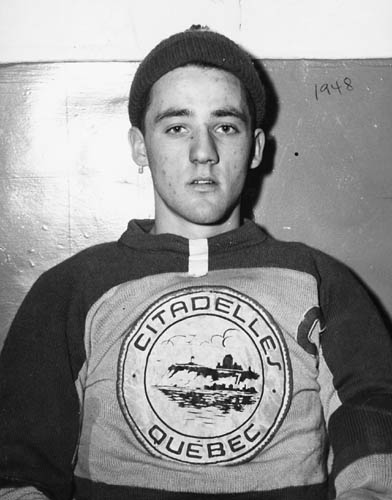
His legacy extends beyond a goaltender’s mask:
Plante was one of the first goaltenders to skate behind the net to stop the puck.[30][69] He also was one of the first to raise his arm on an icing call to let his defencemen know what was happening.[30] He perfected a stand-up, positional style, cutting down the angles; he became one of the first goaltenders to write a how-to book about the position.[30] He was a pioneer of stickhandling the puck; before that time, goaltenders passively stood in the net and simply deflected pucks to defencemen or backchecking forwards.[2]
Plante was inducted into the Hockey Hall of Fame in 1978,[30] and into the Quebec Sports Pantheon in 1994.[67] His jersey, #1, was retired in 1995 by the Montreal Canadiens.[70] The Jacques Plante Memorial Trophy was established in his honor as an award to the top goaltender in the Quebec Major Junior Hockey League.[67] The Jacques Plante Trophy was established in Switzerland after Plante’s death; it is given out annually to the top Swiss goaltender.[71] The main arena in Shawinigan the town he grew up in, was renamed to Aréna Jacques Plante.
Plante was selected by Sports Illustrated magazine to its 1991 all-time All-Star team.
His injury and subsequent donning of a mask was depicted in an installment of Canada’s Heritage Minute series.
On this day in 1863, a pen magnate is born:
On this date George Safford Parker was born in Shullsburg. While studying telegraphy in Janesville, he developed an interest in fountain pens. In 1891 he organized the Parker Pen Company in Janesville. The company gained world-wide acclaim for innovations like the duo-fold pen and pencil. Parker served as president of the company until 1933. Parker died on July 19, 1937. [Source: Dictionary of Wisconsin Biography, p.280]
Assault Awareness & Prevention, City, Corporate Welfare, Culture, Economics, Economy, Free Markets, Government Spending, Local Government, University, Waste Digesters, WEDC, WGTB, WHEN GREEN TURNS BROWN
Boo! Scariest Things in Whitewater, 2015
by JOHN ADAMS •

The list runs in reverse order, from mildly frightening to truly scary.
10. The Coming Ferret Invasion. Alternative title: The Unprepared Will Be Doomed. Earlier this year, I predicted that Whitewater would experience a massive invasion of ferrets. Why? Because I correctly guessed that New York City would not lift its ban on ferret ownership in that city. In consequence, the aggrieved, hidden ferrets of the Big Apple are sure to decamp for  another location.
Whitewater, of course.
In my estimation, they were supposed to be here by mid-October, but perhaps they’re walking more slowly than I’d calculated.
In any event, there’s a way to protect ordinary, decent residents from the rodent takeover. (It’s mistaken to say that this website does not offer solutions to problems. It often does. I would also
remind officials of Whitewater that the easiest way to avoid problems is not to take actions that cause problems.)
Here’s how to protect Whitewater against thousands of invading ferrets. First, find a city official who has time on his hands. That’s the easy part. Second, station that official miles from Whitewater, in a rural location between here and the ferrets’ path. Third, as these small, voracious mammals approach, it will be the official’s job to associate a picture with food, happiness, etc., in the ferrets’ minds. That way, they will seek the location in the picture, and avoid residents’ homes and businesses. The entire advancing horde will congregate only at the location depicted in the photograph.
I’ve just the place in mind:

Problem solved.
9. Key People. I heard a presentation recently where the presenter tried to reassure others that she would seek the input of key people. There are no key people – at least not in a way that makes it worth using the term. There are only key ideas. All the rest is an attempt at flattery or an expression of insecurity.
A group of supposedly key people is no match for one ordinary man or woman with a key idea.
8. One’s Own Words. They must be scary; one hears them so seldom. There are a few who think that somehow they’re better off relying on poorly written and poorly read publications than speaking and writing on their own. That’s a mistake. Servile papers and websites will not prove enough, anymore; the readership dynamic in this city shifted irreversibly against their publications.
(Actual traffic measurements of various publications are nothing like how insiders or publishers want to portray them; realistic measurements show how far insiders’ publications have declined or stagnated, and how much others have gained. One can be very confident about the future in this regard.)
Talented people – including many officials individually – are simply throwing away their opportunities when they rely on publications markedly inferior to their own abilities.
7. Potholes. They must be scary, because we’re avoiding them, and spending more on big projects than we’d need for simple street repair.
6. Gaps. The greatest republic in human history (ours) grew in liberty and prosperity though careful examination of projects and ideas. We did not develop word-class technologies by believing ‘close is good enough’ on engineering or fiscal projects. When, however, someone asks that American standards be applied to Whitewater’s projects, officials whine that identifying gaps is unfair, nitpicking, etc.
In what society do they think they live, for goodness’ sake?
America is great, in significant part, because she – unlike foul Third World autocracies, for example – expects high standards from her leaders and their proposals.
5. Open Government & Temporary Amnesia. Every public body has a website, on which they publish every big boast, but somehow these same officials can’t seem to remember how to post key public documents prominently. They seem to forget, but only temporarily and selectively.
4. WEDC money. Not just worthless – it is – but worse: a diversion of resources from far greater needs. The many poor in this city get nothing from this money.

3. Data. Presenting scores in a realistic context is harder for Whitewater’s school administrators than facing a pack of savage wargs.
2. Filth, Scum, and the Flimsy Scheme to Bring Them to the City. I’ve a series about this, in WHEN GREEN TURNS BROWN. There’s a burn-the-village-to-save it quality to waste importation as a means of revenue. (And yet, the sadness here is that the entire digester-energy project was unnecessary, and the obloquy it brings being wholly deserved for being unforced.)
1. The Ethical Indifference of Act Utilitarianism. Some of the large public institutions of this city show time and again that they care more about their reputations – and that means the reputations of their leaders – than the health and safety of their ordinary members.
The worst example of this has been the repeated downplaying of violent assaults against women on campus while touting accomplishments that cannot, ethically, matter as much as those injuries. These have been self-protective, morally empty, and ultimately futile attempts at diversion and subject-changing.
A climate like this has invited and will invite further tragedies; the worst of this, sadly, surely is not over.
Other officials who allow subject-changing are, themselves, culpable of a supportive wrong. See, An Open Note to Leaders of the Municipal Government, the School District, and UW-Whitewater. It’s right and fair that officials who aid in diversionary conversations should be called out directly & specifically when they make that attempt.
For it all, we’ll get to a better city, consigning these ways to the dustbin.
There’s the 2015 list. We’re more than able to overcome these problems, for a stronger community.
Best wishes to all for a Happy Halloween.