FREE WHITEWATER

About Lily the Dog

Reporter Fred Mogul wonders about his family’s dog: 

Let me say a few things about Lily: She has never tried to herd people, children, cats or dogs. She does not look like a classic herding dog. You wouldn’t mistake her for Lassie or the border collie in Babe. And we have no particular reason to think she’s been yearning to herd sheep.

But she is a proud adoptee from a shelter called Herding Dog Rescue, so we in her family have always had two basic, interrelated questions: Which breeds are mixed into her mongrel lineage, and if she ever met a sheep, what would she do?

Via Do City Dogs Dream Of Chasing Country Sheep? @ NPR

Are Automats Restaurants?

There’s a story over at the New York Times about a new business in San Francisco, Eatsa, that’s like an old-fashioned automat: “[a]t this restaurant, customers order, pay and receive their food and never interact with a person.”

See, Restaurant of the Future? Service With an Impersonal Touch @ NYT.

(The story’s somewhat puzzling because reporter Claire Cain Miller never mentions that America once had many establishments like this, including the Horn& Hardart chain.  Not identical, of course, but very close in character.)  

I’m not sure that automats, let alone an even less-personal one like Eatsa, should be called restaurants. They’re more like grocery stores to me.  Even a fast-food restaurant takes orders, but in Eatsa, there’s no order-taker, just as there wasn’t in an automat.  One selects one’s own, brings it to a cashier, or in the new version even pays without a cashier.

That’s akin to a grocery store or a vending machine.  

There may be times when that’s convenient, and efficient, but without any human service, even in taking one’s request, I wouldn’t think of Eatsa as a restaurant.  

It’s more like a vending machine with a roof.  

Daily Bread for 9.10.15

Good morning, Whitewater.

Thursday in Whitewater will bring scattered thunderstorms and a high of seventy-four. Sunrise is 6:19 and sunset 7:13, for 12h 43m 24s of daytime. The moon is a waning crescent with 6.9% of its visible disk illuminated.

On this day in 1919, Gen. Pershing and thousands of his soldiers, victorious against the Central Powers, receive a parade in their honor in New York:

New York lived yesterday probably the last chapter in its history of great military spectacles growing out of the war.

Devoted to honoring General John J. Pershing, Commander in Chief of the American Expeditionary Forces, and to paying tribute to the final array of veteran fighting men to parade down Fifth Avenue, it was a fitting chapter. For the city proved that, though it is ten months since Armistice Day, it has not forgotten either the hosts who fought in France or the man who led them to Victory.

It was the town’s first opportunity to greet the men of the 1st Division, and to let them know it remembered their glorious part in the American Army’s smashing drives at Toul, at Cantigny, at Soissons, at St. Mihiel, and at the Meuse and the Argonne. Likewise, it was the first appearance here of “Pershing’s Own,” that regiment of stalwart veterans picked from the first six regular army divisions in France, which paraded as Pershing’s escort in Paris and in London, as it did here. Altogether, more than 25,000 fighting men were in line.

A vast throng turned out, which stood in places many deep, all along Fifth Avenue from 107th Street to Washington Square. More than that, it was an enthusiastic crowd, as prone to applause and acclaim as any that a spectacle of the war has called forth.

Here’s the Thursday game in Puzzability’s series for the week, Open Admissions:

This Week’s Game — September 7-11
Open Admissions
Here’s a mixed doubles challenge for this week’s U.S. Open. Each day, we started with a word or phrase, added the six letters in U.S. OPEN, and rearranged the remaining letters to get a new phrase. Both pieces are described in each day’s clue, with the shorter one first.
Example:
A bit open; fruits sold near the Boscs and Bartletts
Answer:
Ajar; Anjou pears
What to Submit:
Submit both pieces, with the shorter one first (as “Ajar; Anjou pears” in the example), for your answer.
Thursday, September 10
Part of Captain Kirk’s log entries; Planters’ basic product type

What City Officials and the Press Haven’t Told You About the HyPro Layoffs

Updated, 9.9.15, 2 PM, and bumped forward from original 9.8.15 post date. I’m always eager for more discussion about WEDC –

To reconcile the figures of $1,300,000 and $262,000: There are differences in the dollar amounts of tax credits depending on whether one considers the maximum authorized or the amount HyPro has so far taken.

In 2013, HyPro had a maximum tax-credit authorization of over a million dollars ($1,300,00). The company used around $262,000 of that maximum. (The Legislative Fiscal Bureau report below lists legal maximums in Economic Development Tax Credit — Maximum Total Tax Credit Limit.)

That maximum, by the way, assumed 80 jobs created for $1.3 million in tax credits, or $16,250 per job.

In the clip below, WKOW reports that HyPro so far took over $262,000 in credits, and created just two jobs.

The tax credits used were actually 8x less efficient than WEDC estimated.

The WEDC’s own records indicate that HyPro created jobs at the price of over $131,000 per job.  

There should have been no tax credits for this employer; everything received should be paid back.

WKOW 27: Madison, WI Breaking News, Weather and Sports

Original post, 9.8.15:

Local newspapers have reported that HyPro is laying off over sixty workers at its Whitewater building. Those workers will be out of jobs by early November.  

What city officials and local newspapers haven’t mentioned is that only two years ago, HyPro received $1,300,000 in tax credit [authorization] from the Wisconsin Economic Development Corporation.  

One-million, three-hundred thousand in tax credits.

See, from the Legislative Fiscal Bureau,  Economic Development Tax Credit — Maximum Total Tax Credit Limit (General Fund Taxes — Income and Franchise Taxes), page 16.

Commenting on these layoffs, Whitewater City Manager Clapper is quoted in the Daily Union observing that that “[w]e’re sad to see them go, but we recognize this happens in the life cycle of a business.” See, HyPro Inc. closing Whitewater plant @ http://www.dailyunion.com/news/article_d83ec8d2-5291-11e5-a5a7-1fb4265234ef.html.  

If that should be so, and these developments occur in the life cycle of a business, then why would Wisconsin offer $1,300,000 in tax credits to that business?  Either that money was futile from the beginning or it’s not true that layoffs like this simply happen in the “life cycle of a business.”  

Proponents of the WEDC cite its funding selectively: big talk when the grants, loans, or credits are issued, but then silence when those grants, loans, or credits prove ineffectual.  

(Rep. Jorgensen is quoted in the same story alluding to the failure of tax credits as an incentive, although his printed remarks don’t say directly that HyPro received tax credits, or in what amount. He’s right to be critical of the WEDC; it’s almost a measure of reasonableness.)

City Manager Clapper has been a supporter of the WEDC, likening its work to a natural science like chemistry.  

WEDC funding is nothing like a natural science; it’s akin to alchemy, not chemistry.

HyPro’s workers deserved better than the WEDC.

Wisconsin Ill Serves Her Nationally-Ambitious Politicians 

Over the last generation, Wisconsin has had her share of politicians with national ambitions, to cabinet offices or elected executive office (Democrat Les Aspin, Republicans Tommy Thompson, Paul Ryan, Scott Walker among them).

They’ve not fared so well; Gov. Walker’s effort is still ongoing.  

All of those I’ve listed were regarded in Wisconsin as especially skilled before they took cabinet positions or sought federal executive, elected office.  

When serving federally or running, however, they all hit (or are hitting) difficult waters. 

I’d say part of the reason is that our state press may be critical, but many reporters ask only one (critical) question, if that. There’s either no follow up, or weak follow up to an odd answer.  Politicians here get to slide on shaky claims.

Nationally, there are enough inquisitive reporters, editorialists, and bloggers so that an easy pass isn’t possible.  

One can rise far in a local arena without persistent follow up, but across America, there are competitive Democrats and Republicans who grew up in a more demanding environment.  When Wisconsin politicians meet rivals from other parts of the country, they find themselves facing foes (often within the same party) that are more adroit.   

These rivals are not smarter, truly, as much as they’re more adroit from a demanding environment.

As it turns out, a national-level of conditioning matters a great deal.  

By the time an aspiring politician sees this, however, it may be too late to acquire the necessary skill and insight. 

It’s simply prudent, locally or nationally, to try (as best one can) to meet a national standard all along.

Daily Bread for 9.9.15

Good morning, Whitewater.

Wednesday in town will be mostly sunny with a high of seventy-seven. Sunrise is 6:28 and sunset is 7:15, for 12h 46m 14s of daytime. The moon is a waning crescent with 12.8% of its visible disk illuminated.

On this day in 1776, Congress adopts a formal name for America:

On this day in 1776, the Continental Congress formally declares the name of the new nation to be the “United States” of America. This replaced the term “United Colonies,” which had been in general use.

In the Congressional declaration dated September 9, 1776, the delegates wrote, “That in all continental commissions, and other instruments, where, heretofore, the words ‘United Colonies’ have been used, the stile be altered for the future to the “United States.”

On this day in 1954, Janesville residents debate alcohol laws:

On this date Janesville residents participated in a public forum at the Janesville Public Library. The topic of discussion was whether Janesville should allow women to be served at the bar, in taverns. Residents also debated whether dancing should be allowed in taverns. Speaking to lift the bans was Erv Lacey, field director of the Tavern League of Wisconsin. Lacey noted that the law against women being served was discriminatory and contended that Janesville taverns lose business because of the laws. The Rev. Frank Dauner, pastor of United Brethren Church, said the strict prohibitions should remain intact because alcohol threatened public health, safety and peaceful domestic life. [Source: Janesville Gazette]

Here’s the midweek game from Puzzability in this week’s Open Admissions series:

Daily Bread for 9.8.15

Good morning, Whitewater.

Tuesday will bring thunderstorms to Whitewater, with a daytime high of seventy-six. Sunrise is 6:27 and sunset 7:16, for 12h 49m 04s of daytime. The moon is a waning crescent with 20.1% of its visible disk illuminated.

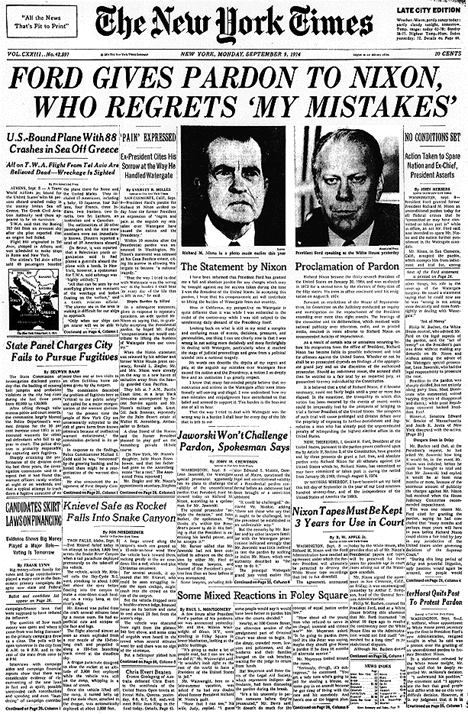
On this day in 1974, Ford Pardons Nixon:

0908_bigWashington, Sept. 8–President Ford granted former President Richard M. Nixon an unconditional pardon today for all Federal crimes that he “committed or may have committed or taken part in” while in office, an act Mr. Ford said was intended to spare Mr. Nixon and the nation further punishment in the Watergate scandals.

Mr. Nixon, in San Clemente, Calif., accepted the pardon, which exempts him from indictment and trial for, among other things, his role in the cover-up of the Watergate burglary. He issued a statement saying that he could now see he was “wrong in not acting more decisively and more forthrightly in dealing with Watergate.”

On this day in 1860, hundreds are lost in Lake Michigan:

1860 – Sinking of the Lady Elgin
On this date the steamship Lady Elgin was lost on Lake Michigan and was one of the lake’s most tragic maritime disasters. The ship had been chartered by Milwaukee’s Irish Union Guards who had been in Chicago attending a fund raiser in order to purchase weapons to arm their unit. Their ship was struck by an unlit lumber schooner and sank. At least 300 lives were lost, many from Milwaukee’s Irish Third Ward community. [Source: History Just Ahead: A Guide to Wisconsin’s Historical Markers edited by Sarah Davis McBride, p. 17]

Here’s Puzzability‘s Tuesday game:

This Week’s Game — September 7-11
Open Admissions
Here’s a mixed doubles challenge for this week’s U.S. Open. Each day, we started with a word or phrase, added the six letters in U.S. OPEN, and rearranged the remaining letters to get a new phrase. Both pieces are described in each day’s clue, with the shorter one first.
Example:
A bit open; fruits sold near the Boscs and Bartletts
Answer:
Ajar; Anjou pears
What to Submit:
Submit both pieces, with the shorter one first (as “Ajar; Anjou pears” in the example), for your answer.
Tuesday, September 8
Newborn child; writing implements requiring separate ink purchases

The Least Possible Information

WGTB logo PNG 112x89 Post 29 in a series. When Green Turns Brown is an examination of a small town’s digester-energy project, in which Whitewater, Wisconsin would import other cities’ waste, claiming that the result would be both profitable and green.

There is a story, an editorial, and an editorial reply at the Janesville Gazette about concentrated animal feeding operations (CAFOs). In effect, CAFOs are factory farms with thousands of animals.

There’s a factory farm near Bradford, the owners (from Nebraska) want another one in Green County, and the Gazette aims to reassure anyone in Green County who might accidentally stumble on the Gazette that a factory farm nearby would be just delightful.

The story is Does it smell? Neighbors to 5,000 cows get questions from neighbors of proposed farm (subscription req’d). The editorial is Our Views: Green County residents should welcome big dairy (subscription req’d). In reply, Kara O’Connor, representing small farmers in Wisconsin, writes Local views: New giant dairy would benefit Nebraska family, not Green County.

Part, but not all, of a waste-importation plan would likely rely on trucking waste from CAFOs into Whitewater.

An examination of CAFOs is a big subject, one that I will undertake later in this series. Wisconsinites, both researchers and ordinary residents, have spent thousands of hours studying concentrated animal feeding operations and their effects on human health and the environment. If anything, that’s a conservative estimate of the amount of time collectively spent.

If one read only the Gazette‘s story and editorial, one wouldn’t know about any of that research. One would have only a tissue-thin story about how a few residents are quoted as saying that a nearby factory farm doesn’t smell so bad. Smell, as though the risks were only those of odor (one that commenters point out is far worse than the reporter’s few quotes suggest).

The original story, by the way, looks like an intentional downplaying of risks so that the paper’s editorial board could flack a local big business’s efforts for another factory farm (‘see, it’s not so bad’).

Go ahead, read all three and compare.

What’s telling here is that if one read only the Gazette‘s story and editorial, one would have no idea about the widespread criticism of these huge farms. (In fact, even O’Connor’s reply highlighting problems is brief and mild compared with accounts across the state.)

Downplaying criticism is effective for factory farmers only if information about hazards to people and the environment can be concealed.

It can’t be.

WHEN GREEN TURNS BROWN: Mondays @ 10 AM, here on FREE WHITEWATER.