
FREE WHITEWATER

Daily Bread for 8.20.14

Good morning, Whitewater.

Wednesday in town will be mostly sunny with a high of eighty-three. Sunrise today is 6:07 AM and sunset is 7:49 PM. The moon is a waning crescent with twenty percent of its visible disk illuminated.

The Whitewater CDA Seed Capital Screening Committee meets at 3:30 PM, and the Community Development Authority Board at 5 PM.

On this day in 1911, the first telegram travels around the world by design in a commercial test:

The New York Times sends a telegram message to test how fast a commercial message could be sent around the world. Reading simply, “This message sent around the world”, it left at 7 PM, traveled over 28,000 miles and was relayed by 16 different operators. It arrived back at The Times only 16.5 minutes later. The building where the message originated is now called One Times Square and is best known for where the ball drops on New Year’s Eve.

On this day in 1794, American soldiers win the Battle of Fallen Timbers:
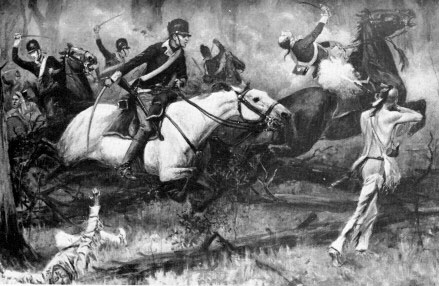
Fallen_timbers
An 1896 depiction of the battle from Harper’s Magazine.

1794 – Battle of Fallen Timbers
On this date American troops under General “Mad” Anthony Wayne defeated a confederation of Indian forces led by Little Turtle of the Miamis and Blue Jacket of the Shawnees. Wayne’s soldiers, who included future Western explorer William Clark and future President William Henry Harrison, won the battle in less than an hour with the loss of some 30 men killed. (The number of Indian casualties is uncertain.)

The battle had several far-reaching consequences for the United States and what would later become the state of Wisconsin.

The crushing defeat of the British-allied Indians convinced the British to finally evacuate their posts in the American west (an accession explicitly given in the Jay Treaty signed some three months later), eliminating forever the English presence in the early American northwest and clearing the way for American expansion.

The battle also resulted in the 1795 Treaty of Greenville, in which the defeated Indians ceded to Wayne the right of Americans to settle in the Ohio Valley (although the northwestern area of that country was given to the Indians). Wayne’s victory opened the gates of widespread settlement of the Old Northwest, Wisconsin included. [Source: American History Illustrated, Feb. 1969]

Google-a-Day poses a question about poetry:

In the poem that includes the lines, “This is the dead land, This is cactus land”, to what work is the first epigraph an allusion?

One Reason a Comprehensive Marketing Plan Can’t Work (Now) in Whitewater

There’s talk, about every six months or so, about launching a comprehensive marketing plan for Whitewater.  (This must be version 17.0 by now.) 

I’ll set aside the problem of past efforts at marketing the city dishonestly, as though prospects were too dim to see through blatant exaggerations or omissions about life in town.  (See, The Failure of Marketing (and the Marketing of Failure)). 

There’s another problem: to market the town to good prospects requires presenting it both honestly and differently from the way in which declining town squires insist it must be presented.

Present effectively, and a waning old guard will be alienated or insulted; present as that old guard insists, and few prospects will find the presentation persuasive (or even credible).

Aging insiders would have to set aside their own pride to present Whitewater both honestly and effectively to newcomers.  They’d have to learn new tricks.

Even if they’re able to imagine a campaign that would be effective to outsiders (and that’s doubtful), they’ll never launch it as the content of that effort would undermine years of smug insistence that they’re masters at all this. 

So, here they are: waste money on a futile effort that appeals only to insiders’ pride, or commit to an effective program that abandons insiders’ tired method in favor of an appeal to motivated newcomers.  

It will be nearly impossible for them to overcome their own pride; it would be easier for them to flap their arms and fly. 

The Fragmented Audience

Whitewater’s a small town, but it has more than one culture within its nine square miles. 

(There’s a separate issue, suitable for another time, about whether it’s legitimate to have more than one culture or method from Whitewater’scity government.  It’s not; unlike diverse private life, a representative government cannot legitimately allow its officials and employees different standards from that of the community.)   

In private life, however, many combinations are, and should, be possible. 

What’s characteristic about Whitewater over these last ten years or so is that a supposedly common view of life here has collapsed.  Some see as much; others refuse to see it.  Many grew up or arrived with the idea of one Whitewater, but that’s no longer true.  Wishing for it will neither obscure change nor restore an older condition. 

Consider just a few statements made in town, or from nearby places.  For those who made them, they seem perfectly true and reasonable.  For others, they seem odd or ill-considered.

  • Ongoing businesses that display a window sign for a program entitled, “What you Will Need to Know When You are Ready (or Not) to Sell Your Business.”
  • “One of the primary purposes of the next meeting is to ensure the construction site is properly protected in anticipation of UWW students returning to campus.”
  • “A major reason for a styled-up front [of a public building costing more than 8 million] was to create curb appeal for the thousands of motorists who travel Highway 51 into the city each week, he said.”

It’s part of Whitewater’s lingering past that some will see them as sensible; it’s part of her transition to something new that others will see these statements as odd.  The older group overestimates its size and ability; the newer group underestimates its own. 

(Election results reveal change, and because of that the older faction avoids any other accurate, comprehensive surveys of popular opinion, lest the extent of this transition be made more obvious.)

Here we are, in flux. 

Daily Bread for 8.19.14

Good morning, Whitewater.

Tuesday brings a slight chance of thunderstorms and a high of eighty-two. Sunrise is 6:06 AM and sunset 7:51 PM. The moon is a waning crescent with twenty-nine percent of its visible disk illuminated.

Common Council meets tonight at 6:30 PM.

On August 19, 1934, Germany selected Adolf Hitler by plebiscite as leader-chancellor. Here’s how the New York Times reported Germany’s descent into despotism the next day:

Berlin, Monday, Aug. 20 — Eighty-nine and nine-tenths per cent of the German voters endorsed in yesterday’s plebiscite Chancellor Hitler’s assumption of greater power than has ever been possessed by any other ruler in modern times. Nearly 10 per cent indicated their disapproval. The result was expected.

The German people were asked to vote whether they approved the consolidation of the offices of President and Chancellor in a single Leader-Chancellor personified by Adolf Hitler. By every appeal known to skillful politicians and with every argument to the contrary suppressed, they were asked to make their approval unanimous.

Nevertheless 10 per cent of the voters have admittedly braved possible consequences by answering “No” and nearly [text unreadable] made their answers, ineffective by spoiling the simplest of ballots. There was a plain short question and two circles, one labeled “Yes” and the other “No,” in one of which the voter had to make a cross. Yet there were nearly 1,000,000 spoiled ballots….

Google-a-Day asks a question about musical history:

What musical period is best described as an era of contrasts; e.g., between loud and soft, fast and slow?

Projects Have a Price, Immediately and Consequently

Government will sometimes offer a look at a program or proposal, with a list of supposed benefits. There may be a set of colorful photographs, and a list of nebulous but optimistic (even grand) declarations of all it will offer (growth, development, jobs, opportunity, etc.).

Toads in the press – and like cane toads, they’re multiplying — will write about these projects uncritically.

What one won’t see – until later – is an initial, estimated cost and a thorough analysis of consequent costs and benefits of the project. 

A technique like this works best, if at all, only on the gullible or otherwise weak-minded.


That won’t stop officials and their press-enablers, however, from using it.

In the end, though, a discussion begins in earnest when one has a projected cost; thereafter, a community may begin assessing that estimate, and calculating otherwise inadvertently ignored (or conveniently hidden) consequences. 

Daily Bread for 8.18.14

Good morning, Whitewater.

Monday brings a one-third chance of thunderstorms during the day, an eight-in-ten chance this evening, with a high of eighty.

On this day in 1991, Soviet diehards stage a coup against Gorbachev:

The 1991 Soviet coup d’état attempt, also known as the August Putsch or August Coup … Avgustovsky Putch), was a coup d’état attempt by a group of members of the Soviet Union‘s government to take control of the country from Soviet president Mikhail Gorbachev. The coup leaders were hard-line members of the Communist Party of the Soviet Union (CPSU) who were opposed to Gorbachev’s reform program and the new union treaty that he had negotiated which decentralised much of the central government’s power to the republics. They were opposed, mainly in Moscow, by a short but effective campaign of civil resistance.[5] Although the coup collapsed in only two days and Gorbachev returned to government, the event destabilised the Soviet Union and is widely considered to have contributed to both the demise of the CPSU and the dissolution of the Soviet Union.

After the capitulation of the State Committee on the State of Emergency—popularly referred to as the “Gang of Eight,” the Supreme court of the RSFSR and the President of the USSR Mikhail Gorbachev qualified their actions as a coup attempt.

In Wisconsin history on this date, a baseball great is born:

1893 – Burleigh Arland Grimes Born

On this date Baseball Hall of Famer Burleigh Arland Grimes was born in Emerald, Wisconsin. Knicknamed “Ol’ Stubblebeard” and known as the last legal spitball pitcher, Grimes played major league baseball for the New York Yankees, St. Louis Cardinals, Chicago Cubs, Boston Braves, Pittsburgh Pirates, New York Giants, and the Brooklyn Dodgers from 1916 to 1934. After spitball pitching was banned in 1920, 17 established spitball pitchers were allowed to continue with the pitch. Grimes lasted the longest, using the spitball until retiring in 1934. He won 270 games over 19 seasons for seven major league teams, reaching 20 wins in a season on five occasions. He helped Brooklyn to the championship in 1920, the Cardinals to pennants in 1930 and 1931, and the Cubs to the flag in 1932. Grimes was known as “Ol’ Stubblebeard” for his habit of not shaving on the day he was scheduled to pitch. Grimes managed the Brooklyn Dodgers from 1937 to 1938. He was elected to the Baseball Hall of Fame in 1964. Burleigh Arland Grimes died on December 6, 1985 in Clear Lake. [Source: Wisconsin Lore and Legends edited by Lou and John Russell, p.30 and Baseball Hall of Fame]

Google-a-Day asks about the architecture of the Ancients:

The Parthenon combined elements of two of three classical architectural orders. Which one was not included?


Daily Bread for 8.17.14

Good morning, Whitewater.

Sunday in Whitewater will be partly sunny with a high of seventy-five, and east winds of ten mph. Sunrise today is 6:03 AM and sunset 7:54 PM. The moon is in its last quarter today.

In the mid-August sky, the conjunction between Venus and Jupiter is on display. A short Vine clip captures the scene, even lovelier when viewed directly:


On this day in 1978, three adventurers make the world’s first trans-Atlantic balloon crossing:

Double Eagle II, piloted by Ben AbruzzoMaxie Anderson, and Larry Newman, became the first balloon to cross the Atlantic Ocean when it landed 17 August 1978 in Miserey near Paris, 137 hours 6 minutes after leaving Presque IsleMaine.

It can be regarded as a successful crossing at the point that the Double Eagle II crossed the Irish coast, on the evening of 16 August, an event that Shannon Airport notified the crew about when it happened. Newman originally intended to hang glide from the balloon to a landing, while Anderson and Abruzzo continued to fly, but the hang-glider had to be dropped as ballast earlier on 16 August.

While flying over France, they heard by radio that authorities had closed Le Bourget Airfield, where Charles Lindbergh had landed, for them. The crew declined the offer as they were running out of ballast and it would be too risky (to themselves and anyone below) to pass over the suburbs of Paris. They landed in a field of barley, owned by Roger and Rachel Coquerel, in Miserey, 60 miles (96 km) northwest of Paris. Television images showed a highway nearby, its shoulders and outer lanes crowded with stopped cars, people sweeping across the farm field to the landing spot. The gondola was protected, but most of the logs and charts were swiped by souvenir hunters.

The flight, the fourteenth known attempt, was the culmination of more than a century of previous attempts to cross the Atlantic Ocean by balloon. Some of the people who had attempted it were never found.

Larry Newman won a draw among the three to sleep in the same bed at the United States embassy that Lindbergh slept in. Cameron and Davey, the British balloonists, feted the trio at a party that included a balloon shaped like the Double Eagle II. The trio and their wives planned to return to the United States aboard the supersonic Concorde. Upon the successful crossing, the trip was accommodated by Air France at no charge to the trio and spouses.

A full chronicle of the voyage can be found in the December 1978 issue of National Geographic.

The Double Eagle II Airport is named for the balloon.

The gondola is displayed at the Steven F. Udvar-Hazy Center of the Smithsonian National Air and Space Museum annex at Washington Dulles International Airport in the Chantilly area of Fairfax CountyVirginiaUnited States.[1] A monument, containing a model of the balloon, was built to commemorate the Double Eagle II and its Atlantic crossing at the field from where the balloon lifted off (46°37?36.54?N 68°1?16.66?W).