FREE WHITEWATER

Daily Bread for 4.18.14

Good morning.

Good Friday in Whitewater will be clear, with a high of fifty-five, and north winds around 5 MPH.

On this day in 1906, an earthquake hits San Francisco:

At 5:13 a.m., an earthquake estimated at close to 8.0 on the Richter scale strikes San Francisco, California, killing hundreds of people as it topples numerous buildings. The quake was caused by a slip of the San Andreas Fault over a segment about 275 miles long, and shock waves could be felt from southern Oregon down to Los Angeles.

San Francisco’s brick buildings and wooden Victorian structures were especially devastated. Fires immediately broke out and–because broken water mains prevented firefighters from stopping them–firestorms soon developed citywide. At 7 a.m., U.S. Army troops from Fort Mason reported to the Hall of Justice, and San Francisco Mayor E.E. Schmitz called for the enforcement of a dusk-to-dawn curfew and authorized soldiers to shoot-to-kill anyone found looting. Meanwhile, in the face of significant aftershocks, firefighters and U.S. troops fought desperately to control the ongoing fire, often dynamiting whole city blocks to create firewalls. On April 20, 20,000 refugees trapped by the massive fire were evacuated from the foot of Van Ness Avenue onto the USS Chicago.

By April 23, most fires were extinguished, and authorities commenced the task of rebuilding the devastated metropolis. It was estimated that some 3,000 people died as a result of the Great San Francisco Earthquake and the devastating fires it inflicted upon the city. Almost 30,000 buildings were destroyed, including most of the city’s homes and nearly all the central business district.

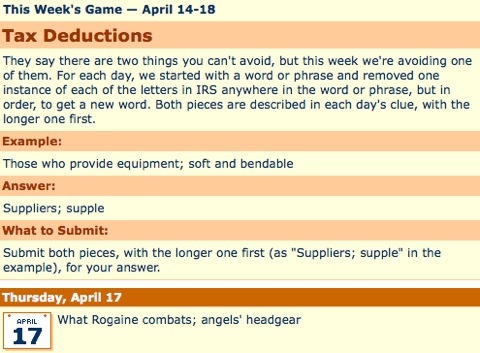
Here’s Puzzability‘s final game in this week’s Tax Deductions series:

This Week’s Game — April 14-18
Tax Deductions
They say there are two things you can’t avoid, but this week we’re avoiding one of them. For each day, we started with a word or phrase and removed one instance of each of the letters in IRS anywhere in the word or phrase, but in order, to get a new word. Both pieces are described in each day’s clue, with the longer one first.
Example:
Those who provide equipment; soft and bendable
Answer:
Suppliers; supple
What to Submit:
Submit both pieces, with the longer one first (as “Suppliers; supple” in the example), for your answer.
Friday, April 18
April Fool’s Day or May Day, for example; burglary

Policy in the City

20140417-113520.jpg

Council had a busy agenda Tuesday night, and there’s much to consider from the meeting.  For today, though, here are two points not about specific policies, but about policy generally.

First, Council Pres. Singer and Pres. Pro Tem Binnie were re-elected unanimously to those posts. That’s good for the city, as they’re steady in manner, in a city where steadiness is often hard to find. Council meetings in Whitewater are well run, and even when there are occasional glitches (as is inevitable, anywhere), Patrick Singer has handled those situations well.  

Second, an unsuccessful request from a local group should be a reminder about the difference between publicity (advertising or marketing) and policy.    

Favorable publicity is not an assurance of favorable policy.  

In the request Tuesday, a group that had (to my mind) a very successful event last week failed to receive a sponsorship grant from Common Council.

Now, I attended the event, with my wife and youngest, and we had a fantastic time.  The next morning at breakfast, we talked about how much fun we had, and how we enjoyed the show.  The hundreds who attended the show with us (and nearly a thousand combined attended one of two shows) would probably say the same – the room that evening was filled with delighted spectators.  

Afterward, the event received favorable coverage elsewhere, with color photos of animals on display that night.       

Nonetheless, color photos are not policy, and favorable publicity is no guarantee of being well-received politically.   

In a world where many people speak or write on policy (Web, Facebook, Twitter, blogs, television, radio etc.), making a case requires repeated, detailed effort.  

One has to return to a policy topic again and again, in a thorough and responsive way (and in new ways, as forms of expression evolve).  

(For example, it’s very true that the forces of white-collar welfare, exaggerated claims, bias, and closed government have an insatiable craving to manipulate public life to their selfish advantage. They don’t rest, and so neither should the advocates of free markets in capital, labor, and goods, of individual liberty, and of limited government.)  

I’m sure Look magazine was a wonderful publication, but it’s not around anymore, and in any event no one called it the ‘in-flight magazine of Air Force One.’  Some said that (at one time) about the New Republic because they saw that different publications have different roles in the marketplace of ideas.  

A picture may be worth a thousand words, but for policy-making one needs certain words – sound, well-crafted, and oft-repeated.

Daily Bread for 4.17.14

Good morning.

Thursday will be a partly sunny day, with a high of fifty-five.  

The Fire & Rescue Task Force is scheduled to meet at 7 PM.  

On this day in 1964, Ford Motor Company unveils a company-saving car:

The Ford Mustang, a two-seat, mid-engine sports car, is officially unveiled by Henry Ford II at the World’s Fair in Flushing Meadows, New York, on April 17, 1964. That same day, the new car also debuted in Ford showrooms across America and almost 22,000 Mustangs were immediately snapped up by buyers. Named for a World War II fighter plane, the Mustang was the first of a type of vehicle that came to be known as a “pony car.” Ford sold more than 400,000 Mustangs within its first year of production, far exceeding sales expectations.

On April 17, 1897, Thornton Wilder is born:

1897 – Thornton Wilder Born
On this date Thornton Wilder was born in Madison. A renowned author and playwright, he taught at the University of Chicago from 1930 to 1937. His plays Our Town (1938) and The Skin of our Teeth (1942) won Pulitzer Prizes and have been performed countless times by school and amateur theatrical companies in the decades since.You can read a 1928 article about his Wisconsin roots in our Wisconsin Local History & Biographies collection. [Source: Thornton Wilder Society]

Here’s Puzzability’s Thursday game:

20140417-070646.jpg

Daily Bread for 4.16.14

Good morning.

We’ll have a pretty Wednesday in Whitewater: sunny, breezy, with a high of fifty-two.

What would happen if a pianist and a singer (let’s say Jimmy Fallon and Anne Hathaway) decided to perform rap songs (let’s say Gin and Juice, In Da Club, and B*tch Don’t Kill My Vibe) as though they were Broadway tunes?

This is what would happen –


Clever.

On this day in 1944, America commissions the Wisconsin:

g453313

1944 – USS Wisconsin Commissioned
On this date the USS Wisconsin battleship was put into active duty for service during World War II. The ship, decommissioned in 1948, was recommissioned in 1951 for service in the Korean War. [Source: United States Navy]

Here’s Puzzability‘s Wednesday game:

This Week’s Game — April 14-18
Tax Deductions
They say there are two things you can’t avoid, but this week we’re avoiding one of them. For each day, we started with a word or phrase and removed one instance of each of the letters in IRS anywhere in the word or phrase, but in order, to get a new word. Both pieces are described in each day’s clue, with the longer one first.
Example:
Those who provide equipment; soft and bendable
Answer:
Suppliers; supple
What to Submit:
Submit both pieces, with the longer one first (as “Suppliers; supple” in the example), for your answer.
Wednesday, April 16
Particles used in PET scans; actor Tom of Newhart

What Would It Take for Someone to Believe Nothing’s Changed in Whitewater in a Generation?

Look around, and you’ll see both physical and social change in our small city.

What, then, might lead someone to insist that nothing in Whitewater seems to have changed in a generation?  

Well, perhaps if someone spent a really long time living underground in a bomb shelter.

Even then, though, one would expect that someone emerging would notice at least a few new things…

(First minute of trailer embedded.)

Innovation as a Fad

Innovation is both a genuine development and a fad.  

In a free society, with unrestricted flows of information, capital, labor, and goods, it’s nearly inevitable that people will improve products and services in powerful, clever ways.   

Innovation – the word, the idea, etc. – is also a contemporary fad, the jargon of our time.  It may be one of the greatest fads of our time, this ceaseless chattering over ‘innovation’ in our politics and economics.  Read, watch, and listen and one finds that – from any direction – America must innovate, must be innovative, desperately needs Innovative Ideas, Innovation Centers, Innovation Programs, Innovation Projects, Innovation Cats & Dogs, Innovation Cereal, etc.    

Over at the New Republic, there’s an essay entitled, Our Naive “Innovation” Fetish that describes how vacuous the term innovation has become.  (The essay mostly criticizes the fad of innovation from the left, because that’s the orientation of the magazine.  Still, author Evgeny Morozov rightly sees over-use of the term as an across-the-spectrum problem.)

I know that there’s a section in the local Gazette that focuses on innovation.  The New Republic‘s essay pre-dates the section in the Gazette, but nicely illustrates the over-use of the word.  

The term – repeated in communities incessantly as though it were a mental tic – is mostly empty when so repeated, borne of insecurity and the chicanery that feeds on insecurity.  

‘Innovation’ has the nature, if not the illegality, of a confidence game to it: “It all begins with ‘you really, really need to do this,’ ‘I just know you can do it,’ and ‘let me be the one to help you.’

In so many cases, and certainly in Whitewater, projects for innovation are (1) schemes to take public money, (2) pretend it has a productive or civic purpose, (3) while actually using it to enrich undeserving, white-collar business people and their connected friends.   

That’s not a crime, but it is repulsive corporate welfare.  

It is the truly needy who have a claim to public support, not a collection of cunning, insatiable men.

Among those who flack innovation as a political solution, one will find, principally, the scared and the scheming.  The first group is sadly desperate; the second is a white-collar group using others’ desperation for its own private profit at public expense.

Daily Bread for 4.15.14

Good morning.

It’s a chilly but mostly sunny tax day for Whitewater, with a high of thirty-eight.

Common Council meets tonight at 6:30 PM.

If you didn’t have the chance (or the viewing conditions) to enjoy the lunar eclipse this early morning, here’s a video replay from the Griffith Observatory. Moving ahead to around 1:40:00 in the video shows the deep red color of a so-called ‘blood moon.’

Video streaming by UstreamOn this day in 1783, Congress ratifies peace with Britain:

…the Continental Congress of the United States officially ratifies the preliminary peace treaty with Great Britain that was signed in November 1782. The congressional move brings the nascent nation one step closer to the conclusion of the Revolutionary War.

Five months later, on September 3, 1783, the Treaty of Paris was signed by representatives of the United States, Great Britain, Spain and France, officially bringing an end to the Revolutionary War. It also formalized Great Britain’s recognition of America’s independence….

This day in 1987, the first Brewers no-hitter:

1987 – Brewer’s First No-Hitter Game
On this date Juan Nieves recorded the Brewers first no-hitter, making him the first Puerto Rican-born pitcher to accomplish this feat in the Major Leauge. [Source: Milwaukee Brewers Timeline]

Here’s Puzzability’s Tuesday, tax-themed game:

This Week’s Game — April 14-18
Tax Deductions
They say there are two things you can’t avoid, but this week we’re avoiding one of them. For each day, we started with a word or phrase and removed one instance of each of the letters in IRS anywhere in the word or phrase, but in order, to get a new word. Both pieces are described in each day’s clue, with the longer one first.
Example:
Those who provide equipment; soft and bendable
Answer:
Suppliers; supple
What to Submit:
Submit both pieces, with the longer one first (as “Suppliers; supple” in the example), for your answer.
Tuesday, April 15
State of being thin but strong; Bordeaux and Chablis, for example

The Art of the Con

I wrote recently about how deception works best when a magician asks someone to look closely in one direction, while he performs his trickery in another direction, outside one’s gaze.  

(See, The Closer You Look, The Less You See.”  See, also, Techniques of Municipal Distraction Numbers 1-9, Numbers 10-18, and Numbers 19-22.)

A skillful confidence game isn’t merely about tricking someone.  It’s about tricking someone in a particular – highly effective – way.

The most effective – and so worst – confidence game isn’t when a swindler persuades a mark to have confidence in the con artist.  

The worst con is when the swindler persuades the mark that he, the swindler, has confidence in his victim, the mark.  

There’s a line from House of Games in which a con man explains a deeper fraud:

“It’s called a confidence game.  Why?  Because you give me your confidence?  No. Because I give you mine.”

Persuading someone to believe in a confidence man is only a penultimate fraud; persuading a victim to believe in his – the victim’s – own supposed need and ability to overcome that need himself (through the con man’s proposal) is the foundation of the ultimate swindle. 

It all begins with “you really, really need to do this,” “I just know you can do it,” and “let me be the one to help you.”

Seeing what’s coming – for what it is – is the beginning of a defense against it.

Be The Middle Cat

In a world of polar opposites, e.g., Left and Right, Republicans and Democrats, etc., there’s gain in taking an independent path.

It’s the middle cat that enjoys some meat, while others remain steadfast, but get nothing.