
Daily Bread
Friday Poll: Who Wins in NFL Playoffs?
by JOHN ADAMS •
Of the remaining eight teams in the NFL playoffs, who wins? I’ll say Seattle, Indianapolis, San Franscisco, Denver.
What do you think? The poll’s below, with multiple answers possible for your four picks.
Daily Bread
Daily Bread for 1.10.14
by JOHN ADAMS •
Good morning.
Friday brings a high of thirty-six and a wintry mix of rain, freezing rain, and sleet during the day.
On this day in 1861, President-elect Lincoln chooses wisely:
…William Seward accepts President-elect Abraham Lincoln’s invitation to become secretary of state. Seward became one of the most important members of Lincoln’s cabinet and engineered the purchase of Alaska after the Civil War.
A native of New York, Seward taught school in the South before returning to New York and entering politics. He became governor in 1838 and began to articulate strong anti-slavery views. Seward entered the U.S. Senate in 1849 and burst onto the national scene during the debates surrounding the Compromise of 1850. He boldly proclaimed that slavery was doomed by a “higher law than the Constitution, the law of God.” This became a catch phrase for abolitionists and Seward became known as a radical, belying his pragmatic tendencies.
Seward joined the Republican Party in the 1850s and appeared to be the leading candidate for president in 1860. However, the party went with Lincoln, feeling that he would draw more votes in the Midwest and border regions. Seward was initially reluctant to accept the position of secretary of state, as he still saw himself as the natural leader of the party and was reluctant to take a back seat to Lincoln. In fact, Seward underestimated Lincoln’s political acumen. His relationship with the president was not particularly close, but they worked well together during the war.
Seward became one of the moderate voices in the Lincoln cabinet. His careful politicking helped to counter the public perception that the administration was dominated by radicals. Although he supported the end of slavery, Seward downplayed the effects of emancipation to gain support from Democrats and conservative Republicans during the presidential campaign of 1864.
The April 1865 assassination that killed Lincoln nearly resulted in Seward’s death as well. Lewis Powell, an accomplice to John Wilkes Booth, stabbed Seward as he lay in bed recovering from a carriage accident. Seward survived, and after a summer convalescing, returned to the State Department. His final achievement came with the purchase of Alaska from the Russians in 1867. Although he considered it one of his greatest accomplishments, critics dubbed the territory “Mr. Seward’s Ice Box.” History would show that Seward’s belief in the value of Alaska was astute.
On 1.10.1883, one of the worst fires in Milwaukee claims scores of lives:
1883 – Newhall House Fire
On this date in 1883, one of America’s worst hotel fires claimed more than seventy lives when the Newhall House burned at the northwest corner of Broadway and Michigan Streets in Milwaukee. Rescued from the fire were The P.T. Barnum Lilliputian Show performers Tom Thumb and Commodore Nutt. The fire, shown here, was discovered at 4:00 a.m. on the 10th, but sources give the date variously as 1/9/1883 or 1/10/1883. [Sources: The History of Wisconsin, Vol. 3, p.452; WLHBA]
Puzzability‘s Re Solutions series ends today:
|
This Week’s Game — January 6-10
|
|||||
|
Re Solutions
|
|||||
|
You’ll only need to keep these New Year’s resolutions for a week. For each day, we started with a word and added the two-letter chunk RE somewhere within the word to get a new word. The two-word answer phrase, described by each day’s clue, is the shorter word followed by the RE word.
|
|||||
|
Example:
|
|||||
|
Pumpernickel that’s been sitting around too long
|
|||||
|
Answer:
|
|||||
|
Bad bread
|
|||||
|
What to Submit:
|
|||||
|
Submit the two-word phrase, with the RE word second (as “Bad bread” in the example), for your answer.
|
|||||
 |
|||||
|
Friday, January 10
|
|||||
|


New Media, Press
Shirky’s ‘Shock of Inclusion’
by JOHN ADAMS •
In 2010, Clay Shirky (then at Harvard, now at NYU) wrote about the changing nature of the news business, in a concise, insightful essay entitled, The Shock of Inclusion and New Roles for News in the Fabric of Society. It’s well-regarded and so has been oft-cited.
These four calendar years later, it’s still the best essay on the startling influence of new media on news. Shirky’s principal points are, by now, nearly axiomatic: they’re accepted as accurate almost everywhere. (Those points also explain, equally well by implication, the influence of new media on politics.)
The whole essay is well worth reading, and citing a part of it is challenging because each paragraph is so solid. Still, I’ll highlight a few main points.
How news once was, no matter how well written or spoken:
If you were in the news business in the 20th century, you worked in a kind of pipeline, where reporters and editors would gather facts and observations and turn them into stories, which were then committed to ink on paper or waves in the air, and finally consumed, at the far end of those various modes of transport, by the audience.
A pipeline is the simplest metaphor for that process, whether distribution of news was organized around the printing press or the broadcast tower….
Professional journalists still see the world as a pipeline between producers and consumers:
That pipeline model still shapes the self-conception of working professionals in the news business (at least working professionals of a certain age), but the gap between that model and the real world has grown large and is growing larger, because the formerly separate worlds of the professionals and the amateurs are intersecting more dramatically, and more unpredictably, by the day….
The news business (and implicitly politics, too) is changing irreversibly:
What’s going away, from the pipeline model, isn’t the importance of news, or the importance of dedicated professionals. What’s going away is the linearity of the process, and the passivity of the audience. What’s going away is a world where the news was only made by professionals, and consumed by amateurs who couldn’t do much to produce news on their own, or to distribute it, or to act on it en masse….
It’s hard for representatives of now-disintegrating pipeline model to accept what’s happening – it’s a shock to them:
We are living through a shock of inclusion, where the former audience is becoming increasingly intertwined with all aspects of news, as sources who can go public on their own, as groups that can both create and comb through data in ways the professionals can’t, as disseminators and syndicators and users of the news.
This shock of inclusion is coming from the outside in, driven not by the professionals formerly in charge, but by the former audience….
I’d encourage anyone who’s not familiar with Shirky to read his full essay (linked above), and when one’s interest is piqued (as it will be, I think) to consider Cognitive Surplus: How Technology Makes Consumers into Collaborators.
Tomorrow: What the shock of inclusion means, locally.
Daily Bread
Daily Bread for 1.9.14
by JOHN ADAMS •
Good morning.
Thursday will be warmer: a high of twenty, with just a one-fifth chance of a wintry mix of sleet and snow in the late afternoon.
On this day in 2007, Steve Jobs announces the first iPhone:
SAN FRANCISCO, Jan. 9 — With characteristic showmanship, Steven P. Jobs introduced Apple’s long-awaited entry into the cellphone world Tuesday, pronouncing it an achievement on a par with the Macintosh and the iPod.
Here’s Puzzability‘s Thursday puzzle:
|
This Week’s Game — January 6-10
|
|||||
|
Re Solutions
|
|||||
|
You’ll only need to keep these New Year’s resolutions for a week. For each day, we started with a word and added the two-letter chunk RE somewhere within the word to get a new word. The two-word answer phrase, described by each day’s clue, is the shorter word followed by the RE word.
|
|||||
|
Example:
|
|||||
|
Pumpernickel that’s been sitting around too long
|
|||||
|
Answer:
|
|||||
|
Bad bread
|
|||||
|
What to Submit:
|
|||||
|
Submit the two-word phrase, with the RE word second (as “Bad bread” in the example), for your answer.
|
|||||
|
|||||
|
Thursday, January 9
|
|||||
|

City, Elections, Politics
The Spring Local Election Outlook
by JOHN ADAMS •
Whitewater’s local election list is now available, and as with most years, it’s a mostly-uncontested affair. There are no challengers for the WWUSD School Board seats, and only Aldermanic District 4 has challengers for a seat on Council. (District 4 has always produced a fair share of candidates for one office or another; it’s a politically active neighborhood.)
There’s nothing surprising among the names of those running (or those declining to run).
A reader wrote in to ask, though, how the list of candidates squares with my prediction for 2014 that, after the spring election, Council would be a bit farther to the left. My answer is that the election will have an influence both in results among those running and for how those results will influence incumbents not running this year.
Overall, Whitewater is turning slightly more blue, and I think we’ll see a bit more of that trend in Council when we look back at the end of 2014.
(I’m a third-party voter, by the way, and a particular left-right balance in Whitewater matters far less to me than does an expansive view of rights and exacting standards in the city.)
No doubt, there are at least a few people in town who have a romantic view of politics, but it’s worth mentioning that the spring primary is February 18th (not 14th). Wisconsin’s spring general elections, however, will be April 1st, confirming that at least a few within state government have a sense of humor.
Although the candidate list is unsurprising, between now and the spring general election we’re likely to hear at least one or two surprising things from one candidate or another.
All in all, it will be well worth the listening.
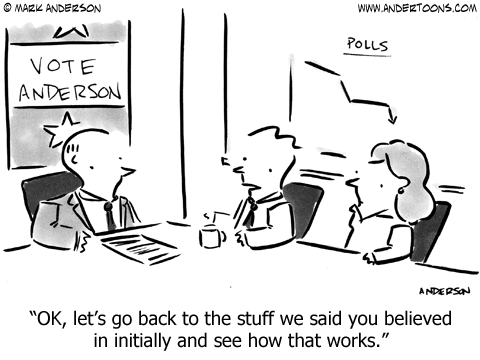
Anderson, Cartoons & Comics
Initially
by JOHN ADAMS •
Daily Bread
Daily Bread for 1.8.14
by JOHN ADAMS •
Good morning.
Whitewater will be cold today, but not as cold: a high of five degrees, with calmer winds producing wind chill values of zero to ten below.
On this day in 1918, Pres. Wilson issued his Fourteen Points proposal:
It will be our wish and purpose that the processes of peace, when they are begun, shall be absolutely open and that they shall involve and permit henceforth no secret understandings of any kind. The day of conquest and aggrandizement is gone by; so is also the day of secret covenants entered into in the interest of particular governments and likely at some unlooked-for moment to upset the peace of the world. It is this happy fact, now clear to the view of every public man whose thoughts do not still linger in an age that is dead and gone, which makes it possible for every nation whose purposes are consistent with justice and the peace of the world to avow nor or at any other time the objects it has in view….
On January 8, 1910, hundreds of vagrants demanded compensation for snow-shoveling:
1910 – Vagrant Snow Shovelers Strike for Pay
On this date 228 vagrants were brought in to shovel snow at the Chicago & Northwestern rail yard in Janesville. Shortly thereafter, they went on strike for 25 cents an hour and better food. Two days later, they went on strike again, asking for 30 cents an hour. [Source: Janesville Gazette]
Puzzability‘s weekly series continues:
|
This Week’s Game — January 6-10
|
|||||
|
Re Solutions
|
|||||
|
You’ll only need to keep these New Year’s resolutions for a week. For each day, we started with a word and added the two-letter chunk RE somewhere within the word to get a new word. The two-word answer phrase, described by each day’s clue, is the shorter word followed by the RE word.
|
|||||
|
Example:
|
|||||
|
Pumpernickel that’s been sitting around too long
|
|||||
|
Answer:
|
|||||
|
Bad bread
|
|||||
|
What to Submit:
|
|||||
|
Submit the two-word phrase, with the RE word second (as “Bad bread” in the example), for your answer.
|
|||||
|
|||||
|
Wednesday, January 8
|
|||||
|

Weather
A New Kind of Great White
by JOHN ADAMS •
Behold, the stupendous, astounding, gigantic… snow shark!
(I’ve even added an exclamation point – fitting here, I think.)
Film, Nature
Film: Suddenly I Feel Light
by JOHN ADAMS •
Suddenly I Feel Light from Jeff Morris on Vimeo.
Daily Bread
Daily Bread for 1.7.14
by JOHN ADAMS •
Good morning.
Tuesday will present partly sunny skies, a high of two degrees, and wind chill values between twenty-nine and thirty-nine below.
On this day in 1901, a native-born Wisconsinite becomes governor:
1901 – Robert Marion La Follette Inaugurated as Governor
On this date Robert M. La Follette was inaugurated as governor after winning the November 6, 1900 election. La Follette was born in Dane County in 1855. A Wisconsin Law School graduate and three-term member of congress, La Follette was renowned for his oratorical style. He was the first Wisconsin-born individual to serve as governor. [Source:Dictionary of Wisconsin History]
Here’s Puzzability‘s Tuesday puzzle:
|
This Week’s Game — January 6-10
|
|||||
|
Re Solutions
|
|||||
|
You’ll only need to keep these New Year’s resolutions for a week. For each day, we started with a word and added the two-letter chunk RE somewhere within the word to get a new word. The two-word answer phrase, described by each day’s clue, is the shorter word followed by the RE word.
|
|||||
|
Example:
|
|||||
|
Pumpernickel that’s been sitting around too long
|
|||||
|
Answer:
|
|||||
|
Bad bread
|
|||||
|
What to Submit:
|
|||||
|
Submit the two-word phrase, with the RE word second (as “Bad bread” in the example), for your answer.
|
|||||
|
|||||
|
Tuesday, January 7
|
|||||
|

Music
Monday Music: Tom Waits, Diamonds on My Windshield
by JOHN ADAMS •
Daily Bread
Daily Bread for 1.6.14
by JOHN ADAMS •
Good morning.
Whitewater’s week starts off cold, with a high of eleven below, wind chill values of thirty to forty below, and a slight chance of occasional light snow in the morning.
Like many districts across the state, the Whitewater School District is closed today.
On January 6, 1838, Samuel Morse conducts a demonstration:
…Samuel Morse’s telegraph system is demonstrated for the first time at the Speedwell Iron Works in Morristown, New Jersey. The telegraph, a device which used electric impulses to transmit encoded messages over a wire, would eventually revolutionize long-distance communication, reaching the height of its popularity in the 1920s and 1930s.
On this day in 1921, a community group takes a stand:
1921 – Janesville Women Abhor Salacious Entertainment
On this date the Janesville Federation of Women decided to “censor” movies and vaudeville in the city. Members of this organization praised and promoted what they considered “better offerings.” They were zealously critical towards those of a “salacious” nature. No follow-up ever determined whether the women were successful in their quest or if the increased publicity for “salacious” shows backfired. [Source: Janesville Gazette]
Puzzability starts its first puzzle series of the new year:
|
This Week’s Game — January 6-10
|
|||||
|
Re Solutions
|
|||||
|
You’ll only need to keep these New Year’s resolutions for a week. For each day, we started with a word and added the two-letter chunk RE somewhere within the word to get a new word. The two-word answer phrase, described by each day’s clue, is the shorter word followed by the RE word.
|
|||||
|
Example:
|
|||||
|
Pumpernickel that’s been sitting around too long
|
|||||
|
Answer:
|
|||||
|
Bad bread
|
|||||
|
What to Submit:
|
|||||
|
Submit the two-word phrase, with the RE word second (as “Bad bread” in the example), for your answer.
|
|||||
|
|||||
|
Monday, January 6
|
|||||
|

Animation, Cartoons & Comics
Sunday Cartoon: Chilly Willy, I’m Cold
by JOHN ADAMS •
Here’s an animated short with a title that seems almost obligatory today.
Walter Lantz’s Chilly Willy was another of his popular characters (Lantz also having created the more famous Woody Woodpecker). From 1954, I’m Cold was the second cartoon in the Chilly Willy series.
The legendary animator Tex Avery’s the director of this short, featuring a penguin who lives in Alaska (not Antarctica), and a dog named Smedley.
Stay warm – enjoy.