FREE WHITEWATER

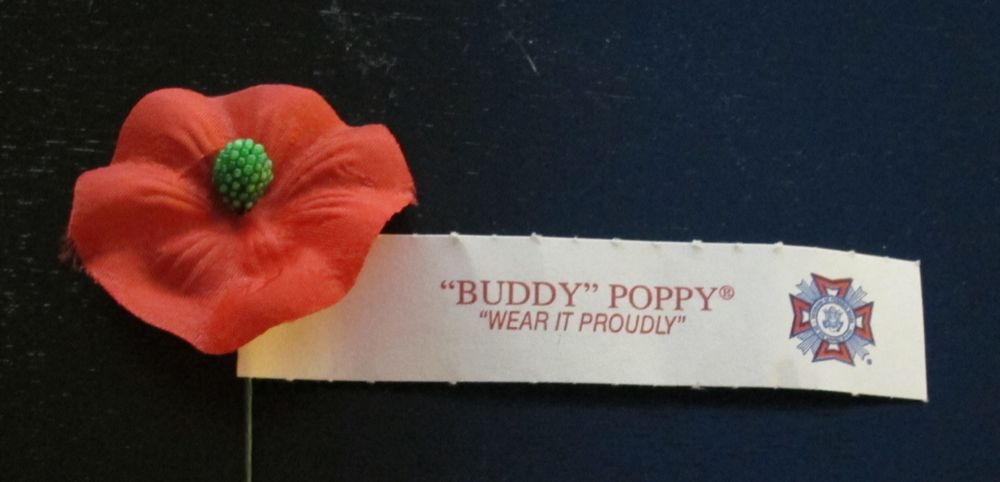
Veterans’ Day 2013

IMG_0744
 

The presidential proclamation for Veterans’ Day 2013:

BY THE PRESIDENT OF THE UNITED STATES OF AMERICA

A PROCLAMATION

On Veterans Day, America pauses to honor every service member who has ever worn one of our Nation’s uniforms. Each time our country has come under attack, they have risen in her defense. Each time our freedoms have come under assault, they have responded with resolve. Through the generations, their courage and sacrifice have allowed our Republic to flourish. And today, a Nation acknowledges its profound debt of gratitude to the patriots who have kept it whole.

As we pay tribute to our veterans, we are mindful that no ceremony or parade can fully repay that debt. We remember that our obligations endure long after the battle ends, and we make it our mission to give them the respect and care they have earned. When America’s veterans return home, they continue to serve our country in new ways, bringing tremendous skills to their communities and to the workforce— leadership honed while guiding platoons through unbelievable danger, the talent to master cutting- edge technologies, the ability to adapt to unpredictable situations. These men and women should have the chance to power our economic engine, both because their talents demand it and because no one who fights for our country should ever have to fight for a job.

This year, in marking the 60th anniversary of the Korean War Armistice, we resolved that in the United States of America, no war should be forgotten, and no veteran should be overlooked. Let us always remember our wounded, our missing, our fallen, and their families. And as we continue our responsible drawdown from the war in Afghanistan, let us welcome our returning heroes with the support and opportunities they deserve.

Under the most demanding of circumstances and in the most dangerous corners of the earth, America’s veterans have served with distinction. With courage, self-sacrifice, and devotion to our Nation and to one another, they represent the American character at its best. On Veterans Day and every day, we celebrate their immeasurable contributions, draw inspiration from their example, and renew our com- mitment to showing them the fullest support of a grateful Nation.

With respect for and in recognition of the contributions our service members have made to the cause of peace and freedom around the world, the Congress has provided (5 U.S.C. 6103(a)) that November 11 of each year shall be set aside as a legal public holiday to honor our Nation’s veterans.

NOW, THEREFORE, I, BARACK OBAMA, President of the United States of America, do hereby pro- claim November 11, 2013, as Veterans Day. I encourage all Americans to recognize the valor and sacrifice of our veterans through appropriate public ceremonies and private prayers. I call upon Federal, State, and local officials to display the flag of the United States and to participate in patriotic activities in their communities. I call on all Americans, including civic and fraternal organizations, places of worship, schools, and communities to support this day with commemorative expressions and programs.

IN WITNESS WHEREOF, I have hereunto set my hand this fifth day of November, in the year of our Lord two thousand thirteen, and of the Independence of the United States of America the two hundred and thirty-eighth.

Daily Bread for 11.11.13

Good morning.

Monday will be a mix of rain or snow in the morning, with a high of thirty-eight for the day, and temperatures falling into the twenties by late afternoon.

Whitewater’s Planning Commission will meet at 6 PM tonight.

On the 11th hour of the 11th day of the 11th month of 1918, the Great War ends:

At 5 a.m. that morning, Germany, bereft of manpower and supplies and faced with imminent invasion, signed an armistice agreement with the Allies in a railroad car outside Compiégne, France. The First World War left nine million soldiers dead and 21 million wounded, with Germany, Russia, Austria-Hungary, France, and Great Britain each losing nearly a million or more lives. In addition, at least five million civilians died from disease, starvation, or exposure.

The Rolling Stones play in Milwaukee on 11.11.1964, and a reporter for the Milwaukee Journal is not impressed:

1964 – Rolling Stones Play Milwaukee
On this date the Rolling Stones first performed in Wisconsin, to a crowd of 1,274 fans at Milwaukee Auditorium. Although Brian Jones remained in a Chicago hospital with a high fever, the rest of the band performed. According to a dubious reporter for the Milwaukee Journal, “Chances are, few in the audience missed his [Jones’] wailing harmonica. Screams from a thousand throats drowned out all but the most insistent electronic cacaphony and the two-fisted smashes of drummer Charlie Watts.”

The reporter continued, “Unless someone teaches guitar chords to chimpanzees, the visual ultimate has been reached in the Rolling Stones. With shoulder length hair and high heeled boots, they seemed more feminine than their fans. The Stones make the Beatles look like clean cut kids. You think it must be some kind of parody – but the little girls in front paid $5.50 a seat.” [Source: Milwaukee Journal November 12, 1964, p.14]

Scientific American‘s daily trivia question asks about a letter. (Clicking on the question leads to its answer.)

What is the only letter that doesn’t appear on the periodic table of the elements?

Daily Bread for 11.10.13

Good morning.

Sunday will grow gradually sunnier, with a high of forty-five, and lighter winds than yesterday, at only 5 to 10 mph for today.

US743801-0

On this day in 1903, Mary Anderson receives a patent:

…the patent office awards U.S. Patent No. 743,801 to a Birmingham, Alabama woman named Mary Anderson for her “window cleaning device for electric cars and other vehicles to remove snow, ice or sleet from the window.” When she received her patent, Anderson tried to sell it to a Canadian manufacturing firm, but the company refused: The device had no practical value, it said, and so was not worth any money. Though mechanical windshield wipers were standard equipment in passenger cars by around 1913, Anderson never profited from the invention.

As the story goes, on a freezing, wet winter day around the turn of the century, Mary Anderson was riding a streetcar on a visit to New York City when she noticed that the driver could hardly see through his sleet-encrusted front windshield. Although the trolley’s front window was designed for bad-weather visibility—it was split into parts so that the driver could open it, moving the snow- or rain-covered section out of his line of vision—in fact the multi-pane windshield system worked very poorly. It exposed the driver’s uncovered face (not to mention all the passengers sitting in the front of the trolley) to the inclement weather, and did not improve his ability to see where he was going in any case.

Anderson began to sketch her wiper device right there on the streetcar. After a number of false starts, she came up with a prototype that worked: a set of wiper arms that were made of wood and rubber and attached to a lever near the steering wheel of the drivers’ side. When the driver pulled the lever, she dragged the spring-loaded arm across the window and back again, clearing away raindrops, snowflakes or other debris. When winter was over, Anderson’s wipers could be removed and stored until the next year. (This feature was presumably designed to appeal to people who lived in places where it did not rain in the summertime.)

People scoffed at Anderson’s invention, saying that the wipers’ movement would distract the driver and cause accidents. Her patent expired before she could entice anyone to use her idea.

Additional information about her patent is available online.

Daily Bread for 11.9.13

Good morning.

Saturday in Whitewater will be partly sunny, and breezy, with a high of fifty-three. We’ll have west winds of ten to twenty mph, with gusts as reaching 30 mph.

What if, as a painter, one were to choose people, themselves, as both subjects and parts of one’s paintings? To be an artist like that would be to be someone like Alexa Meade:

On this day in 1989, the Berlin Wall opens:

East German officials today opened the Berlin Wall, allowing travel from East to West Berlin. The following day, celebrating Germans began to tear the wall down. One of the ugliest and most infamous symbols of the Cold War was soon reduced to rubble that was quickly snatched up by souvenir hunters.

The East German action followed a decision by Hungarian officials a few weeks earlier to open the border between Hungary and Austria. This effectively ended the purpose of the Berlin Wall, since East German citizens could now circumvent it by going through Hungary, into Austria, and thence into West Germany. The decision to open the wall was also a reflection of the immense political changes taking place in East Germany, where the old communist leadership was rapidly losing power and the populace was demanding free elections and movement toward a free market system….

On 11.9.1968, an earthquake in Wisconsin:

1968 – Earthquake Shakes Wisconsin
On this date one of the strongest earthquakes in the central United States occurred in south-central Illinois. Measured at a magnitude of 5.3, press reports from LaCrosse, Milwaukee, Port Washington, Portage, Prairie Du Chien, and Sheboygan indicated that the shock was felt in these cities. [Source: United States Geological Survey]

Poll: Another Star Wars Film?

Disney’s announced a date for the next Star Wars film, the seventh in the series:

“Star Wars: Episode VII” has an official release date: Dec. 18, 2015.

“We’re very excited to share the official 2015 release date for ‘Star Wars: Episode VII,’ where it will not only anchor the popular holiday filmgoing season but also ensure our extraordinary filmmaking team has the time needed to deliver a sensational picture,” Alan Horn, chairman of Walt Disney Studios, said in a press release announcing the date. “Star Wars: Episode VII” was initially expected to arrive sometime during that previous summer. (All six previous “Star Wars” films were released during the month of May.)

In a separate press release from Disney regarding the move, it was also revealed that “Episode VII” will screen in 3D.

Should they keep making more? It’s hard to keep a series going. (I thought that the Lord of the Rings trilogy succeeded, but that the Matrix trilogy should have stopped after the first, good film.)

So what do you think about more Star Wars films? I’d like to see another good film (the first was very good, indeed) , but I’m doubtful. How about you?


Daily Bread for 11.8.13

Good morning.

Friday will be increasingly cloudy with a high of forty-six.

On this day in 1895, a profound discovery:

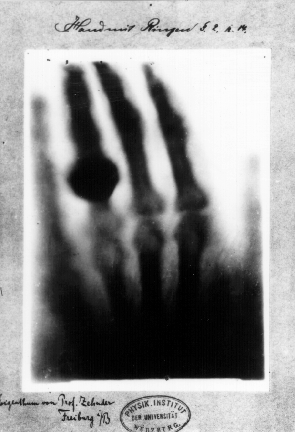
1
“Hand mit Ringen (Hand with Rings): a print of one of the first X-rays by Wilhelm Röntgen (1845–1923) of the left hand of his wife Anna Bertha Ludwig. It was presented to Professor Ludwig Zehnder of the Physik Institut, University of Freiburg, on 1 January 1896.” Photo and caption via Wikipedia

….physicist Wilhelm Conrad Rontgen (1845-1923) becomes the first person to observe X-rays, a significant scientific advancement that would ultimately benefit a variety of fields, most of all medicine, by making the invisible visible. Rontgen’s discovery occurred accidentally in his Wurzburg, Germany, lab, where he was testing whether cathode rays could pass through glass when he noticed a glow coming from a nearby chemically coated screen. He dubbed the rays that caused this glow X-rays because of their unknown nature.

On 11.8.1870, a first for America:

1870 – First National Weather Forecast Published
On this date Increase Lapham recorded the first published national weather forecast, calling for “high winds and falling temperatures for Chicago, Detroit and the Eastern cities.” [Source: History Just Ahead: A Guide to Wisconsin’s Historical Markers edited by Sarah Davis McBride]

Scientific American‘s daily trivia question asks about a patent. (Clicking on the question leads to its answer.)

When was nylon patented?

Downtown Whitewater and an Emerging Business Culture

At Tuesday’s Common Council meeting, there was a brief presentation from two board members of Downtown Whitewater (DTWW), with others from that group also in attendance.  In the life of a small town, success of merchants matters greatly.  (I’m opposed to pitting local independent merchants against local chain stores, but I very much support local businesses generally.)  

Years ago, when we first saw a Main Street program in Whitewater, there was considerable attention to the effort.  The Great Recession later swept across all America, and despite it all, many of our local merchants survived where one might have feared they would succumb (difficult though that time was, and still is).

Now, with a national recovery slowly underway, and years since its founding, DTWW and her merchants look to the new year.  

I’ll consider a few points from that presentation.

New Merchants.  DTWW has new merchants moving in, and if there’s a single gain that a group could have, it’s the ability to attract and retain businesses.  

Nothing kills the way emptiness kills.  There’s a place for marketing, and a place for the look and feel that façade grants bring, but new merchants are the ultimate marketing, occupied storefronts the best façade.  

DTWW’s ability to draw new merchants is an unalloyed gain. 

Memorandum of Understanding.  DTWW is under a clearer arrangement with the city, by the way, that makes accountability more easily reviewed.  

Fundraising. Most of the money received for DTWW now comes from private sources or in-kind donations.  That’s a key accomplishment: one may be rightly suspicious of many government-private partnerships, but by design and inclination this program moves toward greater self-reliance.   

An Emerging, Entrepreneurial Business Culture.  There’s a point in presentation where Dave Saalsaa, DTWW board president, mentions that DTWW is looking to encourage UW-Whitewater grads to stay and be part of an expanding business culture (such as along Whitewater Street).  
He’s right to mention this possibility: there is a real possibility now of an emerging business culture for Whitewater, of independent restaurants and independent merchants.  It has not come – and it will not come – from big grants, state or federal schemes, or big institutions’ heavy hands.  

But we are starting to see it here, after many years of approaches that mostly made things worse, or at least no better.  

After headlines, after exclamation points, after Big Ideas, there’s something better: the actual accomplishments of smaller, independent business people with good ideas.

Once a culture like this takes root, even in a few places, it can spread quickly and inspire others.  

The efforts of an emerging group of small business people, striving mostly on their own, with a new, hip and more fashionable presentation to this town, may be an important development of the next few years.  

Communications.  How the group communicates among its leaders, members, and the community is something I’m sure they’ll sort out.  If it goes well for them, they’ll advance their goals; if not, they’ll have difficulty meeting them.  Communicating should, after all, be a simple routine, like respiration.  

It’s only when one notices it that it’s a problem.  

Whatever hard work it takes to get there, though, is something the group can and almost surely can accomplish.

Pig in the Park and the Jack Hanna Animal Show.  Downtown Whitewater is planning two events, among others, for next year: Pig in the Park near Cravath Lake, and a return of Jack Hanna’s animal show (this time in collaboration with the university).

Events like this, if handled well, endear people to the city.  They’re not a substitute for prosperity, but can advance an optimism that prosperity requires.

My youngest attended the Jack Hanna show when it was here, and very much enjoyed it.  

DTWW is a small group, and these events are sure to be demanding to them.  Whitewater can manage big, annual events very well (our Fourth of July celebration comes to mind), but it takes more effort and planning when the group is small.

One simple suggestion: each and every volunteer should carry a sheet with the behind-the-scenes work for the day, the public schedule of events, the mobile numbers of every other volunteer, and all volunteers’ designated responsibilities.

That way, whenever anyone asks about a given event or with a question, everyone volunteering will have access to information or a directory listing others of whom they can ask.  

Full storefronts and a full calendar are both beneficial.      

Façades.  In the end, it seems to be that nothing matters more than occupancy, but I see that the ‘look and feel’ of a shop matters.  

(About this topic, I’m thinking of Virginia Postrel’s excellent book, The Substance of Style: How the Rise of Aesthetic Value Is Remaking Commerce, Culture, and Consciousness.  Postrel’s a libertarian and former editor at Reason who rightly sees that a free society and economy offer the best opportunities for creative, inspiring design. )

Style does matter, and so façades do matter.  TID 4’s dried up; we’ll have to go on in any event.  Fundraising from private sources to provide money for new façades certainly has its place.  

2014.  Lasting gains won’t come from big organizations or so-called big players: it’s been tried and it’s failed.  

Whitewater will have to look toward gains from small entrepreneurs, often unheralded, yet truly meaningful to the town’s confidence and long-term prospects.

We have a good chance for a better year ahead.

Daily Bread for 11.7.13

Good morning.

Thursday will be cloudy with a high of forty-three.

Whitewater’s Landmarks Commission meets tonight at 6 PM.

On this day in 1944, America re-elects FDR a third time, for a total of four presidential wins:

In 1940, with World War II raging in Europe and the Pacific, Roosevelt agreed to run for an unprecedented third term. Reelected by Americans who valued his strong leadership, he proved a highly effective commander in chief after the December 1941 U.S. entrance into the war. Under Roosevelt’s guidance, America became, in his own words, the “great arsenal of democracy” and succeeded in shifting the balance of power in World War II firmly in the Allies’ favor. In 1944, with the war not yet won, he was reelected to a fourth term.

Scientific American‘s daily trivia question asks about dinosaurs. (Clicking on the question leads to its answer.)

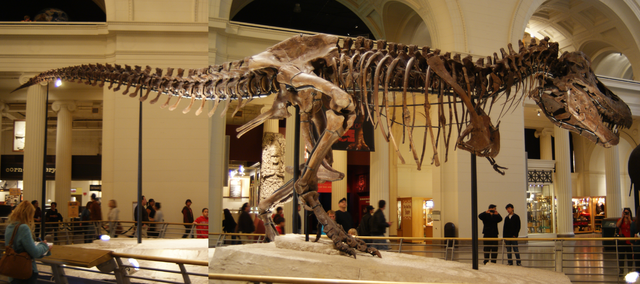
640px-Sue_side_full_(Field_museum)

Sue (Tyrannosaurus rex) at the Field Museum, Chicago, IL via Wikipedia

How many dinosaur genera have been discovered?

Common Council for 11.5.13 (Bus & Budget)

Update, 2 PM: Earlier today, in response to my email inquiry, I received kind messages in reply from City Manager Clapper and City Clerk Michele Smith, about posting online the documents I mentioned below. They’ve acted quickly and thoroughly to provide materials that others gave to them only at the last minute. It’s right to mention as much plainly.

I’ve one other comment, that requires mentioning, about the current municipal administration. Whitewater has had its share of challenges, and policy disagreements now and again, but it seems obvious to me that one should hope for the success of this city administration – Whitewater would very much benefit if her current municipal manager enjoys a long and successful career. Not every day can be an easy one, but I have never met anyone who wasn’t hoping for the best in this regard. I know I am; there’s reason to have optimism about our future.

Last night’s Common Council session continued budget presentations, but also saw a presentation from Downtown Whitewater and discussion of a possible 80% increase in funding for a transit bus that benefits, mostly, one big company.

There’s more to write about the budget, but I’ll do so after considering the city’s long and short-term fiscal prospects.

The Downtown Whitewater presentation was interesting, and I’ll follow up on it Thursday.

About the bus, though, there was about an hour’s discussion, and a decision to defer consideration while City Manger Clapper and Finance Director Doug Saubert look for other places within the budget to take money for 2014 funding. They’ll be back to Council with options they believe they’ll find.

The hour was a trove of information about the bus – in this, one could not have been happier. The more one hears, the more that’s said, the more telling is the situation.

The discussion, and the arguments presented, reminded me that there’s an opportunity to look at Council presentations on the bus, in the spring and fall of 2012, and now in 2013, and prepare posts that list each and every argument made for or against the project, and to assess them. One could include the actual statements made for or against, supplemented with clips of what those speaking once said, or promised, about the bus.

I’ll work out how to organize posts like that, but I’m curious: what will these presentations, from over a year and a half, look like? One could catalog 2012, then 2013, and then offer a separate assessment of the claims made over these eighteen months.

There’s a lot of discussion in Whitewater, but how much of what one reads in print is much more than a warmed-over press release or poorly-written account? Isn’t our city worth more than that?

I’m quite sure it is.

As the discussion began, City Manager Clapper mentioned documents that he’d received from Janesville’s transportation director, but too late to appear in the City of Whitewater’s online agenda packet about the meeting. This is the second time that some documents about the bus from Janesville’s representative have appeared late at Council; the same happened in 2012. There’s no emergency nature in any of these materials – Janesville’s representative could have provided them on time for all Whitewater’s residents to see.

I’ve written to City Manager Clapper, to request these documents that were mentioned and available at the meeting (including a marketing survey that Janesville’s representative mentioned last night), but that were too late to make Whitewater residents’ online packet.

One last point, for now, although no one should be surprised: multi-billion-dollar Generac sent no one to the meeting. They’ll gain from hundreds of thousands (in total public money) for a venture that benefits mostly them, but as for sending any representative to speak to our Common Council?

No, that’s just not on their agenda.