FREE WHITEWATER

Review: Jessica’s Family Restaurant


View Larger Map

20130918-140043.jpg

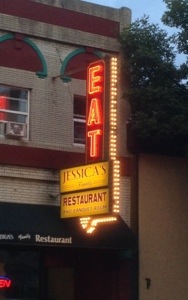
Warm & Welcoming Sign

A quick and happy declaration: I really love diners, their food, their atmosphere, their very American tradition. There’s a way of defining a diner that requires that it be a freestanding establishment, but to me, Jessica’s Family Restaurant at 140 West Main Street is a diner.

It’s a good one, too: there’s a reason that Jessica’s is a popular spot in Whitewater.

The menu offers breakfast all day – essential for a diner – and among the large number of selections one finds those for breakfast, cold or hot sandwiches, dinner, Italian cuisine, and several salads. One hears that a large menu is a risky one, but it can be done well, and it’s part of a family restaurant or diner’s offering.

One doesn’t have to be born here to love this food, this atmosphere, this presentation. There’s part of me that thinks this style is naturally appealing and friendly.

I’d recommend the skillets, any of them, at any time of day. Coffee, orange juice, the Mexican skillet (especially), ketchup, a bottomless pot of coffee – nothing else needed.

There’s a separate dining area, in which I have not been seated, but I’d guess that it would be a good option for a meeting.

A family restaurant or diner should always be low-key, and Jessica’s is that way. A patron walks in, perhaps with a newspaper, gets some coffee, has a slice of pie, and it’s a refuge from a busy day. One could say the same about a place like a Starbucks, of course, but to say as much would be to ignore the differences between those experiences.

I’ve found the service friendly, relaxed, and warm on my visits.

Easily recommended.

Enjoy.

LOCATION: 140 W Main St, Whitewater, WI 53190. See, Google Map and directions embedded at the beginning of this review. (262) 473-9890.

OPEN: Monday – Thursday 6:00 AM – 9:00 PM, Friday 6:00 AM – 9:00 PM, Saturday 6:00 AM – 9:00 PM, Sunday 7:00 AM – 3:00 PM.

PRICES: Meal & coffee for under $10.

RESERVATIONS: Unnecessary.

DRINKS: Coffee, tea, juice, sodas.

SOUND: Moderate.

SERVICE: Friendly and attentive service.

VISITS: Three (two for breakfast, one for supper).

RATING: Recommended, 3.5 of 4.

GoldStarGoldStarGoldStarGoldStar1

RATING SCALE: From one to four stars, representing the full experience of food, atmosphere, service, and pricing.

INDEPENDENCE: This review is delivered without financial or other connection to the establishment or its owner. The dining experience was that of an ordinary patron, without notice to the staff or requests for special consideration.
Common Council Session of 9.17.13: Police and Fire Commission Dismissal Proceedings

Last night’s Common Council session had a large agenda, including toward the end consideration of whether to appoint outside counsel for a possible complaint against a Police and Fire Commissioner.

After a closed session of about seventy minutes, Council returned to open session and unanimously voted to authorize outside counsel to be hired for a claimant, at a maximum hourly rate, with authorization of related costs, and with an outline of the procedure to be followed. (If both claimnant and accused have representation, some of the procedures will likely be established between the two sides’ attorneys.)

In the end, every situation like this involves a possible claimant and someone accused, and the procedures and expenditures and costs matter in relation to the complaint lodged. Procedural fairness matters, but it matters because specific people and specific situations warrant fair treatment.

Without knowing the nature of the complaint, the particular allegations against someone, there’s not much more to say, about procedures or costs or other matters. (It’s also possible that there will be no dismissal hearing, the matter being settled without need for one.)

Whitewater, as would many other places in similar circumstances, will probably slip into a parlor game about all this, but the more serious the matter, the less worthy that game will be. If all this should be serious enough for a hearing, then it’s already too serious for speculation and guessing.

We’ve had controversies before, and we’ll have them again, but each and every one of them has involved people aggrieved or accused, and there’s no general view of things that trumps a particular person’s right to be heard, as complainant or accused.

Daily Bread for 9.18.13

Good morning.

Wednesday will see an even chance of scattered showers or thunderstorms, with a high near seventy-seven.

An architectural beginning for America:

On this day in 1793, George Washington lays the cornerstone to the United States Capitol building, the home of the legislative branch of American government. The building would take nearly a century to complete, as architects came and went, the British set fire to it and it was called into use during the Civil War. Today, the Capitol building, with its famous cast-iron dome and important collection of American art, is part of the Capitol Complex, which includes six Congressional office buildings and three Library of Congress buildings, all developed in the 19th and 20th centuries.

On this day in 1870, the Old Faithful Geyser gets its name.

On the afternoon of September 18, 1870, the members of the Washburn-Langford-Doane Expedition traveled down the Firehole River from the Kepler Cascades and entered the Upper Geyser Basin. The first geyser they saw was Old Faithful. In his 1871 Scribner’s account of the expedition, Nathaniel P. Langford wrote:

“Judge, then, what must have been our astonishment, as we entered the basin at mid-afternoon of our second day’s travel, to see in the clear sunlight, at no great distance, an immense volume of clear, sparkling water projected into the air to the height of one hundred and twenty-five feet. “Geysers! geysers!” exclaimed one of our company, and, spurring our jaded horses, we soon gathered around this wonderful phenomenon. It was indeed a perfect geyser. The aperture through which the jet was projected was an irregular oval, three feet by seven in diameter. The margin of sinter was curiously piled up, and the exterior crust was filled with little hollows full of water, in which were small globules of sediment, some having gathered around bits of wood and other nuclei. This geyser is elevated thirty feet above the level of the surrounding plain, and the crater rises five or six feet above the mound. It spouted at regular intervals nine times during our stay, the columns of boiling water being thrown from ninety to one hundred and twenty-five feet at each discharge, which lasted from fifteen to twenty minutes. We gave it the name of “Old Faithful.”

See, also, a link to the Old Faithful Geyser Live webcam.

Scientific American‘s trivia question asks about a different kind of natural phenomenon. (Clicking on the question leads to its answer.)

How fast does a tsunami move in the deep ocean?

Daily Bread for 9.17.13

Good morning.

Tuesday in Whitewater will be partly sunny with a high of sixty-eight.

Common Council meets tonight at 6:30 PM. Agenda items C-3 and C-8 will offer information about the city’s fiscal account. Thereafter, another twist in the life of this small town.

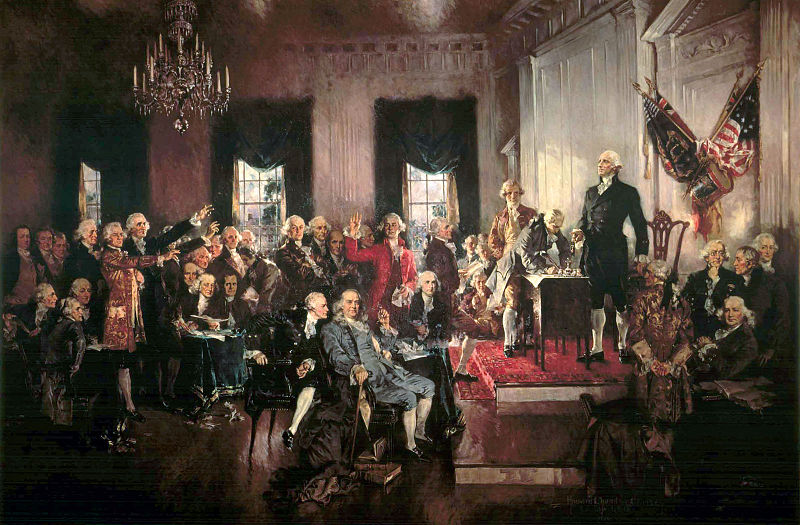
It’s Constitution Day in America:

800px-Scene_at_the_Signing_of_the_Constitution_of_the_United_States

Howard Chandler Christy (1873–1952) Scene at the Signing of the Constitution of the United States via Wikipedia. See, also, a guide to the key figures in the painting

The Constitution of the United States of America is signed [in 1787] by 38 of 41 delegates present at the conclusion of the Constitutional Convention in Philadelphia. Supporters of the document waged a hard-won battle to win ratification by the necessary nine out of 13 U.S. states.

On May 25, 1787, delegates representing every state except Rhode Island convened at Philadelphia’s Pennsylvania State House for the Constitutional Convention. The building, which is now known as Independence Hall, had earlier seen the drafting of the Declaration of Independence and the signing of the Articles of Confederation. The assembly immediately discarded the idea of amending the Articles of Confederation and set about drawing up a new scheme of government. Revolutionary War hero George Washington, a delegate from Virginia, was elected convention president.

During an intensive debate, the delegates devised a brilliant federal organization characterized by an intricate system of checks and balances. The convention was divided over the issue of state representation in Congress, as more-populated states sought proportional legislation, and smaller states wanted equal representation. The problem was resolved by the Connecticut Compromise, which proposed a bicameral legislature with proportional representation in the lower house (House of Representatives) and equal representation of the states in the upper house (Senate).

On September 17, 1787, the Constitution was signed. As dictated by Article VII, the document would not become binding until it was ratified by nine of the 13 states. Beginning on December 7, five states–Delaware, Pennsylvania, New Jersey, Georgia, and Connecticut–ratified it in quick succession. However, other states, especially Massachusetts, opposed the document, as it failed to reserve undelegated powers to the states and lacked constitutional protection of basic political rights, such as freedom of speech, religion, and the press. In February 1788, a compromise was reached under which Massachusetts and other states would agree to ratify the document with the assurance that amendments would be immediately proposed. The Constitution was thus narrowly ratified in Massachusetts, followed by Maryland and South Carolina. On June 21, 1788, New Hampshire became the ninth state to ratify the document, and it was subsequently agreed that government under the U.S. Constitution would begin on March 4, 1789. In June, Virginia ratified the Constitution, followed by New York in July.

Scientific American has a trivia question about animals and flag poles. Clicking on the question leads to its answer.

What natural predators destroyed the world’s tallest flagpole?

What Tires and Ages a City?

In my last post, I wrote about a survey that identified Whitewater as an especially youthful town (mind you, by median age, and only from CNN Money’s limited selection of small towns).

Well, what would the opposite be like: what would age a town, and drive it into decrepitude?

The sarcastic answer, of course, is time, itself: the passage of time makes a place grow older. That, needless to say, isn’t what I have in mind. In fact, time needn’t take a toll. Some societies stay vigorous generation to generation.

Among those forces that would make a place old, even prematurely, I’d suggest (1) regulating excessively, (2) taxing heavily, (3) prohibiting widely, (4) spending profligately from others’ earnings, (5) building vaingloriously from the public coffers, (6) using still more public money to boost one’s undeserving cronies, (7) conflating headlines with facts, (8) ignoring the truly needy, all the while (9) insisting that this is the very definition of serving one’s community.

A community like that would tire and age prematurely from the damage those bad policies would necessarily inflict on an otherwise vigorous and energetic place.

Dirigisme like this benefits a few at the expense – in vigor and productivity – of the many.

That’s a partial list of what ages an otherwise active place.

Whitewater as a Youthful Town

One hears that CNN Money has a story that lists Whitewater as one of their youngest towns in America. See, 25 youngest small towns in America.

Whitewater comes in at number eight on the list (a typo lists us as six), with a population of 14,470 and a median age of 22.0 years.

A sharp reader brought the story to my attention, and perceptively observed that the list describes (almost inevitably) small college towns, as those are the places likely to have a low median age. Our average age, needless to say, is not twenty-two. The median, too, is likely to be different for one-quarter of the year than for the other three seasons when campus is in full session.

Yet, it’s true that we have many young people in town. Young, middle-aged, elderly: it’s no single demographic.

I’d not urge government, by the way, to favor one kind of resident over another: I’d encourage as little planning as possible, and would invite anyone of any age who wishes to live here to do so.

There’s something odd, however, about contending that we’re youthful while simultaneously regulating and restricting the very impulses the story finds so advantageous. Whitewater has not resolved her town-gown conflicts, and I’d guess that the authors of the story have not the slightest feeling for those conflicts in our small town or others on their list.

It’s fine to want the headline; it’s hypocritical to tout a youthful ethos while regulating the city in ways that limit youthful creativity, or any creativity, really.

There’s nothing wrong with libraries, or retirement communities, but there’s something risible in promoting a headline about youthfulness while simultaneously shushing everyone as though all the town where a quiet zone. One feels this through restrictions on conduct, or through a tax burden that inhibits valuable private conduct in favor of hollow public schemes and selfish cronyism.

A truly vibrant community – one that is youthful regardless of the median age – lives out that ethos beyond headlines, beyond self-promotion, and beyond mere appearances.

This town is no fading scrapbook, no mere headline, no set of photos accompanying a feel-good list. If anything, the statistics that truly matter show how much work is to be done.

I want, and in any event believe, in a future that assures a vibrant, New Whitewater.

CNN Money’s story doesn’t make us such.

We’ll have to do that – and will do that – on our own.

Daily Bread for 9.16.13

Good morning.

The week begins with sunny skies and a high of sixty-four, with north winds of 5 to 10 mph.

The Whitewater School Board meets tonight at 6 PM.

On this day in 1908, a major car company is born:

On September 16, 1908, Buick Motor Company head William Crapo Durant spends $2,000 to incorporate General Motors in New Jersey. Durant, a high-school dropout, had made his fortune building horse-drawn carriages, and in fact he hated cars–he thought they were noisy, smelly, and dangerous. Nevertheless, the giant company he built would dominate the American auto industry for decades.

Here’s a trivia question, and its answer, for today: Do any animals use mechanical gears for locomotion?

Amazingly, there’s at least one:

To the best of our knowledge, the mechanical gear—evenly-sized teeth cut into two different rotating surfaces to lock them together as they turn—was invented sometime around 300 B.C. by Greek mechanics who lived in Alexandria. In the centuries since, the simple concept has become a keystone of modern technology, enabling all sorts of machinery and vehicles, including cars and bicycles.

As it turns out, though, a three-millimeter long hopping insect known as Issus coleoptratus beat us to this invention. Malcolm Burrows and Gregory Sutton, a pair of biologists from the University of Cambridge in the U.K., discovered that juveniles of the species have an intricate gearing system that locks their back legs together, allowing both appendages to rotate at the exact same instant, causing the tiny creatures jump forward.

burrows2HR

burrows5HR

The small hopping insect Issus coleoptratus uses toothed gears (magnified above with an electron microscope) to precisely synchronize the kicks of its hind legs as it jumps forward. All images courtesy of Malcom Burrows.

Recent Tweets, 9.8 to 9.14