FREE WHITEWATER

Friday Poll: Dog or Spouse?

s-MAN-SAVES-DOG-YACHT-large

Yachtsman and Beloved Terrier

So one reads that a yachtsman first saved his dog from his sinking boat, and only thereafter swam back to rescue his wife:

Graham Anley, his wife Cheryl and their 9-year-old Jack Russell Rosie were sailing from East London to Madagascar for a holiday when their yacht hit a reef in the early hours of Sunday morning, the National Sea Rescue Institute’s Geoff McGregor said.

Anley and the dog swam to shore before returning for his wife whose safety line had snagged on the steering gear.

The Jack Russell was wearing a specially tailored dog life-jacket which has its own emergency strobe light attached to it.

In that situation, which would you rescue first: spouse or dog? I’ll answer spouse.

What’s your pick?

Daily Bread for 8.9.13

Good morning.

Friday in town will be partly sunny, with a high of seventy-eighty. We’ll have west winds at 5 to 10 MPH, and just a slight chance of isolated morning showers.

On this day in 378, a bad day for the Roman Empire:

In one of the most decisive battles in history, a large Roman army under Valens, the Roman emperor of the East, is defeated by the Visigoths at the Battle of Adrianople in present-day Turkey. Two-thirds of the Roman army, including Emperor Valens himself, were overrun and slaughtered by the mounted barbarians.

Crowned in 264, Emperor Valens initiated warfare against the semi-civilized Visigoths in 364 and by 369 had defeated them. Visigoths under Fritigern were given permission to settle south of the Danube in the Roman Empire but, subjected to oppressive measures by Roman officials, they soon rose in revolt. In 378, Valens marched a Roman army against Fritigern, and 10 miles from Adrianople the Romans came upon the massed barbarians. As the Visigoth cavalry was off on a forging mission, Valens ordered a hasty attack on August 9. The Romans initially drove the barbarians back, but then the Visigoth cavalry suddenly returned, routing the Romans and forcing them into retreat. The horsemen then rode down and slaughtered the fleeing Roman infantry. Some 20,000 of 30,000 men were killed, including Emperor Valens.

The decisive Visigoth victory at the Battle of Adrianople left the Eastern Roman Empire nearly defenseless and established the supremacy of cavalry over infantry that would last for the next millennium. Emperor Valens was succeeded by Theodosius the Great, who struggled to repel the hordes of Visigoth barbarians plundering the Balkan Peninsula.

Puzzability‘s series about mythology concludes today:

Myth Takes
For this week of freaks and Greeks, we started each day with a mythical creature. Then we hid it in a sentence, with spaces added as necessary. The answer spans at least two words in the sentence and starts and ends in the middle of words. The day’s clue gives the sentence with a Greek column in place of the creature.

Example:
I am not rising from this comfortable socolumntil I’ve finished this fascinating myth about the early days of Mt. Olympus.

Answer:
Faun (sofa until)

What to Submit:
Submit the mythical creature (as “Faun” in the example) for your answer.

Friday, August 9:

My daughter only likes love stories, so if a myth isn’t rocolumnotional, she won’t finish it.

Daily Bread for 8.8.13

Good morning.

Thursday in Whitewater will be a mostly sunny day with a high of seventy-seven. Sunrise was at 5:54 AM and sunset will be at 8:06 PM. The moon is a waxing crescent with 3% of its visible disk illuminated.

On this day in 1974, Pres. Nixon announces his resignation, to take effect the following day at noon:

In an evening televised address, President Richard M. Nixon announces his intention to become the first president in American history to resign. With impeachment proceedings underway against him for his involvement in the Watergate affair, Nixon was finally bowing to pressure from the public and Congress to leave the White House. “By taking this action,” he said in a solemn address from the Oval Office, “I hope that I will have hastened the start of the process of healing which is so desperately needed in America.”

Just before noon the next day, Nixon officially ended his term as the 37th president of the United States. Before departing with his family in a helicopter from the White House lawn, he smiled farewell and enigmatically raised his arms in a victory or peace salute. The helicopter door was then closed, and the Nixon family began their journey home to San Clemente, California. Minutes later, Vice President Gerald R. Ford was sworn in as the 38th president of the United States in the East Room of the White House. After taking the oath of office, President Ford spoke to the nation in a television address, declaring, “My fellow Americans, our long national nightmare is over.” He later pardoned Nixon for any crimes he may have committed while in office, explaining that he wanted to end the national divisions created by the Watergate scandal.

Six years earlier, on 8.8.1968, Wisconsin Republican delegates nominated Nixon for president:

1968 – Wisconsin Delegates Nominate Nixon
On this date thirty Wisconsin delegates at the Republican National Convention in Miami cast their votes to nominate Richard Nixon as the Republican party presidential candidate. These thirty votes gave Nixon the majority over Nelson Rockefeller and Ronald Reagan and won for him the party nomination. Nixon selected Spiro Agnew to be his running mate. [Source: Back in Time]

Here’s Thursday’s puzzle from Puzzability, with a series this week about mythology:

Myth Takes
For this week of freaks and Greeks, we started each day with a mythical creature. Then we hid it in a sentence, with spaces added as necessary. The answer spans at least two words in the sentence and starts and ends in the middle of words. The day’s clue gives the sentence with a Greek column in place of the creature.

Example:
I am not rising from this comfortable socolumntil I’ve finished this fascinating myth about the early days of Mt. Olympus.

Answer:
Faun (sofa until)

What to Submit:
Submit the mythical creature (as “Faun” in the example) for your answer.

Thursday, August 8:

Hector’s young son played with a toy sword just like the famous warrior’s in order to mimicolumndicating enemies.

On the Field of Dreams Project: In Support of Starting Construction Now

Last night, Whitewater’s Common Council discussed beginning construction of the Treyton Kilar Field of Dreams, to build a baseball diamond and related facilities on a part of Starin Park. I’ve written previously in support of the project, and believe Council made the right decision last night to begin construction by awarding an adjusted bid.

See, for example, a sample of previous posts in support: The Common Council’s positive vote for the Field of Dreams, On the 7.24.12 Special Council Session: Supporting Treyton Kilar’s Field of Dreams Project, Daily Bread for 1-31-11.

(I’ve neither personal nor political connection to the organizers of this project; like so many others in this community, my support is simply recognition of a good idea.)

Last night, one heard concerns – and one can read those concerns repeated elsewhere again today – about the city’s financial contribution to this project. These concerns, about a community-oriented and charitable project are, I think, misplaced. The full discussion, by my count, was a thorough one, lasted just under twenty-nine minutes.

The Field of Dreams is a fundamentally private initiative, involving years of private effort in time and money, with broad-based support across Whitewater.

It’s different in goals and character from countless prior city projects that have relied entirely on public money, with no real support among ordinary residents, flacked by ceaseless false claims about their supposed value to others. I am well-sensitive to the harm those kinds of projects have caused to Whitewater’s economy.

It’s ironic, though, that some gentlemen, who have boosted so many wholly public projects (millions in taxpayer funds for money-suck buildings, tax incremental districts without adequate private guarantees that have gone bust, crony-capitalist buses, all to the detriment of this city’s future) would write critically about this truly community-based, significantly private effort.

To oppose the Field of Dreams diamond after so many common men and women have worked so diligently would be to turn the back of one’s hand to a genuinely community-rooted effort that’s raised hundreds of thousands in private contributions of money and volunteer time by value. Rejection or delay would have been a disincentive to so much effort from so many ordinary people. One hopes for more, not less, of that kind of private effort.

Council made the right decision to award the sensibly-adjusted bid; further delay would have been, and would be, a mistake.

Best wishes for a smooth and happy groundbreaking.

Daily Bread for 8.7.13

Good morning.

We’ll have a partly sunny Wednesday in Whitewater, with a high of eighty, and southwest winds at 5 to 15 MPH.

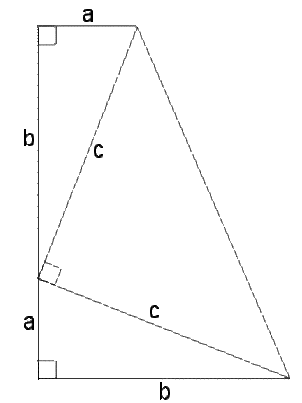
I had no idea that Pres. Garfield had an interest in mathematics, but yesterday I learned that he did. While a member of Congress, he produced a simple proof of the Pythagorean theorem, as Esther Inglis-Arkell explains:

original

Most will remember the Pythagorean Theorem as the old A2 + B2 = C2 problem, wherein the square of the two sides of a right triangle, added together, will yield the square of the hypotenuse. Garfield’s proof is simple, but it takes a little fiddling with paper.

Grab a piece of paper and cut two identical right triangles, trying to include one long side and one short side. Call the long side A, the short side, B, and the hypotenuse C. Place them, opposing points together, on a piece of paper so that they look like this.

Draw the third line in and you’ve made three triangles. The total area of a triangle can be calculated as one half the base times the height. Each of the original triangles has an area of ½ ab, and the third has an area of ½c2.

A trapezoid has an area calculated by its height times one half the sum of its uneven sides. So the trapezoid has an area of ½ (a+b)(a +b).

Since these areas are the same, this leads us to an equation.

½ ab + ½ ab + ½c2 = ½ (a + b)(a +b)

This simplifies quickly. On the left, the two halves of ‘ab’ can be added together. On the right, we just multiply all the terms.

ab +½c2 = ½ (a2 + b2 + 2ab)

ab +½c2 = ½ a2 + ½ b2 + ab

Since we have ‘ab’ on either side, they cancel each other out.

½c2 = ½ a2 + ½ b2

Multiply it all by 2, and you get:

c2 = a2 + b2

Well, you get that, and the deep satisfaction that you have solved a problem, Presidential-style.

From mathematics to a different sort of puzzle:

Puzzability‘s series this week is about mythology:

Myth Takes
For this week of freaks and Greeks, we started each day with a mythical creature. Then we hid it in a sentence, with spaces added as necessary. The answer spans at least two words in the sentence and starts and ends in the middle of words. The day’s clue gives the sentence with a Greek column in place of the creature.

Example:
I am not rising from this comfortable socolumntil I’ve finished this fascinating myth about the early days of Mt. Olympus.

Answer:
Faun (sofa until)

What to Submit:
Submit the mythical creature (as “Faun” in the example) for your answer.

Wednesday, August 7:

In Roman mythology, the iridescolumnora (the goddess Eos in Greek myths) creates a beautiful dawn across the sky.

Candidate Searches for Our Schools

The inevitable and happy risk of having talented employees is that other employers will notice them, and make competitive offers to them. That’s what’s happened for Whitewater Middle School principal Dan Foster, who is returning to Waterford Union, this time to be its high school principal.

He’s paid a required early-departure penalty, and one wishes him the best. I think about this the way I thought about Dr. Zentner’s departure: capable employees will be in demand elsewhere.

Why anyone would write of his departure without the simple announcement of his new position I’ll not understand; it’s to our credit that we’re both open and congratulatory in a departure of this kind. No matter how much a few would wish otherwise, I’m quite sure Whitewater does not sit on a high plateau beyond which there are only deep chasms shrouded in mist.

We have now a position to fill, and it should be filled (permanently) only after a search of at least two candidates. The method (ridiculously tried in this district) of picking one candidate and interviewing him several times does not produce a competitive process.

That way poses a manipulative question to honest interviewers: here’s your one option, dare you have the audacity to object to our insiders’-backed, speeding-train process?

However many or few applications come in, an open process for a permanent replacement needs at least two candidates.

Whitewater’s certainly worthy of a legitimate, solid process.

Daily Bread for 8.6.13

Good morning.

We’ll have a partly sunny day with a high of eighty-three.

Common Council meets today at 6:30 PM.

On this day in 1945, fewer than fours years after the Japanese attack on Pearl Harbor, America bombs Hiroshima:

…at 8:16 a.m. Japanese time, an American B-29 bomber, the Enola Gay, drops the world’s first atom bomb, over the city of Hiroshima. Approximately 80,000 people are killed as a direct result of the blast, and another 35,000 are injured. At least another 60,000 would be dead by the end of the year from the effects of the fallout.

U.S. President Harry S. Truman, discouraged by the Japanese response to the Potsdam Conference’s demand for unconditional surrender, made the decision to use the atom bomb to end the war in order to prevent what he predicted would be a much greater loss of life were the United States to invade the Japanese mainland. And so on August 5, while a “conventional” bombing of Japan was underway, “Little Boy,” (the nickname for one of two atom bombs available for use against Japan), was loaded onto Lt. Col. Paul W. Tibbets’ plane on Tinian Island in the Marianas. Tibbets’ B-29, named the Enola Gay after his mother, left the island at 2:45 a.m. on August 6. Five and a half hours later, “Little Boy” was dropped, exploding 1,900 feet over a hospital and unleashing the equivalent of 12,500 tons of TNT. The bomb had several inscriptions scribbled on its shell, one of which read “Greetings to the Emperor from the men of the Indianapolis” (the ship that transported the bomb to the Marianas).

Puzzability‘s new series this week is about mythology:

Myth Takes
For this week of freaks and Greeks, we started each day with a mythical creature. Then we hid it in a sentence, with spaces added as necessary. The answer spans at least two words in the sentence and starts and ends in the middle of words. The day’s clue gives the sentence with a Greek column in place of the creature.

Example:
I am not rising from this comfortable socolumntil I’ve finished this fascinating myth about the early days of Mt. Olympus.

Answer:
Faun (sofa until)

What to Submit:
Submit the mythical creature (as “Faun” in the example) for your answer.

Tuesday, August 6:

The preaccolumnmas of Euripides are a bit much for me; I prefer lightweight comedies by playwrights like Aristophanes.

Recent Tweets, 7.28 to 8.3

Daily Bread for 8.5.13

Good morning.

Whitewater will have a Monday of showers with a high of seventy-one.

The School Board meets tonight, first in closed session at 6 PM and later to open session.

On this day in 1914, a new method of traffic regulation:

The world’s first electric traffic signal is put into place on the corner of Euclid Avenue and East 105th Street in Cleveland, Ohio, on this day in 1914….

Various competing claims exist as to who was responsible for the world’s first traffic signal. A device installed in London in 1868 featured two semaphore arms that extended horizontally to signal “stop” and at a 45-degree angle to signal “caution.” In 1912, a Salt Lake City, Utah, police officer named Lester Wire mounted a handmade wooden box with colored red and green lights on a pole, with the wires attached to overhead trolley and light wires. Most prominently, the inventor Garrett Morgan has been given credit for having invented the traffic signal based on his T-shaped design, patented in 1923 and later reportedly sold to General Electric.

Despite Morgan’s greater visibility, the system installed in Cleveland on August 5, 1914, is widely regarded as the first electric traffic signal. Based on a design by James Hoge, who received U.S. patent 1,251,666 for his “Municipal Traffic Control System” in 1918, it consisted of four pairs of red and green lights that served as stop-go indicators, each mounted on a corner post. Wired to a manually operated switch inside a control booth, the system was configured so that conflicting signals were impossible. According to an article in The Motorist, published by the Cleveland Automobile Club in August 1914: “This system is, perhaps, destined to revolutionize the handling of traffic in congested city streets and should be seriously considered by traffic committees for general adoption.”

On this day in 1850, Wisconsin gets a new fraternal organization:

1850 – Order of the Druids Organized in Milwaukee
On this date the Order of the Druids was organized in Milwaukee. One of the oldest fraternal organizations in Wisconsin, Wisconsin Grove No. 1 was organized by charter members A.F. Hausemann, H.M. Brietz, Joseph Lachner, and G.F. Becker. The order offered benefits and insurance for its members. [Source: History of Milwaukee, Vol.II, by William George Bruce, p.285]

Puzzability‘s new series this week is about mythology:

Myth Takes
For this week of freaks and Greeks, we started each day with a mythical creature. Then we hid it in a sentence, with spaces added as necessary. The answer spans at least two words in the sentence and starts and ends in the middle of words. The day’s clue gives the sentence with a Greek column in place of the creature.

Example:
I am not rising from this comfortable socolumntil I’ve finished this fascinating myth about the early days of Mt. Olympus.

Answer:
Faun (sofa until)

What to Submit:
Submit the mythical creature (as “Faun” in the example) for your answer.

Monday, August 5:

Some people called Zeucolumnant, but many mortals felt he was a benevolent ruler.