FREE WHITEWATER

Daily Bread for 5.2.13

Good morning.

Thursday in Whitewater will be a bit cooler, and a bit wetter (perhaps), than yesterday: a high of fifty-nine and a one-third chance for showers.

The Landmarks Commission meets at this evening at 6 PM.

On this day in 1941, a breakfast offering is born: “General Mills began shipping a new cereal called “Cheerioats” to six test markets. (The cereal was later renamed ‘Cheerios.’)” Cheerios billed itself as the world’s first “ready-to-eat oat cereal.”

20130502-063449.jpg

Google-a-Day poses a question about pop culture: “Which playwright’s work inspired the 2011 film directed by the actor who played Count Laszio de Almásy in 1996?”

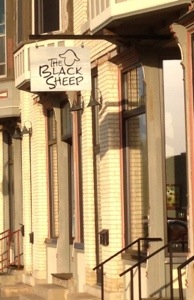
Restaurant Review: The Black Sheep

20130501-115313.jpg

I wrote two weeks ago that I’d review two restaurants in succession, and Chef Tyler Sailsbery’s Black Sheep, at 210 W. Whitewater Street along Cravath Lake, is the promised second of those two reviews.

And yet, it’s odd to write about Whitewater’s Black Sheep as the second of a series – it’s a fine establishment on its own. There never has been (and never will be) a perfect restaurant, but the Black Sheep is a strong addition to area dining.

The restaurant offers a New American cuisine, with with an emphasis on fresh, local ingredients. There’s a nationwide trend toward upscale restaurants of this type, and part of Chef Sailsbery’s accomplishment is embracing this trend for Whitewater.

Alice Waters, the author of the Art of Simple Food, derived from experiences at her Berkeley restaurant on Shattuck Avenue, would find much she’d appreciate at the Black Sheep. She calls her own recipes the ammunition of a delicious revolution, but it’s more informative to say that it’s a new, lighter, more organically-sourced American cuisine.

There’s an entire publishing industry for – and a bit against – Waters’s ideas, but I’ll declare my allegiance, and say that I’ve enjoyed many of her recipes.

For a smaller restaurant, the Black Sheep has a comprehensive menu. Although that might signal problems elsewhere, I found every dish I tried to be well-prepared; Sailsbery’s menu exhibits overall strength.

Lunch affords choices of about five salads, three soups, a few appetizers, and about ten principal choices. Patrons will find real enjoyment in the mushroom bisque, properly light and subtle. There’s none like it in the city, and that’s too bad: this is a bisque as it should be. It’s more than a shame that so many offerings in restaurants are heavy, thick, almost leaden.

The Black Sheep avoids this — successful New American cooking rests on dishes that are light, relatively simple, and never overpowering. One should taste the combination of ingredients, rather than only one over others.

Those having lunch will enjoy the salmon cakes, with chipotle aioli and sautéed spinach.

The dinner menu presents ten principal dishes, about four more of pasta, and two weekly specials (beef short ribs or lamb shank during my visits).

On one visit I chose the lamb ravioli, and the suggested pairing with Bell’s Two Hearted Ale was sound.

You know, that the suggested pairings include a Merlot (Velvet Devil Merlot) is an encouraging sign. Merlot’s taken quite the hit, in film and popular opinion thereafter, and Sailsbery’s suggestion shows a thoughtful assessment rather than an acceptance of a passing bias.

One enters the Black Sheep on Whitewater Street, to find two principal rooms: an entranceway with small dining room and full bar to the left, and a second dining room to the right. They’re not independent spaces: it’s simply the configuration of the building, one that formerly housed a meat market. The division of the space works very well, with the bar separate from the larger dining area.

One quick note – this is fine, but not formal, dining. I rather like that, but the atmosphere is more casual than some might expect. Seating includes couch and cushions along one row of tables, and to my mind that’s all to the good.

There are – in any place – a few gaps. On one visit I noticed that the menus had seen one to many presentations, and I’d switch the tablecloths for something just a bit more textured that wouldn’t need pressing.

One hears so much about what it means to aspire, to be aspirational. It does mean something, but nothing matters more for a restaurant than what patrons truly experience – the table is set only for them, and only their impressions truly matter.

The Black Sheep aspires to offer fine dining for Whitewater, but the strength of Sailsbery’s offering is not simply an aspiration, but rather an accomplishment.

Easily recommended – equally suitable for an enjoyable evening with one’s spouse, friends, or colleagues.

LOCATION: 210 W. Whitewater Street, Whitewater, WI 53190 (262) 458-4751.

OPEN: Mon to Sat, 11 AM – 10 PM — there’s much to be said for simple, regular hours like these, that patrons will easily remember.

PRICES: Main dish and a glass of wine for about $20-25.

RESERVATIONS: Accepted.

DRINKS: Good election of Whites and Reds. Wollersheim’s Prairie Fumé will not disappoint.

SOUND: Moderate, but one can hear one’s companions easily.

SERVICE: Relaxed, attentive, conversational, and friendly. I found a light, welcome playfulness in the waiters and waitresses I met during my visits.

VISITS: Three (one lunch, two dinners).

RATING: Recommended — 3.75 of 4.

20130501-121823.jpg20130501-121823.jpg20130501-121823.jpg20130501-115411.jpg

RATING SCALE: From one to four stars, representing the full experience of food, atmosphere, service, and pricing.

INDEPENDENCE: This review is delivered without financial or other connection to the establishment or its owner. The dining experience was that of an ordinary patron, without notice to the staff or requests for special consideration.


Daily Bread for 5.1.13

Good morning.

A new month begins with mostly sunny skies, a high of 81, and southwest winds at 5 to 10 mph. We’ll have 14h 6m of sunlight, 15h 8m of daylight, and a waning gibbous moon. There will be two minutes more light tomorrow.

Tonight at 5:30 and again at 6:30, in Hyland Hall Room 3101, there will be training sessions for business people on a Digital Mapping Project: the sessions will present tips on marketing a business in an environment of digital communication. For more information, see Wednesday, May 1st: The Digital Whitewater Mapping Project.


The Empire State Building from Paul Sellen on Vimeo.

It’s the anniversary of the Empire State Building’s dedication ceremony:

On this day in 1931, President Herbert Hoover officially dedicates New York City’s Empire State Building, pressing a button from the White House that turns on the building’s lights. Hoover’s gesture, of course, was symbolic; while the president remained in Washington, D.C., someone else flicked the switches in New York.

The idea for the Empire State Building is said to have been born of a competition between Walter Chrysler of the Chrysler Corporation and John Jakob Raskob of General Motors, to see who could erect the taller building. Chrysler had already begun work on the famous Chrysler Building, the gleaming 1,046-foot skyscraper in midtown Manhattan. Not to be bested, Raskob assembled a group of well-known investors, including former New York Governor Alfred E. Smith. The group chose the architecture firm Shreve, Lamb and Harmon Associates to design the building. The Art-Deco plans, said to have been based in large part on the look of a pencil, were also builder-friendly: The entire building went up in just over a year, under budget (at $40 million) and well ahead of schedule. During certain periods of building, the frame grew an astonishing four-and-a-half stories a week.

At the time of its completion, the Empire State Building, at 102 stories and 1,250 feet high (1,454 feet to the top of the lightning rod), was the world’s tallest skyscraper. The Depression-era construction employed as many as 3,400 workers on any single day, most of whom received an excellent pay rate, especially given the economic conditions of the time. The new building imbued New York City with a deep sense of pride, desperately needed in the depths of the Great Depression, when many city residents were unemployed and prospects looked bleak. The grip of the Depression on New York’s economy was still evident a year later, however, when only 25 percent of the Empire State’s offices had been rented….

Google has a question about a mountain in Europe: “What mountain in Switzerland includes three types of glacial erosion, and resembles an ancient Egyptian structure with four specific sides?”

Daily Bread for 4.30.13

Good morning.

Our month ends with a high of eighty-three and an even chance of thunderstorms.

Common Council meets tonight at 6:30 PM, for closed session deliberations, to reconvene in open session thereafter, about a fiber installation proposal.

On this day in 1789, the first presidential inauguration takes place in New York:

In New York CityGeorge Washington, the great military leader of the American Revolution, is inaugurated as the first president of the United States.

In February 1789, all 69 presidential electors unanimously chose Washington to be the first U.S. president. In March, the new U.S. constitution officially took effect, and in April Congress formally sent word to Washington that he had won the presidency. He borrowed money to pay off his debts in Virginia and traveled to New York. On April 30, he came across the Hudson River in a specially built and decorated barge. The inaugural ceremony was performed on the balcony of Federal Hall on Wall Street, and a large crowd cheered after he took the oath of office. The president then retired indoors to read Congress his inaugural address, a quiet speech in which he spoke of “the experiment entrusted to the hands of the American people.” The evening celebration was opened and closed by 13 skyrockets and 13 cannons.

On 4.30.1845, Wisconsin approves public education:

1845 – Wisconsin Approves Free Schools
On this date, under the leadership of Michael Frank, Wisconsin adopted “free” education for its residents. Frank’s plan narrowly passed the legislature by a vote of 90 to 79. Frank’s motivation for free education in Wisconsin was partially inspired by a similar campaign, promoted by Horace Mann in Massachusetts. On June 16, 1845 the first free school opened in Wisconsin. It was one of only three free schools in the country, outside the New England states. By August 1845, Wisconsin had five free schools in operation. [Source:Badger Saints and Sinners, Fred L. Holmes, pg 78-92]

A public program, surely, but there never was, and never will be, one that’s truly without cost.

Google-a-Day asks a history question: “From what kind of facility was the founder and leader of the Mormons escaping when he was shot and killed?”

Monday Music – 2012 Camp Jitterbug

Not long ago, someone preposterously complained that my iPhone’s playlist only had old jazz songs. The observation was surprising because a discerning person should know that a playlist of old jazz songs is, truly, a playlist of good music.

Worse, imagine hearing that one can’t dance to swing.

One might as well be told that polar bears can’t manage snow. They can – and, actually, they love it.

Almost as much, I’d guess, as these dancers love swing.

Enjoy.

Daily Bread for 4.29.13

Good morning.

Monday brings a chance of afternoon thunderstorms with a high of seventy.

Whitewater’s Fire & Rescue Task Force meets today at 5:30 PM.

On this day in 1974, a release of audio recordings:

…President Richard Nixon announces to the public that he will release transcripts of 46 taped White House conversations in response to a Watergate trial subpoena issued in July 1973. The House Judiciary committee accepted 1,200 pages of transcripts the next day, but insisted that the tapes themselves be turned over as well.

Nixontapes.org has transcripts and audio files of the recordings.

Google poses a geography question: “What area of the country is the main benefactor of the electricity generated by the Hoover Dam?”

Recent Tweets, 4.21 to 4.27