
I’m surprised I didn’t stumble upon this sooner.
Poll
Friday Poll: Guerrilla Gardening
by JOHN ADAMS •
So, Ron Finley of California is a guerrilla gardener, planting in whatever space he can find: ‘abandoned lots, traffic medians, along the curbs,’ etc.
So what do you think? Bold or bad? I’ll say bold. (Stubborn as I am, I think there should be two rs in guerrilla, by the way. Spelled either way, I like the idea.)
Daily Bread
Daily Bread for 3.15.13
by JOHN ADAMS •
Good morning.
Friday brings rain to Whitewater, with a high of thirty-five.
Today was, in 44 B.C., an especially bad day for Julius Caesar:
Julius Caesar, the “dictator for life” of the Roman Empire, is murdered by his own senators at a meeting in a hall next to Pompey’s Theatre. The conspiracy against Caesar encompassed as many as sixty noblemen, including Caesar’s own protege, Marcus Brutus.
Caesar was scheduled to leave Rome to fight in a war on March 18 and had appointed loyal members of his army to rule the Empire in his absence. The Republican senators, already chafing at having to abide by Caesar’s decrees, were particularly angry about the prospect of taking orders from Caesar’s underlings. Cassius Longinus started the plot against the dictator, quickly getting his brother-in-law Marcus Brutus to join.
Caesar should have been well aware that many of the senators hated him, but he dismissed his security force not long before his assassination. Reportedly, Caesar was handed a warning note as he entered the senate meeting that day but did not read it. After he entered the hall, Caesar was surrounded by senators holding daggers. Servilius Casca struck the first blow, hitting Caesar in the neck and drawing blood. The other senators all joined in, stabbing him repeatedly about the head.
On this day in 1862, Wisconsinites muster in for the Union:
1862 – (Civil War) 17th and 18th Wisconsin Infantry Regiments Mustered In
The 17th and 18th Wisconsin Infantry regiments mustered in at Madison and Milwaukee, respectively. Both regiments would move from the lower Mississippi Valley into Tennessee and Georgia, participate in Sherman’s March to the Sea, and converge on Virginia at the end of the war. Before they mustered out, the 17th would lose 269 men and the 18th, 225.
Google-a-Day asks a sports question: “What 2009 Formula One race, in the nation that invented motor racing, was canceled due to a financial crisis?”
Anderson, Cartoons & Comics
Fast Food
by JOHN ADAMS •

Daily Bread
Daily Bread for 3.14.13
by JOHN ADAMS •
Good morning.
Thursday brings mostly cloudy skies and a high of thirty-four (with a chance of snow) to Whitewater.
On this day in 1879, Albert Einstein is born:
On March 14, 1879, Albert Einstein is born, the son of a Jewish electrical engineer in Ulm, Germany. Einstein’s theories of special and general relativity drastically altered man’s view of the universe, and his work in particle and energy theory helped make possible quantum mechanics and, ultimately, the atomic bomb.
After a childhood in Germany and Italy, Einstein studied physics and mathematics at the Federal Polytechnic Academy in Zurich, Switzerland. He became a Swiss citizen and in 1905 was awarded a Ph.D. from the University of Zurich while working at the Swiss patent office in Bern. That year, which historians of Einstein’s career call the annus mirabilis–the “miracle year”–he published five theoretical papers that were to have a profound effect on the development of modern physics….
What to do when a whale is entangled? Something like this:
In Wisconsin history, from 1979, a big day for the Bucks:
1979 – Bucks Set Scoring Record
Milwaukee set a team scoring record for a regulation-length game with 158 points against New Orleans. [Source: Bucks.com, Official Site of the Milwaukee Bucks]
Google-a-Day asks a question about literature: “In the poem that includes the lines, ‘This is the dead land, This is cactus land,’ to what work is the first epigraph an allusion?”
Daily Bread
Daily Bread for 3.13.13
by JOHN ADAMS •
Good morning.
It’s a sunny day ahead with a high of thirty. Today brings 11h 48m of sunshine, 12h 44m of daylight, and a new moon.
On this day in 1855, American astronomer Percival Lovell is born. Lovell’s work aided Clyde W. Tombaugh in the discovery of Pluto, and it was Lovell, of course, who famously believed he’d discovered canals and proof of life on Mars.
Lovell’s error about seeing water on surface of Mars may have been one of time more than truth, as NASA now believes that water did once flow across the Martian surface. (There’s no present speculation that, as Lovell believed, intelligent Martians somehow channeled that water for their own purposes.)
There are risks of kayaking, as with any sport, but one would not have expected this one:
Google-a-Day asks a science question: “What is the atomic weight of the lightest element on the periodic table?”
Film
Milk Run
by JOHN ADAMS •
Daily Bread
Daily Bread for 3.12.13
by JOHN ADAMS •
Good morning.
Tuesday brings afternoon snow showers and a high of thirty-two.
They can rebuild him. They have the technology. It’s just that he’s an alligator:
On this day in 1933, FDR gives his first fireside chat:
….eight days after his inauguration, President Franklin D. Roosevelt gives his first national radio address or “fireside chat,” broadcast directly from the White House.
Roosevelt began that first address simply: “I want to talk for a few minutes with the people of the United States about banking.” He went on to explain his recent decision to close the nation’s banks in order to stop a surge in mass withdrawals by panicked investors worried about possible bank failures. The banks would be reopening the next day, Roosevelt said, and he thanked the public for their “fortitude and good temper” during the “banking holiday.”
Google-a-Day asks a history question: “Where had the man, who in 2008 set fire to South Korea’s first National Treasure, set a fire in 2006, for which he was also arrested and charged?”
Daily Bread
Daily Bread for 3.11.13
by JOHN ADAMS •
Good morning.
Monday brings rain, turning to light snow, with little accumulation and a high of thirty-six.
Whitewater’s Planning Commission meets today at 6:00 PM.
On this day in 1818, a literary masterpiece is published:
Frankenstein; or, The Modern Prometheus is published. The book, by 21-year-old Mary Wollstonecraft Shelley, is frequently called the world’s first science fiction novel. In Shelley’s tale, a scientist animates a creature constructed from dismembered corpses. The gentle, intellectually gifted creature is enormous and physically hideous. Cruelly rejected by its creator, it wanders, seeking companionship and becoming increasingly brutal as it fails to find a mate.
Mary Shelley created the story on a rainy afternoon in 1816 in Geneva, where she was staying with her husband, the poet Percy Bysshe Shelley, and their friend Lord Byron. Byron proposed they each write a gothic ghost story, but only Mary Shelley completed hers. Although serving as the basis for the Western horror story and the inspiration for numerous movies in the 20th century, the book Frankenstein is much more than pop fiction. The story explores philosophical themes and challenges Romantic ideals about the beauty and goodness of nature.
Google-a-Day has a geography question: “In the 8th edition of “Human Geography: People Place and Culture,” chapter 9 is devoted to what subject?”
Public Meetings
Community Development Authority
by JOHN ADAMS •
Public Meetings
Planning Commission
by JOHN ADAMS •
Cartoons & Comics
Sunday Morning Cartoon: Meet Buck
by JOHN ADAMS •
Daily Bread
Daily Bread for 3.10.13
by JOHN ADAMS •
Good morning.
It’s a rainy Sunday for Whitewater, with a high of forty-one.
On this day in 1927, Robert Kearns is born:
Robert Kearns, who patented a design for a type of windshield wiper and later won multi-million dollar judgments against Chrysler and Ford for using his concept without permission, is born on March 10, 1927, in Gary, Indiana. Kearns’ invention, the intermittent windshield wiper, enabled wipers to move at timed intervals, rather than constantly swiping back and forth. Intermittent wipers aided drivers in light rain or mist and today are a standard feature of most cars. Kearns’ real-life David versus Goliath story about taking on the auto giants was made into a movie titled “Flash of Genius” that opened in 2008 and starred Greg Kinnear.
Kearns was raised near Detroit, Michigan, and later worked as a professor of engineering at Wayne State University. He first patented his wiper design in 1967 and tried to license his invention to various automakers but failed to make a deal with any of them. Then, in 1960, Ford debuted the first intermittent wiper; other car companies eventually followed suit. In the late 1970s, Kearns sued Ford for patent infringement and went on to take legal action against more than two dozen other automakers.
The ensuing legal battles lasted more than a decade and consumed Kearns, who often acted as his own attorney. Kearns’ quest cost him his marriage and also may have contributed to a nervous breakdown he suffered. In 1990, a jury ruled that Ford was guilty of non-deliberate patent infringement and Kearns was later awarded some $10 million. He also went on to win a $20 million judgment against Chrsyler. Kearns’ lawsuits against other automakers were dismissed for technical reasons.
Google-a-Day poses a history question: “In what state were the naval oil reserves that became an issue during the term of the POTUS whose middle name was Gamaliel?”
Daily Bread
Daily Bread for 3.9.13
by JOHN ADAMS •
Good morning.
Saturday in Whitewater will be a rainy day with a high of forty. We’ll have 11h 37m of sunlight, 12h 33m of daylight, and somewhere behind the clouds there’ll be a waning crescent moon.
On this day in 1862, the U.S.S. Monitor battles the C.S.S. Virginia:
….one of the most famous naval battles in American history occurs as two ironclads, the U.S.S. Monitor and the C.S.S. Virginia fight to a draw off Hampton Roads, Virginia. The ships pounded each other all morning but their armor plates easily deflected the cannon shots, signaling a new era of steam-powered iron ships.
The C.S.S. Virginia was originally the U.S.S. Merrimack, a 40-gun frigate launched in 1855. The Confederates captured it and covered it in heavy armor plating above the waterline. Outfitted with powerful guns, the Virginia was a formidable vessel when the Confederates launched her in February 1862. On March 8, the Virginia sunk two Union ships and ran one aground off Hampton Roads.
The next day, the U.S.S. Monitor steamed into the Chesapeake Bay. Designed by Swedish engineer John Ericsson, the vessel had an unusually low profile, rising from the water only 18 inches. The flat iron deck had a 20-foot cylindrical turret rising from the middle of the ship; the turret housed two 11-inch Dahlgren guns. The Monitor had a draft of less than 11 feet so it could operate in the shallow harbors and rivers of the South. It was commissioned on February 25, 1862, and arrived at Chesapeake Bay just in time to engage the Virginia.
The battle between the Virginia and the Monitor began on the morning of March 9 and continued for four hours. The ships circled one another, jockeying for position as they fired their guns. The cannon balls simply deflected off the iron ships. In the early afternoon, the Virginia pulled back to Norfolk. Neither ship was seriously damaged, but the Monitor effectively ended the short reign of terror that the Confederate ironclad had brought to the Union navy….
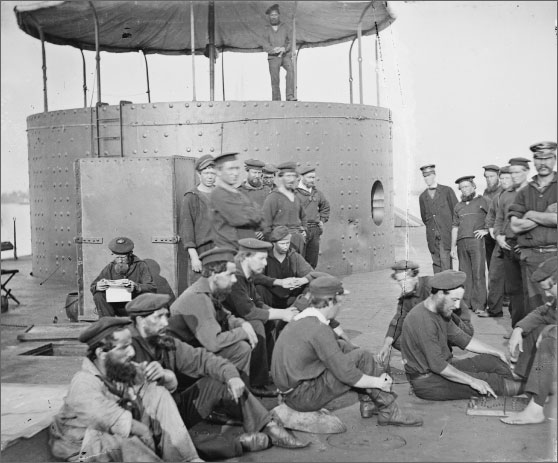
This month, over 150 years later, the “Remains of USS Monitor sailors [were] interred at Arlington National Cemetery.”
Google-a-Day asks a geography and history question: “What was the profession of the pioneer of ‘The Great Silk Road’?”