
FREE WHITEWATER

Daily Bread for 2.121.3

Good morning.

Today brings mostly sunny skies and a high of thirty-two to Whitewater.

It’s Lincoln’s birthday, and in 1859, while a presidential candidate, he spoke in Milwaukee at the Wisconsin State Fair.  Here’s a part of the text of that address, ostensibly about agriculture (but truly about even more):
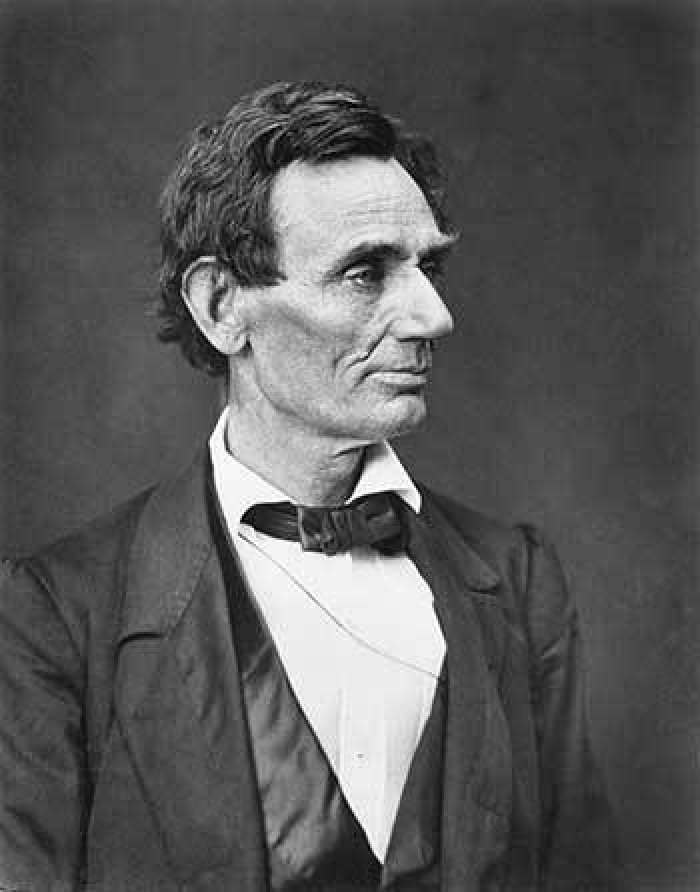
url

The world is agreed that labor is the source from which human wants are mainly supplied. There is no dispute upon this point. From this point, however, men immediately diverge. Much disputation is maintained as to the best way of applying and controlling the labor element. By some it is assumed that labor is available only in connection with capital — that nobody labors, unless somebody else, owning capital, somehow, by the use of that capital, induces him to do it. Having assumed this, they proceed to consider whether it is best that capital shall hire laborers, and thus induce them to work by their own consent; or buy them, and drive them to it without their consent. Having proceeded so far they naturally conclude that all laborers are necessarily either hired laborers, or slaves. They further assume that whoever is once a hired laborer, is fatally fixed in that condition for life; and thence again that his condition is as bad as, or worse than that of a slave. This is the “mud-sill” theory.

But another class of reasoners hold the opinion that there is no such relation between capital and labor, as assumed; and that there is no such thing as a freeman being fatally fixed for life, in the condition of a hired laborer, that both these assumptions are false, and all inferences from them groundless. They hold that labor is prior to, and independent of, capital; that, in fact, capital is the fruit of labor, and could never have existed if labor had not first existed — that labor can exist without capital, but that capital could never have existed without labor. Hence they hold that labor is the superior — greatly the superior — of capital.

They do not deny that there is, and probably always will be, a relation between labor and capital. The error, as they hold, is in assuming that the whole labor of the world exists within that relation. A few men own capital; and that few avoid labor themselves, and with their capital, hire, or buy, another few to labor for them. A large majority belong to neither class — neither work for others, nor have others working for them. Even in all our slave States, except South Carolina, a majority of the whole people of all colors, are neither slaves nor masters. In these Free States, a large majority are neither hirers or hired. Men, with their families — wives, sons and daughters — work for themselves, on their farms, in their houses and in their shops, taking the whole product to themselves, and asking no favors of capital on the one hand, nor of hirelings or slaves on the other. It is not forgotten that a considerable number of persons mingle their own labor with capital; that is, labor with their own hands, and also buy slaves or hire freemen to labor for them; but this is only a mixed, and not a distinct class. No principle stated is disturbed by the existence of this mixed class. Again, as has already been said, the opponents of the “mud-sill” theory insist that there is not, of necessity, any such thing as the free hired laborer being fixed to that condition for life. There is demonstration for saying this. Many independent men, in this assembly, doubtless a few years ago were hired laborers. And their case is almost if not quite the general rule….

It is said an Eastern monarch once charged his wise men to invent him a sentence, to be ever in view, and which should be true and appropriate in all times and situations. They presented him the words: “And this, too, shall pass away.” How much it expresses! How chastening in the hour of pride! — how consoling in the depths of affliction! “And this, too, shall pass away.” And yet let us hope it is not quite true. Let us hope, rather, that by the best cultivation of the physical world, beneath and around us; and the intellectual and moral world within us, we shall secure an individual, social, and political prosperity and happiness, whose course shall be onward and upward, and which, while the earth endures, shall not pass away.

Downtown Whitewater 2013/2014 Board of Directors Nomination Form

Please see a Downtown Whitewater 2013/2014 Board of Directors Nomination Form:

The Downtown Whitewater, Inc. Board of Directors is the legal entity responsible for overseeing Whitewater’s downtown revitalization program under the guidance of the Wisconsin Main Street Program, including the budget, staff, and program effectiveness.

We are currently seeking nominations to fill five seats of the eleven-seat board.

What you should know

The board is a decisive, action-oriented group of individuals that recognizes that each Whitewater community member is a stakeholder in the downtown revitalization process. Board members must be willing to:

  • Understand and promote the Downtown Whitewater mission and goals.
  • Contribute knowledge, effort, time, and/or labor to downtown revitalization.
  • Attend board meetings on a regular basis and commit to a two-year term.
  • Actively participate and be member in one of the standing committees: Promotions, Economic Restructuring, Design or Organization.
  • Promote unity within the group and seek to resolve internal conflict.
  • Support board decisions even when he or she disagrees with the majority.
  • Offer opinions honestly, constructively, and without reservation.
  • Help the board stay focused on the “Action Plan” and discourage it from being distracted by secondary issues or projects not included in the plan.
  • Actively seek additional participation of all forms; encourage new members and input in the downtown revitalization process; recruit new board members.

Nominations and election process

Nominations: Any Whitewater community member, business owner, or property owner may nominate a qualified individual (see details) by Thursday, February 14, 2013 at 5 PM.

Elections: Individuals nominated will be contacted and asked to submit a brief bio listing their interest in the downtown and possible resources and talents they have to contribute by Monday, February 25, 2013. This information will be sent via email to eligible voters and also available at the Downtown Whitewater office the week of March 4 – March 8, 2013. Ballots must be cast Thursday, March 14 between 6 PM & 9 PM during the Annual Member Meeting at Jessica’s Family Restaurant. Our new board members will be announced after all ballots are counted and verified and all new members notified. The first meeting for new board members will be on April 24, 2013.

Eligible voters include donors to Downtown Whitewater, active committee and board members, and those who sign an indication of interest form, available at Downtown Whitewater, Inc. or online at www.downtownwhitewater.com.

Nominations due Thursday, February 14, at 5 PM. Return this form to Downtown Whitewater, send it to PO Box 688, or email it to director@downtownwhitewater.com.

Nominations form

Please indicate your nominations for the following positions.

Two Downtown Business Owners

Nominees must own a business in the downtown district (see website for map).

name: _________________________ contact info: ______________________

name: _________________________ contact info: ______________________

Two Members-at-Large

Nominee must provide a point of view or experience not necessarily represented by other stakeholders.
name: _________________________ contact info: ______________________

name: _________________________ contact info: ______________________

One Downtown Property Owner

Nominee must be a local property owner
name:_________________________ contact info:______________________

2012 Downtown Whitewater, Inc. Board of Directors

Downtown Business Owner
Dennis Salverson (Coyote Grill)
Open (term expires: 03/2013)

Downtown Business Owner
Open (term expires: 03/2013)

Downtown Property Owner
Geoff Hale (Home Lumber)
Open (term expires: 03/2013)

Member-at-Large
Roni Telfer
Open (term expires: 3/2013)

Member-at-Large
Tyler Sailsbery (The Black Sheep)
Open (term expires: 03/2013)

Downtown Business Owner
Dave Saalsaa (Quiet Hut Sports)
(term expires: 03/2014)

Member-at-Large
Pete Hill
(term expires: 03/2014)

Member-at-Large
Glen Gebauer (Associated Bank)
(term expires: 03/2014)

Financial Representative
Nate Parrish (First Citizens State Bank)
(term expires: 03/2014)

UW-W Representative
Rob Boostrom (Asst. Professor)
(term expires: 03/2014)

Ex-Officio Cameron Clapper (Whitewater City Manager) 

Please see a printable or downloadable (in full size) version of the Nomination Form:

Monday Music: Valentine’s Holiday Edition

Monday Music is a weekly feature at my websites, and here are a few songs with a Valentine’s Day connection, with choices suitable for those in love, those hoping for love, and those who are now (but I would hope only temporarily) broken-hearted.

For those falling in love: Something in the Air Between Us

For those in now in love: Nobody’s Baby Now

For those who’d like a consolation song: So Long, You Fool

For those who’d like to try again: Let’s Try This Again

Bonus — for a song with one of the worst pickup lines of all time (‘I aint the worst that you’ve seen’): Jump

Daily Bread for 2.11.13

Good morning.

Snow showers and flurries, with no expected accumulation, and a high of thirty-three start our week.

Downtown Whitewater’s board meets today at 8 AM, and Whitewater’s Planning Commission later today at 6 PM.

On this day in 1861, Lincoln leaves for Washington:

On a cold, rainy morning, Lincoln boarded a two-car private train loaded with his family’s belongings, which he himself had packed and bound. His wife, Mary Lincoln, was in St. Louis on a shopping trip, and joined him later in Indiana. It was a somber occasion. Lincoln was leaving his home and heading into the maw of national crisis.

Since he had been elected, seven Southern states had seceded from the Union. Lincoln knew that his actions upon entering office would likely lead to civil war.

He spoke to a crowd before departing: “Here I have lived a quarter of a century, and have passed from a young man to an old man. Here my children have been born, and one is buried. I now leave, not knowing when, or whether ever, I may return, with a task before me greater than that which rested upon Washington. Without the assistance of that Divine Being… I cannot succeed. With that assistance, I cannot fail… To His care commending you, as I hope in your prayers you will commend me, I bid you an affectionate farewell.”

A bystander reported that the president-elect’s “breast heaved with emotion and he could scarcely command his feelings.” Indeed, Lincoln’s words were prophetic—a funeral train carried him back to Springfield just over four years later.

It’s an understatement to say that 2.11.1842 was a low point in Wisconsin’s legislative history:

1842 – Shooting in the Legislature

On this date the Territorial Legislature of Wisconsin met in Madison, only to be interrupted by the shooting of one member by another. The legislature was debating the appointment of Enos S. Baker for sheriff of Grant County when Charles Arndt made a sarcastic remark about Baker’s colleague, James Vineyard. After an uproar, adjournment was declared and when Arndt approached Vineyard’s desk, a fight broke out during which Vineyard drew his revolver and shot Arndt. [Source: Badger Saints and Sinners by Fred L. Holmes]

Google-a-Day offers a history question: “What nation was the source of the missiles found aboard the Yemen-bound unflagged freighter intercepted by the Spanish SPS Navarra on December 9, 2002?”

Recent Tweets, 2.3 to 2.9

Daily Bread for 2.10.13

Good morning.

Sunday brings rain or freezing rain, with a high of forty today.

On this day in 1763, it’s the end of the French and Indian War:

The Seven Years’ War, a global conflict known in America as the French and Indian War, ends with the signing of the Treaty of Paris by France, Great Britain, and Spain.

In the early 1750s, France’s expansion into the Ohio River valley repeatedly brought the country into armed conflict with the British colonies. In 1756, the British formally declared war against France.

In the first year of the war, the British suffered a series of defeats at the hands of the French and their broad network of Native American alliances. However, in 1757, British Prime Minister William Pitt (the older) recognized the potential of imperial expansion that would come out of victory against the French and borrowed heavily to fund an expanded war effort. Pitt financed Prussia’s struggle against France and her allies in Europe and reimbursed the colonies for the raising of armies in North America. By 1760, the French had been expelled from Canada, and by 1763 all of France’s allies in Europe had either made a separate peace with Prussia or had been defeated. In addition, Spanish attempts to aid France in the Americas had failed, and France also suffered defeats against British forces in India.

The Seven Years’ War ended with the signing of the treaties of Hubertusburg and Paris in February 1763. In the Treaty of Paris, France lost all claims to Canada and gave Louisiana to Spain, while Britain received Spanish Florida, Upper Canada, and various French holdings overseas. The treaty ensured the colonial and maritime supremacy of Britain and strengthened the 13 American colonies by removing their European rivals to the north and the south.

The end of that war brings a change to Wisconsin:

1763 – Treaty of Paris Cedes Wisconsin to England
On this date the Treaty of Paris ceded formerly French-controlled land, including the Wisconsin region, to England. [Source: Avalon Project at Yale University]


Google-a-Day asks about a book proposal’s original title: “When Maurice Sendak first pitched the idea for the book that would eventually become “Where The Wild Things Are”, what was the title?”

Daily Bread for 2.9.13

Good morning.

A partly sunny Saturday, with a high of thirty-one, lies ahead.

So Monopoly now has a cat playing-piece, and the Daily Show’s Jon Stewart thinks it should have been the robot. There’s still room for an obvious compromise:

2.9.1964:

At approximately 8:12 p.m. Eastern time, Sunday, February 9, 1964, The Ed Sullivan Show returned from a commercial (for Anacin pain reliever), and there was Ed Sullivan standing before a restless crowd. He tried to begin his next introduction, but then stopped and extended his arms in the universal sign for “Settle Down.” “Quiet!” he said with mock gravity, and the noise died down just a little. Then he resumed: “Here’s a very amusing magician we saw in Europe and signed last summer….Let’s have a nice hand for him—Fred Kaps!”

For the record, Fred Kaps proceeded to be quite charming and funny over the next five minutes. In fact, Fred Kaps is revered to this day by magicians around the world as the only three-time Fédération Internationale des Sociétés Magiques Grand Prix winner. But Fred Kaps had the horrific bad luck on this day in 1964 to be the guest that followed the Beatles on Ed Sullivan—possibly the hardest act to follow in the history of show business.

It is estimated that 73 million Americans were watching that night as the Beatles made their live U.S. television debut. Roughly eight minutes before Fred Kaps took the stage, Sullivan gave his now-famous intro, “Ladies and gentlemen…the Beatles!” and after a few seconds of rapturous cheering from the audience, the band kicked into “All My Lovin’.” Fifty seconds in, the first audience-reaction shot of the performance shows a teenage girl beaming and possibly hyperventilating. Two minutes later, Paul is singing another pretty, mid-tempo number: “Til There Was You,” from the Broadway musical Music Man. There’s screaming at the end of every phrase in the lyrics, of course, but to view the broadcast today, it seems driven more by anticipation than by the relatively low-key performance itself. And then came “She Loves You,” and the place seems to explode. What followed was perhaps the most important two minutes and 16 seconds of music ever broadcast on American television—a sequence that still sends chills down the spine almost half a century later.

On this day in 1870, a dream of Wisconsin naturalist Increase Lapham comes true:

1870 – National Weather Service Authorized
On this date President Ulysses S. Grant signed a joint resolution authorizing a National Weather Service, which had long been a dream of Milwaukee scientist Increase Lapham. Lapham, 19th-century Wisconsin’s premier natural scientist, proposed a national weather service after he mapped data contributed over telegraph lines in the UpperMidwest and realized that weather might be predicted in advance. He was concerned about avoiding potential disasters to Great Lakes shipping and Wisconsin farming, and his proposal was approved by Congress and authorized on this date. [Source: History Just Ahead: A Guide to Wisconsin’s Historical Markers, edited by Sarah Davis McBride]

Google-a-Day asks a question of geography and art: “In what European capital can you view the city’s first nude statue by Sir Richard Westmacott erected in 1822?”

The Whitewater Premiere of Heavy Hands: Sunday, 2.10.13 @ 7 PM

Supporters of independent filmmaking helped fund Sean Williamson’s Heavy Hands through Kickstarter.

His film will have a local premiere on Sunday, February 10th at 7 P.M. Following a December showing in Milwaukee, the film will be screened at here in Sommers Theater at UW-Whitewater.

Heavy Hands tells the story of “anti-hero Jimmy Lee as he deals with the ramifications of a careless and selfish act. Set in a cold and dangerous country climate, Heavy Hands is funny, sad and sexy.”

Film critic Matt Wild, writing at the AV Club, offers praise for Williamson’s work:

Though only an hour long, Heavy Hands tells its story at a leisurely pace, finding time for picturesque respites and unexpected cameos from the The Royal Tenenbaums’ Kumar Pallana and Milwaukee’s own Mark Borchardt and Frankie Latina. (Milwaukee groups Jaill, Hello Death, Hot Coffin, and Altos provide the soundtrack.) The film’s cinematography—handheld and mostly utilitarian—owes a debt to the earlier work of Jim Jarmusch, though a few scenes, like Jimmy’s fateful camping trip and a walk through a haunted house, are surprisingly lyrical. But it’s the film’s experimental, avant-garde bent that leaves the greatest impression. Heavy Hands may bill itself as cowpoke crime drama full of bleak landscapes and tortured souls, but, like all good experimental films, it’s really about the power of film—honest-to-God film—itself.

An extended trailer appears immediately below: