
FREE WHITEWATER

Daily Bread for 2.4.13

Good morning.

We’ve had a few inches of snow overnight, and we’ll have about one more before the show ends in the early afternoon. It’s a MOnday high of twenty, with 10h 5m of sunlight and 11h 5m of daylight.

Whitewater’s Parks & Rec Board will meet later today at 5 PM.

On this day in 1938, a now-famous animated film meets its public:

“See for yourself what the genius of Walt Disney has created in his first full length feature production,” proclaimed the original trailer for Snow White and the Seven Dwarfs, released on this day in 1938.

Based on the famous fairy tale by the Brothers Grimm, Snow White opened with the Wicked Queen asking her magic mirror the question “Who is the fairest one of all?” The mirror gives its fateful answer: Snow White, the queen’s young stepdaughter. Ordered by the queen to kill the young princess, a sympathetic woodsman instead urges Snow White to hide in the forest; there she encounters a host of friendly animals, who lead her to a cottage inhabited by the Seven Dwarfs: Sleepy, Dopey, Doc, Sneezy, Grumpy, Bashful and Happy. Eventually, in the classic happy ending viewers would come to expect as a Disney trademark, love conquers all as the dwarfs defeat the villainous queen and Snow White finds love with a handsome prince.

Walt Disney’s decision to make Snow White, which was the first animated feature to be produced in English and in Technicolor, flew in the face of the popular wisdom at the time. Naysayers, including his wife Lillian, warned him that audiences, especially adults, wouldn’t sit through a feature-length cartoon fantasy about dwarfs. But Disney put his future on the line, borrowing most of the $1.5 million that he used to make the film. Snow White premiered in Hollywood on December 21, 1937, earning a standing ovation from the star-studded crowd. When it was released to the public the following February, the film quickly grossed $8 million, a staggering sum during the Great Depression and the most made by any film up to that time.

Critics were virtually unanimous in their admiration for Snow White. Charlie Chaplin, who attended the Hollywood premiere, told the Los Angeles Times that the film “even surpassed our high expectations. In Dwarf Dopey, Disney has created one of the greatest comedians of all time.” The movie’s innovative use of story, color, animation, sound, direction and background, among other elements, later inspired directors like Federico Fellini and Orson Welles. In fact, Welles’Citizen Kane features an opening shot of a castle at night with one lighted window that is strikingly similar to the first shot of the Wicked Queen’s castle in Snow White.

Disney won an honorary Academy Award for his pioneering achievement, while the music for the film, featuring Snow White’s famous ballad, “Some Day My Prince Will Come” and other songs by Frank Churchill, Larry Morey, Paul J. Smith and Leigh Harline, was also nominated for an Oscar. The studio re-released Snow White for the first time in 1944, during World War II; thereafter, it was released repeatedly every decade or so, a pattern that became a tradition for Disney’s animated films. For its 50th anniversary in 1987, Snow White was restored, but cropped into a wide-screen format, a choice that irked some critics. Disney released a more complete digital restoration of the film in 1993. Its power continues to endure: In June 2008, more than 60 years after its U.S. release, the American Film Institute chose Snow White and the Seven Dwarfs as the No. 1 animated film of all time in its listing of “America’s 10 Greatest Films in 10 Classic Genres.”

Google-a-Day has a basketball question for this morning: “The youngest recipient of the NBA MVP award joined which one of his “Bulls” teammates in receiving this honor?”
Recent Tweets, 1.27 to 2.2

Daily Bread for 2.3.13

Good morning.

For Sunday, it’s light snow in the morning, a high of twelve, and then more snow tonight.

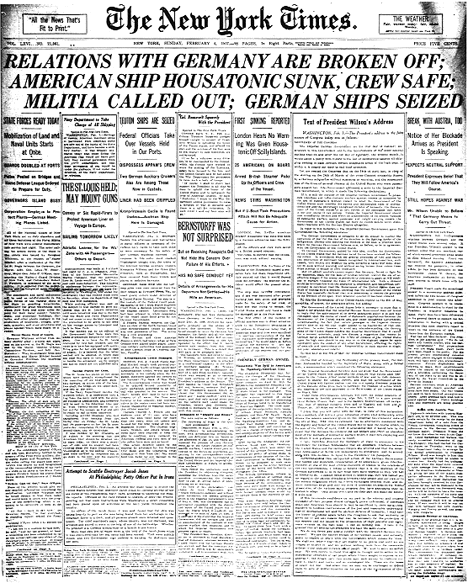
On February 3, 1917, America drew closer to war with Imperial Germany:

0203_big

Washington, Feb. 3 — Diplomatic relations between Germany and the United States were severed today. It was President Wilson’s answer to the German notice that any merchant vessel which entered prescribed areas would be sunk without warning. Count von Bernstorff, the Kaiser’s Ambassador, has received his passports, in other words, he has been dismissed by this Government. James W. Gerard, the American Ambassador at Berlin, has been ordered to return home with his staff.

President Wilson made the sensational answer in a momentous address delivered before the two houses of Congress assembled in joint session this afternoon. Congress appears to be unanimous in a determination to stand by the President in whatever measures he takes. Party lines have been obliterated in the general desire to support the Administration in dealing with a critical situation that most observers expect to result in the entrance of the United States into the European conflict.

2.3.1959 is

The Day the Music Died
Bad winter weather and a bus breakdown prompted rock-and-roll musicians Buddy Holly, Ritchie Valens, and the Big Bopper to rent a plane to continue on their “Winter Dance Party” tour. Icy roads and treacherous weather had nearly undermined their performances in Green Bay and Appleton that weekend, so after a show at the Surf Ballroom in Clear Lake, Iowa, on February 2, 1959, they boarded a four-seat airplane. The three performers and pilot Roger Peterson perished when the plane crashed about 1:00 AM on Monday, February 3rd (“The Day the Music Died,” according to singer Don McLean in his song “American Pie”) . [Source: Mark Steuer; Wikipedia]

Google-a-Day offers an entertainment question: “The part of Leigh Anne Tuohy’s daughter in “The Blind Side” is played by the daughter of what famous performer?”

Phil the Groundhog’s Forecast

It’s Groundhog Day in America, and we’ve now a prediction from Punxsutawney Phil, the planet’s most famous groundhog.

Phil’s call, not having seen his shadow earlier this morning, is for an early spring:

On this February 2nd, 2013,
the One Hundred and Twenty Seventh Annual Trek of the
Punxsutawney Groundhog Club at Gobbler’s Knob….

Punxsutawney Phil, the King of the Groundhogs,
Seer of Seers, Prognosticator of Prognosticators,
Weather Prophet without Peer,
was awakened from his borrow at 7:28 am
with a tap of the President’s cane.

Phil and President Deeley conversed in Groundhogese
and Phil directed him to the chosen Prognostication scroll.

The President tapped the chosen scroll and
directed Phil’s Prediction be proclaimed:

My new Knob entrance is a sight to behold
Like my faithful followers, strong and bold

And so ye faithful,
there is no shadow to see
An early Spring for you and me.

Daily Bread for 2.2.13

Good morning.

It’s a forecast of light snow in the morning, leading to a mostly cloudy day with a high of fourteen.

On this day in 1887, the first ‘official’ Groundhog Day:

…Groundhog Day, featuring a rodent meteorologist, is celebrated for the first time at Gobbler’s Knob in Punxsutawney, Pennsylvania. According to tradition, if a groundhog comes out of its hole on this day and sees its shadow, there will be six more weeks of winter weather; no shadow means an early spring.

Groundhog Day has its roots in the ancient Christian tradition of Candlemas Day, when clergy would bless and distribute candles needed for winter. The candles represented how long and cold the winter would be. Germans expanded on this concept by selecting an animal–the hedgehog–as a means of predicting weather. Once they came to America, German settlers in Pennsylvania continued the tradition, although they switched from hedgehogs to groundhogs, which were plentiful in the Keystone State.

Groundhogs, also called woodchucks and whose scientific name is Marmota monax, typically weigh 12 to 15 pounds and live six to eight years. They eat vegetables and fruits, whistle when they’re frightened or looking for a mate and can climb trees and swim. They go into hibernation in the late fall; during this time, their body temperatures drop significantly, their heartbeats slow from 80 to five beats per minute and they can lose 30 percent of their body fat. In February, male groundhogs emerge from their burrows to look for a mate (not to predict the weather) before going underground again. They come out of hibernation for good in March.

In 1887, a newspaper editor belonging to a group of groundhog hunters from Punxsutawney called the Punxsutawney Groundhog Club declared that Phil, the Punxsutawney groundhog, was America’s only true weather-forecasting groundhog

In 1905 on this day, a sports advancement for Wisconsin:

1905 – Professional Baseball Arrives in Wisconsin
On this date the Wisconsin State League was formed, bringing professional baseball to five Wisconsin cities. The six-team league began play the following summer with franchises in Beloit, Green Bay, La Crosse, Oshkosh, Wausau, and Freeport, Illinois. The league lasted through 1914, although its named was changed to Wisconsin-Illinois in 1908.

From Google-a-Day, a geography question: “The cities of Amsterdam, including Rotterdam, The Hague and Utrecht make up what area that is home to more than 40% of the population of The Netherlands?”

Friday Catblogging: Ultimate Predator Edition™

Your pet cat may not be as cute and cuddly as you might think. According to a new study published Tuesday in the journal Nature Communications, domestic cats kill billions of birds, mice and small animals in the U.S. each year.

Biologists estimated that cats are responsible for the deaths of as many as 3.7 billion birds and 20.7 billion smaller animals, including mice, voles and chipmunks, the Agence France-Presse reported. The study also concludes that cats are likely the No. 1 killer of birds and small mammals in the country.

Led by Scott Loss of the Smithsonian Conservation Biology Institute, the study drew from past research on the predatory habits of cats. While previous studies have suggested cats are responsible for billions of small creature deaths, the most recent estimates are significantly higher.

Via Domestic Cats Kill Billions Of Mice And Birds Per Year, Study Estimates.

Friday Poll: Super Bowl XLVII

About as likely as any poll topic before of this weekend: 49ers or Ravens? Oddsmakers give San Francisco about a 4 point edge, not far from the odds when betting began.

Those odds seem about right to me, but I’ll make a sentimental pick and say Ravens by three, 24-21. That’s not a reasoned picked: it’s heavy on hope. Still, if there’s ever been a day for wishful thinking, it’s Super Bowl Sunday.

But has there been a recent Super Bowl with more criticism and controversy about the players on both teams? Press scrutiny of comments from San Francisco’s players, and Washington Post stories about Ray Lewis of nearby Baltimore (hitting him as hard as they possibly could), stand out as exceptions to typically bland SB coverage.

What do you think?


Daily Bread for 2.1.13

Good morning.

It’s a cold Friday, with a high likely to be about eight, increasing clouds, and wind chill measurements between -10 and -20.

On this day in 1884, a great dictionary is born:

…the first portion, or fascicle, of the Oxford English Dictionary (OED), considered the most comprehensive and accurate dictionary of the English language, is published. Today, the OED is the definitive authority on the meaning, pronunciation and history of over half a million words, past and present

Plans for the dictionary began in 1857 when members of London’s Philological Society, who believed there were no up-to-date, error-free English dictionaries available, decided to produce one that would cover all vocabulary from the Anglo-Saxon period (1150 A.D.) to the present. Conceived of as a four-volume, 6,400-page work, it was estimated the project would take 10 years to finish. In fact, it took over 40 years until the 125th and final fascicle was published in April 1928 and the full dictionary was complete–at over 400,000 words and phrases in 10 volumes–and published under the title A New English Dictionary on Historical Principles.

Unlike most English dictionaries, which only list present-day common meanings, the OED provides a detailed chronological history for every word and phrase, citing quotations from a wide range of sources, including classic literature and cookbooks. The OED is famous for its lengthy cross-references and etymologies. The verb “set” merits the OED’s longest entry, at approximately 60,000 words and detailing over 430 uses.

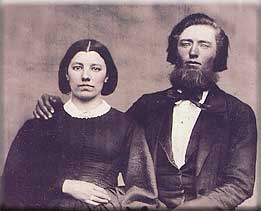
In the Wisconsin of 1860,

CharlesCarolineIngalls_2

1860 – Ma and Pa Ingalls [Were] Married

On this date Charles Ingalls and Caroline Quiner were married in Concord, Wisconsin. They were the parents of noted Wisconsinite Laura Ingalls Wilder, author of the “Little House” series. [Source: Herbert Hoover Presidential Library and Museum]

Google-a-Day poses a history question: “What notable river was close by the campaign in which Lee defeated the much larger army led by Major General Joseph Hooker?