
FREE WHITEWATER

Whitewater-Area League of Women Voters November 2012 Newsletter

The Whitewater-Area League of Women Voters’ November 2012 Newsletter has arrived, featuring articles and a calendar of upcoming events.

This latest edition is available as a link on my blogroll, and is embedded below.

Upcoming events:

December 9th (Sunday)
Event: League Holiday Dinner with WHS Madrigal Singers, Making Democracy Work award presentation
Where: Whitewater Country Club, 5:30 PM Cocktails, 6 PM Dinner, 7 PM Program

The League is proud to announce that Whitewater City Clerk Michele Smith will receive our 3rd annual Making Democracy Work award. Michele has served as Whitewater City Clerk since September 2000. Over the past twelve years she has managed countless elections for our community with integrity and administrative professionalism. This year Michele steered us through an unprecedented six elections! Thanks to Michele’s fair-mindedness, efficiency and competence, the entire Whitewater electorate benefits every Election Day knowing their vote counts because they know it will be counted. Michele will be presented with her award on Sunday evening, December 9th at the League Holiday Dinner. Please join us at the Whitewater Country Club as we pay tribute to one of our community’s outstanding public servants.

The newsletter embedded above includes a dinner reservation form with choice of entrée.

January 5th (Saturday)
Event: LWV Board Meeting
Where: Whitewater Public Library, 10 AM

January 17th (Thursday)
Event: Public Meeting, Obamacare: Post-election and Post Supreme Court Ruling
Where: 7 PM, Whitewater City Hall, Council Chambers

Fairhaven Lecture Series:

Mondays at 3 PM, Fellowship Hall, Fairhaven Retirement Center

Nov. 19 Polls, pols and polarization: Wisconsin and the nation, 2012
Wayne Youngquist, Senior Lecturer, Sociology, Anthropology and Criminal Justice
Whitewater League Website
www.lwvwhitewater.org

Daily Bread for 11.12.12

Good morning.

Monday begins with a high of thirty-three, and a slight chance of flurries in the afternoon.

Tonight at 6 PM, Whitewater’s Planning Commission meets.

On this day in 1942, the Battle of Guadalcanal began. The battle ended as a major American victory over Japan. Here’s how the New York Times reported the beginning of the battle:

The Army and Marine forces on Guadalcanal Island carried out offensive action against the Japanese there both on the east and west on Monday (Solomons date), the Navy reported in a communique issued here today. The communique indicated, by lack of word to the contrary, that the operations proceeded successfully. Army planes based in Alaska destroyed seven Japanese seaplanes and damaged two cargo vessels in the western reaches of the Aleutian Islands, the Navy said.

The Guadalcanal operations were supported by Army planes, which on previous occasions have aided in our new offensive moves by bombing enemy supply dumps and by strafing such enemy forces as could be located in clearings in the jungle.

While supporting the ground attacks the air forces based at Henderson Field, on Guadalcanal, also carried attacks to the enemy at sea and in the air. One group of unidentified American planes attacked five Japanese destroyers to the east of New Georgia Island, but the fliers were unable to observe the results of their attack.

On this day in 1836, the Wisconsin Territory had her first law:

1836 – Governor Dodge Signs First Law
On this date territorial governor, Henry Dodge, signed the first law passed by the Wisconsin Territorial Legislature. The law prescribed how the legislators were to behave, and how other citizens were to behave towards them. For example, it authorized “the Assembly to punish by fine and imprisonment every person, not a member, who shall be guilty of disrespect, disorderly or contemptous behavior, threats, in the legislature or interference with witnesses to the legislature; also to expel on a two thirds majority in either house a member of its own body…” This did not keep the members from vociferous arguments, fist fights, or even shooting one another (see Odd Wisconsin or the entry in This Day in Wisconsin History for February 11th)

Google’s daily puzzle asks about poetry: “Which poet likens youth to a budding flower in his “carpe diem” poem, urging its reader to gather them up?”

Daily Bread for 11.11.12

Good morning.

Happy Veterans’ Day. Whitewater’s Sunday will bring showers and a high of sixty-five.

On this day in 1918, the First World War came to an end:

At the 11th hour on the 11th day of the 11th month of 1918, the Great War ends. At 5 a.m. that morning, Germany, bereft of manpower and supplies and faced with imminent invasion, signed an armistice agreement with the Allies in a railroad car outside Compiégne, France. The First World War left nine million soldiers dead and 21 million wounded, with Germany, Russia, Austria-Hungary, France, and Great Britain each losing nearly a million or more lives. In addition, at least five million civilians died from disease, starvation, or exposure.

On this day in 1964, the Rolling Stones first played Wisconsin:

1964 – Rolling Stones Play Milwaukee
On this date the Rolling Stones first performed in Wisconsin, to a crowd of 1,274 fans at Milwaukee Auditorium. Although Brian Jones remained in a Chicago hospital with a high fever, the rest of the band performed.

According to a dubious reporter for the Milwaukee Journal, “Chances are, few in the audience missed his [Jones’] wailing harmonica. Screams from a thousand throats drowned out all but the most insistent electronic cacaphony [sic] and the two-fisted smashes of drummer Charlie Watts.”

The reporter continued, “Unless someone teaches guitar chords to chimpanzees, the visual ultimate has been reached in the Rolling Stones. With shoulder length hair and high heeled boots, they seemed more feminine than their fans.

The Stones make the Beatles look like clean cut kids. You think it must be some kind of parody – but the little girls in front paid $5.50 a seat.” [Source: Milwaukee JournalNovember 12, 1964, p.14]

Wow, that’s one uptight reporter: on November 12th, 1964, Milwaukee was still standing.

Google’s daily puzzle combines pop culture and geography: “You leave the Kodak Theater in Los Angeles and walk to a nearby park on Franklin to meet a friend. What is the name of the park?”

Daily Bread for 11.10.12

Good morning.

A lovely Saturday unfolds for Whitewater, with decreasing clouds, mild temperatures with a high of sixty-five, and south winds at 10 to 15 miles per hour.

On this day in 1969, Sesame Street made its debut:

“Sesame Street,” a pioneering TV show that would teach generations of young children the alphabet and how to count, makes its broadcast debut. “Sesame Street,” with its memorable theme song (“Can you tell me how to get/How to get to Sesame Street”), went on to become the most widely viewed children’s program in the world. It has aired in more than 120 countries.

The show was the brainchild of Joan Ganz Cooney, a former documentary producer for public television. Cooney’s goal was to create programming for preschoolers that was both entertaining and educational. She also wanted to use TV as a way to help underprivileged 3- to 5- year-olds prepare for kindergarten. “Sesame Street” was set in a fictional New York neighborhood and included ethnically diverse characters and positive social messages.

Taking a cue from “Rowan and Martin’s Laugh-In,” a popular 1960s variety show, “Sesame Street” was built around short, often funny segments featuring puppets, animation and live actors. This format was hugely successful, although over the years some critics have blamed the show and its use of brief segments for shrinking children’s attention spans.

In 1862 Wisconsin, a riot on this day:

1862 – Draft Riot of 1862
On this date angry citizens protesting a War Department order for 300,000 additional troops, rioted in Port Washington, Ozaukee County. As county draft commissioner William A. Pors drew the first name, cannon fire resounded and a mob of over 1,000 angry citizens wielding clubs and bricks and carrying banners scrawled with the words “No Draft!” marched through the streets. The mob stormed the city destroying buildings, setting fires, and gutting the interior of homes and shops. Troops were brought in the next day to quell the violence. The Ozaukee rioters were captured and remained prisoners at Camp Randall for about a year before they were finally released. In all, more than a half-dozen homes were damaged and dozens of citizens were injured. [Source: Ozaukee Country Wisconsin]

From Google’s daily puzzle, a question about Ireland: “In what county of Ireland is the megalithic complex set between Macroom and Millstreet near Musherabeg mountain?”

Friday Poll: Jaguars’ Coach Mike Mularkey’s Meltdown

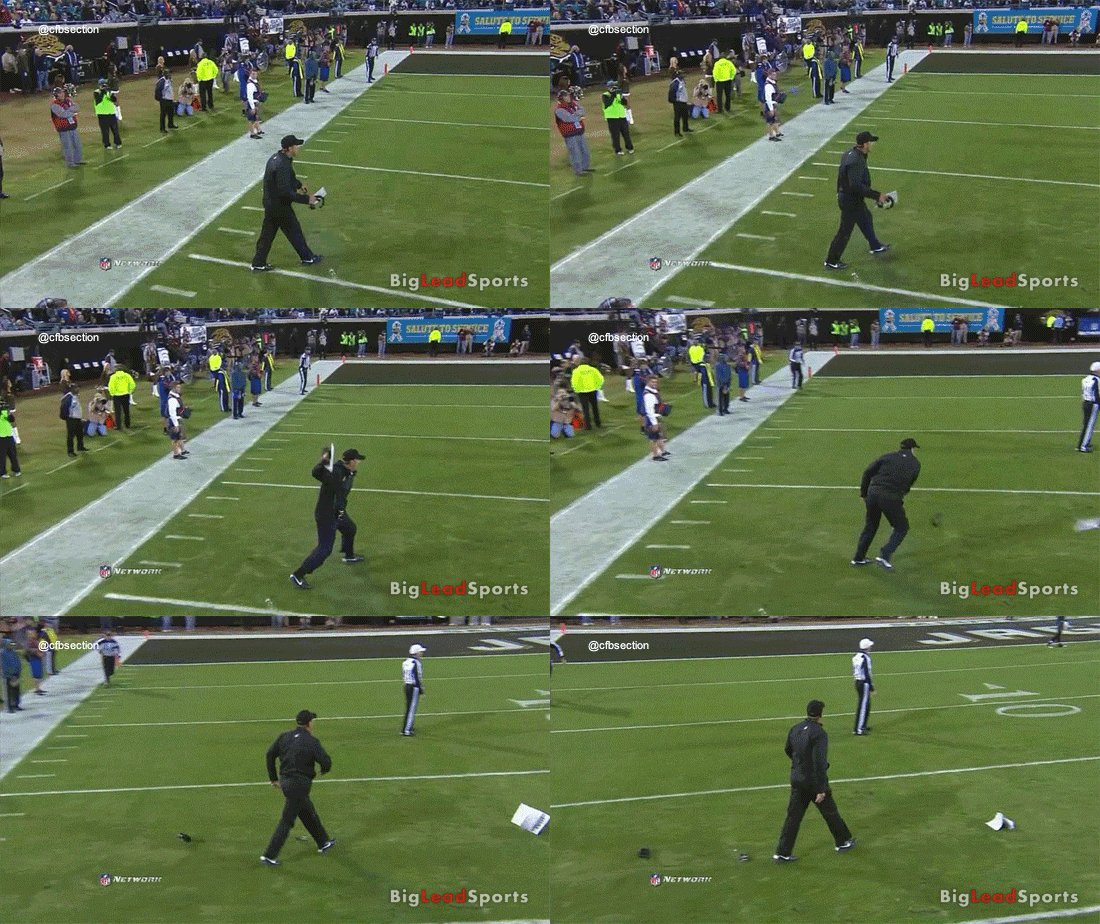
During a 27-10 loss to the Colts, the 1-8 Jacksonville Jaguars coach Mike Mularkey threw his headset and clipboard onto the field, costing his team a 15-yard unsportsmanlike conduct penalty. The Colts are now 6-3 on the season.

I’ve embedded an animated picture of the incident, h/t BigLeadSports.com.

One can guess that with a 1-8 season behind him, there’s talk that Mularkey’s job is already in jeopardy.

But what do you think of Mularkey’s actions: unsportsmanlike conduct or righteous indignation at a supposedly bad call? I’ll say unsportsmanlike conduct in itself and as a deterrent to copycat conduct from other coaches.


Daily Bread for 11.9.12

Good morning.

Our work week in Whitewater ends with a 30% chance of afternoon showers and a high of fifty-two.

On this day in 1872, a widespread Boston fire kills over a dozen and destroys hundreds of buildings:

In the aftermath, the city established an entirely new system of firefighting and prevention. The fire also led to the creation of Boston’s financial district.

The fire began in the basement of a warehouse at the corner of Kingston and Summer streets. At the time, this area of the city contained a mix of residences and light industry. Its buildings and most area roofs were made mainly of wood, allowing the blaze to spread quickly as the wind blew red hot embers from rooftop to rooftop. In addition, as Boston streets were narrow, large flames from one structure could literally leap across them to nearby buildings.

Firefighting units from Maine to New Haven, Connecticut, arrived to help, but efforts to fight the fire were plagued by difficulties. There was not enough water on hand to get the fire under control; the hydrant system did not work well because much of the equipment was not standardized; and even when firefighters got their hands on an adequate supply of water, the height of the buildings and the narrowness of the streets made it difficult to direct the water at the blaze from the optimum angle. Because a local equine epidemic had struck the city fire department’s horses, it was difficult to get the fire engines to the correct locations at the right times. In addition, some of the efforts were counter-productive. Explosions were used to attempt fire breaks, but this high-risk strategy was not executed with enough precision and served only to further spread the fire.

In Wisconsin on this day in 1968, an earthquake:

1968 – Earthquake Shakes Wisconsin
On this date one of the strongest earthquakes in the central United States occurred in south-central Illinois. Measured at a magnitude of 5.3, press reports from LaCrosse, Milwaukee, Port Washington, Portage, Prairie Du Chien, and Sheboygan indicated that the shock was felt in these cities. [Source:United States Geological Survey]

From Google’s daily puzzle, a question on geography: “On what river will you find the only inland municipality of the four direct-controlled municipalities in China?”

Libertarian Nick Gillespie on Why the GOP Lost in 2012

Gillespie gives a quick – but representative – expression of libertarian thinking on where the GOP went wrong. There was much about which to disagree over Pres. Obama’s policies, but in the three areas Gillespie mentions, a decidedly more libertarian direction (truly smaller, less intrusive government) would have helped Republicans.

As for social conservatism, profound conservative opposition to liberal social policy isn’t going away. For it all, though, a political party during a long economic downturn should ask itself: what’s the leading issue before the voters?

There’s a fourth area where a few Republicans went wildly wrong, too: unbelievable theories about where Obama was born, his faith, whether he has a secret agenda, or that all the major state polls were somehow skewed in his favor.

It’s impossible to think that Goldwater, Reagan, or Kemp would ever have spent time on theories like those, or that they had anything like the opposition to immigration that’s now so powerful within the GOP.

I’ve no idea what the Republican Party will look like four years on. Republicans will craft a platform of their own design.

I do know what libertarianism looks like now, what it will continue to look like, and the positive outlook it offers all Americans.

Posted also at Daily Adams.