FREE WHITEWATER

Reviewing Pres. Obama’s First 2012 Campaign Ad

Pres. Obama’s released his first campaign commercial of the 2012 election.

Here are impressions of the commercial (playing in Wisconsin), embedded below. They address the politics, and not the merits, of Obama’s message.

Video quality. As one might expect at this level, the video looks great — sharp, with brisk pacing, and a good mix of photos and video clips. It’s a big step up from statewide or local campaign ads. No surprise there.

Video message. The ad starts abruptly, and defensively. That cannot be by accident, as it starts so abruptly that it’s meant to address a particular concern in a particular way for a particular purpose.

The particular concern: that Obama has fumbled on green energy, in way that may also be unethical. The particular way: by presenting criticism of Obama as part of a billionaire’s conspiracy. The particular purpose: to test themes in a battleground state, while the GOP is still picking a nominee. There’s a conspiratorial cast to the early part of the commercial that’s probably of interest to Team Obama — how helpful is it it answer criticism by impugning critics as shadowy, big-moneyed, corporate oligarchs?

They likely know what focus groups think, but how do prospective voters (and Democratic leaders) where these ads run feel, before and after the commercials?

Will this ad allow Obama to inoculate himself from charges in a conservative commercial that hit him over companies like Solyndra?

Narration. The ad uses a narrator, and he sounds fine — middle-aged, confident, but understated. That’s the right approach — a deeper, more assertive voice isn’t needed, and would be counterproductive. Pres. Obama seeks to convey greater reliability than his GOP rival; as an incumbent, he can make that case without narration that rattles one’s stereo speakers.

If I thought that this were something other an in-market test message, I’d think it too abrupt, and a failure. This commercial’s like a large-scale drug trial: does it stop the lethal spread of criticism over mishandling of green-energy funding?

Too many trial messages like this are a bad idea, but one here or there will be more helpful than harmful. If they succeed with voters, their themes can be repeated in the months ahead. If they’re failures, they’ll be forgotten before the Republicans have their nominee.

But, for a fully-cooked campaign ad from the Obama campaign, we’ll have to wait. This isn’t it, and it’s not meant to be.

The Williamsburg Neighborhood in Brooklyn

I mentioned that I would write a bit about the Williamsburg neighborhood. Brooklyn’s huge (millions of residents) and there are many neighborhoods (themselves large) within that borough. One of them is Williamsburg, a diverse and eclectic community, with both Hasidim and hipsters, and a thriving arts scene.

These groups within the neighborhood do not always get along. As one can guess, the Hasidim don’t like the hipster bars and social scene. (It is, reportedly, from one of those bars that the Pickleback originated.)

And yet, there they both are, and neither has effectively prevented the growth of the other, nor evicted the other. No one in Williamsburg has successfully placed a finger on government’s scale, assuring that only his or her own kind will live there.

These two groups — and many more people who are part of neither — are all residents of the same, large neighborhood.

They’ve had their share of tensions, but they’ve gone on, and done well for themselves, despite these problems.

It’s a characteristic of successful people that they thrive in many environments, and that they focus on their own accomplishments rather than on limiting and restricting others.

In this regard, so much of Old Whitewater is a failure: a few people patting others’ backs, while doing what they can to limit, inhibit, restrict, and prevent.

I sometimes think that Whitewater’s town squires would rather that the town be perpetually struggling and miserable rather than that there should be greater prosperity with a new and different atmosphere. (More particularly: if a few people feel like they’re doing well enough as things are, they don’t really give a damn if the rest of the town scrapes by, or even declines.)

Too much noise, too much fuss, too much energy, too much commotion: this is what these tired and dull officials will not brook. What they really fear is the energy and dynamism of new people, new ideas, new opportunities. They don’t want anything new that they cannot control, manage, or administer.

The problem, though, is that what they can control, manage, or administer isn’t nearly as good as what new people, new ideas, and new opportunities offer free of control.

Nothing stays the same: Whitewater will either grow more prosperous or less, more vibrant or less, more open or less. The same won’t be the same – the same will be among the less and lesser.

I’m confident that — over time — Whitewater will prosper, as the other places have. How wasteful and sad will these times seem from the vantage of that time-to-come?

Wasteful and sad, indeed, I think.

Poll: Patriots or Ravens?

I’ll leave aside the NFC for a bit, and ask an AFC question: Patriots or Ravens? The question’s intentionally ambiguous — one can answer for either the team one prefers, or the team one expects to win, should that require a different answer.


Friday Catblogging: Patch Poll’s Most Popular Cat Names

Fox Point Patch has a poll of the Most Popular Cat Names. Janine Anderson writes that

Lucy, Smokey, Bella, Charlie and Tiger were the top 5 most popular cat names for adoptable cats in 2011, according Petfinder.com. Rounding out the list were Oreo, Daisy, Molly, Max and Midnight.

Those are all good names, but of that list, I’d go for Smokey, Tiger, or Max as preferred choices.  No name, though, could top Suzie, a great name for a great cat.

Daily Bread for 1.20.12

Good morning.

It’s snow for Whitewater today, with 2-4 inches expected, and a high temperature in the low teens.  In Anchorage, it will be even colder (single digits), but they’ll have no snow.

There’s good news for conservationists today: Near-Extinct Monkeys Rediscovered in Borneo.  Dave Mosher writes that

Deep in a pristine Borneo rainforest, researchers have found an endangered species of monkey recently feared to be extinct.

Surveys in the late 1970s spotted the monkey, called Miller’s grizzled langur, in Borneo’s easternmost national forest. Three decades later, all but 5 percent of the habitat had been destroyed by logging, agricultural encroachment, coal mining and fire.

As late as 2011, many researchers feared the langur was extinct. One place they hadn’t searched intensively, however, was Wehea — a rainforest preserve 90 miles west of the langur’s traditional territory.

Armed with camera traps and some luck, a survey team accidentally captured the first images of grizzled langurs in years.

“Locals knew they lived in this forest but had no idea what they were looking at. When we saw them, we were shocked,” said conservation scientist Brent Loken of Simon Fraser University, co-author of a study published online Jan. 20 in the American Journal of Primatology.

A Wisconsin scientist is among those studying the langur:

Stephanie Spehar, a primatologist at the University of Wisconsin in Oshkosh, said the adult langurs weigh between 13 and 16 pounds, munch primarily on leaves and tend to live in groups of one male, several females and their infants. She said it’s too soon to estimate their population size.

“We know almost nothing about this species or its ecology,” Spehar said. “I’m incredibly eager to begin the long-term ecology studies. That information will be crucial to their preservation.”


Photo: Eric Fell

It’s three years since the last presidential inauguration, but the Wisconsin Historical Society recalls a particularly special inauguration for student-musicians in Milton:

1961 – Milton Marching Band Performs at Inauguration

On this date the 78-piece Milton Union High School Band, directed by Richard Dabson, marched in the parade at JFK’s inauguration in Washington, D.C. [Source: Janesville Gazette]

A bit more of music, from Google’s daily puzzle: “To which note does an orchestra concertmaster tune his instrument’s highest string?”

And on this January 20th, twenty years after the Milton band marched, on January 20th, 1981, “Iran released 52 Americans held hostage for 444 days, minutes after the presidency had passed from Jimmy Carter to Ronald Reagan.”

The Overpowering Fear of a … Sports Bar

Perhaps some fret all day, dreading the prospect of a sports bar in a business district in a town that has too few businesses of any kind.

I am not among them.

In small-town Whitewater, the main thoroughfare is called, creatively, Main Street. Along it one finds dozens of commercial businesses. Fast-food restaurants, strip malls, a Wal-Mart, etc., line much of the street. One of those shops was a coffee shop, and the owner had proposed the sale of that business to a new owner so that he might convert the location into a sports bar.

To operate as a sports bar, the prospective owner needed Planning Commission conditional-use approval to sell beer or liquor by bottle or glass at that business location. (The coffee shop already had, since 2004, a license to sell beer or liquor at the location.)

The Planning Commission discussion takes place beginning at 6:20 in the embedded video below.

Plan Commission Meeting 01/09/2012 from Whitewater Community TV on Vimeo.

There’s much fuss about whether people living nearby might hear noise, but it’s all conjecture — there’s been no noise of which anyone might complain. Furthermore, do bars in the downtown not co-exist with apartments much closer by than this sports bar would be to nearby homes?

Is there anyone who, having purchased a home or rented an apartment near the main business strip in town, should be surprised that a new business might move in? Several complaining residents act as if they own not only their properties, but have a right to stall retail development in a business district of which they’ve invested not a dime.

They should not be so indulged. If nearby residents didn’t want to be so close to the main retail district in town, they should have purchased or rented elsewhere.

Consider the presumptuous assertion that — in a commissioner’s estimation — another bar isn’t the best use for the property, or for Whitewater, generally.

That should be a market decision, of consumers and merchants in the marketplace. Should a sports bar succeed, it succeeds through consumer support; should it fail, it fails through lack thereof.

If there were a healthier climate already, we’d be able to attract more diverse businesses. Yet, there isn’t, because existing planning and municipal intervention have been a wreck.

To every commissioner who voted against a new business in this troubled town: what are you doing to fill these shops? You have the power to keep a place vacant, in a town that has too many vacancies already. What have you done to reduce vacancies?

The members of the commission all have jobs, or pensions, and not a one looks to be going hungry.

There was a sad moment in all this, when the applicant was asked about the possible clientele of the sports bar. More than one commissioner asked what the prospective clientele of the establishment might be. (One can guess why they asked: the hope that the prospective owner would say something foolish, so that they might pounce on it.)

The would-be owner was puzzled by their question, and answered more than once that he hoped for a clientele of ‘all people.’ To them, he must have seemed unsophisticated.

On the contrary, his answer was better than their questions. He answered in a way they may not have expected, or understood. He wasn’t answering simply about types or backgrounds, but about customers apart from those narrow characteristics.

I’m an optimist, in spite of provincial municipal interference in the marketplace. A decade from now, I believe Whitewater will be more diverse, and more cosmopolitan, than she is now. In that time, an answer of ‘all people’ won’t be unsophisticated; it will be the common reply in a fair, vibrant, prosperous city.

Reviewing Kathleen Falk’s Recall Campaign Announcement

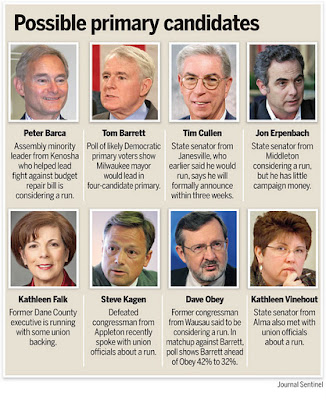
Kathleen Falk, former Dane County Executive, declared her candidacy yesterday for governor. Below I have embedded her video declaration, a screenshot of her website, and a chart from the Journal Sentinel of Democrats who may run against Walker.

These are first impressions of Falk’s campaign announcement. They address only the politics, and not the merits, of Falk’s campaign.

The video. Falk’s video surprises – for someone who has been in politics for years, this is a poor setting, poor delivery, and poor presentation.

It’s a mistake to put Falk on camera behind a stark black background. Even a blank white background would have been better. A recall campaign should inspire optimism; this dark setting does the opposite.

She should not be in a studio; the entire video should have shots of her walking around, with her own narration. Fast-paced, energetic, confident.

The delivery. Her delivery is slow, almost somnolent, where a quicker tempo would be preferable. It’s fine to tell a story about someone she’s met, but Falk should do so with evident enthusiasm. An NPR-style delivery will not serve a Democrat well in a race against Gov. Walker.

There’s nothing pithy or epigrammatical in her remarks, and yet that’s critical for a recall candidate: a mix of terse, easily-remembered, variously funny or biting comments is essential.

There’s no energy in her delivery, and worse, she speaks with a discernible lisp. That slurring of consonants (particularly ‘s’) may be a consequence of age, or of ill-fitting dental work, but either way it conveys an impediment.

Falk’s sixty, I think, and she looks like a woman of her age. She’s not aged poorly, but she’s not aged particularly well, either. For a woman with a white-collar career (lawyer, politician) behind her, she’s probably aged less well than some Wisconsin women who’ve had harder lives.

Her hair, short, overly-dark, and pulled back from her face, reminds viewers of an ageing teacher on the verge of retirement. Look at her photo from the Journal Sentinel’s chart of candidates, and one sees a softer, more appealing image. There, she’s lovely and professional, with lighter hair, covering her forehead and just around her ears.

The website. The website, as the screenshot shows, now highlights Falk’s announcement video. Since the video displays her poorly, the website is a disadvantage. She needs a better photo, and a livelier video, as her re-introduction to voters. (She’s run and lost statewide twice before, to Doyle in a primary and to J.B. Van Hollen in a general election.)

Even as a bare-bones start, this is a tepid effort.

Other Democrats, and Team Walker, will see as much.


http://kathleenfalk.com

Daily Bread for 1.19.12

Good morning.

It’s a clear and breezy day for the Whippet City, with a high of nine; in Las Vegas, it’s a mostly sunny day with a high temperature of sixty-five.

Tonight at 7 PM, the League of Women Voters hosts a program at city hall: “Budget Repair Bill Update: Impact on City/County Operations” with speakers: Kevin Brunner, Whitewater City Manager and David Bretl, Walworth County Administrator.

On this day in 1937, an aviation record from Howard Hughes: “millionaire Howard Hughes set a transcontinental air record by flying his monoplane from Los Angeles to Newark, N.J., in 7 hours, 28 minutes and 25 seconds.”

In Wisconsin, an anniversary of which we can be proud:

1939 – Chicken Plucking World Record
On January 19, 1939 Ernest Hausen (1877 – 1955) of Ft. Atkinson set the world’s record for chicken plucking. [Source: Guiness Book of World’s Records, 1992]


Today’s Google puzzle comes from Dave Matthews: “If these people didn’t make what they make with their truss rods and kerfing and braces, then I couldn’t play what I play.”

The ACLU on SOPA/PIPA

The ACLU’s Rights Blog posted today on the controversy over the Stop Online Piracy Act (SOPA), and the post mentions the ACLU’s constructive role in limiting this latest regulatory overreach.  (See, Online Protest Over SOPA Helps » Blog of Rights: Official Blog of the American Civil Liberties Union.)   I have reproduced parts of their post below.

It’s telling that senators didn’t start bailing on restrictive legislation (PIPA in the Senate, SOPA in the House) until major websites went dark temporarily (Wikipedia, Reddit)  or displayed protest banners (Google, many others).

Big Content got worried not when ordinary people complained, but when Internet powerhouses growled and a few big political sites made threats.

(One reason that more Senate Republicans than Democrats have bailed is because the highly-influential conservative blog redstate.com threatened GOP candidates who supported SOPA or PIPA.)

Hollywood’s really not thinking about ordinary consumers’ complaints on Facebook or Twitter, but when Facebook’s founder and then Google complain, or when a political site warns legislators about what’s in store, results come quickly.

Here’s an except from the ACLU’s blog:

Today, major tech advocates are dimming their websites in protest over a proposed new law that would result in our government blocking access to websites that contain copyright infringing material. And they’re right to be concerned.

There are two bills pending before Congress — the Stop Online Piracy Act (SOPA) in the House and the PROTECT IP Act (PIPA) in the Senate — that would not only impact unlawful infringing content, but also a wealth of completely legal content that has nothing to do with online piracy.

We opposed SOPA in its original form mostly because the impact on non-infringing content would violate the First Amendment right to free speech of the owners and authors of that content, as well as the rights of Internet users to access that content. In fact, we were asked to present our views at a hearing of the House Oversight and Government Reform Committee scheduled for today and submitted our testimony in preparation for that hearing. But the hearing was postponed after SOPA’s proponents promised to significantly change the bill and after House Majority Leader Eric Cantor proposed not to bring any bill to the floor for a vote unless it represented a true consensus of those who support and those who oppose SOPA.

Because of those developments over the weekend — and because the White House also issued a statement opposing any bill that would impact First Amendment-protected online content — we are redoubling our efforts to find the compromise that will not only inhibit online infringement of original works of art, but also will truly eliminate online access restrictions to lawful non-infringing content….

May 2nd to May 6th: the Libertarian National Convention

The LP’s announced its national convention, 5.2.12 to 5.6.12 in, of course, Las Vegas. (The convention is there not principally for the freewheeling atmosphere, but because flights and hotel deals are cheaper for some activists on a budget. It’s a simple affair compared with the GOP or Democratic Conventions.)

Press release follows:

The 2012 National Libertarian Party convention will be held on May 2-6 in Las Vegas, Nevada, featuring:

Nomination of our 2012 Libertarian Presidential and Vice Presidential candidates as well as our party officers.
Workshops on a variety of topics including how to grow state and local LP affiliates, ballot initiatives, and how to run Libertarian campaigns

Confirmed speakers and workshop leaders:

o Keynote Speaker Michael Cloud, author of Secrets of Libertarian Persuasion

o Advocates for Self-Government President, Sharon Harris

o National Libertarian Party Executive Director, Carla Howell

The Libertarian Solutions Contest! This is your chance to create and submit a video featuring a Libertarian proposal to shrink Big Government – which will be shown on the convention floor. Convention attendees will get to vote among the finalists for the best one….

See meeting info at LP Press Release.

Local Politics of a Whitewater Schools Referendum

Like many communities, Whitewater’s schools have a structural deficit. In the past, they’ve plugged that deficit via referendum, or through federal grant money (now in short supply).

I’ll not now comment on the merits of a referendum, but rather on the politics of one. The district has not yet set the final amount of a referendum request, and there may be changes to a possible list of cuts. There’s ample time to consider the merits of a proposal; for now, it’s the politics of a referendum that I’ll ponder.

Whitewater’s filled with smart people who are well-familiar with the points I’m making; the oddity is that many of those smart people won’t play a role in a referendum debate, thereby leaving the issue to less-capable town figures.

Spring is hard. I’ve written before that spring elections favor the right, not the left. See, Why Whitewater Isn’t a Progressive City; Why Whitewater’s ‘Conservatives’ Hold the City Tenuously. A spring election will tend right, and this would be true even without a GOP presidential primary on that date. (The GOP race will probably be over by April in any event.)

I’d guess that a referendum in the spring has only about a one-in-three chance of success, perhaps less, based on the likely composition of the electorate. Without a large citywide vote, there’s no chance to balance the opposition to a referendum sure to come from outlying towns in the district.

So is a referendum doomed? No, it’s not. The odds may be against a referendum, but it’s possible to change those odds.

It’s smart to lay out what’s at stake, but only if it’s done cleverly. I’ve argued that a referendum campaign should include an itemized list of what’s at risk without approval. (See, A Referendum for Whitewater’s Schools (Part 3).)

A list is good policy (because it begs the legitimate question about what’s at-risk list, and what’s not), and good politics (it shows that pro-referendum advocates will be specific in their requests).

The political danger, however, is clear: if one simply publishes a list of possible cuts, without further advocacy, residents may decide that they’ll go for all the cuts, without any referendum to mitigate some cuts.

If one favors a referendum, and lists possible cuts without elaboration, then I’m not sure what to say. Either one’s being disingenuous about one’s actual support for a referendum, or one’s politically naive.

There’s nothing wrong with publishing a list, but it’s foolish for a pro-referendum advocate to publish a list without carefully-placed talking points.

Misunderstanding the need for a solid public case. Pro-referendum advocates will want to make their case through a website like the Banner or a newspaper like the Daily Union.

There’s no likelihood that either publication will change anyone’s mind. They have (I’m sure) a similar and committed readership, but it’s a readership too small and too similar to make a difference in an election. Reaching the same small band who follow these issues anyway won’t make a difference.

Even then, as I note above, some people will read what those publications print and come away with an unfavorable view of a referendum.

Most won’t pay attention, though. Look around at an event at which thousands of people pour out (like the Fourth of July celebration), and you’ll see an overwhelming majority who care nothing for city or district politics, and wouldn’t recognize most of the officials in town, anyway. (That’s rational — most people have more important things to do.)

If one intends to win a referendum — or even come close — there needs to be a direct-to-the-voters effort that avoids the mixed messages, jumbled presentation, and weak advocacy that those local publications offer.

Question’s about Rep. Wynn’s role as a citizen financial advisor. I’ll assume that Rep. Wynn played a role on a panel of citizen financial advisors to the district. (If he didn’t, then he shouldn’t have been listed — more than once — as a member of the panel.)

If he played a role, does Wynn support a referendum? If he does, why has he taken a position in support of closing a structural deficit through additional public debt when the conservative governor he dutifully supports derides that very approach?

If Wynn opposes a referendum, what does it say about his skills as an advocate that he was unable to persuade his fellow citizen-advisors to oppose, similarly, that referendum?

I’m not persuaded that the panel’s composition — all men but one — was either practically or politically sound. Practically, it’s impossible to contend that financial expertise in Whitewater resides in men more than women by a ratio of 17-1. The only place that so lopsided a ratio might predictably occur would be, say, Saudi Arabia.

Politically, even with a calculation that a probable pro-referendum recommendation from the panel would need men as advocates (to win over other men who might be skeptical), a ratio like this is too extreme.

Personal advocacy. This referendum may be won, but it can only be so through personal advocacy. The same stodgy local publications will be useless to bring success to an uphill-effort. Advocates will have to take their case directly to others. They’ll have to organize diligently and zealously, and meet with potential voters in groups big and small. If a spring referendum like this is to be successful, it will be a coffee klatch and meeting-hall effort. Arms-length print and Web-based efforts of dubious quality won’t help.

That’s why more women on a financial panel would have been a good idea; the same men who sit on so many committees won’t be the best evangelists of this cause. A few energetic women are worth more than a dozen middle-aged men.

Playing to win, or playing to do well-enough? It’s possible, of course, that those pushing a referendum don’t expect or even care to win; they may be hoping for a good-enough result, and the chance to offer a referendum again later.

That’s foolish: the way to win, and even the way to get a good-enough result, is to play to win.