Here in our exceptional city of 14,622, we can’t be too careful about outside influences, nefarious plots, and the reputed scheming of Madisonians to force every man, woman, and child in the city to wear tie-dye clothing.
And yet, and yet, there’s something even worse than these unsettling threats: at any moment, hordes of Roma gypsies or Bedouin nomads might flood the city, and declare themselves candidates for political office.
Whatever would we do?
Fortunately, long ago, incumbent politicians foresaw this dark prospect, and insisted on candidate requirements (beyond mere residency) of written declarations, nomination papers, and very specific deadlines.
To allow voters to choose from among a less-restricted set of candidates was too risky to the health and safety of a micropolitan dreamtown.
There are losses to us, of course. I’d guess that a torrent of Roma or Bedouin politicians might bring the occasional new idea, fresh perspective, or even aesthetic advantages that we lack.
We must be strong, as we’re called to vigilance in these difficult times. Let others encourage, welcome, and accept; we will discourage, regulate, and forfend.
It should be so: the stability of business as usual, unchanging from decade to decade, shall not be risked.
It’s a day with a high of forty-one for Whitewater, with a chance of a wintry mix earlier in the morning. In caucus state Iowa, Cedar Rapids will see a mostly sunny day with a high of forty-six.
It’s a puzzle from Google today, about a liberty-loving American: “Henry David Thoreau wrote about the Walden Pond wilderness. How many miles was it from the house where he was born? (Measured from his birthplace to the current Walden Pond Visitors Center.)”
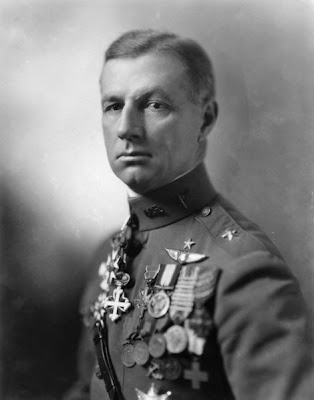
It’s a famous Wisconsinite’s birthday today. On this day in 1879, Gen. Billy Mitchell was born, as the Wisconsin Historical Society recalls:
1879 – General William “Billy” Mitchell Born
On this date aviation pioneer Billy Mitchell was born in Nice, France. Mitchell grew up in Milwaukee and attended Racine College. During World War I, Mitchell was the first American airman to fly over enemy lines. He also led many air attacks in France and Germany. Upon return to the U.S., headvocated the creation of a separate Air Force. Much to the dislike of A.T. Mahan, Theodore Roosevelt, and other contemporaries, Mitchell asserted that the airplane had rendered the battleship obsolete, and attention should be shifted to developing military air power.
Mitchell’s out-spokenness resulted in his being court martialed for insubordination. He was sentenced to five years suspension of rank without pay. General Douglas MacArthur — an old Milwaukee friend — was a judge in Mitchell’s case and voted against his court martial. Mitchell’s ideas for developing military air power were not implemented until long after his death. In 1946 Congress created a medal in his honor, the General “Billy” Mitchell Award. Milwaukee’s airport, General Mitchell International Airport, is named after him. [Source: American Airpower Biography]
Former GOP governor of New Mexico Gary Johnson declared officially today for the Libertarian Party presidential nomination. He never caught on as a GOP presidential candidate, but then he’s closer to LP positions than those of the Republican party.
He’s not a household name, but his two terms as the governor of New Mexico assures that he’s an experienced option. It’s a good sign that the LP (as with former Congressman Bob Barr in 2008) can attract established politicians.
Indeed, it is far too soon. America’s best days are yet ahead. Chinese officials who dream of their own dominance will be as disappointed as Japanese bureaucrats who dreamt the same scenario a generation ago.
The world belongs neither to the selfish ambitions of those Japanese corporatist s nor to those of contemporary Chinese statists.
Bremmer sees ways in which we’re doing well, even now:
Yet investment in the future continues apace. No nation is home to more elite universities and graduate schools, more major multinational corporations, and more breakthroughs in state-of-the-art technology. Silicon Valley’s latest tech start-ups have built enough momentum to fuel talk of a new “bubble”. Development of unconventional gas technologies has been the single most economically significant innovation of the past several years; US-based companies have led the way. All these traditional measures of strength suggest the country is doing fine.
Match that – as we will – with a restored confidence in democratic government and truly free markets – and we’ll be just fine.
There’s a story at the WashingtonPost website describing GOP candidate Ron Paul’s supporters. They’re younger, more secular, and more dedicated than other Republicans. That they’re disproportionately younger suggests to me that they’re not from movement families (that is, they’re not from old and longstanding libertarian households). Paul, to his credit, has attracted an energetic, young following.
At the same time, this also means that these followers are ill-suited to take a long view of politics, Republican or libertarian.
Some libertarians, notably Brian Doherty, have tried to reassure skeptical members of movement families that Paul’s newsletters, etc., shouldn’t be held against him. (Doherty is writing a book about Paul, having previously written an exhaustive history of libertarianism.) Doherty means to soothe:
I can assure any old libertarian worried about old libertarian movement business that it is the good things about Ron Paul that have won him the support and love he has won, and that this old business is irrelevant to them, and thus irrelevant to the actual important political and cultural story about Ron Paul now.
Doherty writes to those of us within the family, so to speak. We would reply that we like Paul well enough personally, but we also see that some of Paul’s views aren’t traditionally libertarian at all. Mixed in are far-right notions outside of traditional libertarianism (or opportunity conservatism, for that matter) with which we disagree.
I agree that Paul has much to offer, and that his platform offers considerably more than his GOP opponents’ manifestos; yet, he would be a far stronger and better candidate today without those newsletters from years ago. Believing otherwise is politically naive and ideologically compromising.
I don’t know, really, but I’m inclined to answer paradoxically that it’s never a libertarian year, and yet it’s always one.
If one means by libertarian year the election of lots of libertarians, then the answer’s surely no. There are lots of Republicans and Democrats, not lots of Libertarians.
Yet, if one means that libertarian ideas will play a key role in 2012, then I’d say yes, they will. We represent enduring and significant ideas about individual rights, liberty, economics, and peaceful commerce with other countries.
We’ve been declared dead a hundred times, but our good and sincere ideas are ones to which Americans have always returned. There’s a resiliency in libertarian policies that keeps those ideas evergreen, long after other, competing views wither.
Others may scramble over this day, or that election, but we have no reason to be similarly nervous and frantic. We have a longer view of things. A political confidence in ‘limited government, individual liberty, free markets, and peace’ is a well-placed confidence.
We’ll make a difference in ’12, and be around long thereafter.
Late December in Whitewater: Mostly cloudy in the thirties. In San Francisco: Mostly cloudy, but sixty-one. There’s a funny quote attributed to Mark Twain about San Francisco’s weather (“The coldest winter I ever saw was the summer I spent in San Francisco”), but sixty-one at any time is mild when considered from Wisconsin.
On this date in 1981, Elizabeth Jordan Carr, the first American ‘test-tube’ baby, was born in Norfolk, Va.
Today’s puzzle from Google comes via the suggestion of Zacary Saliba, aged nine, and it’s one of the best Google’s yet offered: “What is the largest air-breathing fish found in the body of water that ends at 0°10’0” S 49°0’0” W?”
The Wisconsin Historical Society offers evidence that, sure enough, Joseph McCarthy was a liar and skunk his whole life:
On this date [12.28] future senator Joseph McCarthy announced his candidacy for the Wisconsin 10th Circuit Court judgeship, a position that had been held for 24 years by Edgar V. Werner. The 30-year-old McCarthy used Werner’s age against him, claiming that Werner was 73 while secretly knowing he was 66. In the election, held in April of the following year, McCarthy earned 15,160 votes to Werner’s 11,154. Although McCarthy’s campaign tactics and spending practices were investigated, he was cleared of wrong-doing. [Source: Legal Affairs]
There’s a lot more to say about Ron Paul between now and the January 3rd Iowa caucuses, but it’s too funny that Newt Gingrich finds Paul objectionable to ‘virtually every decent American.’ Gingrich – a man of plentiful hyperbole – held back with virtuallyevery decent American? Who’s beyond virtuallyevery – Paul’s family?
Gingrich has been at the top of national polls only for about two weeks or so, and if you’re wondering why his reign will be brief, hysterical statements like this are why:
Newt Gingrich has finally found a politician he considers even worse than the president he calls socialist, anti-colonialist and radical. That would be his fellow Republican Ron Paul.
“I think Barack Obama is very destructive to the future of the United States. I think Ron Paul’s views are totally outside the mainstream of virtually every decent American,” Gingrich said Tuesday in a CNN interview with Wolf Blitzer.
There’s an even-handed story at the Janesville Gazette about Wisconsin’s non-partisan local elections. Some of those interviewed are sure that partisanship is a bad thing, and that it gets in the way of serving citizens, etc. I understand this view, and however well-intentioned, it’s one with which I strongly disagree. (The story presents diverse points of view, and something of our history.)
There’s a distinction, of course, between political partisanship and ideological commitment. One may not be a partisan of the Republican or Democratic parities and yet be ideologically-oriented (right, center, left, libertarian).
Unfortunately, non-partisan elections have the consequence of discouraging ideological and philosophical professions in favor of empty, platitudinous declarations about doing the right thing, etc. It’s false, though, to say that the zealously non-partisan or non-ideological have no commitments — in all too many cases they replace ideology and principle with the self-interest of being re-elected again and again.
They have a party, a philosophy, and a faith in their own incumbency.
This is far worse than being a political partisan. We have seemingly cast out ideology, but we have established a veiled selfishness. That’s why so many conservatives come to office, only to become big-government Republicans. It’s why so many liberals set aside a defense of civil liberties for fear of aliening majority opinion. Principle gives way to re-election.
More than once I’ve heard the declaration that a candidate would like to run for office so that he or she could be an ‘adult in the room.’ What else would one be? I’d rather know what kind of adult, with what opinions and views. Politics should be more than a sometime exercise of self-affirmation through government office.
We’d do better with more, and clearly-defined, professions of ideology in our politics.
I wrote last week about a video from CNN, in which Gloria Borger asks Ron Paul about his old newsletters.
A Paul supporter wrote in, with a link to raw video of the interview, contending that the full video shows Paul didn’t walk away from the interview. (I’ve embedded the raw clip at the end of this post.) The correspondent suggests that I admit that, in fact, Paul didn’t walk away.
I originally remarked of the CNN clip that
If so [that Paul’s newsletters are no issue], why walk away from an interviewer? It’s a bad move: one should never walk out. If anything, one should insist on staying longer, and talking about more things, to compensate for talking about what one contends is a bogus issue.
This was a rookie mistake, from a man whose age and experience leave him anything but a rookie.
While the post’s headline was too much (Paul didn’t ‘storm out’ as Mike Riggs and I wrote), he most certainly did walk away – in both videos he takes off his microphone and walks away. If the Paul supporter’s contention is that Paul didn’t storm out, then he’s right. If the contention is that Paul didn’t walk away, because he walked back, he’s wrong. One can walk away and then walk back, as Paul plainly does.
I was clear and right about staying longer, too: it would be better to cancel the next event than flub the CNN interview. Borger, by the way, isn’t rude, she’s just persistent. If anything, in CNN’s finished video and in the raw footage, she’s solicititous of Paul. (Far more so, really, than other interviewers would have been. Paul’s been around a long time; he surely knew that Borger’s questioning was persistent but relatively mild.)
Finally, thanks to the Paul supporter for pointing me to the raw video of the interview. The video was linked through Drudge, a site that the supporter assures me is from an ‘a lister.’ There’s a bit of irony in this, for while Drudge is an alister, he’s one in the corner of MittRomney. (See, a June 2011 story that’s still true: Mitt Romney leads the Drudge primary.)
When Matt Drudge bolsters Paul in a multi-candidate field, it promotes the idea that the race is between the well-funded Romney and Ron Paul. Romney supporters are sure they’ll win that contest in the end. I’d guess they’re right, and that the GOP will go for Romney, but in any event Drudge is not boosting Paul for the sake of Paul.
So we’re clear, I don’t think Paul’s a racist because of the newsletters; I do think he’s handled the issue very poorly. Of the newsletters themselves, and also of Paul’s anti-market views on immigration, I’ve been critical before.
Whitewater will look forward today to a mostly cloudy day with a high temperature of thirty-six, and a slight chance of rain or snow. In Portland, it’s a rainy day with a high of forty-six.
On this day in 1979, “Soviet forces seized control of Afghanistan. President Hafizullah Amin, who was overthrown and executed, was replaced by Babrak Karmal.”
The trailer for The Hobbit is out, and from this brief clip, the film looks intriguing —
— one of the many things to look for in the new year. more >>
It’s a day in the low forties in store for Whitewater, but a day of snow showers and a high of thirty-five for Bangor.
The Cassini spacecraft snapped a photo of Saturn’s moons Titan and Dione in front of Saturn’s rings, and it’s a lovely and (by definition) other-worldly photo:
Google’s question for today comes from Tom Arnold (the actor and comedian): “What American pastime incorporates the use of a prolate spheroid with pointed ends?” It’s not a hard question, but it’s a hard fact for a baseball fan. Baseball was once America’s pastime, but Arnold’s certainly not asking about baseball.
I’m sure to have questions about why I’m reading Sacha Scoblic‘s Unwasted: My Lush Sobriety. The answer is that I saw an essay Scoblic wrote around the time of Amy Winehouse’s death, on sobriety and the false notion that art somehow justifies (or requires) addiction. (See, Amy Winehouse: The Insidious Response to Her Addiction and Death.) She wrote well and persuasively. I made note of her book, and now I’m reading it.
I offer no claim to a special understanding of alcoholics, recovering alcoholics, or afflicted artists. Yet, having met people who are those things, one sees the great gap between policies that address substances, and other policies that treat addicts.
We talk less about alcoholics than we do about alcohol, yet it must be addiction that matters. I’m curious to see what Scoblic has to say, of her experiences, both drunk and sober.