FREE WHITEWATER

Daily Bread for 8.5.11

Good morning.

Whitewater’s week ends with a partly sunny day, with high temps in the mid eighties.

You’ve probably wondered (and who hasn’t?) what a tarantula’s heartbeat looks like.  Wired Science has the answer for which you’ve been patiently waiting, in a story entitled, “Tarantula MRI Reveals Strange Double Heartbeat.” Danielle Venton explains:

Spider hearts may contract in a unique double beat. By placing tarantulas in a magnetic resonance imaging scanner, biologists from Edinburgh University made a video of a living spider’s beating heart.

“In the videos you can see the blood flowing through the heart and tantalizingly it looks as though there might be ‘double beating’ occurring; a distinct type of contraction which has never been considered before,” said Gavin Merrifield in a press release. Merrifield presented the research at the Society for Experimental Biology Annual Conference in Glasgow last month.

See for yourself, in these photos, and the video link (above) —


Image credits: Gavin Merrifield

Defending Street Vendors, Food Trucks, and Consumer Choice

Here’s an update in the battle for economic freedom and consumer choice.

I’ve written before about how incumbent, brick-and-mortar restaurants try to use government to shield themselves from food-truck competitors. Those restaurateurs do not — will never — deserve governmental protection. They made a free choice to open a store, instead of operating a truck, and if that voluntary investment does not work out, it’s not government’s job to regulate away competitors who were wiser to avoid the overhead. If consumers don’t care for the supposed ambiance of a restaurant, and prefer instead a food truck’s fare, they should be allowed to make that choice.

Traditional merchants who use the state to crush lower-cost and more-desirable consumer choices are particularly loathsome. Those who operate food trucks are hard working, often new arrivals to America, and by their very offerings are committed to freedom of choice in the marketplace. They’re far, far closer to the American ideal than selfish, manipulative incumbents who use municipal regulations to bolster unpopular, uncompetitive enterprises.

See, previously, Institute for Justice Defends the Rights of Street Vendors and A Victory in the Food Truck Wars.

There’s help on the way for these bullied vendors: the Institute for Justice has now filed suit on behalf of street vendors in Atlanta, who are being forced from their long-standing locations. See, Atlanta Vendors File Major Lawsuit Against City, Join National Street Vending Initiative: New Study Shows Atlanta Has the Worst Vending Laws in the Country.


The IJ summarizes what’s at stake:

Should the city of Atlanta be allowed to create a single street vending monopoly that forces existing vendors to start paying up to $20,000 in rent and fees every year?

That is the question to be answered by a major lawsuit filed today by the Institute for Justice (IJ) – a national civil liberties law firm – and two well-known Atlanta vending entrepreneurs: Larry Miller and Stanley Hambrick….

In conjunction with the lawsuit, the Institute released a national report, Streets of Dreams, which reviews vending laws in America’s 50 largest cities. The lawsuit and report continue IJ’s National Street Vending Initiative, a nationwide effort to vindicate the right of street vendors to earn an honest living.

Earlier this year, El Paso, Texas, repealed its protectionist vending regulations in response to an IJ lawsuit.

Here’s a backgrounder on the case, Miller v. City of Atlanta.

Raw Foods Raids: Rawesome Foods Raided…Again

Today’s a day of catching up on new developments about earlier posts. Longtime readers may recall a post from November 2010, entitled, Raw Foods Raids: The Fight for the Right to Eat the Food that You Want, about an armed raid on the Rawesome Foods co-op in California.

They’ve been raided yet again.

Here’s a new video about the raid, with an accompanying description from Reason.


A little more than a year ago, Rawesome Foods, a health food co-op based in Venice, California was the target of an armed raid by several agencies, and the resulting video went viral. On August 3, 2011, Rawesome experienced another multi-agency raid, but this one resulted in the arrest of the establishment’s owner James Stewart.

Stewart, and Sharon Palmer, the farmer who supplies him with raw goat milk, are being held on bails in excess of $100,000 and are each charged with four felonies and several more misdemeanors. Some examples of the charges are “processing unpasteurized milk,” “improper labeling of food,” and “improper egg temperatures.”

The government has kept pursuing Stewart and his club for years, despite a lack of any reports of illness or injury from consumption of his foods. Rawesome members argue that they are part of a private club, not subject to government regulation, and that they are being persecuted for their alternative lifestyles.

The Los Angeles County District Attorney’s office would not comment for this video, but offered this press release and also released a list of the charges against Stewart and Palmer.

Reason.tv covered the first Rawesome raid in 2010 here.

Approximately 3:30.

Produced by Zach Weissmueller. Camera by Sharif Matar.

Daily Bread for 8.4.11

Good morning.

It’s a partly cloudy day today with a high of eighty-three for the Whippet City.

The draft’s never been popular, and sometimes unpopular even in wartime. The Wisconsin Historical Society writes about how Wisconsinites reacted in 1862:

1862 – War Department Order Prompts Riot

On this date the War Department issued General Order No.99, requesting by draft 300,000 troops to reinforce the Union armies in the Civil War. This action reinforced public sentiment against the draft and prompted the citizens in Port Washington, Ozaukee County to riot in protest.

Here’s a brief video describing economist and libertarian Milton Friedman’s role in ending the draft during Vietnam (an end that made America freer, stronger, and safer with a professional, volunteer military).


Daily Bread for 8.3.11

Good morning.

It’s a partly cloudy day for Whitewater today, with only a small chance of rain, and a high temperature of eighty-six.

There’s a meeting of Whitewater’s Landmarks Commission this afternoon, at 5 p.m., in the city manager’s conference room at the municipal building. The agenda is available online.

Danielle Venton, writing at Wired Science, asks “Can Planting Vegetables in Vacant Lots Save Cleveland?” Cleveland needs help, as

Ten percent of Clevelanders have been diagnosed with diabetes, as compared to the national average of 8 percent, and more than a third are obese. Among cities with a population between 100,000 and 500,000, it is the seventh most dangerous, according to one crime ranking. Growing tomatoes and beans, and keeping bees and chickens, would change all this, [Parwinder] Grewal said. Studies have shown that gardens improve community health, reduce crime and increase property values.

Grewal is

….co-author of a study ?Can cities become self-reliant in food?? published July 20 in Cities.

?I was motivated to show how much food a city could actually produce by using this land,? he said. ?We could address global problems through this way of gardening.?

Urban gardening improves health, reduces pollution, and creates local businesses, Grewal said. The population of Cleveland, what Grewal considers a typical post-industrial city, peaked near one million in 1950, and has been declining since. Today scarcely half a million people call Cleveland home.

Previously, Drew Carey proposed libertarian solutions to help spark a renaissance in Cleveland. See the series, Reason Saves Cleveland with Drew Carey.

Gardens, including vegetable gardens, will always be an improvement over vacant, junk-filled lots, and can be an improvement over ordinary lawns, too. That’s why the war against gardens, or natural lawns, is more than just dull, middle-class bureaucrats trying to impose their ill-developed, uncreative sensibilities on others – that war holds down a city’s health and prosperity in proportion to its restrictions on liberty.
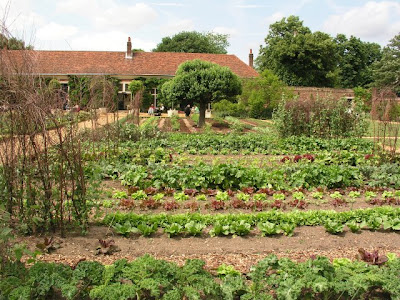


English garden via Wikimedia Commons.

Daily Bread for 8.2.11

It’s thunderstorms ahead for Whitewater today, with a high temperature in the lower nineties.

There’s a Common Council meeting tonight, at 6:30 p.m. The meeting agenda is available online.

The Wisconsin Historical Society marks this day in 1832 as the end of the Black Hawk War:

On this date the defeat of Black Hawk and his followers at the Battle of Bad Axe, ended the Black Hawk War. Black Hawk led the American troops northward while the rest of the Indians constructed rafts and canoes to facilitate an escape over the Mississippi river. The plan was successful initially but eventually General Atkinson realized the ruse. In the battle, women, children and the elderly hid behind rocks and logs and American soldiers often could not or did not differentiate between warriors and the women and children. Atkinson sent Wabasha and his Sioux warriors, enemies of the Sauk, after the approximately 150 members of the British Band that made it to the Western bank of the Mississippi. The Sauk, “escaped the best they could, and dispersed“, but only 22 women and childern were spared. Black Hawk escaped, but the Battle of Bad Axe marked the end of the war. [Source: Along the Black Hawk Trail by William F. Stark, p.142-153]

Plant a Garden, Go to Jail for 93-Days?! Reason’s Nanny of the Month for July 2011

Food trucks, baggy pants, but the winner involves trying to ban vegetables in a front yard. Oak Park, Michigan’s city planner, Kevin Rulkowski, tried (but ultimately failed) to ban a front-yard vegetable garden on private property.

What’s funny-sad is his attempt to justify the ban through his limited understanding of the word ‘suitable,’ coupled with a dimwit’s confidence that a dictionary definition (even if correctly understood) settles a public policy debate. It’s a telltale sign of not being able to see the forest for the trees, and it’s just about every mediocre bureaucrat’s recourse at one time or another.


Daily Bread for 8.1.11

Good morning.

It’s a warm and humid Monday for Whitewater, with a chance of afternoon thunderstorms, and a high of ninety.

There’s a meeting of the Park & Rec Board today at 4 p.m.  The meeting agenda is available online.  At 4:30 p.m., there’s a meeting of the Community Development Authority, with that meeting agenda also available online.

In news of the Black Hawk War, the Wisconsin Historical Society writes that on this day in 1832

On this date the armed steamboat the Warrior reached the British Band on the Mississippi where they hoped to cross the river and escape the American troops. After being guided by a Sioux Indian, the ship which held an artillery piece, dropped anchor, making the Sauk escape virtually impossible. Black Hawk attempted to surrender to the Warrior, waving a white cloth, but the crew either did not understand or did not accept the message. The ship and its men opened fire, killing a number of unprepared Indians. [Source: Along the Black Hawk Trail by William F. Stark, p. 140-141]