
FREE WHITEWATER

On Whitewater, Wisconsin’s 2011 Municipal Budget

Whitewater’s lengthy budget process draws to a close. I offer proposed changes as a longstanding objection to current policy; I don’t expect that any of these changes will be implemented this year. In time, though, Whitewater will have to make drastic reductions, and the longer they’re put off, the worse they’ll be.

There are four points to consider: our current economic situation, our current fiscal (municipal budgetary) policy, changes to make, and the advantage of those changes.

Whitewater’s economy.

We’re a struggling town, with child poverty above of average of other towns — that’s the truth that town squires refuse to discuss. Our current policies have left thousands, in a small city, with no advantage or opportunity. Whitewater’s municipal manager has his Potemkin Village, useful to no one. Each year this persist, Whitewater draws closer to a permanent, but ignored, underclass.

A few striving bureaucratic men, eager to justify their paltry accomplishments as greatness, trumpet empty schemes over lasting prosperity. No proud project, no vainglorious vision, has improved the condition of those now distressed. On the contrary, there are likely more residents living in poverty in Whitewater today than in decades.

Municipal Finances.

Our city manager presides over a city more impoverished than when he first took office, and a municipal government whose future fiscal
prospects are precarious. The City of Whitewater’s own financial analysis paints a stark, bleak landscape. See, Whitewater’s Fiscal Trend Analysis. Whitewater’s prospects are troubled, as I have written then:

Municipal government’s revenues per capita.
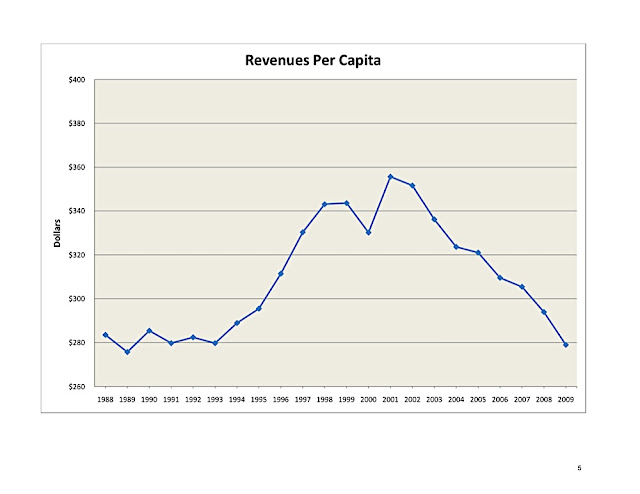
Page 5 tells the tale on revenues per capita, from 1988 to 2009. Beginning in 2001, revenues per capita begin a precipitous plunge, as the city gets less each year in revenue. The city’s analysis, following the graph, is telling:

The warning trend is that there is a decrease in net operating revenues per capita occurring in Whitewater. Over the studied 21 year period, adjusting for inflation, revenues per capita has varied from $275.2 (1989) to $355.66 (2001). For 2009, the Revenue Per Capita equals $278.97. Since 2001, revenues per capita has been steadily declining. This reclects [sic] lack of growth in the City’s major revenue source, – state shared revenues.

It’s true, of course, that the ground on which so much relies has been the shifting (simply eroding, really) sand of shared revenues. In this critical respect, we are considerably different from most of Wisconsin communities of similar size. I’ve written on this topic before.

Municipal government’s net direct debt service.
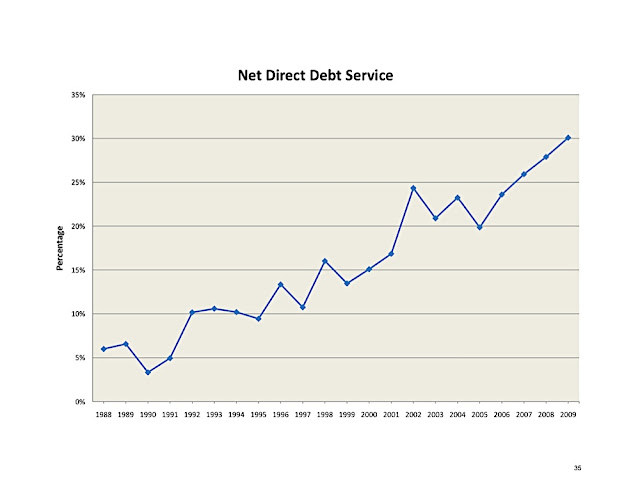
Page 35 shows how the city’s net direct debt service has been rising markedly from 2005 through 2009. Here’s the city’s analysis:

According to credit industry standards, debt service on net direct debt exceeding 20 percent of operating revenues is considered a potential problem. Ten percent is considered acceptable.

In analyzing this trend, the City in 2006 had a percentage of 24.35% which is considerably above the credit industry standard.

However, because the City has issued $ 3,618,622 in new debt for TID#4 in 2005, $500,000 in 2006, and $5,600,000 in 2008, this percentage will be increasing. The general fund has only a small portion of the total debt service outstanding for the City. 85% of the net direct debt service is due to borrowings for TID #4. The balance of 15% is supported by the shared revenue utility payment from the power plant.

Policy statements should be developed by the City that would indicate desirable levels of debt service as well as procedures for analyzing future debt service. Suggested policies are that 1) total debt service for general obligation debt will not exceed 10 percent of annual operating revenues and 2) before bonded long-term debt is issued, the impact of debt service on total annual fixed costs will be analyzed.

Our municipal administration relies on a drying stream of state shared revenues. We rely on this more than most cities of similar size. See, The City Manager’s Selective and Deceptive Use of Data. Even as the city’s reliance on Madison proves imprudent, city manager Brunner has committed this small, struggling town to a tech park project that “relies on millions in public grants, millions in subsidized public bonds, will use a third of its space for a publicly-funded tenant, has no clear private purpose, violated commonsense competitive principles in awarding contracts, was once shut down for federal violations of obvious competitive rules, takes place in a town that has high poverty that the project has no hope of alleviating, and that’s nearly certain to fail as other projects of its kind typically do.” See, Whitewater’s Innovation Center: Good for Producing Innovative, ‘International’ Fairy tales.

For it all, what kind of budget does our city manager produce for 2011? Nothing but a status quo, kick-the-can-down-the-road effort. Here’s how, with America, Wisconsin, and Whitewater facing hard times, city manager Brunner describes his budget:

This slight increase in the tax rates won’t really put much of an impact on residents….

We try to sail a lean ship by producing a high level of services at the lowest tax rate possible.

Madison’s significant but dwindling shared revenues to Whitewater are responsible for this; the city manager’s budget is balanced through others’ earnings, not his own.

If our situation is troubled — and it is — Brunner can’t seem to grasp that whatever our relationship to other cities now, we need to improve our position. That means lower taxes and less spending. Brunner’s budget is about trudging along, preserving as much of government as possible, and hoping like mad that his administration can rely on grants and shared revenue for as long as possible, to keep going and generate publicity for showy projects.

Seeing how many plates a man can keep spinning at once isn’t prudent policy or good government; it’s a circus act.

Changes in Spending from the Proposed Budget.

I believe in a much smaller budget, with a minimum burden on taxpayers, and with preservation of services that recognize the community in which we actually live. Significantly, though, I am opposed to spending cuts that affect services disproportionately benefitting the disadvantaged. I also strongly oppose the city’s grand projects that, in the end, will either prove ineffectual, or a kind of corporate welfare (itself a mistake and disincentive to efficiency).

Here’s a copy of the 2011 proposed budget, with recommended spending reductions and a memo in reply from Whitewater’s police chief, Jim Coan, that I have attached at the end.

2011 Municipal Budget Proposal with Amendments. (pdf opens in new window)

One quick note: For all the millions involved, only two council members took the time to propose additional savings. Only two. That no others on our Common Council could find suggestions of their own to add to this list, is astonishing. Those two who have offered suggestions should be commended. They did the good work others have ignored.

Spending changes (either more or less):

1. Support all the proposed reductions in spending that council members Singer and Butler have, separately, proposed, with the change to police force reductions as note below. (Reductions over present.)

2. Establish a permanent position overseeing our food pantry and services for the needy. (Increase over present.) Principal task is to develop a modern and professional method of food distribution for the poor of Whitewater. Significant emphasis on finding a better location and contemporary standards for food distribution. This should be a three-year position, at a minimum. City to provide effective assistance to overcome objections. Rome was not built in a day.

3. Restore library hours. (Restoration over present proposed reduction.) These cuts disproportionately affect the disadvantaged. Those who have more should feel cuts first.

4. Keep parks and recreation fees where they are. (Restoration over proposed fee increase.) This idea is a diffident man’s cut, asking other people to pay more while unnecessary bureaucrats keep their jobs. A city manager who advocates cuts like this is more concerned about preserving an institutional status quo than making true reforms. (That’s a joke, of course — there’s not a reformist element anywhere in this municipal administration. It’s all status quo now, status quo tomorrow, status quo forever.)

5. Eliminate two administrative posts, effective March 31, from among the following four: assistant to the city manager, director of finance, director of neighborhood services, director of public works. One subordinate from these groups would become a team leader (if there are subordinates). (Reductions over present.) Which leader occupies these post is a concern of others; that we have too much administration is clear.

6. Return to the city any and all compensation the city manager receives for work on the Community Development Authority. (Reductions over present.) The best course would be to remove the city manager from this role, as it creates conflicts and allows only the speedier propagation and adoption of bad ideas.

7. Eliminate one FTE in the police department, as proposed, but for the administrative lieutenant’s position within the department. (Reductions over present.) These duties would become those of the police chief. We’re a small town – we don’t need that much administration. Which leader occupies the post is a concern of others; that we have too much administration is clear.

8. Reduce consulting expenses 25% over proposed budget. (Reductions over present.) Those leaders working in the administration should be expected to know and manage planning within their areas of responsibility. Those leaders who require significant assistance from outside consultants should not be retained.

Result: More services for the needy, while returning all remaining amounts to the taxpayers who, through their own efforts, earned them. We would have both a leaner and more humane municipal government. The arrogance of big projects in a small town has come only at the expense of ordinary residents.

For these changes, Whitewater would save hundreds of thousands dollars, offer more to residents, and bring this administration away from public relations and closer to worthy governance.

Wisconsin Dem lawmaker says Walker should sell or lease mansion – JSOnline

It’s a fine idea — our governor does not need a mansion.

A Democratic Wisconsin state senator says Republican Gov.-elect Scott Walker should sell or lease the governor’s mansion to send a message to voters that he’s serious about cutting waste.

Sen. Bob Wirch of Pleasant Prairie made the same request eight years ago after Democratic Gov. Jim Doyle was elected.

See, Dem lawmaker says Walker should sell or lease mansion – JSOnline.

Bed Bug Busters: Actors or a Beagle Named Max?

Over at the Wall Street Journal, there’s a story about an anti-bed bug service that uses out-of-work actors to hunt for bed bugs. Here’s the owner’s justification for employing actors:

Actors have great personalities and follow directions well,” says Janet Friedman, owner of Bed Bug Busters NY, who employs many people from the theater world to clean up the vermin. She favors entertainers, she says, because they can improvise, work quickly and are used to the drama of a stressful situation.

The WSJ has a video interview with Friedman, describing her company:


See Who You Gonna Call? For Bedbugs, an Out-of-Work Actor – WSJ.com.)

For hunting beg bugs, though, I’d put my money on a beagle named Max:

If people in Wisconsin are sleeping tight these days, they might have a dog named Max to thank.

The 22-pound beagle is the latest, and possibly most efficient, way of detecting bed bugs for Wil-Kil Pest Control. The tiny insects have made an unwelcome comeback in the past decade.

That means the phrase “don’t let the bed bugs bite” is less of a children’s rhyme and more of a potential liability issue for hotels, apartments and a possible problem in any situation where people move from place to place….

A 2008 University of Florida study reported that trained dogs were 98 percent successful in finding bed bugs.

See, Bed bug problem? Call a dog named Max. more >>

Rep. Paul Ryan on Tax Increases

Here’s Rep. Paul Ryan of Wisconsin’s first congressional district, on federal taxation, as his remarks appeared on Monday, November 15th in USA Today. Ryan is set to become chairman of the House Budget Committee in the new Congress


Stop the Tax Hikes
By Paul Ryan

Congress should act now to prevent across-the-board tax increases from hitting nearly all Americans on Jan. 1. Sustained job creation and economic growth are urgently needed — higher tax rates are not. The failure to take decisive action on this issue further heightens the uncertainty holding our economy back.

It would be a mistake to increase taxes on any American family, worker or job creator. President Obama continues to make the case for raising the top two income tax rates, and raising tax rates on capital gains and dividends. Class warfare might make for good politics, but it results in terrible economics.

Misguided efforts to “soak the rich” would impact roughly half of all small-business income, as many small businesses file as non-corporate businesses and pay individual income tax rates. The president’s tax plan dampens incentives for small businesses to invest and expand, puts us at a competitive disadvantage in today’s global economy, and makes it more difficult for our economy to create jobs.

There is no question that the $13.7 trillion national debt represents a dangerous anchor on the economy going forward. To address the federal government’s fiscal imbalance, we need both economic growth and serious spending restraint.

Policymakers cannot continue to chase ever-higher levels of government spending with ever-higher tax rates. Increasing the government’s take from the economy hinders growth and avoids the necessary spending cuts. It is critical we match opposition to tax increases with a fervent commitment to spending restraint and reform.

This contentious issue provides an opening for a conversation on pro-growth tax reforms, reorienting a simpler, more competitive tax code to raise revenue needed to meet government’s priorities, while maximizing economic growth.

Altogether, Congress must get the pro-growth economic fundamentals right. Economic policies must restore the basic foundations of growth: low tax rates; sound and honest money; fair, predictable and reasonable regulations; spending restraint and government reform.

Americans reject the “new normal” of high unemployment, stagnant growth and excessive government overreach. Stopping these tax hikes is a critical first step to restoring the promise and prosperity of our exceptional nation.

Walworth County Genealogical Society Christmas Party: Tuesday, December 7th

Here’s a press release from the Walworth County Genealogical Society

WCGS ANNUAL CHRISTMAS PARTY

The Annual Walworth County Genealogical Society Christmas Party will be held on Tuesday, December 7, 2010, 6:00 PM at the Community Centre, 826 E. Geneva Street, Delavan. The festivities will start out with a holiday pot-luck supper with each family bringing a dish to pass. The Society will provide barbecues and tableware.

There will be a German Christmas display table with books, decorations and items pertaining to the German culture. Enjoy some samples of Spekulatius, a German spiced cookie. Diana Bird will tell about the Christkindlmarkt she attended.

Everyone is asked to bring a wrapped item with a value of $5 to be used for Bingo prizes. Also requested are canned goods and grocery items for the local food pantry.

Just a reminder there will not be a meeting in January. Also the WCGS Library in the Matheson Memorial Library will be closed from December 15 through January 10.

Enjoy the Holidays!

For information, please call 275-2426.

Daily Bread for Whitewater, Wisconsin: 11-16-10

Good morning,

It’s a day of increasing clouds ahead for Whitewater, with a high temperature of fifty-two.

Whitewater’s Common Council meets tonight, to consider the 2011 City of Whitewater municipal budget. The meeting agenda is available online. The municipal government’s budget only a part of it the greater community’s economy and well-being. I will post on the budget today, not because writing on it has the slightest chance of changing an outcome, but because a common person has a right to commentary.

Over at ScienceNews.org, there’s a story from Laura Sanders about robots entitled, Robots can use coffee as a picker-upper: Gripper made of bag of loose grains helps machines get a grip.

She reports that

A small bag filled with coffee grounds is lending robots a fingerless hand. The new kind of gripper, described online the week of October 25 in the Proceedings of the National Academy of Sciences, is capable of grasping all sorts of different objects with ease….

The simple gripper is made of a bag of coffee grounds and a vacuum, though other grains such as couscous and sand also work, says study coauthor Eric Brown of the University of Chicago. To pick something up, the bag of loose grounds first melds around the object. Then as a vacuum sucks air out of the spaces between grains, the gripper stiffens, packing itself into a hard vise molded to the outline of the object. Reducing the bag’s starting volume by just a teeny amount — less than 1 percent of the total — was enough to make the gripper latch on, the team found.

Here’s a video of the robot in action (picking up an egg and pouring water are my favorites):


QUICKER PICKER UPPER from Science News on Vimeo.


more >>

Lions, tigers and budgets, oh my! – JSOnline

It’s not a program we want to drop,” said Dale Bjorling, professor and chairman of the school’s department of surgical sciences. “When we think about our mission here – we’re a school, but we provide a service here to the people of Wisconsin.”

During fiscal year 2010, the UW veterinary school, which offers both residency and clinical programs, logged 790 patient visits by exotic species.

Eighty students are admitted each year for the four-year program at the veterinary school, and a rotation with exotic species is a popular elective for those who plan to work in small animal practices that treat rabbits, cockatoos, iguanas and ferrets in addition to German shepherds and calico kittens. The students might even see wombats, Tasmanian devils, sugar gliders, tamarins and chinchillas. Or possibly tigers, elephants and orangutans, since the exotic species rotation is also sought after by students who want to work at zoos or wildlife programs.


Via Lions, tigers and budgets, oh my! – JSOnline. more >>

Downtown Coyote Could Be On Rat Patrol (Video)

Here’s a government program I’d readily support —

A coyote that was spotted running down State Street [in Chicago] early Monday may be in the Loop on assignment: to help keep the city’s rodent population at bay.

….several coyotes fitted with GPS devices have been allowed by the state to run through Chicago to deal with the city’s rodent population.


View more news videos at: http://www.nbcchicago.com/video.


Via Downtown Coyote Could Be On Rat Patrol (VIDEO). more >>

The Dodgy Statement About Violations of a Federal Grant for the Whitewater Innovation Center

There’s a Whitewater Community Development Authority and Tech Park Board meeting today. Before the CDA meets again, one should consider how principal players in Whitewater’s multi-million dollar Innovation Center project have rationalized explained violations of federal competition in bidding requirements.

Explanations offered at the October 13th Tech Park Board meeting and the October 25th Community Development Authority meeting don’t reduce skepticism about the project and its incompetent handling.

These explanations only reveal how ill-conceived and poorly executed this project really is. It’s not better than one thought; it’s much worse than one thought.

I’ve written about violations of common-sense federal bidding requirements before. (Construction management firms that recommend bids shouldn’t be in a position to recommend themselves!)

See, Whitewater’s Innovation Center: Economic Development Administration Sends ‘Cease and Desist’ Letter Over Alleged Violation of Competition in Construction Requirements, Wisconsin State Journal: Work was stopped on Whitewater technology park due to federal rules violations, and The City Manager’s Dodgy Tale About Violations of a Federal Grant for the Whitewater Innovation Center.

(For the State Journal story, see Work was stopped on Whitewater technology park due to federal rules violations.)

In the draft minutes of the CDA meeting of October 25th, a CDA member read a letter explaining the federal violations.

The text of the letter appears on pages 3 to 4 of the linked document.

Here’s the text of the prepared statement:

Jeff Knight stated that he was present at EDA meeting on Oct. 6, 2010. Mr. Knight read out loud this prepared statement for the record.

“On September 28, 2010, a letter from the Chicago Regional Office of the Economic Development Administration (EDA) was received by representatives of the Whitewater Community Development Authority, the City of Whitewater, and the University of Wisconsin-Whitewater. This letter advised the cogrant recipients to cease and desist all construction activities associated with the grant.

Upon receipt of the letter, City Manager Kevin Brunner advised the contractors of the letter and put them on notice that construction may need to be stopped. On Wednesday, September 29th, he sent an e-mail to members of the Common Council, the Community Development Authority, and the University Technology Park Board, explaining the situation and including a copy of the September 28th EDA letter.

A meeting with the EDA in Chicago was scheduled for the morning of October 6th. Kevin Brunner, Mary Nimm, Denise Ehlen, Jeff Knight, Richard Telfer, and Cliff Goodhart attended this meeting. During the meeting the EDA’s concerns were discussed and elements of a possible resolution were considered.

On October 7th, a letter was sent to C. Robert Sawyer, Regional Director of the EDA explaining what had happened and why and proposing a resolution going forward. Also on October 7th, in response to this letter, a letter from the EDA was received accepting the proposed solution and lifting the stop advisory. These letters were shared with members of the Common Council, the Community Development Authority, and the University Technology Park Board.

The area of non-compliance indicated by the EDA concerned the use of J.P. Cullen as the construction manager and as the general contractor. While a number of safeguards were in place to ensure a bid process in compliance with federal regulations regarding competition, the EDA determined that awarding this contract did not satisfy the requirements of the code. The agreed-upon resolution to the situation involves EDA providing support for labor and materials associated with construction management and the general contract. The Whitewater partners must fund all overhead costs incurred by J.P. Cullen to ensure compliance.

It is clear that the EDA understands the importance of this project for Whitewater and for southern Wisconsin. They continue to be strongly in support of this project and recognize its importance for job growth and economic development in the region. The partners in the project are committed to moving this project forward. We are taking additional steps to ensure compliance, including conducting regular telephone conferences with our EDA Construction Project Manager. We appreciate the EDA’s cooperation and support for this project.”

A few remarks:

1. These violations are rare.

Violations of the most basic principles of competitive bidding are rare. Projects don’t typically receive cease-and-desist letters from a federal agency. Then again, most people who submit grants for millions in federal money understand that construction service firms who recommend bids should not be recommending themselves for contracting work.

2. Did Whitewater City Manager Kevin Brunner know about EDA violations before September 28th?

The prepared remarks of the letter contend that the City of Whitewater, among others, received a cease-and-desist letter from the EDA on September 28th. Does this mean that Brunner first knew of these violations only on Tuesday, September 28th?

That’s highly implausible, for three reasons.

First, it assumes that a federal agency’s regional director simply sent a letter out-of-the-blue, with no prior warning or discussion about violations. No prior email, no prior calls, nothing — just a cease-and-desist letter with no warning. That’s unlikely.

Notice how careful the prepared statement is — it refers to a letter on September 28th, rather than stating expressly that’s when any of the co-grant recipients of the multi-million dolllar payment actually knew and were told of violations. Why not simply say: “This is when we first knew of violations?”

Second, consider Brunner’s remarks a day earlier, on Monday, September 27th, at a CDA meeting. In those remarks, he talks about ‘compliance’ issues.

Beginning at 1:17:45 into the recording, Whitewater city manager Brunner discusses item 10 b, “Economic Development Administration Update.” I have embedded the video below, with my own transcription of the relevant discussion:


Transcript of conversation:

Brunner: Economic Development Administration update. We continue to work with the EDA on a variety of compliance issues. We have a meeting scheduled with them next week to discuss some concerns the EDA has regarding the Innovation Center and we hope to work out the details of that with them next week.

[Cross talk with Mary Nimm, CDA Coordinator]

And we have a new rep who has brought a new set of eyes and a lot more [laughs] detail, a lot more detail that we have to go through… So, that’s that… I don’t know, Mary, do you want to make any other EDA comments?

Nimm: Just that we have a new rep.

Did Brunner know through prior means before a letter – such as a phone call or email — that there were competition in construction violations?

Third, when Brunner spoke to the Wisconsin State Journal, on October 7th, he said that “he had no idea until a few weeks ago that the arrangement didn’t comply with federal rules.” Until a few weeks ago would place Brunner’s knowledge of EDA violations well before the September 28th letter.

That makes sense — as he admits in a recorded, public meeting on September 27th to questions with federal compliance, and it’s credible that the letter was preceded by prior EDA information. It’s not at all credible that the letter was a bolt-out-of-the-blue.

After all, Brunner wasn’t meeting with the EDA for tea and crumpets.

This suggests lack of candor about violations in the first instance. More significantly, had the EDA cease-and-desist letter not been published, the city might not have learned about such incompetence, ever.

3. Excuse-making at the October 13th Tech Park Board meeting.

If all this seems dodgy, there’s yet more. Consider the minutes of the October 13th Tech Park Board. Item 3 includes these notes:

After Telfer’s statement, there was general discussion regarding the financial impact that the EDA compliance issues might have. In response to a question from Chenoweth, Brunner explained that we don’t know exactly the net financial impact but it could result in additional dollars being paid under the EDA grant for construction management services that previously were thought not to be grant-eligible. The financial impact will be dependent upon how the EDA treats overhead and profit on the general construction contract as well as what construction management costs will be allowable under the grant. Brunner indicated that he would keep the Board informed as the administration of the EDA grant goes forward.

Gayhart questioned whether or not we should have known earlier in the process about the noncompliance issue. Ehlen responded that there was mutual culpability on the compliance issue. Telfer noted that the general construction contract was bid on in an open competitive process with Eppstein Uhen, as project architects, to serve as the overseer of the general construction contract.

City Attorney McDonell stated that the City was never alerted about the non-compliance with the CFR until a new EDA project engineer was assigned to the project a few weeks ago….

Imagine the oddity of a city attorney mentioning that “the City was never alerted about the non-compliance with the CFR [Code of Federal Regulations] until a new EDA project engineer was assigned to the project a few weeks ago….”

The City of Whitewater, the University of Wisconsin-Whitewater, and Whitewater Community Development Authority didn’t (1) understand simple principles of competitive contracts, (2) the city attorney expects someone else to explain a basic principle of a federal code to him, and (3) explain to him the clear terms and conditions of the grant document to which of city officials agreed (so that they would get millions in federal money).

Note also, that looking back ‘a few weeks ago’ from October 13th matches what Brunner and Nimm said on September 27th about having a new rep. City Attorney McDonell identifies this new project engineer as the reason for being alerted to the violation.

Is anyone to believe that the new project engineer was in place before September 28th, by everyone’s account, but that only unexpectedly on September 28th did the city receive notice of clear federal violations of competition regulations?

4. The Changing Story on Financial Impact of the Federal Violations.

In remarks published on October 9th in the Janesville Gazette, Brunner reportedly declared that “he doesn’t expect the violation to have any financial impact on the project.” One sees that just four days later, Brunner acknowledged to the Tech Park Board that he wasn’t really sure about the net financial impact.

The prepared statement doesn’t clear matters up; it suggests how dodgy this whole project, and explanations of it, have become. more >>

Daily Bread for Whitewater, Wisconsin: 11-15-10

Good morning,

Whitewater’s forecast calls for a partly sunny day, with a high temperature of fifty degrees.

Whitewater’s Community Development Authority and Tech Park Board will meet today, at 4:15. The agenda is available online.

The Wisconsin Historical Society recalls that on this day in 1887,

1887 – Georgia O’Keeffe Born

On this date Georgia O’Keeffe was born in Sun Prairie. She studied at the Chicago Art Institute from 1904 to 1905. In 1907 she relocated to New York to study at the Arts Students League with William Chase. In 1926 she unveiled her now famous flower paintings. She received much of her artistic inspiration from her surroundings in New Mexico, where she settled permanently in 1946. O’Keeffe was awarded the Presidential Medal of Freedom in 1977. Georgia O’Keeffe died in 1986 in Santa Fe. [Source: Wisconsin Women: A Gifted Heritage]


Georgia O’Keeffe, Black Petunia and White Morning Glory I

Secret Places: Your luggage takes a trip at the airport

The Wisconsin State Journal has a periodic feature called “Secret Places’ that takes readers behind the scenes of Wisconsin buildings to reveal how they work. The latest is about luggage handling at the Dane County Airport.

Truth be told, a piece of luggage can probably get on an airplane more efficiently at Dane County Regional Airport than a human being.

Not that either process is particularly complex at the Madison airport, but there’s a good chance a passenger’s bag might be ready to head to its next city before the traveler gets his or her shoes back on to walk toward the gate.

Via Secret Places: Your luggage takes a trip at the airport.

For a prior edition, see Secret Places: Wisconsin Historical Society’s Treasure Trove.