Who are the biggest egomaniacs in the United States Senate? Darren Garnick and Ilya Mirman write that
In a quest to find out, we developed the Senate Vanity Index, a formula that measures the level of egotism displayed in each senator’s lobby, the part of his or her office open to the public….
Visiting all 100 offices, we counted every award and picture on the walls—giving special weight to each senator’s poses with celebrities, presidents, and foreign dignitaries. We make no claims that our vanity formula is flawless. But we do feel comfortable declaring that we have found a truly bipartisan issue: Of the top 10 egos in our rankings, five are Republicans, four are Democrats, and one is an independent who caucuses with the Democrats.
For 130 years, the kilogram has weighed precisely one kilogram. Hasn’t it?
The U.S. government isnt so sure.The precise weight of the kilogram is based on a platinum-iridium cylinder manufactured 130 years ago; it’s kept in a vault in France at the International Bureau of Weights and Measures. Forty of the units were manufactured at the time, to standardize the measure of weight.
But due to material degradation and the effects of quantum physics, the weight of those blocks has changed over time. That’s right, the kilogram no longer weighs 1 kilogram, according to the National Institute of Standards and Technology NIST. And it’s time to move to a different standard anyway.
Real GDP is still 0.8% below the prior cyclical peak, which was 11 quarters ago. Such a result is considerably worse than prior cyclical experience. Other “recent” recessions (since the 1970s) show that real GDP is usually more than 6% above the previous peak by now. Softer than usual consumption, housing, commercial real estate, and state and local government spending are the main reasons for the poor performance relative to history. –Jay Feldman, Credit Suisse
Support for campaign finance restrictions notwithstanding, Feingold’s been a good senator for Wisconsin. His opponent would never do so well.
Describing the Republican nominee as a “one-note” candidate, the paper said Johnson made a big deal about the need for fiscal responsibility but “seemed unable to further articulate his plan for job creation — especially for the middle class — during a recent meeting with the Green Bay Press-Gazette editorial board.”
….In contrast, the Press-Gazette noted: “Feingold has a solid jobs plan and detailed, specific proposals for controlling spending and reducing the federal deficit. He is a leading proponent of the pay-as-you-go principle that says government should not cut taxes or add entitlement spending without paying for it elsewhere, and he has joined with Rep. Paul Ryan, R-Janesville, in an effort to reduce pork-barrel spending in Washington.”
Reason considers our economic situation today and compares it with one from the ’30s. I don’t think the New Deal brought private jobs back, but I will say this much for FDR (as I have before): his New Dealers cared more about results than any local official hawking an empty idea like a so-called ‘Innovation Center’ for Whitewater. (It should be called a “Decline Center” to highlight the steep backwards direction in political and administrative quality from FDR’s New Dealers to Whitewater’s current municipal administration.)
Here’s an excerpt of the description accompanying the video:
The Great Recession officially ended way back in June of 2009, so why are so many Americans still out of work?
It’s not because politicians were twiddling their thumbs. Indeed, from from bailouts to “Cash for Clunkers” to the massive stimulus plan, government has busied itself with trying to fix the economy. And, according to President Obama, this “bold, persistent, experimentation” has brought our country back from the brink….The Great Recession officially ended way back in June of 2009, so why are so many Americans still out of work?
It’s not because politicians were twiddling their thumbs. Indeed, from from bailouts to “Cash for Clunkers” to the massive stimulus plan, government has busied itself with trying to fix the economy. And, according to President Obama, this “bold, persistent, experimentation” has brought our country back from the brink.
Obama borrows that phrase from President Franklin Rooselvelt, and today’s president has a lot in common with the original bold, persistent, experimenter. Like Obama, FDR was a charismatic Democrat who replaced an unpopular Republican during a time of crisis. And like Obama, FDR championed a slew of policies designed to get America back to work.
Today many Americans credit FDR with rescuing our nation from the Great Depression, but there’s plenty wrong with that view, says Lee Ohanian, a UCLA economics professor who specializes in economic crisis. “What’s wrong with that view is that private-sector job growth did not come back under Roosevelt,” says Ohanian, who notes that Americans often forget how long the Great Depression lasted. Unemployment stood at 17 percent in 1939, a decade after the infamous stock market crash, and, although times were much worse back then, Ohanian sees troubling parallels between the Great Depression and the Great Recession. In both instances our nation emerged from a severe downturn with strong productivity growth and the banking system largely restored. “So the key puzzle for both today and the 1930s is why aren’t private-sector jobs being created at a much more rapid rate?”
….According to research conducted by Ohanian and fellow UCLA economist Harold L. Cole, FDR’s anti-market policies actually prolonged the Great Depression by seven years. And what about Obama’s policies? When the unemployment rate finally does improve will he receive credit for rescuing America from the Great Recession or blame for prolonging the crisis?
Approximately 6.40 minutes
“Where are the Jobs? The Parallels between Today and the Great Depression” is written and produced by Ted Balaker. Field Producers: Paul Detrick and Zach Weissmueller; Production Associate: Sam Corcos.
Nina Easton writes about so-called reform that’s both anti-speech, and deeply hypocritical:
One narrative of election year 2010 was shaped long before any votes were tabulated. President Barack Obama penned the first chapter with his January condemnation of a Supreme Court ruling that lifted government prohibitions on spending by corporations in elections. The 5-to-4 decision in Citizens United v. Federal Election Commission “strikes at our democracy itself,” he said. Democrats and the media followed with tales of horror and fright, warning of corporate super-PACs and foreign donors. You could practically hear the theme from Jaws rumbling in the background….
As constitutional scholar Floyd Abrams recently wrote in the Yale Law Journal, campaign finance reform is considered so sacred that any ruling like this [Citizens United] was bound to be unpopular. The Citizens United decision “was treated as a desecration,” Abrams notes, even though Justice Anthony Kennedy, writing for the majority, likened the overturned restrictions to suppression of political speech in newspapers, books, and television….
Nor is the ruling likely to enshrine a permanent tilt in favor of Republicans. (Where was all the media hand-wringing when money from unions and wealthy individuals was gushing on behalf of Democrats in 2006 and 2008?) Campaign money follows the intensity gap — which is on the Republican side this year but was on the Democratic side in the past two elections.
Forecasts from Goldman Sachs of growth way too low for a meaningful recovery —
We expect US growth to remain sluggish next year, as the temporary boosts from inventory restocking and fiscal stimulus wanes while final demand remains weak. If our view is correct, 2011 consensus expectations will move significantly over the months to come. The US consensus estimate of 2.4% in October is still 0.6 ppts above our forecast and will need to continue its recent downward fall see “Forecasters Need to Cut GDP Estimates a Lot Further”, US Daily Comment, August 23, 2010.
Whitewater’s forecast calls for a sunny day with a high temperature of fifty degrees.
The Comment Forum will be off today, but will return next Friday. Other features are on the way, today and through the holiday weekend.
Tomorrow I’ll post FREE WHITEWATER’s annual Scariest of Whitewater, with this year’s top ten list of the scariest things in town. For a quick look at past posts, follow these links to the 2007, 2008, and 2009 editions.
The brain uses two different checks to guard against sloppy copy, a new study finds. By using a doctored word processor to sneak errors into typed words and surreptitiously fix typists’ real errors, researchers teased apart the various ways people catch their own mistakes. The study, published in the Oct. 29 Science, highlights the complexity of performance monitoring….
The results may reveal a hierarchical method of error correction — with a “lower” system doing the actual work and a “higher” system assigning credit and blame, Logan suggests. These multiple layers of control may be evident in tasks such as playing music, speaking and walking to a destination, Logan says. As a man heads toward a new restaurant, his brain is noticing landmarks and keeping on the right course. Meanwhile, his feet steadily plod along, navigating the terrain automatically.
Here’s the citation: G. Logan and M. Crump. Cognitive illusions of authorship reveal distinct hierarchical error detection in skilled typists. Science. Vol. 330, October 29, 2010, p. 683.
Another unfunded mandate at the worst possible time —
Milwaukee city officials are asking the federal government to give them more time to comply with rules that require replacing signs and traffic signals, at a cost of $5.3 million to local taxpayers.
For a quaint college town, Whitewater has a spooky past.
Its urban legends, chock-full of witches, spirits and mysterious happenings, may stem from stories surrounding the Morris Pratt Institute….
Even before the Institute, however, stories of witchcraft and a sacrificial altar, which allegedly lies near UW-Whitewater dorm Wells Hall, earned the town the nickname of the “second salem.”
It’s a breezy day in Whitewater, with a forecast for a high temperature of forty-five.
School’s out, for the next two days, a kind of pre-Halloween treat for thousands.
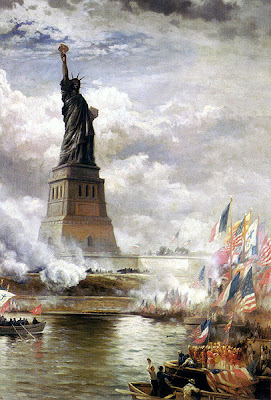
The New York Timesreported that on this day in 1886, President Cleveland dedicated the Statue of Liberty:
The statue of Liberty yesterday was seen through a mist darkly. Piercing winds blew around Bedlow’s Island, and the numerous workmen, who were not in any way protected from the weather, worked uncomfortably. The speakers’ stand, and that for the use of musicians above it, were in readiness yesterday. Planks were removed and a semblance of tidiness was given to the island. A big barge, which looked extremely dismal, with its legend in red characters, “Eat, drink, and be merry,” stood at the Bedlow’s Island dock to land visitors. It will be used for that purpose this afternoon.
Unveiling of the Statue of Liberty Enlightening the World (1886) by Edward Moran. Oil on canvas. The J. Clarence Davies Collection, Museum of the City of New York.
Police in Montana say a man robbed a bank and then called a taxi to make his getaway, tipping the driver $5 just before squad cars surrounded the cab. Taxi driver James Anderson told the Missoulian the man was acting strangely when he picked him up at a Missoula coffee shop.