Excuses made on behalf of Whitewater’s publicly-funded Innovation Center and Tech Park are growing increasingly absurd, and are easily refuted. Each attempt of officials to justify the project only shows, yet again, what a wasteful scheme it is. Serious and thorough examination of tech parks like this shows they’re money-draining failures.
The Milwaukee Journal Sentinel has a fine story, entitled “UW-Whitewater breaks ground on technology park,” that includes supposed justifications for the project from Whitewater City Manager Kevin Brunner and UW-Whitewater Chancellor Richard Telfer. Their explanations are risible, and the story points to a fine study showing the many ways a project like this is a very bad idea. The story also includes a picture of the construction site that’s worth far more than a thousand words. (More on that in a bit).
I’ll consider the remarks offered on behalf of the project.
The Anchor Tenant. There’s little doubt that using a state education agency — the publicly-supported school service agency, CESA 2 — as an anchor tenant has nothing to do with technology, not being a technology concern in any legitimate way. In this article, Whitewater’s city manager drops even the pretense that there’s something tech-related about CESA 2:
So far, the Innovation Center’s largest tenant is CESA 2, a state agency that provides teacher training. A smaller education agency also signed a lease recently. Prospective tenants are private firms, and Brunner said the public agency leases were needed to generate rental income.
“This helps pay the bills,” he said.
I’ve been a critic of this project, but it’s hard to imagine how obtuse Brunner’s justification really is. To justify public spending of millions in public money on a building that’s supposed to foster private tech firms, Brunner points to another public expense, the public cost of rent for a publicly-funded building!
This is just absurd, and is no justification at all. If Brunner thinks that it’s a sensible explanation that the Innovation Center took on a public tenant, on top of a public funding scheme, to get to a possible private set of tenants, then he can’t think clearly at all.
Here’s what might have made much more sense: A tech park building, needing an anchor tenant, takes on a private, non-tech business to provide rent to allow for other, genuine, private tech businesses. For example, the Innovation Center, needing money from an anchor tenant, takes on a private restaurant and bookstore to support a building that will house genuine tech businesses. Any variation like that would be a stretch as an anchor tenant, but at least it would be a private source of funding.
That’s not what’s happened here.
Brunner hasn’t found a private (anchor) business to pay the bills for a public project meant to attract private businesses — he’s found a taxpayer-supported agency to pay its rent through ordinary people’s taxes. Who pays the bills of the school agency that pays the bills of the public project?
Taxpayers.
The Prospective Fund. The story mentions a possible tenant, and here’s the relevant passage:
Prospective tenants include a start-up investment fund led by Patrick Monaghan, the university’s entrepreneur-in-residence.
Monaghan, working with UW-Whitewater professors and students, has created software that uses a quantitative technique known as predictive analytics to pick stocks and other investments. Monaghan envisions about a half-dozen employees working at the Innovation Center, with research conducted on campus, once the fund is launched in early 2011.
Monaghan, who lives in the Whitewater area, never considered using the university’s resources until an acquaintance introduced him to Choton Basu, an associate professor in information technology and business education. Monaghan now works out of the university’s Global Business Resource Center, which is based in the business college’s new building, Hyland Hall.
“It’s a small undergraduate state school. I just didn’t think of Whitewater,” he said.
One can only guess about the prospects of the fund, not yet launched. There’s so much speculation and uncertainty in this venture as a possible tenant that one see how shaky are the prospects of the Innovation Center. If this is the most certain prospect that the backers of the Innovation Center have to offer, then they’ve truly embarrassed themselves, and at the expense of those ordinary people who had taxes taken for this effort.
Telfer’s Lack of Choice. In describing the decision to go ahead with this public scheme, here’s what UW-Whitewater Chancellor Telfer had to say:
Telfer acknowledged that the public funding of Whitewater Technology Park involves “a little bit of a leap of faith.” Telfer, whose academic background is education, also said he would have never considered such a project 20 years ago. But the university’s role is changing, he said.
“I don’t think we have a choice,” Telfer said. “I really think universities need to be more explicitly involved in helping to grow more business opportunities.”
Telfer has no choice? He just had to get Whitewater to take a taxpayer grant, and for the community to issue millions in debt, so that he could have this project? There was no alternative except to have this, this way?
Of course there was an alternative — these gentlemen could have restrained themselves, and not sought millions in other people’s earnings to fund his project. Men who have spent years on the public tab, in fields other than businesses or technology, now insist that they had no choice but to have this project, now. All around our city, there’s child poverty, hunger, with unemployed blue collar workers, but these gentlemen just had to have this, now.
The selfishness of this project, with so many greater needs, is disgraceful. These middling few have funded their scheme on the backs, and from the pockets, of ordinary people. This project is merely a moment to their pride.
The Truth About These Projects: They Don’t Work!. There’s a solid study to which this story links, from Marc Levine, UW-Milwaukee history professor, and the director of the university’s Center for Economic Development, entitled “The False Promise of the Entrepreneurial University.” I read this paper near the time it was written, and its assessment is thorough and compelling. I’ll post more about this later, as there’s a series I have yet to complete on the funding of Whitewater’s park, and its supposed justification.
For now, consider Levine’s informed observation:
While proponents of academic commercialism routinely overstate its economic benefits for cities and regions, they rarely mention the significant costs. These include potential undermining of the system of basic research and open science that has been the cornerstone of scientific discovery in the US, and, ironically, undercutting innovation. Contrary to claims by many university leaders that research commercialization will generate revenues for their institutions, for most universities tech transfer is a money- losing proposition. Tech transfer is a classic example of jackpot or casino economics, with very few big winners, and over half of US universities lose money in academic commercialization. Research funding and commercialization revenues are heavily skewed to the same “top 15” universities that have dominated these statistics for decades, and, as one expert has argued, outside of this top group most universities are getting nothing out of tech transfer “except a lot of economic development rhetoric.”
The Accompanying Photo. Accompanying the story is photo of construction at the Innovation Center building. Nothing could be more appropriate than that photo: a worker grouts a hole for a fancy ‘geothermal heating and cooling system,’ paid for with ordinary people’s taxes, while the foreground shows a muddy construction site, of ruts and pools of water.
When this is all done, and the ground dries, there’ll be another photo, of another hole, that will be a suitable metaphor for the project:
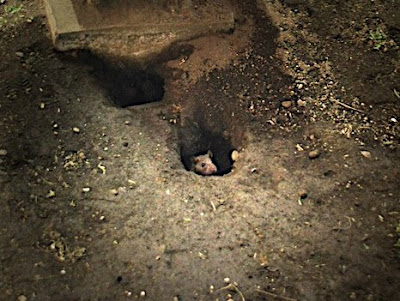
Rat hole avec rat