FREE WHITEWATER

Balko on Concealment and Dishonesty in Northern Virginia

The battle for openness in government is a difficult but necessary one. In some parts of the country, notably northern Virgina, some police departments are doing everything they can to prevent greater openness. Radley Balko of Reason writes about how departments in that state batten on the legitimate need for public safety to justify their own illegitimate desires for concealment and secrecy from the very public that supports and pays for those departments.

See, Trust Me: You Can Trust Us.

Even a modest bill to allow limited public access to public documents has been met with a firestorm of bureaucratic opposition in Virginia.

Consider these objections to open records laws —

When asked why she couldn’t release the name of a Virginia police officer who shot and killed an unarmed man last November, Fairfax County police spokeswoman Mary Ann Jennings replied, “What does the name of an officer give the public in terms of information and disclosure? I’d be curious to know why they want the name of an officer.”

Pope reported that “police chiefs, prosecutors, and sheriffs from across Virginia” spoke against Edwards’ bill” at last week’s hearing, complaining that “incident reports were raw and unedited documents full of accusations and opinions that would reveal police operations to criminals.”

They also warned that releasing such documents would “create a chilling effect on victims and witnesses,” discouraging them from “coming forward to share information.”

Balko observes that

These worries are red herrings. Nearly every other police department in the country releases police reports to the public without compromising investigations, public safety, or the security of witnesses. Sensitive information such as the identity of police informants or the names of witnesses can be redacted.

What’s the reason for such opposition to simple requests? Keeping watchdog organizations, journalists, bloggers, and families in the dark about incidents shields the small number of bad officers from public view.

In shielding them, corrupt leaders compromise entire departments of good officers for the sake of a few of their incompetent or dishonest friends. Rather than clean house, bad leaders circle the wagons.

Perhaps one shouldn’t be surprised by any of this — bad leaders protect bad employees (at the expense of good ones). What’s particularly unfortunate is how those who are supposed to oversee departments impartially are so quick to cover for bad leaders, and to support secrecy and concealment:

Meanwhile, the elected officials who are supposed to oversee law enforcement in these jurisdictions told Pope they saw nothing wrong with all the secrecy. “I am in the corner of trusting our police department,” said Arlington County Board Member Barbara Favola.

That’s why, on a bad oversight board, there will be no attempt at balance — sycophants — toadies of every shape and size — will fill the board. There will be not even the pretense of impartiality — just boosters, cheerleaders, and starstruck defenders. Defenders not of good conduct, but of any conduct as though it were good conduct..

Fortunately, the defer-to-authority, don’t-you-know-who-I-am-crowd faces a bleak future. They’ve run out of excuses, and the flimsy ones they’ve offered aren’t credible beyond they tiny spheres in which they circulate. When they leave the scene — and they will, as they’re tired mediocrities — better leaders and overseers will take their places.


The Wall Street Journal on State and Municipal Privatization

The Wall Street Journal published a story recently on privatization, entitled Facing Budget Gaps, Cities Sell Parking, Airports, Zoo. Ianthe Jeanne Dugan writes that

Cities and states across the nation are selling and leasing everything from airports to zoos- a fire sale that could help plug budget holes now but worsen their financial woes over the long run. California is looking to shed state office buildings. Milwaukee has proposed selling its water supply; in Chicago and New Haven, Conn., it’s parking meters. In Louisiana and Georgia, airports are up for grabs.

For those who (erroneously) think that the Wall Street Journal writes only one way – to the right — consider Dugan’s description of privatization:

“Privatization” – selling government-owned property to private corporations and other entities- has been popular for years in Europe, Canada and Australia, where government once owned big chunks of the economy.

In many cases, the private takeover of government-controlled industry or services can result in more efficient and profitable operations. On a toll road, for example, a private operator may have more money to pump into repairs and would bear the brunt of losses if drivers used the road less.

While asset sales can create efficiencies, critics say the way these current sales are being handled could hurt communities over the long run. Some properties are being sold at fire-sale prices into a weak market. The deals mean cities are giving up long-term, recurring income streams in exchange for lump-sum payments to plug one-time budget gaps.

There’s a sale, and then there’s an under-sale. Dugan’s story makes the difference clear, and describes how some municipalities aren’t just making deals with private concerns, but bad deals with private concerns.

I’d contend that one of the reasons that many municipalities across America are in trouble now is because bureaucrats falsely believed that they understood business transactions and conditions well, and consequently dabbled in too many projects styled as ‘government-business partnerships.’ These deals were often expensive and ill-conceived (as some in my own, small town have been.)

Across America, some of the same men who made fiscal mistakes (often through these wasteful ‘partnership’ ventures) are now looking to sell as fast as they can – for fire-sale prices. In doing so, they’re compounding their initial errors with subsequent ones.

As they’re the same men, then and now, this is unsurprising.

Daily Bread for Whitewater, Wisconsin: 8-31-10

Good morning,

Whitewater’s forecast for today calls for a partly sunny day with a high temperature of eighty-nine degrees.

Whitewater’s Common Council will meet tonight at 6:30 p.m. for a budget planning session. The agenda is available online.

At the Huffington Post, there’s a story best read in the morning, rather than at night: “U.S. Grappling With Bedbugs, Misusing Dangerous Pesticides.”

Of all things, America now faces a bed bug plague. It’s a return of a bed bug plague, really, and more intractable than before, as this generation of insects is resistant to many ordinary pesticides. One often associates bed bugs with the Great Depression, and by coincidence, we face them now while in the grip of a great and lingering recession.

Here’s one of the species we confront:


Cimex lectularius

Associated Press: Cuba embraces 2 surprising free-market reforms

Best reform would be a true free market….

Cuba has issued a pair of surprising free-market decrees, allowing foreign investors to lease government land for up to 99 years — potentially touching off a golf-course building boom — and loosening state controls on commerce to let islanders grow and sell their own fruit and vegetables.

“These are part of the opening that the government wants to make given the country’s situation,” said Oscar Espinosa Chepe, a state-trained economist who is now an anti-communist dissident.”

See, The Associated Press: Cuba embraces 2 surprising free-market reforms.

Pres. Obama’s Mission Accomplished Moment at GM – Forbes.com

….[the] administration’s wanton disregard for both taxpayers and the company shows just how desperate it is getting to deliver some sliver of economic good news to angry voters ahead of the November elections. But its actions only bespeak of the dangers of government bailouts. GM has a long way to go before it is truly back on its feet.

It might make it–eventually–just as Iraq seems to have stabilized seven years after President Bush first declared victory. But as in Iraq, it will remain an open question as to whether the bailout was worth the risk and cost to taxpayers.

See, Obamas Mission Accomplished Moment at GM – Forbes.com.

Instapundit – A Prosecutor on the War Against Photography

The principal attribute of a campaign against photography, or the encroachment on private property rights (see, “Is a Man’s Home Still His Castle? – Washington Examiner“) is that officials aim to take from American citizens rights that Americans now have, and have historically had. This is the dark – and reactionary — side of contemporary bureaucracy. In the name of security, or public health, or simply from officials’ feelings of entitlement, comes the demand that private citizens give up rights of property, association, speech, etc.

The political and legal backlash against this official over-reaching has only begun. I’d guess it will be a years-long effort, so long that it will come to be seen as a distinctive political era. Much of the over-reach one sees now, that has spread its tentacles into America over the last dozen or so years, will wither away. Those who have slavishly and servilely defended officials’ encroachments will find that the next generation holds them only as objects of ridicule. Americans’ natural taste for liberty, coupled with use of social media that are naturally open, will prove irresistible.

There are many benefits of a more open society, one of which Professor Reynolds of Instapundit.com highlights in an email from a reader:

….nearly all of our officers and their chiefs strongly support audio and visual recording of officers while on duty. Most jurisdictions here have voice-activated microphones and video cameras mounted in their patrol cars and remote microphones clipped to their officers’ collars. Many of these devices automatically download video and audio feeds directly to remote servers to prevent tampering with the raw footage.

But the cameras cannot capture everything that happens around an officer and the microphones have a limited range, so bystanders’ portable video can be a potent source of evidence documenting that an officer acted properly – which they do in the vast majority of instances.

See, Instapundit – A PROSECUTOR ON THE WAR AGAINST PHOTOGRAPHY.

Murkowski As Libertarian Polls 34% | Independent Political Report

Update:

The right decision – Libertarians: No Ballot Switch. (This was a unanimous decision.)

In Alaska, there’s a United States Senate primary, with a close vote yet to be decided between incumbent Republican Lisa Murkowski and challenger Jeff Miller. If Murkowski should lose the primary, there’s speculation that she might run on the Libertarian ticket in the fall. The Independent Political Report cites polling that shows Murkowski would do fairly well. (I’ve quoted the IPR story below.)

Murkowski’s not a Libertarian (or libertarian), has not espoused libertarian views, and would only be running on the LP line to have a chance at staying in office. On principle — and the LP refers to itself as the ‘party of principle’ — it’s a cynical idea.

If big-government, status quo incumbent Murkowski gets on the LP ticket, she’s likely to lose. Even now, Republican Jeff Miller polls ahead of her in a three-way race with Murkowski, Miller, and Democrat Scott McAdams. I’d guess (like Charlie Crist in Florida) that Murkowski would only fall father behind the Republican, after people considered her switch, and concluded she was just another incumbent eager to stay in office forever. (Arlen Specter of Pennsylvania is another variation on this doomed, party-switching scheme.)

Murkowski may win her primary, and run as a Republican. If not, the LP should avoid her, and reject any overtures she might make.

The Libertarian Party is better off without an needy incumbent who considers herself deserving of a Senate seat, perpetually, policy and philosophy notwithstanding.

Here’s an excerpt from that Independent Political Report story —

This poll does not mean that Murkowski will run as a Libertarian. Wes Benedict, the national party?s Executive Director, has come out against such a move. However, Alaska LP State Chair Scott Kohlhaas is at least open to the idea for the press it could give the party. (This may not be surprising; Kohlhaas is running a serious campaign for the state legislature and is likely hoping for a down-ballot effect).

See, Murkowski As Libertarian Polls 34% | Independent Political Report.

For Sale: T. Rex, Good Condition, Wooly Mammoth, Needs Repair – WSJ.com

This lingering recession has affected many businesses, great and small. Among those small businesses are any number of unusual and eccentric tourist spots. Many were vulnerable even before the recession, and a good number will likely be lost during these difficult times.

Prairie Dog Town, near Oakley, Kan., is for sale, with an asking price of $450,000, says its owner, Larry Farmer, who also wants to retire. It comes with 37 billboards advertising the attraction, 400 prairie dogs and – for anyone not sufficiently excited by burrowing rodents – a live, six-legged cow. Deer Forest in Coloma, Mich., is also on the market. The owner, John S. Modica, says he would throw in the llamas and pot-bellied pigs. Dinosaur World, near Beaver Lake in Arkansas, closed five years ago.

“Some of the classic tourist stops have disappeared,”says Doug Kirby, publisher of roadsideamerica.com. Snake farms are in a rut, and mermaid springs are evaporating. When owners decide to retire, there often is no one willing to take over. Even so, Mr. Kirby’s website still lists more than 9,000 attractions and & oddities including the world’s largest hairball in Garden City, Kan., and the Cockroach Hall of Fame in Plano, Texas.

Via For Sale: T. Rex, Good Condition, Wooly Mammoth, Needs Repair – WSJ.com

Daily Bread for Whitewater, Wisconsin: 8-30-10

Good morning,

Today’s Whitewater forecast calls for a slight chance of thunderstorms and a high temperature of eighty-six degrees.

At Wired‘s science column, there’s just the story for a Monday morning: Dancing Parrot Boogies Better With a Partner.

Snowball the dancing parrot doesn’t just bob to the beat. The YouTube sensation, who proved last year that humans aren’t the only species that got rhythm, gets his groove on better with a dance partner.

“It’s not just an automatic response to sound,” said neurobiologist Aniruddh Patel of the Neurosciences Institute in San Diego. “It’s concerned with bonding.” Patel presented new research about the boogieing bird Aug. 24 at the International Conference on Music Perception and Cognition in Seattle, Washington.

For the famous sulfur-crested cockatoo, it’s about bonding with his human caretaker, Irena Schultz. Snowball became an online celebrity in 2007 after Schultz, who runs the Bird Lovers Only Rescue Service in Indiana, put a video of him dancing to “Everybody” by the Backstreet Boys up on YouTube.

Two papers in Current Biology in May 2009 showed that Snowball — plus a total of 14 species of parrots and one species of elephant — move rhythmically to music in a way that other animals don’t, demonstrating that dancing is not uniquely human. The ability to dance could come from a connection between the auditory centers and the motor centers in avian and human brains, which allows for speech and lays the foundation for synchronizing our bodies to music.

Here’s Snowball in action:


Link:
http://link.brightcove.com/services/player/bcpid90402333001?bclid=90190339001&bctid=594239584001 more >>

Is a man’s home still his castle? | Washington Examiner

But to arrest someone who is unmistakably on their own property, and doing nothing remotely illegal, is an abuse of power pure and simple. Even if it were true that Gibson was endangering herself by witnessing the traffic stop from the confines of her front porch, how could that possibly be construed as “resisting arrest” or “obstructing the police” without eviscerating everything that the concept of private property (not to mention plain old individual rights) stands for? Taking such a risk is not illegal. Doing it while occupying one’s homestead should be recognized as unassailably within one’s rights.

Since it appears that neither the police nor the district attorney’s office can be shamed into refraining from such power abuses, perhaps it will take a fat lawsuit for violations of Gibson’s (et al.) constitutional rights to get their attention. 

The castle walls may be crumbling and decayed, but they invaders can be fought back and the walls rebuilt.

Via Is a man’s home still his castle? | Washington Examiner.

Ample justification for an appeal and lawsuit…

Carmen Reinhart Warns That Economic Recovery Could Be Slow – NYTimes.com

At the recent meeting of federal bankers in Wyoming, there was sobering news:

Ms. Reinhart’s paper drew upon research she conducted with the Harvard economist Kenneth S. Rogoff for their book “This Time Is Different: Eight Centuries of Financial Folly,” published last year by Princeton University Press. Her husband, Vincent R. Reinhart, a former director of monetary affairs at the Fed, was the co-author of the paper.

The Reinharts examined 15 severe financial crises since World War II as well as the worldwide economic contractions that followed the 1929 stock market crash, the 1973 oil shock and the 2007 implosion of the subprime mortgage market.

In the decade following the crises, growth rates were significantly lower and unemployment rates were significantly higher. Housing prices took years to recover, and it took about seven years on average for households and companies to reduce their debts and restore their balance sheets. In general, the crises were preceded by decade-long expansions of credit and borrowing, and were followed by lengthy periods of retrenchment that lasted nearly as long.

Via Carmen Reinhart Warns That Economic Recovery Could Be Slow – NYTimes.com.

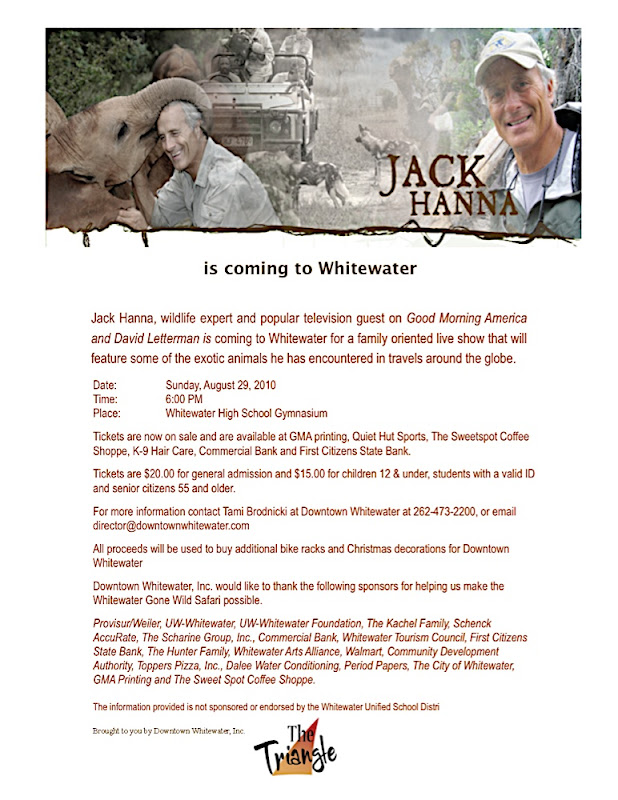
Tickets Available at the Door: Jungle Jack Hanna Brings Live Animal Pals to Whitewater August 29, 2010 at 6:00 p.m.

Here’s a post that I’ve bumped up (appearing previously) as a reminder — and now with an update —

Tickets for this show are available at the door.

Here’s a list that I’ve received of animals that may appear at the show —

Cheetah, Lynx, Flamingo, Fennec Fox, Wallaby, Armadillo, Palm Civet, Python, Clouded Leopard, Gray Fox, Lemur, Red Tail Hawk, Coatimundi, Alligator, and a Macaw. These animals may change slightly, but it’s an impressive list.

Here’s what a fennec fox looks like:


Photo from Tom Thai

Adorable, isn’t he? Any of the animals appearing at the show are sure to be even more remarkable as they’ll be live and up close.

I received the following press release that I am happy to post. Tickets are now on sale and are available at GMA printing, Quiet Hut Sports, The SweetSpot Coffee Shoppe, K-9 Hair Care, Commercial Bank, and First Citizens State Bank.

Click for larger image