FREE WHITEWATER

When (Canadian) Bureaucrats Attack

Kevin Libin, of the Canadian National Post has a story about how Canadian officials are bullying a libertarian family of immigrants to Canada from what was Soviet-occupied Poland. They left a dictatorship, but they’ve run into the soft, oppressively bureaucratic culture of modern-day Canada. (Sadly, something like his story might easily happen in countless places in America.)

Peter Jaworski wasn’t born in the cradle of freedom, but his mother says she hid illegal, anti-Soviet pamphlets in his baby carriage, covertly passing them out to fellow dissidents on the streets of Wroclaw, Poland. When local police sent an order to his father to report to them for unspecified reasons, the family used a permit to travel to Germany and fled, eventually settling in Orono, Ont[ario].

Since coming to Canada, Peter has celebrated freedom with more enthusiasm than most. He helped found the Institute for Liberal Studies, a libertarian advocacy group; he’s writing his PhD thesis about concepts of ownership rights; and every summer for the past 10 years he’s hosted the two-day Liberty Summer Seminar on his parents’ acreage. There, a few dozen libertarians – past attendees have included Conservative Cabinet minister Jason Kenney and Ontario Cabinet minister Randy Hillier – camp out on the idyllic grounds, hear a handful of pro-liberty speakers, tap their feet along with some freedom-minded musical acts, and enjoy Mother Jaworski’s cooking.

At least, they used to. This past July may have been the last, as the libertarians met their nemeses in the flesh: bureaucrats armed with a red tape roll full of regulations that may not only shut down the seminar for good, but threaten to hit the Jaworskis with as much as $50,000 in fines for using their property for reasons unapproved by government.

“I thought government would help me to do business, to be independent, not to be on welfare, but it’s the opposite. It’s like “you own this property? Now we own you,” Marta Jaworski says. “Government is just like Big Brother. Without government we would [apparently] be all dead. They think we need them so much in every aspect of our lives.”

The way they’ve come under officials’ scrutiny is so very typical of how bureaucrats operate in towns across this country:

The Jaworskis aren’t sure why inspectors, after years of summer seminars, suddenly showed up on the property to itemize violations. There was a “complaint,” they were told, though they insist neighbours always seemed fine with the event, which drew 72 people this year, each paying $125 each ($75 for students). They recently turned their home into a bed and breakfast to make ends meet, marketing their pastoral property as a perfect spot for wedding planners. They suspect another hospitality business in the municipality of Clarington turned them in. They have no proof, but they have grown suspicious others are exploiting government to hurt them.

Ever wonder if this happens in your own towns, where a businessman will use regulations — and cozy connections to local officials — to harass his competitors? Often, when bureaucrats say they re pro-business, it turns out to mean only the business owners they like, their friends’ businesses. For their friends’ competitors, there’s not so much liking, and a lot of regulating.

It’s a middling official’s way of feeling important, of misusing the public trust to be a ‘person of influence.’


See, Bureaucratic Bullies Foil Annual Libertarian Retreat.

Wall Street Journal – SEC Sues New Jersey as States’ Finances Stir Fears

One can expect to read of more suits like this, against sundry state and local governments that have issued bonds –

The Securities and Exchange Commission, in its first securities-fraud case against a state, accused New Jersey of misleading investors about the health of its two largest state pensions while selling billions of dollars in bonds.

New Jersey settled SEC charges that the state misled investors about the health of its two largest pensions while issuing billions of dollars in bonds. Peter Landers, David Weidner and David Reilly discuss. Also, Stephanie Banchero discusses a new company that allows students to bet for (or against) their grades.
State authorities settled the case without admitting or denying wrongdoing.

While it singled out New Jersey, the SEC is conducting several investigations into what other states disclosed about their weakened finances.

States ranging from California to Illinois to New York have been thrown into financial difficulty by the economy but have been able to avoid disaster by selling bonds to investors, many of them individuals seeking safe, tax-free income.

States as a whole face a trillion-dollar gap between the pensions, health care and other retirement benefits they have promised to public employees, and the money set aside to pay the benefits, according to a report by the Pew Center on the States.

The SEC said it is concerned about how these problems are disclosed to investors.

“We want to make sure that states or municipalities who go out and raise money from the public are adequately disclosing all material information in connection with their pension liabilities,” said Elaine Greenberg, head of the SEC’s municipal securities and public pension unit, which was created in January.

In the New Jersey action, the SEC cited municipal bonds in 79 separate offerings totaling $26 billion from 2001 to 2007. Many of those sales occurred after the SEC said the state abandoned a plan to bring pension funding up to snuff.

The SEC’s filing in the civil case described a series of moves that it alleged misled investors into believing the state was adequately funding the $34 billion Teachers’ Pension and Annuity Fund and the $28 billion Public Employees’ Retirement System.

See, SEC Sues New Jersey as States’ Finances Stir Fears

Daily Bread for Whitewater, Wisconsin: 8-19-10

Good morning,

Today’s forecast for Whitewater calls for a slight chance of thunderstorms with a high of eighty-three degrees.

Jazz singer and activist Abbey Lincoln passed away over the weekend. Allison Keyes recalled Lincoln’s many accomplishments:

Abbey Lincoln, the legendary jazz singer who believed in singing as a political act, died Saturday in Manhattan. She was 80. An actress, artist and composer, Lincoln created music ranging from avant-garde civil-rights-era recordings to the equally powerful but more introspective work of her later years.

Her 1960 collaboration with jazz drummer Max Roach, We Insist! Max Roach’s Freedom Now Suite, put her voice smack in the middle of the soundtrack of the civil-rights movement. In “Triptych: Prayer/Protest/Peace,” Lincoln literally screams her anger. But that’s not how she started out.

Village Voice jazz critic Nat Hentoff supervised the recording of the Freedom Now Suite and watched Lincoln transform from a sultry nightclub singer into a more sophisticated artist. Hentoff says Lincoln was a sometimes self-deprecating woman with a ready, sardonic wit, and says her death is a huge loss to a jazz community that doesn’t have musicians like her anymore.

See, Remembering Jazz Singer and Activist Abbey Lincoln.

Keyes’s tribute links to Lincoln singing Driva’Man, and here’s another song from the same album (We Insist! Max Roach’s Freedom Now Suite), Freedom Day:


more >>

Human/Capuchin Parallels Revisited – Freakonomics Blog – NYTimes.com

So are people hard-wired to make bad decisions, the way monkeys do?

Take finance: we tend to play it safe in situations where we stand to make gains. But faced with the risk of a substantial loss, we get nervous and opt for even riskier strategies in the vain hope we can avoid losses altogether….[Researcher Laurie] Santos says that makes us — as Freakonomics readers will have already guessed — just like capuchin monkeys.

Yes, he’s sharp-looking, but surely we can do better than this guy —


A white-headed Capuchin in Costa Rica’s Manuel Antonio National Park. Taken by John Hayashi, 15 July 2006.

Via Human/Capuchin Parallels Revisited – Freakonomics Blog – NYTimes.com.

State, ACLU to settle suit over female prisoner care – JSOnline

It was right for the State of Wisconsin to settle — a justice system where a prison for men provides preferential medical care compared with a prison for women is no justice system at all.

The state must spend hundreds of thousands of dollars to provide female prisoners with the same level of health care services and mental health treatment already provided to men, under a settlement expected to be filed Friday in a federal lawsuit.

Via State, ACLU to settle suit over female prisoner care – JSOnline.

The Public Service of a Private Newspaper

Government taxes to establish a public school system, from the property of private parties, draining them of resources they could use to build alternatives, requiring their children to attend, to be placed in the care of publicly-paid teachers and administrators, but only supplies an answer for why an administrator — with authority over children — was fired when a newspaper seeks information under a public records request.

Instead of releasing a report on its own initiative, as it should have done, the Janesville School District only released information about Principal John Walczak’s firing when a private party — a newspaper — sought through law the public records about public officials and public duties.

When one hears that each and every public administrator is truly a public servant, one may safely reject the contention. A group of sincere public servants would have published records of a fired principal’s conduct immediately upon his firing — no open records request would or should be needed. That sincere group would have fought the delaying tactics of the principal’s attorney to keep the documents secret.
See, Former Janesville principal fired for sexual harassment and inappropriate conduct.

The Gazette‘s headline tells why Walczak was fired: for sexual harassment and inappropriate conduct. That doesn’t mean that Walczak did what the report alleges, but it does show why the district fired him.

Here’s just a sampling from a story worth reading, several times, in its entirety —

A former Janesville principal was fired after being accused of sexual harassment and inappropriate behavior, including making comments about women?s body parts and partying with staff members, according to documents obtained by the Gazette.

Former Jackson School Principal John Walczak also was accused of bullying employees and failing to visit classrooms for evaluations, according to 208 pages of documents from a school district investigation.

Staff members also told school officials that Walczak missed parts of a Green Bay conference because he was at a bar or had a hangover, according to the documents.

Walczak was placed on administrative leave in May after complaints were made against him. He was fired in July for violating the Janesville School Board?s sexual harassment policy and not upholding the dignity and decorum of his position, according to the documents.

The school district released the documents after the Gazette filed a request under the Wisconsin Open Records Law to learn why Walczak was fired.

If Wisconsin didn’t have a Public Records Law (Wis. Stat. ss. 19.31-19.39), and Janesville didn’t have a newspaper will to exercise its rights under that law, would the community have learned about the allegations against a principal with authority over children? How long, if ever, would the truth have been kept from the parents of these children?

When faced with allegations like these, the best policy will always be complete disclosure to the public, at the earliest opportunity, and on the public entity’s own initiative. If that’s not to happen, then a community may, at least, be grateful that a private newspaper is prepared to act in the public interest.

June jobs report reveals recession’s still-tight hold on [Wisconsin] state

The report’s findings confirm one thing, and suggest a second. First, regardless of the different solutions economists have for remedying our troubled economy, there’s general agreement that difficult conditions persist.

Second, although the state is seeing hard times, not every community will feel the same hardships. Unemployment is not uniformly distributed across the state. Some areas will be harder hit, and some will react more sensibly to the hit they take, reducing the severity of its impact.

Wisconsin went the other way in June, losing another 8,200 jobs, according to the Center on Wisconsin Strategy’s monthly report.

Wisconsin has added 34,000 non-farm positions since December 2009, welcome news for a state that had been hemorrhaging jobs for the better part of two years.

But the number of jobs fell again in the April to June period, erasing some of the earlier momentum. Wisconsin is now down 162,000 jobs since the recession began in 2007, with the state’s job base sitting 5.6 percent below its pre-recession level.

“The severity of this recession stands out when compared to the three most recent downturns of 2001, 1990, and even that of 1981,” says COWS, a liberal UW-Madison think tank. “Despite the increase in jobs starting at the beginning of this year, jobs fell yet again in June and we have a long way to climb to reach pre-recession levels.”

Via June jobs report reveals recession’s still-tight hold on state.

Daily Bread for Whitewater, Wisconsin: 8-18-10

Good morning,

Today’s forecast for Whitewater calls for a day of patchy fog with a high temperature of eighty-one degrees.

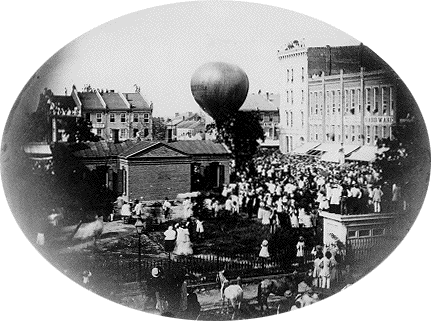
Over at Wired, there’s a story about an American milestone, from 1859:

1859: Mail is carried by air for the first time in the United States.

On a hot summer day as the temperature soared toward 91 degrees, John Wise stood at the town square in Lafayette, Indiana, waiting next to a balloon named Jupiter. Even for a balloon enthusiast and a well-known aeronaut, it was a big moment.

Wise was set to carry what would be the first U.S. airmail. A postmaster had handed him a bag with 123 letters. Destination of the balloonist and his precious cargo: New York City.

Delivering letters by air had been attempted before. There had always been carrier pigeons. And in 1785, a balloon flight from Dover, England, to Calais, France, had carried mail.

Wise’s attempt was to be the big event for the United States. Wise, who was 51, was also hoping to set a record for the longest balloon flight. He took off at 2 p.m.

But the weather wasn’t on his side. He found that the wind was blowing southwest, not east. Still, he went up to 14,000 feet. But five hours — and just 30 miles later — Wise gave up and landed in Crawfordsville, Indiana.

The mail had gone partway by air, but was ignominiously put on a train to New York City to assure the swift completion of its appointed round.

The Lafayette Daily Courier mocked the flight as “trans-county-nental.”


This Friday, August 20th, the Friday Comment Forum will feature a cinematic topic: “Your 10 Favorite Films of All Time.” Picking just ten isn’t easy, but it’s a fun challenge….

Eminent domain controversy prompts Greenfield to rethink development plan – GreenfieldNOW

It’s simply wrong and a misuse of the definition of ‘blight’ to use eminent domain law for supposed blight when all a municipal government would do would be to replace one ongoing private business with another one.

State Sen. Mary Lazich entered the fray in the redevelopment discussions on Tuesday, saying she will introduce legislation clarifying state laws on eminent domain and the term “blight.”

“The statutes have to be clear enough to protect property owners from unjust use of eminent domain and to protect local governments from the waste of time and money that accrues from the challenge and defeat of improper use of eminent domain,” Lazich said.

In an interview, Lazich said many states have already addressed eminent domain laws following a landmark U.S. Supreme Court case in 2005, which allowed local governments to acquire properties through eminent domain and sell them to another private owner.

But this state isn’t one of them, she said.

“Unfortunately in Wisconsin law, there’s a loophole large enough for a herd of animals to jump through,” she said, referring to the “blight” declaration.

Via Eminent domain controversy prompts Greenfield to rethink development plan – GreenfieldNOW.

How Is Smoking Pot Like Beating an Old Lady? – Reason Magazine

It’s like beating an old lady in the way it’s prosecuted and the sentences handed down for possession.

The Associated Press reports that “[Udonis] Haslem was charged with possessing more than 20 grams of marijuana, a third-degree felony which could bring maximum punishments of a $5,000 fine and a five-year prison sentence.” Twenty grams is less than three-quarters of an ounce….

Even without evidence of intent to distribute, possessing a small quantity of marijuana in Florida can get you the same sentence as grand theft, burglary, and battery of a police officer or an old lady.

Aside from medicinal use cannabis (where it’s lawful), I wouldn’t encourage marijuana or tobacco smoking. And yet, these sentences are so disproportionately severe compared to sentences for violent crimes that they’re an affront to justice.

Via How Is Smoking Pot Like Beating an Old Lady? – Hit & Run : Reason Magazine.