FREE WHITEWATER

State, ACLU to settle suit over female prisoner care – JSOnline

It was right for the State of Wisconsin to settle — a justice system where a prison for men provides preferential medical care compared with a prison for women is no justice system at all.

The state must spend hundreds of thousands of dollars to provide female prisoners with the same level of health care services and mental health treatment already provided to men, under a settlement expected to be filed Friday in a federal lawsuit.

Via State, ACLU to settle suit over female prisoner care – JSOnline.

The bookstore massacre is coming – MarketWatch

….e-books have now reached that tedious cliché, the tipping point. Amazon.com Inc.’s latest Kindle e-book reader has sold out — weeks before it even started shipping. The new device is smaller, cheaper, and has a better screen.

Amazon (AMZN 129.17, -0.48, -0.37%) says it’s now selling more e-books than paper-based books — about 43 % more in the last quarter, including about 80% more in the final month.

It doesn’t end there.

Expect prices for e-book readers to start collapsing. How can Barnes & Noble still charge $149 for its Nook, or Borders $149 for the Kobo reader, when Amazon’s newer, better product sells for $139?

Via The bookstore massacre is coming — MarketWatch.

The Public Service of a Private Newspaper

Government taxes to establish a public school system, from the property of private parties, draining them of resources they could use to build alternatives, requiring their children to attend, to be placed in the care of publicly-paid teachers and administrators, but only supplies an answer for why an administrator — with authority over children — was fired when a newspaper seeks information under a public records request.

Instead of releasing a report on its own initiative, as it should have done, the Janesville School District only released information about Principal John Walczak’s firing when a private party — a newspaper — sought through law the public records about public officials and public duties.

When one hears that each and every public administrator is truly a public servant, one may safely reject the contention. A group of sincere public servants would have published records of a fired principal’s conduct immediately upon his firing — no open records request would or should be needed. That sincere group would have fought the delaying tactics of the principal’s attorney to keep the documents secret.
See, Former Janesville principal fired for sexual harassment and inappropriate conduct.

The Gazette‘s headline tells why Walczak was fired: for sexual harassment and inappropriate conduct. That doesn’t mean that Walczak did what the report alleges, but it does show why the district fired him.

Here’s just a sampling from a story worth reading, several times, in its entirety —

A former Janesville principal was fired after being accused of sexual harassment and inappropriate behavior, including making comments about women?s body parts and partying with staff members, according to documents obtained by the Gazette.

Former Jackson School Principal John Walczak also was accused of bullying employees and failing to visit classrooms for evaluations, according to 208 pages of documents from a school district investigation.

Staff members also told school officials that Walczak missed parts of a Green Bay conference because he was at a bar or had a hangover, according to the documents.

Walczak was placed on administrative leave in May after complaints were made against him. He was fired in July for violating the Janesville School Board?s sexual harassment policy and not upholding the dignity and decorum of his position, according to the documents.

The school district released the documents after the Gazette filed a request under the Wisconsin Open Records Law to learn why Walczak was fired.

If Wisconsin didn’t have a Public Records Law (Wis. Stat. ss. 19.31-19.39), and Janesville didn’t have a newspaper will to exercise its rights under that law, would the community have learned about the allegations against a principal with authority over children? How long, if ever, would the truth have been kept from the parents of these children?

When faced with allegations like these, the best policy will always be complete disclosure to the public, at the earliest opportunity, and on the public entity’s own initiative. If that’s not to happen, then a community may, at least, be grateful that a private newspaper is prepared to act in the public interest.

June jobs report reveals recession’s still-tight hold on [Wisconsin] state

The report’s findings confirm one thing, and suggest a second. First, regardless of the different solutions economists have for remedying our troubled economy, there’s general agreement that difficult conditions persist.

Second, although the state is seeing hard times, not every community will feel the same hardships. Unemployment is not uniformly distributed across the state. Some areas will be harder hit, and some will react more sensibly to the hit they take, reducing the severity of its impact.

Wisconsin went the other way in June, losing another 8,200 jobs, according to the Center on Wisconsin Strategy’s monthly report.

Wisconsin has added 34,000 non-farm positions since December 2009, welcome news for a state that had been hemorrhaging jobs for the better part of two years.

But the number of jobs fell again in the April to June period, erasing some of the earlier momentum. Wisconsin is now down 162,000 jobs since the recession began in 2007, with the state’s job base sitting 5.6 percent below its pre-recession level.

“The severity of this recession stands out when compared to the three most recent downturns of 2001, 1990, and even that of 1981,” says COWS, a liberal UW-Madison think tank. “Despite the increase in jobs starting at the beginning of this year, jobs fell yet again in June and we have a long way to climb to reach pre-recession levels.”

Via June jobs report reveals recession’s still-tight hold on state.

Daily Bread for Whitewater, Wisconsin: 8-18-10

Good morning,

Today’s forecast for Whitewater calls for a day of patchy fog with a high temperature of eighty-one degrees.

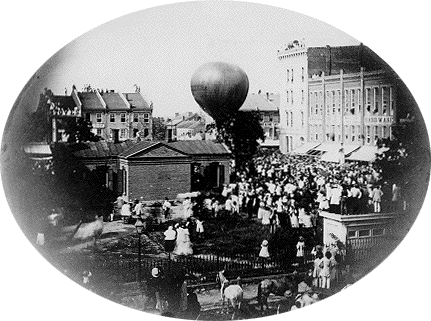
Over at Wired, there’s a story about an American milestone, from 1859:

1859: Mail is carried by air for the first time in the United States.

On a hot summer day as the temperature soared toward 91 degrees, John Wise stood at the town square in Lafayette, Indiana, waiting next to a balloon named Jupiter. Even for a balloon enthusiast and a well-known aeronaut, it was a big moment.

Wise was set to carry what would be the first U.S. airmail. A postmaster had handed him a bag with 123 letters. Destination of the balloonist and his precious cargo: New York City.

Delivering letters by air had been attempted before. There had always been carrier pigeons. And in 1785, a balloon flight from Dover, England, to Calais, France, had carried mail.

Wise’s attempt was to be the big event for the United States. Wise, who was 51, was also hoping to set a record for the longest balloon flight. He took off at 2 p.m.

But the weather wasn’t on his side. He found that the wind was blowing southwest, not east. Still, he went up to 14,000 feet. But five hours — and just 30 miles later — Wise gave up and landed in Crawfordsville, Indiana.

The mail had gone partway by air, but was ignominiously put on a train to New York City to assure the swift completion of its appointed round.

The Lafayette Daily Courier mocked the flight as “trans-county-nental.”


This Friday, August 20th, the Friday Comment Forum will feature a cinematic topic: “Your 10 Favorite Films of All Time.” Picking just ten isn’t easy, but it’s a fun challenge….

Eminent domain controversy prompts Greenfield to rethink development plan – GreenfieldNOW

It’s simply wrong and a misuse of the definition of ‘blight’ to use eminent domain law for supposed blight when all a municipal government would do would be to replace one ongoing private business with another one.

State Sen. Mary Lazich entered the fray in the redevelopment discussions on Tuesday, saying she will introduce legislation clarifying state laws on eminent domain and the term “blight.”

“The statutes have to be clear enough to protect property owners from unjust use of eminent domain and to protect local governments from the waste of time and money that accrues from the challenge and defeat of improper use of eminent domain,” Lazich said.

In an interview, Lazich said many states have already addressed eminent domain laws following a landmark U.S. Supreme Court case in 2005, which allowed local governments to acquire properties through eminent domain and sell them to another private owner.

But this state isn’t one of them, she said.

“Unfortunately in Wisconsin law, there’s a loophole large enough for a herd of animals to jump through,” she said, referring to the “blight” declaration.

Via Eminent domain controversy prompts Greenfield to rethink development plan – GreenfieldNOW.

How Is Smoking Pot Like Beating an Old Lady? – Reason Magazine

It’s like beating an old lady in the way it’s prosecuted and the sentences handed down for possession.

The Associated Press reports that “[Udonis] Haslem was charged with possessing more than 20 grams of marijuana, a third-degree felony which could bring maximum punishments of a $5,000 fine and a five-year prison sentence.” Twenty grams is less than three-quarters of an ounce….

Even without evidence of intent to distribute, possessing a small quantity of marijuana in Florida can get you the same sentence as grand theft, burglary, and battery of a police officer or an old lady.

Aside from medicinal use cannabis (where it’s lawful), I wouldn’t encourage marijuana or tobacco smoking. And yet, these sentences are so disproportionately severe compared to sentences for violent crimes that they’re an affront to justice.

Via How Is Smoking Pot Like Beating an Old Lady? – Hit & Run : Reason Magazine.

Which Government Programs are Real and Which are Fake?

Over at Reason’s Rough Cut group blog, there’s a posted video entitled, “Which Government Projects are Real and Which are Fake?”


“Joke-telling robots, expensive walking tunnels, BlackBerries for smokers, and training American prostitutes to drink responsibly. What do these things have in common? They’re all questionable government spending projects in a time when our economy is struggling and people can’t get jobs….or, maybe we just made them up.

Put yourself to the test. See if you can outwit the Rebel Economist before she stumps you. So what is it: REAL or FAKE?”

Here’s the video:


Link:
http://www.youtube.com/watch?v=9Gp0JuBp8xA.

The gentlemen who concocted these spending programs have lost all sense of what’s legitimate. Ideas like these would only make sense to someone without any sense of how ordinary people live. more >>

The Whitewater, Wisconsin City Manager’s Unpersuasive Lament

I read, each week, the Weekly Report from Whitewater’s City Manager, Kevin Brunner. The August 13th issue has clippings that Brunner chose to include from news stories and columns published elsewhere. Brunner included one from New York Times columnist Paul Krugman. Here’s the clipping Brunner included:

Krugman States Anti-Government Movement Hurting “Basic Government Functions.”
Paul Krugman writes in his column for the New York Times (8/8, A9), “We’re told that we have no choice, that basic government functions – essential services that have been provided for generations – are no longer affordable. And it’s true that state and local governments, hit hard by the recession, are cash-strapped. But they wouldn’t be quite as cash-strapped if their politicians were willing to consider at least some tax increases.” Krugman argues that “the antigovernment campaign has always been phrased in terms of opposition to waste and fraud…But those were myths, of course; there was never remotely as much waste and fraud as the right claimed. And now that the campaign has reached fruition, we’re seeing what was actually in the firing line: services that everyone except the very rich need, services that government must provide or nobody will, like lighted streets, drivable roads and decent schooling for the public as a whole.”

Although Krugman’s a noted, respected economist, but he’s a poor columnist. Worse than a poor columnist, though, is any appointed city bureaucrat who re-prints a column like this — the content is partly false, partly distorted, and the bureaucrat’s use of it is self-pitying and tone deaf.

First, Krugman’s column, one I presume Brunner actually read, talks about how America is unpaving roads because of a bad economy. That’s misleading, as Jack Shafer notes, in a column at the Washington Posts’s Slate entitled, What Krugman, Maddow, and the press corps don’t understand about gravel roads. Only a minuscule number of roads are returning to unpaved gravel, and in many cases that’s because they’ve been replaced by newer, paved roads. Furthermore, as Shafer observes, America’s been on a road-paving frenzy for decades. We don’t lack for paved roads.

Second, Brunner uses the headline — perhaps one that someone else originally vote — “Krugman States Anti-Government Movement Hurting “Basic Government Functions.” ” There’s really no significant anti-government movement in America — there’s a limited government movement, a limited and responsible government movement. All sensible people, of whom one includes libertarians, believe in the truly basic government functions of public safety for police and fire, for example. There are questions about policy for police and fire departments, but no one questions that American communities need both services. It’s just hyperbole and grandstanding to contend otherwise.

It’s a false dichotomy to contend that there are two sides to this debate: anti-government or pro-basic functions. That’s just silly. The question is what size for basic functions, not whether there will be basic functions. I can see how a columnist might exaggerate the debate, but what of Brunner? How can he contend that there are anti-government forces fighting basic services, when he’s been paid for a long career, at public expense?

His role is not nearly as fundamental as police or fire protection, and yet he’s enjoyed an long career as a city manager on the public tab.


Third, Brunner’s leadership is hardly a model of efficiency, sound management, or good governance. Whitewater has a tax incremental financing debacle, budget problems, high poverty, open storefronts, and problems of basic enforcement & the administration of justice, all of which I have written about before. If one is to look for someone who would stand athwart a supposed challenge to government, itself, perhaps it should be someone less connected with the many problems we now face.

Having committed so many resources to big-ticket project after big-ticket project, all the while wheedling for his own assistant to the city manager, in times of hardship for front-line employees and residents, Brunner’s just not a credible defender of good and sound fiscal policy.

There’s a serious examination due of Whitewater’s tax policy under Brunner’s administration, as well as our tax incremental financing debacle, his administration’s city budget policy, a full assessment of the Innovation Center, and beyond all that, issues of equitable enforcement of regulations, and administration of justice. Much of this will require a careful, line-by-line assessment (as of Brunner’s new Fiscal Analysis for the City of Whitewater).

It’s a task well worth undertaking in the months ahead — to see where we truly are, and how to walk the difficult terrain ahead. There are reasonable solutions and reform proposals to consider along the way. I am convinced that, no matter how challenging these times for Whitewater or America, a set of reforms can produce a fairer, more prosperous city. Not how things have been, but by change, to create new and lasting opportunities.