I don’t know if raw milk’s a wonder tonic, but people in a dairy state should be able to buy it and enjoy natural, unpasteurized milk.
A study at the University of Wisconsin-Madison examined the reasons people want to drink raw milk, and the backgrounds of those who want to drink it:
New research at the University of Wisconsin-Madison Department of Community and Environmental Sociology may offer some answers. Researchers surveyed twelve consumers who had purchased raw milk and 13 farmers who sold raw milk.
Eleven of the surveyed consumers started drinking raw milk within the last five years. Their reasons for buying raw milk included improving their health, cultivating relationships with family farmers, good flavor and supporting “local, sustainable farms”.
Ten of the 12 consumer respondents were health-conscious, urban professionals with college degrees….
That’s a description of knowledgeable adults who are able to decide for themselves. Many of these people chose raw milk as part of an organic food diet, sometimes following illnesses that prompted them to consider natural foods. Portraying those who want to drink raw milk as unsophisticated hicks is false. They’re likely as capable as the bureaucrats who do Big Dairy’s bidding by keeping natural, unpasteurized milk away from consumers.
Poll after poll suggests the profligate president and his party are vulnerable to a smart, clearly articulated alternative that does not further elevate the ravenous federal leviathan. But GOP leaders, from national strategists to congressional heavyweights, have been either unwilling or unable to rally around a message – one of intellectual substance as well as tea party style – that offers a clear response to the Democrats’ reflexive Keynesian expansion of government….
Ryan’s Roadmap for America’s Future, first introduced in 2008, is a daring, comprehensive proposal that reforms ballooning entitlements, addresses the debt crisis, cuts taxes, puts health care decisions in the hands of consumers and promises to once again jumpstart the American economic engine….
Inexplicably, most Republicans see this [smears and distortions against the plan] and remain bashful about publicly embracing Ryan’s Roadmap, even as it gains traction in the debate over the nation’s percolating debt crisis. They seem content to shamble about in the tall weeds, hoping that an ineffectual president alone will ensure their political survival. Given the stakes and the opportunity before them, this is almost laughably gutless.
Well said.
The Ryan’s Roadmap is a way out of encroaching government and oppressive debt. There are few politicians in all America more contemptible than those glutinous Republicans who have embraced big government so that they can keep a place for themselves at the federal, state, or local trough. They sold out the principles of their party, and in doing so, greased the path for an even more profligate federal administration to follow their own.
I’m not a Republican, but I look at that party, and the damage some big-spending Republicans have done to the GOP, and I think that those incumbents must be among the most selfish men one could ever meet.
That’s a sensible result: Judge rules that defendant, Julio Martinez, can look foolish so long as he doesn’t offend public order and decency. Slovenly isn’t, and shouldn’t, be criminal.
The story reports that a collection of local government associations estimated that, nationally, local governments may cut almost 500,000 jobs through 2011 (or 8.6% of their total workforces).
These are only estimates, and they say nothing about how any particular community will fare.
In any event, sacrifices should always begin at the top, as meaningful reductions in municipal compensation costs.
I wrote earlier this week about the agenda of a Whitewater Community Development Authority meeting. The agenda seemed oddly vague, and some portions of it were so obscure that it provided no reasonable information about a subject’s contents. See, Daily Bread for Whitewater, Wisconsin: 7-26-10.
The agenda’s not a minor task; it’s a public announcement, and should be the responsibility of the person who runs the organization. Public officials should review announcements themselves, as should citizen leaders of boards or commissions for their own areas of responsibility. In Whitewater, for the CDA, that leader would be Kevin Brunner, Whitewater’s city manager. (That’s so much for the idea of an independent CDA with only limited participation of current officeholders.)
When one sees a sketchy agenda, and mentions it, I’m sure some officials feel the criticism is an unfair burden, as though it’s an imposition on their (visionary) work. That’s not true, and it’s self-flattering of officials to see it that way.
A vague agenda keeps the public in the dark about a meeting, and serves only insiders who want to keep matters quiet, although they’re on public boards considering public matters under Wisconsin law.
Even if officials won’t produce clear agendas as the law requires, they can still make accurate and through recordings of the meetings they conduct. Minutes may be sketchy, too, but there’s a may around that deficiency.
We have a community television station, and it offers the best and most honest way to learn the contents of a meeting. In all Whitewater, no record is more honest and complete than the video recordings of Whitewater’s public meetings. In a town of dodgy officials, Whitewater Community Television stands out for its accuracy and true public spirit. They record some of Whitewater’s leading boards and commissions, as often as they can.
They can’t be everywhere at once, but for those times they can’t, there’s a solution:
That’s it. A simple camera from an American company, available for less than 200 dollars, would allow Whitewater’s boards and commissions to record meetings where Whitewater’s Community Television would not be present. These videos wouldn’t look as sharp, but they would be more accurate than any agenda anyone in the city has ever typed as a meeting’s summary. Words, pictures, tone, and atmosphere: the camera would show all that.
It wouldn’t be as sharp as a professionally recorded video, but it would be better than no video. For those concerned that the video wouldn’t look right, a small introduction could appear before each video posted on the Community Television website:
This video, recorded using a simple camera, represents the City of Whitewater,Wisconsin’s commitment to open government, for each and every public meeting in the city. What it lacks in visual quality, it makes up in dedication to the public good.
We’re foolish to make the better the enemy of the good.
A citizen has the right to record any public portion of a public meeting in this way, and I’m sure that will start happening soon enough. It would be responsible if Whitewater took this step on its own.
Whitewater’s politicians and city manager should support recording all meetings, as a commitment to a more open politics.
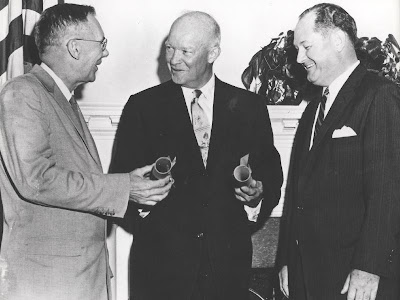
President Eisenhower signed the legislation creating NASA on July 29, and it officially became a functioning entity Oct. 1, with T. Keith Glennan as its first administrator. There were 8,000 employees (inherited from NACA), three research laboratories — Langley Aeronautical Laboratory, Ames Aeronautical Laboratory and Lewis Flight Propulsion Laboratory — and an annual budget of $100 million. (That’s about $750 million in today’s money, compared to a 2010 budget of nearly $18 billion.)
The agency’s mission statement will have faint echoes for Star Trek fans: “To improve life here, to extend life there, to find life beyond.”
President Eisenhower Presents NASA Commissions
Photo: NASA
Ilya Shapiro’s right — the Democratic National Committee’s attempt to embarrass Republicans by producing a parody of the 1994 Contract with America actually lists good ideas that many Americans would support.
Following former Walworth County Economic Development Alliance leader Fred Burkhardt will prove no easy task. The hardest roles aren’t those following a good leader, but a poor one.
There’s much to consider about Wisconsin’s Public Records Law, before and after the Wisconsin Supreme Court’s decision in Schill v. Wisconsin Rapids School District . Attorney General Van Hollen — who has been fair in analyzing Wisconsin’s Public Records Law (Wis. Stat. 19.31-19.39) and Open Meetings Law (Wis. Stat. 19.81-19.98) — offered a memorandum on the PRL after Schill.
For any Wisconsin city, not merely my own, here are quick points to consider about the compliance with the Public Records Law:
1. Does every official have and use a public email address as a contact address?
2. If not, why not? If there has been a rationale for the use of a private email address as a primary contact, what is that rationale? How sound is it? (Hint: It won’t be sound, as any rationale will be contrary to the public interest, and shabbily contrived.)
3. When there’s an open records request submitted to a municipality, who sees the actual request? Is it only those who act as custodians to collect records, or do those who likely have the sought-after records in their respective offices see the actual request?
4. Do officials in a department tell employees what they should submit, or do employees see the actual request, and its scope, when going through their records? Put another way: are employees — to whom the law applies — allowed to think for themselves, or are they told only what they are to provide?
5. Do employees know that records include more (much more) than emails?
6. Does a city seem to submit some records, but with gaps that suggest other records might have been withheld? (If withheld, does the custodian even know?)
7. Do any records received seem to include transparently self-serving emails by officials to each other, in which they exonerate themselves of having any records to collect? (Example: “Hey, X, so I guess despite all our diligent efforts, we have no records to send?” “Yes, Y, that’s right! There’s no way to get any more information!”)
8. Do records take a long time to arrive, as was the case with a request to a nearby Wisconsin county official from an area newspaper?
9. Do officials suddenly find obvious records they first denied they had when someone presses yet again? (“Oh, yes, it was sitting here all the time…”)
There’s much more to write about all this, but I wanted to mention Van Hollen’s memo today, upon its release.