Eight honest but grim pages: Federal Debt and the Risk of a Fiscal Crisis.
Daily Bread
Daily Bread for Whitewater, Wisconsin: 7-29-10
by JOHN ADAMS •
Good morning,
Whitewater’s forecast for today calls for a sunny day with a high temperature of eighty-three degrees.
On this day in 1959, NASA was created. Wired describes the events leading to NASA’s birth in a story entitled, July 29, 1958: Ike Inks Space Law, NASA Born in Wake of Russ Moon”
President Eisenhower signed the legislation creating NASA on July 29, and it officially became a functioning entity Oct. 1, with T. Keith Glennan as its first administrator. There were 8,000 employees (inherited from NACA), three research laboratories — Langley Aeronautical Laboratory, Ames Aeronautical Laboratory and Lewis Flight Propulsion Laboratory — and an annual budget of $100 million. (That’s about $750 million in today’s money, compared to a 2010 budget of nearly $18 billion.)
The agency’s mission statement will have faint echoes for Star Trek fans: “To improve life here, to extend life there, to find life beyond.”
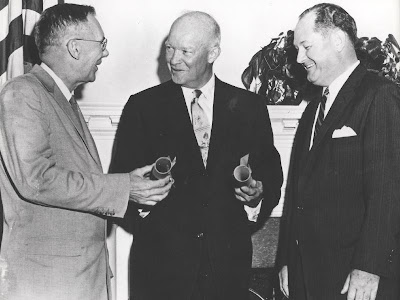
Photo: NASA
There’s now also a growing private space-travel industry, and President Obama deserves credit for encouraging private innovations.
Here’s a video of a ride on the smaller SpaceShip One from Virgin Galactic:
Politics
‘Contract on America’ Parody Actually Sounds Pretty Good | Cato @ Liberty
by JOHN ADAMS •
Ilya Shapiro’s right — the Democratic National Committee’s attempt to embarrass Republicans by producing a parody of the 1994 Contract with America actually lists good ideas that many Americans would support.
Pretty good, indeed.
See for yourself: ‘Contract on America’ Parody Actually Sounds Pretty Good | Cato @ Liberty.
Development, Elkhorn, Planning
WCEDA tabs executive director — GazetteXtra
by JOHN ADAMS •
Following former Walworth County Economic Development Alliance leader Fred Burkhardt will prove no easy task. The hardest roles aren’t those following a good leader, but a poor one.
Law
Milwaukee Journal Sentinel On Wisconsin Attorney General Van Hollen’s Memo on Email and Public Records
by JOHN ADAMS •
There’s much to consider about Wisconsin’s Public Records Law, before and after the Wisconsin Supreme Court’s decision in Schill v. Wisconsin Rapids School District . Attorney General Van Hollen — who has been fair in analyzing Wisconsin’s Public Records Law (Wis. Stat. 19.31-19.39) and Open Meetings Law (Wis. Stat. 19.81-19.98) — offered a memorandum on the PRL after Schill.
See, Van Hollen memo clarifies release of e-mail under open records.
For any Wisconsin city, not merely my own, here are quick points to consider about the compliance with the Public Records Law:
1. Does every official have and use a public email address as a contact address?
2. If not, why not? If there has been a rationale for the use of a private email address as a primary contact, what is that rationale? How sound is it? (Hint: It won’t be sound, as any rationale will be contrary to the public interest, and shabbily contrived.)
3. When there’s an open records request submitted to a municipality, who sees the actual request? Is it only those who act as custodians to collect records, or do those who likely have the sought-after records in their respective offices see the actual request?
4. Do officials in a department tell employees what they should submit, or do employees see the actual request, and its scope, when going through their records? Put another way: are employees — to whom the law applies — allowed to think for themselves, or are they told only what they are to provide?
5. Do employees know that records include more (much more) than emails?
6. Does a city seem to submit some records, but with gaps that suggest other records might have been withheld? (If withheld, does the custodian even know?)
7. Do any records received seem to include transparently self-serving emails by officials to each other, in which they exonerate themselves of having any records to collect? (Example: “Hey, X, so I guess despite all our diligent efforts, we have no records to send?” “Yes, Y, that’s right! There’s no way to get any more information!”)
8. Do records take a long time to arrive, as was the case with a request to a nearby Wisconsin county official from an area newspaper?
9. Do officials suddenly find obvious records they first denied they had when someone presses yet again? (“Oh, yes, it was sitting here all the time…”)
There’s much more to write about all this, but I wanted to mention Van Hollen’s memo today, upon its release.
Weird Tales
On Lake Geneva: “Wisconsin Teens Take Flying Leap to Deliver Mail”
by JOHN ADAMS •
Teenagers on a mail delivery boat jump from boat to dock and back again to deliver mail to homes on Lake Geneva.
Politics
Wisconsin County Board Sizes
by JOHN ADAMS •
Over at the GazetteXtra.com, Greg Peck asks Should Walworth County Board Expand?. He notes that Dane County’s considering downsizing its county board, at a time that Walworth County officials (some, anyway) are pondering an expansion. (The Walworth County Board was recently downsized, but now some supervisors are complaining about too much work.)
Peck’s right to raise the question, and I know that my own view (more below) in answer is a minority view.
The Wisconsin State Journal addresses Dane County’s situation in a July 27th editorial.
The State Journallists and refutes the arguments against downsizing:
A host of supervisors oppose a significant reduction in the number of board seats because it would cost some incumbents their jobs.
That’s a lame excuse for the status quo.
Some supervisors complain about having to represent more people. But our elected officials shouldn’t be in the business of public service if they don’t like a lot of contact with constituents.
The silliest argument against significantly reducing the size of the Dane County Board is that it will create so much work for the remaining supervisors that they’ll have to serve – and be paid – as full-time workers.
This argument ignores that virtually every other county board in the nation has fewer members – the vast majority of whom are not full-time. If the rest of the nation can get its work done without an army of supervisors, Dane County should be able to. Unlike a lot of those counties, Dane County also has a full-time county executive.
I posted on Walworth County’s board recently, and opposed re-expansion of the Walworth County Board.
No one is required to serve on the Walworth County Board, and for a small county — far smaller than Dane County — the current total of eleven supervisors seems appropriate. (It’s a total that leaves each supervisor with fewer constituents than a member of the Assembly, and fewer responsibilities than an Assembly representatives, too.)
Some supervisors feel overworked. I am convinced that the best recourse for them is a return to private life. There will be others who’ll run, and serve, in their places.
I also oppose compensation for supervisors or, in my own small town, members of our common council. A Wisconsin county or city will have a paid executive, and other full-time employees; that’s enough. Politicians in cities and counties should not be paid.
Politicians at this level should never be compensated, but certainly not now, when cities and counties are cutting budgets. Those who cut a budget should feel the result first.
My view may seem severe, but I believe it’s a view that will produce a better politics.
It was, after all, the Vulcans who would announce their arrival with the greeting, “we come to serve.” It’s a fine expression. They didn’t walk into a room, and declare, “we come to serve, and while we’re at it, to take from taxpayers for that service.” I don’t know how Vulcans were paid in Star Trek, but if any showed up here, I very much doubt they’d hit up the residents of Walworth County.
Neither should those humans who serve here presently. I believe political service as a freely chosen, uncompensated task would lead to a better politics.
Government Spending
Excessive Public Compensation in Bell, California (Lessons for the Rest of America)
by JOHN ADAMS •
It’s hard to believe, but true: Bell, California paid its city manager eight-hundred thousand dollars ($800,000) per year in salary. When I first read about this, I thought it was a typo, or that they were paying Robert Rizzo in some other currency. It’s true, and astonishing. He’s now resigned, but every politician connected with approving Rizzo’s compensation should resign, too.
Bell, California is one of the poorest cities in California, yet politicians approved, and Rizzo took, this money from taxpayers while residents struggled and went hungry (some, literally, are destitute and in need of food assistance).
Residents staged a protest against that compensation, and Reason was there to record the outcry. Here’s a description accompanying the video:
Should a city manager from one of Los Angeles County’s poorest cities earn twice as much as President Obama?
Residents from the working-class town of Bell erupted in outrage after learning that their city pays its officials some of the highest local-government salaries in the nation, including City Manager Robert Rizzo who takes home nearly $800,000 per year.
Rizzo has resigned, as have some of Bell’s other top-earning government officials. But on Monday evening frustrated residents gathered at a city council meeting to demand more resignations and an end to what they regard as widespread corruption.
Reason.tv spoke with protesters furious with high taxes, cronyism, and inflated public-sector compensation.
Approximately 3 minutes. Produced by Ted Balaker and Tim Cavanaugh, who also hosts. Camera by Zach Weissmueller and Sam Corcos. Edited by Weissmueller.
During the deepest recession since the Great Depression, residents gather to voice opposition to a bureaucrat’s excessive compensation:
Link: http://www.youtube.com/watch?v=v1effEnDsrM
Fortunately, there’s nothing this extreme — I’m tempted to use a term of my town’s city manager, and say egregious — in my small city of Whitewater, Wisconsin. Bell, California, however, should not be the benchmark for suitable compensation.
Any town should consider a few, simple principles for compensation: (1) residents’ actual economic well-being should be taken into account, (2) leaders of a city or department should experience salary reductions before workers’ salaries or jobs are cut, (3) employees hired to support a leader should be considered as a benefit to the leader when establishing a leader’s compensation, (4) multiple sources of compensation should be totalled, and (5) time spent away from core duties should not be compensated if core duties are not performed adequately.
That’s not all, but it’s a good start. more >>
Daily Bread
Daily Bread for Whitewater, Wisconsin: 7-28-10 (Drinking Fountain Bubbler Edition)
by JOHN ADAMS •
Good morning,
Today’s forecast for Whitewater calls for a high temperature of eighty-five, and an even chance of thunderstorms.
From Wisconsin history on this date, the Wisconsin Historical Society recalls long-enduring labor strife, and strikes, at the Kohler Company:
1934 – Two killed, 40 hurt in Kohler riot; National Guard occupies town
On this day, the “model industrial village” of Kohler became an armed camp of National Guard cavalrymen after deadly strike-related rioting. The July 27th violence, which killed two Sheboygan men and injured 40 others, prompted the summoning of 250 Guardsmen to join the 200 special deputy village marshals already present. After striking workers became agitated and began to destroy company property, deputies turned to tear gas, rifles, and shotguns to quell the stone-throwing crowd, resulting in the deaths and injuries. Owner Walter Kohler blamed Communists and outside agitators for the violence, while union leaders blamed Kohler exclusively. Workers at the Kohler plant were demanding better hours, higher wages, and recognition of the American Federation of Labor as their collective bargaining agent. Not settled until 1941, the strike marked the beginning of what was to become a prolonged struggle between the Kohler Company and organized labor in Wisconsin; a second Kohler strike lasted from 1954 to 1965. [Source: Capital Times 7/28/1934, p.1]
More on the strikes and the planned industrial village is available in Alanen, A.R. and Peltin, T.J. “Kohler, Wisconsin: Planning and Paternalism in a Model Industrial Village.” Journal of the American Institute of Planners 44, April 145-159.
The term bubbler for a drinking fountain originates with the Kohler Company:
We have traced the origin of the modern bubbler back to 1888 and a small waterworks company in Kohler, WI.
This new-fangled product shot water about 1″ straight up and you drank from the “bubble” of water created, the excess of which ran back down over the sides of the nozzle.
This company, called Kohler, was already well known for its water faucet production. In fact, Kohler is still one of the nation’s leading producers of faucets. But a man with a vision, Harlan Huckleby, came up with an idea that revolutionized the way the world drinks water.
He called it The Bubbler, and Kohler immediately patented the product and promoted its trademark name. Other waterworks manufacturers copied the product, but weren’t allowed to use its original name. The imitations went by names like “The Gurgler” and “The Gusher”, but those names didn’t catch on.
The competition’s products eventually saturated the market, and bubbler became just another name. Yet, it is still used today in parts of the world; mainly, Wisconsin and Australia.
Today, bubblers stream water from a nozzle in an arc projection, thus allowing the user to drink with ease.

Politics
Amity Shlaes: Palin Mama Grizzly Shows Limit of Woman Wisdom
by JOHN ADAMS •
Yes. Good governance, and the instinct for it, transcend gender.
See, Amity Shlaes: Palin Mama Grizzly Shows Limit of Woman Wisdom.
City, Economy, Poverty
Rethinking the U.S. Poverty Measure
by JOHN ADAMS •
I’ve written about poverty in Whitewater before, and the 2010 Census will offer fresh information on the state of Whitewater’s economy. It’s a subject that cheerleaders for the town probably wish would go away. An ordinary person would prefer economic arrangements that make poverty go away, but there you see the distinction between sensible & ordinary as against foolish & political.
I’ve emphasized three points (1) poverty is relatively higher in Whitewater than neighboring towns, (2) child poverty is terribly high here, and (3) all the grand public works projects we’ve undertaken haven’t brought those high figures down.
I emphasize our relatively greater poverty to show that as other towns do better, so we can, too. I emphasize child poverty both because it’s so damaging and because it puts lie to the contention that Whitewater’s economy looks worse because of non-working students in town. That’s not where Whitewater falls short — child per child, there’s greater economic hardship here than in other American towns, and excuse-making about this situation is unavailing.
Our grand public projects directed at the upper middle class are a waste of taxes and have not improved the conditions of those most in need. They’re merely monuments to bureaucrats’ pride and lines on officials’ resumes.
At the Wall Street Journal, there’s a Q&A about current poverty measurements, and how they’re changing. The changes in measurement are significant, but the extent of change from one measure to another can be tempered with a comparison of relative conditions between cities, using either measure.
Economist Bruce Meyer discusses the impending changes, and what he likes and doesn’t about them, in a story entitled, Q&A: Rethinking U.S. Poverty Measure.
Libertarians
Are Jedi Knights Libertarians or Socialists?
by JOHN ADAMS •

It’s impossible to watch the Star Wars saga and not like Jedi Master Yoda. He’s one of the great science fiction characters of all time.
He’s not the only Jedi, however, and over at the Atlantic, Max Fisher asks of those guardians of the Old Republic: “Are Jedi Knights Libertarian or Socialist?”
Fisher notes that Canadian blogger P.M. Jaworski thinks that Jedi are libertarians, Jesse Kline thinks that they’re big government liberals, and Daniel Drezner thinks that they’re centrists. Here’s part of what Drezner has to say:
Are the Jedi big government advocates? That’s unclear. I think it would be more accurate to describe them as cartelistic — they refuse to permit a free market in learning the ways of the Force. After all, the Jedi Council’s initial inclination is not to train Anakin Skywalker despite his obvious talents, using some BS about fear as a cover.
Only when Qui-Gon threatens to go rogue do they relent. The Council does not inform the Senate that their ability to detect the force has been compromised.
They’re reluctant to expand their assigned tasks — they’re keepers of the peace, not soldiers. Just as clearly, their anti-competitive policies weakened their own productivity, given the fact that they were unable to detect a Sith Lord walking around right under their noses for over a decade.
I think Drezner’s right — not libertarians, and not socialists, either. I also think what he says about moderates would apply more nicely to so-called big government conservatives: they’re anti-market. The operate as a guild, and see the world that way. It’s a mostly closed order, no matter how cool it seems. (It does seem cool after all.)
One can see a version of this — although definitely not a cool version, in small-town government. A few people try to keep knowledge to themselves, for whatever reason (in town politics, these reasons are likely to be self-flattering and illegitimate).
As with other closed systems, the town grows unproductive over time, as uncompetitive systems always degenerate. Politicians’ husbanding of information and attempts to pick winners in the marketplace prove to be losing strategies when compared with system of free, private choices.
As for Yoda himself, however, I am quite certain of his views: deep down, he’s libertarian.
I’m just sure of it.
Uncategorized
Capital Times: Moped Driver Arrested for What Would Be Sixth OWI
by JOHN ADAMS •
The very definition of incorrigible. He should be restricted only to walking, and then only along straight lines (although he might not be able to manage even that).
Daily Bread
Daily Bread for Whitewater, Wisconsin: 7-27-10
by JOHN ADAMS •
Good morning,
Whitewater’s forecast calls for a warm day, with a high of eighty-seven degrees, and a chance of scattered thunderstorms.
In Wisconsin history, the Wisconsin Historical Society recalls that on this day in 1894,
Forest Fire Destroys Phillips
On the afternoon of this day, a forest fire swept over the Price Co. town of Phillips from the west, destroying nearly all the buildings and forcing 2,000 people to flee for their lives. When the sun came up the next morning, 13 people had been killed, the entire downtown was in ashes, and exhausted survivors were wandering through the ruins in a daze. The fire ultimately consumed more than 100,000 acres in Price County. Much of the town was rebuilt within a year.
Phillips is far north of Whitewater, in Price County: