FREE WHITEWATER

Citizens’ Complaints and the Reaction of Misguided, Selfish Officials

Here’s a question about (limited) government: If the residents of a town want an official fired, is the fundamental problem that they’re asking that he be fired, or the reason that they’re asking? In the Township of Linn, not far from Whitewater, a group of residents want the police chief fired.  They’ve filed a complaint against him with the town board, “accusing [Police Chief] Wisniewski of disrespecting a superior, neglecting his duty and “repeatedly belittling officers and eroding department morale.”  See, Linn residents want town police chief fired
 
Longtime readers of FREE WHITEWATER know that I’ve posted on this matter before, following local press coverage of several issues.  The town’s chief sold a lawnmower that was part of a criminal investigation, a police lieutenant who complained about the sale was fired, and the municipality later reached a five-figure settlement with the fired officer.  (As one could guess, the lawnmower — worth far less than good government and sound policing — was sold to a relative of another officer in the department.)
 
The chief was briefly suspended, and these charges seem to stem from conduct related to that lawnmower sale, but taking place since that time:
 

The complaint, which accuses Wisniewski of several infractions that stem from the lawnmower incident, including lying to the sheriff’s office during an investigation, states “his inclination to retaliate has been a threat to local citizens and has hindered and done irreparable harm” to the town.

The complaint also states his “capricious and retaliatory mindset” has cost town taxpayers more than $100,000 for legal fees.

The residents who signed the complaint have asked the town board to place Wisniewski on administrative leave and convene the town police committee as soon as possible. They also have asked that Wisniewski undergo an updated background check, routine physical examination and psychological evaluation.
“We have reason to believe that Mr. Wisniewski could be a danger to himself or to the township as well,” the complaint states.

 
Those are no light charges.  If even some of these claims prove true –and I’m not a resident of Linn, and don’t know — they would certainly disqualify anyone from serving effectively. 
 
There’s a deeper question, underling the issues in this matter: what does on think of citizens complaining this way?  For many places, including my own small town of Whitewater, Wisconsin, I’m sure the very idea of it would be unsettling to local officials.
 
They’d consider a complaint against an official an affront to decency, order, morality, propriety, and the physical laws of the known universe.  There’s lip service about good government from many local officials, but nothing more. 
 
A complaint about a public official — even a small town one — would be less welcome than a petition in support of cannibalism.   
 
It’s not, of course, the community that’s threatened, but officials themselves, and so they contend that questions about their conduct amount to a challenge to all civilization.  A few people like this will make their way into government, and then they hire others like themselves, making the lion’s share of a political culture in their own, pale images. 
 
Looking at my own town, I’m trying to think of those occasions when our city manager has expressed genuine frustration or irritation in a public meeting.  I can think of only two occasions.  Those times were not about our many empty buildings, idle spaces, high child poverty, increasing municipal debt, multiple conflicts of interest, or officials’ penchant to exaggerate, distort, and preen. 
 
No, the only two public meetings of so very many where I saw Kevin Brunner, our city manager, show frustration involved criticism of our city’s tree pruning.  He complained, on separate occasions,  that employees were being maligned and later that lawful criticism of them was egregious.  
 
That’s it.  
 
Defenders, and detractors, too, might say that he gets upset behind the scenes more often.  So what?  When it matters, he acts only to defend the status quo, and boast about the empty accomplishments  of a failing municipal administration.
 
If anything like the complaint in Linn happened in Whitewater, so upset would the dim and dull leaders of the town be that their anxiety would cause the earth to break open, and the lot of them to fall into a vast sinkhole of consternation.  
 
And yet, and yet — all of this is nothing more than a citizen concern, to be aired and addressed.  If true, acted upon; if false, dismissed.  That some cannot see as much, is a disgrace to them, and a burden on the cities in which they live.

Alzheimer’s Association: Learn About Early Signs of Alzheimer’s Disease, Tuesday, August 3, 2010

I received the following press release that I am happy to post:
 
LEARN ABOUT THE EARLY SIGNS OF ALZHEIMER’S DISEASE

With 10 Million Baby Boomers at Risk, Early Detection is Critical to Future Planning

Current data suggests that less than 35 percent of people with Alzheimer’s disease or other dementias have a diagnosis of the condition in their medical record (Boise et al., 2004; Boustani et al., 2005; Ganguli et al., 2004; Valcour et al. 2000).

While there is currently no cure for Alzheimer’s, a fatal brain disease that gets worse over time and causes changes in memory, thinking and reasoning, early detection and diagnosis is critical to ensuring the more than 5 million Americans living with Alzheimer’s have the power to plan their own healthcare and future.
 
To increase public awareness on this issue, the Alzheimer’s Association will present a community workshop called “Know the 10 Signs – Early Detection Matters,” on Tuesday, August 3, 2010 from 10:30 a.m. to 12:00 p.m. at the Eagle Municipal Building, 820 E. Main Street, in Eagle. This interactive workshop will identify the key signs of Alzheimer’s disease and offer first hand experiences from people who have the disease, and the steps they took after diagnosis.

The program is ideal for individuals and families who may be witnessing memory loss or behavioral changes, and want the facts. The presenter for this program is Judy Gunkel, Regional Services Coordinator, Alzheimer’s Association. This program is being offered at no charge to the community, in collaboration with the Alice Baker Memorial Library.
 
The Alzheimer’s Association is a national non-profit organization whose mission is to eliminate Alzheimer’s disease through the advancement of research, to provide and enhance care and support for all affected and to reduce the risk of dementia through the promotion of brain health. For more information about Alzheimer’s disease and local services visit www.alz.org/sewi target or call the Alzheimer’s Association 24/7 Helpline at 800-272-3900.

Daily Bread for Whitewater, Wisconsin: 7-7-10

Good morning,

Today’s forecast for Whitewater calls for scattered thunderstorms today, and heavy rainstorms tonight. Eventually, one National Weather Service forecast or another will prove correct. The high temperature is forecast for 85 degrees.

There’s a Landmarks Commission meeting in the City of Whitewater this afternoon, from 5 p.m. to 6:30 p.m. The agenda is available online.

The Wisconsin Historical Society recalls that on this date in 1832, there were more developments in the Black Hawk War:

Black Hawk War Encampment in Palmyra

On this date during the Black Hawk War, General Atkinson led his entire militia, which included future Presidents Abraham Lincoln and Zachary Taylor, to a camp just south of Palmyra. [Source: History Just Ahead: A Guide to Wisconsin’s Historical Markers, edited by Sarah Davis McBride]

Frontier Airlines, eager to make its presence felt in the Wisconsin market, painted one of its planes with a badger on the tail. They held a contest to name the badger, and Buddy was the winning name. The badger looks great, even if the rest of the plane looks non-descript. The badger more than makes up for it:

Very sharp, indeed.

If you’ve been following the Tour de France, you heard about all you might have ever wanted to know about cobblestones. Stage 3 was a boon to anyone who wanted to talk about road surfaces, risks from road surfaces, or risks from the early stages of the Tour. (Some of which involved rain on Stage 2, a condition that the Tour’s organizers could not have commanded.)

If the question is whether a common man could ride well under those conditions, the answer is surely no. I’ve not tried to ride on cobblestones, not by myself at slow speed, and certainly not in a group (where I could not sustain anything like the steady speeds of the riders on the Tour, in any event.) Still, many of these riders are familiar with this kind of pavement, have been in races on it before, and can and did manage well.

I think It’s exciting to watch not because these riders cannot do well, but because I — and countless others — couldn’t do something like this at all.

I can think of two riders who did very well indeed: “Cancellara back in yellow as Hushovd claims the stage.”

Eleven Fifty-Nine for 7-6-10

Good evening,

The forecast is for scattered showers tonight, as it has been for rain these past few nights. And yet, these last several forecasts have been like mirages, suggesting rain that never comes to pass as one draws near. With or without rain, there must be a temperature, and tonight it’s likely to be one in the low seventies.

There’s a story at the Janesville Gazette online about people who buy health insurance for their pets. See, More People are Buying Pet Health Insurance. Pets are precious to their owners, and veterinary bills can be expensive, so it may be a prudent decision. The story describes costs of insurance, the experiences of a pet-owner (of Popcorn and Kernel), and a veterinarian’s observation of some patients that “[t]hey don’t realize or think they’re ever going to need it,” he said. “Nobody ever thinks its worth it until they need it, and then it’s too late.’’

They’re not the only ones who might not think it’s useful: I recall a young business student who once learned how resistant people can be to new ideas. A many years ago, in school, I knew a fellow student who was part of our school’s tony business program who ran afoul of conventional wisdom over pet insurance. He had to present a proposal for a senior thesis on a possible business venture, and he suggested veterinary insurance for people’s pets.

He spent nearly forever drafting detailed proposal for the idea of pet insurance, only to find that when he presented his idea, he was nearly laughed out of the room. A faculty panel heaped scorn on the idea, as laughable and embarrassing. They knew very well, they said, how stupid the idea was. He was crushed, and had to scramble to find a more conventional idea, with little time left.

I don’t know what became of him, these years later, but I’d like to hope that he’s the successful CEO of a pet insurance firm. It’s unlikely, yet that outcome would be right, somehow. He was just ahead of his time.

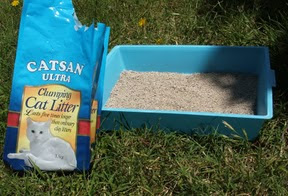
Of pets, there’s a recent, odd story about how a cat’s litter box can be a weapon. I like cats, but the UPI story, “Cat Litter Box Allegedly Weapon of Choice,” is the first time I’ve heard of that possibility. In Florida, two women has a fight, and allegedly

A Florida woman was jailed after allegedly assaulting her girlfriend with a feces-filled cat litter box, authorities say.

New Port Richey police said Kristin Stiehler allegedly attacked Rachel Switzer Wednesday after Switzer refused to give her Roxicodone pills, the St. Petersburg Times reported Friday. Stiehler allegedly broke through their bedroom door, picked up the litter box and went after Switzer with it.

Police said Switzer wound up with cat feces on her face, hair and ears, and cat litter coating her hair, the newspaper said.

Of all the many unfortunate instances of domestic violence about which one hears, this is the first I’ve heard about a litter box as a weapon. Considering how many people live in America, how many have cats, how almost all cats have litter boxes, how some people fight, and how some fights lead tragically to violence, it’s a wonder that this hasn’t happened before (or more often).

Wrong and a strange mess, both.

Chrysler Car Ads for Tea Party Supporters: Hard to Believe Anyone is that Impressionable

There’s a story at CBS news about how Chrysler is using ads in which an actor portraying George Washington drives a Dodge Charger. The ad is – wait for it – supposedly an effort to appeal to political supporters of the Tea Party movement.

Even if Chrysler hadn’t accepted billions in bailout money – and they did – I don’t see how any political party’s supporters would buy a Chrysler because an actor dressed up like Washington.

Although not a member of the Tea Party, I would guess that not one of them will be swayed in favor of that shaky auto company because of this ad.

I’d be more inclined to think the story a spoof than the ad campaign one that’s truly supposed to appeal to the Tea Party. (The question mark in the story’s title gives the game away.)

Here’s the story – Chrysler Ad an Appeal to the Tea Party?

What do you think: Inspired or Insipid?


Link: http://www.youtube.com/watch?v=Ezk0e1VL80o more >>

After Ineffective Spending, an Effective Comparative Advantage Solution

There are two recent stories that highlight the challenges facing the national economy, and that implicitly show the impossibility of a national solution to Whitewater, Wisconsin, or any other small town.

One has probably read that U.S. Representative Ryan of Wisconsin said that he thought of “the stimulus as a sugar high.” See, Top Republican: Obama’s stimulus little more than ‘sugar high’ for economy. It’s been that for us, in this small part of America.

In a different story, a commentator from the other side of the Atlantic suggests a solution for what ails America (and Europe and Asia). Looking at the problems of sluggish growth and high unemployment, Ambrose Evans-Pritchard suggests a solution:

Investors are starting to chew over the awful possibility that America’s recovery will stall just as Asia hits the buffers. China’s manufacturing index has been falling since January, with a downward lurch in June to 50.4, just above the break-even line of 50. Momentum seems to be flagging everywhere, whether in Australian building permits, Turkish exports, or Japanese industrial output.

On Friday, Jacques Cailloux from RBS put out a “double-dip alert” for Europe. “The risk is rising fast. Absent an effective policy intervention to tackle the debt crisis on the periphery over coming months, the European economy will double dip in 2011,” he said.

It is obvious what that policy should be for Europe, America, and Japan. If budgets are to shrink in an orderly fashion over several years – as they must, to avoid sovereign debt spirals – then central banks will have to cushion the blow keeping monetary policy ultra-loose for as long it takes.

The Fed is already eyeing the printing press again. “It’s appropriate to think about what we would do under a deflationary scenario,” said Dennis Lockhart for the Atlanta Fed.

I don’t know what federal fiscal policy will be after the November elections, and no one else knows, either. What’s clear, however, is that there’s no independent monetary solution for state or local governments to offset necessary budget tightening. (If the federal government has spent all she can spend, and must cut back to prevent disaster, there’s sure to be cuts for state and local governments with no local offset of a looser monetary policy that localities obviously don’t have.)

There’s still a way out, for Whitewater and other towns with too many public projects and too few private jobs: a change to a climate of low regulations. Low when compared to present levels, and lower than nearby communities. That comparative advantage will attract investment and bolster local businesses.

Evans-Pritchard’s article is dramatically entitled, “With the US trapped in depression, this really is starting to feel like 1932. Although he accurately notes grim statistics (“US workforce shrank by 652,000 in June, one of the sharpest contractions ever. The rate of hourly earnings fell 0.1pc. Wages are flirting with deflation.”), there are few who think a depression is possible.

If further budget cuts at the local level are necessary (and overdue), there’s still much to be done, by which we could boost the comparative attractiveness of the city. That boost will not — and finally cannot — come from more public projects, but from a significantly more limited and less bothersome local government.

“A Better Welcome for Our Nation’s Immigrants”

At the Washington Post, former Florida Governor Jeb Bush and Harvard professor of public policy Robert Putnam have an essay entitled, A Better Welcome for Our Nation’s Immigrants. It’s an historically sound reflection on immigrants in America, with recommendations for public policy:

Immigration has always caused frictions and controversies: “On our national birthday, and amid an angry debate about immigration, Americans should reflect on the lessons of our shared immigrant past. We must recall that the challenges facing our nation today were felt as far back as the Founders’ time. Immigrant assimilation has always been slow and contentious, with progress measured not in years but in decades.”

Immigrants adopt English as their language: “Yet learning a language as an adult is hard, so first-generation immigrants often use their native tongue. Historically, English has dominated by the second or third generation in all immigrant groups. Most recent immigrants recognize that they need to learn English, and about 90 percent of the second generation speak English, according to the Pew Hispanic Center. Research by sociologists Claude Fischer and Michael Hout published in 2008 suggests that English acquisition among immigrants today is faster than in previous waves.” (Emphasis added.)

There’s nothing unusual about immigrants living in enclaves of fellow immigrants upon arrival.: “Residential integration of immigrants is even more gradual. Half a century ago, sociologist Stanley Lieberson showed that most immigrants lived in segregated enclaves, “Little Italy” or “Chinatown,” for several generations. This segregation reflected discrimination by natives and the natural desire of “strangers in a strange land” to live among familiar faces with familiar customs.

Only with suburbanization, encouraged by government policy in the 1950s and 1960s, did the children and grandchildren of the immigrants of the 1890s and 1900s exit those enclaves. That many of today’s immigrants live in ethnic enclaves is thus entirely normal and reflects no ominous aim to separate themselves from the wider American community.”

Sadly, we’re less welcoming as a people than earlier American generations were: “One important difference, however, that separates immigration then and now: We native-born Americans are doing less than our great-grandparents did to welcome immigrants.

A century ago, religious, civic and business groups and government provided classes in English and citizenship. Historian Thomas P. Vadasz found that in Bethlehem, Pa., a thriving town of about 20,000, roughly two-thirds of whom were immigrants, the biggest employer, Bethlehem Steel, and the local YMCA offered free English instruction to thousands of immigrants in the early 20th century, even paying them to take classes. Today, immigrants face long waiting lists for English classes, even ones they pay for.”

There’s always the temptation — one well known to many communities, including Whitewater — to scapegoat immigrants or stay silent while others do so. It’s destructive and futile, but tempting. There’s no honorable capstone to a career to be had in victimizing immigrants, condoning others doing so, or staying silent.

H/T Radley Balko of Reason for the pointer.

Daily Bread for Whitewater, Wisconsin: 7-6-10

Good morning,

Today’s forecast calls for thunderstorms for Whitewater today, as the forecast has for the last few days. We’ve had less than forecast, and in this case less is more. The high temperature should be about 84.

It’s back to business, of sorts, for Whitewater’s city government, with an Urban Forestry Work Session from 9 a.m. to 11 a.m. For a prior post on the city’s tree care, see Whitewater’s Overreaction to Citizen Complaints: Trees, Tree Commission, and Urban Forestry Commission.

The Wisconsin Historical Society recalls a Wisconsin workers’ riot that took place on this day in 1934:

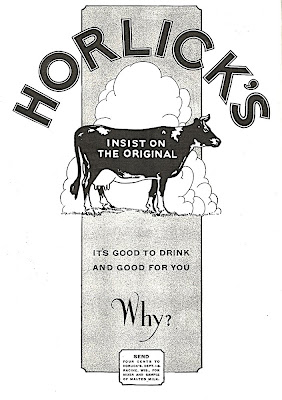
Seven injured in riot at Horlick plant

On this day three policemen and five office employees of the Horlick Malted Milk Corp. were injured when a crowd of strike sympathizers stormed a motorcade of employees entering the plant’s main gate. Emerging from a crowd of 500 striking employees, the rioters overpowered police escorts, shattered windshields and windows, and pelted officers with rocks. Police blamed Communist influence for the incident, and former Communist congressional candidate John Sekat was arrested in the incident. Employees of the plant were demanding wage increases and recognition of the Racine County Workers Committee as their collective bargaining agent. [Source: Capital Times 7/6/1934, p. 1]

More on Horlick’s history, in America and abroad, is available online.

Here’s a sound file of a Horlick’s Radio Commercial from 1935. Enjoy.

Eleven Fifty-Nine for 7-5-10

Good evening,

There’s a good chance of overnight thunderstorms for Whitewater, and a low temperature no better than seventy-one degrees. Hardly good weather for sleeping, but then I’m not asleep.

I was in Lake Geneva and Elkhorn, Wisconsin today, and if there’s a more depressing town in Walworth County than Elkhorn, if I’ve yet to visit it. Their downtown, such as it is, is drab and gray, and they’ve the exacerbating problem of being the county seat. For other towns that might be an advantage; I think it’s only an advantage for those officials in Elkhorn whose careers have eluded greater public awareness. They have thrived in gray; they’d be unsuited to a brighter place.

I’ve been watching the Tour de France on Versus, and reading coverage of it here and there. It’s a shame about the Tour, in one way, though — it’s just not enjoyable to most people, the popularity (I think unfairly earned) of Lance Armstrong not withstanding. Cycling is like the violin to most people — something for the rich, the stuffy, the pretentious. That’s too bad, because it’s not true. Most riders are hardly wealthy, and they should not be conflated with pretentious fans who over-buy and under-ride.

I think LeMond is the better man, and worthier athlete, but Lance is the story of the last decade. He may find, in unwelcome ways, that he’s the story of the new decade, too. America produced a three-time champion in LeMond, in whom all Americans can be proud. LeMond has been controversial to many, but when the current fashion fades, we’ll find that we always had a great cyclist, just from Minnesota, rather than Texas.

Cobblestones for stage three, but there was enough excitement today without them.

I’m not sure if it’s a snowball effect, or slippery slope, etc., but there’s a story about a consequence of World Naked Bike Day in Madison — World Naked Yoga Day. See, First there was the World Naked Bike Ride, and now get ready for Naked Yoga. (For a post on the bike day, see “Wisconsin State Journal: Naked Cyclists Put on a Show.”)

Inspired by the World Naked Bike Ride and hoping to draw attention to healthy body images, yoga instructor Natalia Hacerola is holding a World Naked Yoga Day.

World Naked Yoga Day is different from World Naked Bike Ride in that while the ride focused on public nudity — along with calling attention to oil independence and body acceptance — the yoga day focuses on private nudity, Hacerola said.

That’s quite a difference. I have doubts about effectiveness of the prior bike-riding protest, but it was a protest. I understand that the purpose of the nude yoga day is self-awareness, but I thought that yoga’s practitioners professed that it already brings awareness. If regular, clothed yoga still leaves people needing something more by way of wearing less, then perhaps regular yoga’s been over-sold all these years.

State Journal: Running for Governor (of WI) with Hope — but without much money or recognition

There’s a story at the Wisconsin State Journal about small-party candidates who are running for governor of Wisconsin. See, Running for Governor with Hope — but without much money or recognition.

It says much about our politics that although Wisconsin makes it easy for smaller-party candidates to get on the ballot, they’re unknowns.

The story also tacitly illustrates the difference between libertarians (of which there are many in Wisconsin) and candidates of the Libertarian Party proper (of which there’s not a single mention). Most libertarians vote with one of the two major parties, shifting between the two from season to season depending on the major parties’ positions.

The LP has done nothing these many years to change that, and this election year in Wisconsin proves no different.