FREE WHITEWATER

Milwaukee County’s Immoral Utilitarianism: Update 4 (Documentation of Patient Abuse)

I’ve written before about Milwaukee County’s Behavioral Health Division, and sexual assaults among mental patients at its Mental Health Center. BHD’s Director, John Chianelli, has implemented a policy of trading male-on-male violence among mental patients for male-on-female sexual assault. I’ve posted about Chianelli’s policy, and the tragedy that is conduct at the MHC, before. See, A Milwaukee County Bureaucrat’s Immoral Utilitarianism, Update: A Milwaukee County Bureaucrat’s Immoral Utilitarianism, Update 2, and Update 3.

The Journal Sentinel has been covering this story closely and well, and reporters Steve Schiltze and Meg Kissinger have posted a story entitled, Advocacy group’s report slams Mental Health Complex.

(The report of Disability Rights Wisconsin and a reply from Milwaukee County are both available online, at the Journal Sentinel website.)

Here are some key findings of Disability Rights Wisconsin (DRW)’s report:

Patients at Milwaukee County’s Mental Health Complex are not kept safe from sexual predators, and comments by administrators and staff claiming otherwise reveal a disturbing indifference, says a watchdog group that has reviewed patient files.

Of 17 patients whose records were reviewed, 10 had improper sexual contact with other patients and five were sexually assaulted at the complex during the last half of 2009, according to a blistering report compiled by Disability Rights Wisconsin.

The advocacy group rushed early findings to print because of concerns over patient safety at the complex. A more detailed report from the group is expected this summer.

As the state’s designated watchdog group for patients, Disability Rights Wisconsin has authority to scrutinize confidential patient files and interview patients and staff of the complex….

The hospital has a policy of no physical contact among patients, but that policy is frequently violated and many staff members were unaware it existed, the group’s investigators found….

Staff, including top administrators, did not seem alarmed at the amount of inappropriate sexual contact, she said.

“What we saw is very disturbing,” Beckert said. “Yet, it is being treated as though these were not grave concerns. If it’s not grave, then that’s really disturbing. Where is the outrage?”

When assaults and abuse like this are uncovered, elected and appointed officials have two broad options: a comprehensive review of what’s gone bad, or an easily-controlled, manipulated review, followed by a lot of hesitation and the urging of caution, etc.

Here’s the chairman of the Milwaukee County Board, though a spokesperson(!):

County Board Chairman Lee Holloway said through a spokesman that the Disability Rights report was premature. Holloway feels that Disability Rights has a pro-patient bias that could shade its findings, said spokesman Harold Mester. An audit on the Mental Health Complex being done by the county auditor should be more objective, Mester said.

Holloway’s kidding only himself if he thinks that a county review of allegations against the county will be credible. The allegations against the county include concealment of information, but now Holloway expects people to believe that employees of the same county will be forthcoming.

Chianelli needs to go, but beyond that, Milwaukee County needs to accept an independent, state audit. (It’s something that State Rep. Tamara Grigsby has called for; she’s right.) She’s quoted as observing that “[w]e entrusted the county to provide these services, and it is absolutely clear that the county has not done that in a way that has been acceptable.”

I would encourage readers to review both the DRW reports and Milwaukee County’s reply. The report has over a dozen solid recommendations to remedy misconduct of county workers and mistreatment of county mental patients.

One need only compare the report (itself preliminary to a more exhaustive one) with the paltry reply of Milwaukee County. The thin Milwaukee County reply makes only general claims of improvement “over the last several months.”

None of it is specific and quantified; someone without any professional training could have produced as much in reply to the DRW report. Much of the county’s reply involves what they’re “working on,” or “additional training,” etc. It’s the kind of weak and flimsy response that reasonable people have come to expect from middling, excuse-making officials.

One finds these kinds of tissue-paper excuses for problems in my own, small town, too. There’s no learning from mistakes when those in authority have no obligation to true accountability. They use the words, and apply them to everyone except themselves. Milwaukee County’s will have no more traction, outside of a small, addled group of lemmings and magpies, than similar ones do in my own town.

A small circle will insist that all is well, while far more people see the truth of conditions, and ignore happy talk and false claims. (Many of the people in a small circle like this don’t even, truly, believe the claims of others in the group. They just like being insiders more than they care about being principled, so they defend or ignore misconduct.)

Holloway’s out of his depth; he can’t talk or wish these problems away. No amount of excuses, risible counter-accusations, or efforts to pretend it’s all business as usual will help these patients, or even make this issue go away. A spokesman won’t insulate Holloway from ridicule and contempt; on the contrary, using one only undermines the shoddy argument he’s trying to make.

Garden-variety blame shifting and wagon-circling won’t be enough.

On Edgerton, Wisconsin’s Police Dog

There’s an old expression that “every dog gets one free bite.” The expression is sensible — a person may do something wrong, but one should be lenient with a first offense. One could apply the expression to either dogs or people — an initial misdeed offers no prior history or warning for misconduct.

I’m sure public safety officials in Edgerton are familiar with the expression, but I they apparently have no grasp of its implication: that one should react more strictly to a second misdeed, from dogs or people. The second bite’s not free.

Edgerton, Wisconsin has a population of approximately five-thousand. Most of that number are probably very sensible people; regrettably, not enough of those sensible people are distributed among those in local government.

I know that that must be true, because after an Edgerton police dog has twice without command attacked someone, it yet remains an Edgerton police canine. See, Edgerton police dog will stay on job.

The two-year old dog, a German Shepherd, “on Monday bit and significantly injured the arm and face of Stephanie Balis, an administrative assistant at the police department.”

Here are the details of German shepherd’s latest bite attack:

In a report to the committee at a special meeting Friday, [Edgerton Police Chief] Klubertanz admitted he made the mistake of leaving a fledgling police dog untied and without a muzzle inside his office at the department, moments before it bit Balis.

“We had an unfortunate accident. I feel bad that it happened. I have since day one,” Klubertanz told the committee Friday.

Klubertanz said he had brought the dog into the police department Monday morning, leashed and muzzled, to show it to workers. He took the dog to his office and removed its muzzle so it could chew a treat Balis had given it earlier. He said he untied the dog for a moment while searching for some files.

That’s when the bites occurred.

According to a department report, Balis approached Klubertanz’s office from a darkened hallway carrying some paperwork. The dog was startled, and went into the hallway, Klubertanz said.

Balis declined an interview, but her husband, Marc Balis, said Balis was in the hall near the chief’s office when she heard a growl and saw the dog lunge at her.

As Balis threw her hand up to block her face from bites, the dog clamped its jaws onto her arm, her husband said. The dog then bit Balis’s nose and cheek before Klubertanz was able to pull it away, her husband claims.

Klubertanz claims the dog, which is trained to protect its handler, became defensive and must not have heard his commands to stop.

The bites required 16 stitches on Balis’s arm and face, and one of her nostrils was “tore open” by the bites, her husband said.

I write that this is the latest biting atack by the dog, beause earlier “[o]n April 13, during training at Steinig Tal kennel, Campbellsport, the dog bit a city of Wisconsin Dells K-9 officer who was training another dog, a Wisconsin Dells Police Department report said. The Wisconsin Dells officer was handing a leash to another officer when Edgerton’s police dog lunged and bit the officer’s left wrist and right hand, causing puncture wounds and a laceration, the report said.”

One dog, two incidents. That’s at least one too many. It’s also why, according the the Gazette story, Edgerton’s insurer has recommended that the city should replace the dog.

Seems sensible, doesn’t it? If a police dog bites, and fails to obey commands, it gets replaced by a more obedient, disciplined dog. The city would still have a police dog, but one that wouldn’t bite other police officers or office workers.

That the city wants to continue training the dog is secondary to the dog’s current inability to behave as commanded. That alone should disqualify the dog from current service. After two bites, a sensible city would send the dog away, and find another.

I suppose, as an alternative, the City of Edgerton could buy hockey pads and face masks for all its workers, and later all its residents. That would, though, cost far more than getting a new dog, and those protective garments would be uncomfortable in summer weather.

For those who wonder how aggressive these dogs can be, I have embedded a video of police dogs when attacking . (The name of the video is When Police Dogs Attack, but I’m not embedding it to tease, as the title is not mine. Rather, I am including it to show how strong and powerful these dogs can be.)

Link: http://www.spike.com/video/when-police-dogs/2705075

One might grow attached to a dog, but a service animal is meant to help defend people from crime, not to injure other police officers or innocent people. Here’s a community that would be better off with another dog, and officials sensible enough to know as much. more >>

Whitewater’s Planning Commission Meeting: Residential Overlay Miscellany

Here’s a bit more on the proposed overlay — there are arguments that I’ve made before, but did not repeat in my 5/16/10 post about the May 10th Planning Commission meeting.

The proposed overlay has a grandfather clause for existing rental properties, but that hardly solves the long-term problem of restrictions on buying and selling of property for certain uses. There’s a gamble here, a hope that by excluding certain uses, existing owners (at least most of them) will achieve the economic benefits of a stable, residential neighborhood. Less onerous restrictions were ineffective in the Tratt Street area, and I doubt that stricter ones will work here.

On Tratt Street — the city’s planning consultant once ridiculously proposed a residential island in that area, only to find that owners saw that once an area moved to mostly rental properties, further restrictions against rental housing actually reduced their options for sale at a good price.

Here’s the situation the city faces, since this municipal administration has inadequately encouraged sufficient rental space in a college town. Restrictions on the Starin neighborhood (for example) work, and rental demand goes elsewhere. Restrictions on the Starin neighborhood fail to prevent rental conversion, and area residents will be back for something more draconian. Note that over time, however, the restrictions on possible uses reduce opportunities for re-sale, and a smaller number of potential buyers will disadvantage prospective owner-sellers.

Finally, there’s something funny about an association called itself ‘historic,’ as a way to justify its use of government to get its way. If the neighborhood seemed truly historic to enough buyers, they’d not have problems of ‘encroachment’ with landlords as potential buyers. Average people, considering buying a house, are apparently unpersuaded that the area’s historic in a way that would command a large number of buyers at a good price.

So the Starin association seeks to alter the legal landscape, and use an ordinance to boost housing prices that buyers won’t offer now. I doubt that will work long-term, and to the extent it does work, this neighborhood association is simply diverting the buyers it does not like into other neighborhoods.

Those other neighborhood should act quickly, and form their own special-interest associations, with even more categorical and definitive names. I’d suggest Really, Truly Historic, and Way More Historic Than Those Weasels on the Other Side of Town as possible choices.

Update: When does a private group go astray of good and limited government? When it seeks a public, legislative, imposed fix to circumvent the voluntary, free exchanges of ordinary buyers and sellers.

Daily Bread for Whitewater, Wisconsin: 5-17-10

Good morning,

The forecast for Whitewater calls for a slight chance of showers with a high of sixty-four degrees.

Last night, as part of a post on a residential overlay district for Whitewater, I quoted from a dissent that Thurgood Marshall wrote while on the United States Supreme Court. (I would agree with Marshall’s analysis of freedom of association, but would differ with his suggestions for possible remedies.)

Today is the anniversary of the U.S. Supreme Court’s unanimous decision in Brown v. Board of Education. Marshall argued that case before the court as chief counsel for the N.A.A.C.P.

In Wisconsin history, the Wisconsin Historical Society recalls that on this day in 1673, the

1673 – Jolliet and Marquette Expedition Gets Underway

On this date Louis Jolliet, Father Jacques Marquette, and five French voyageurs departed from the mission of St. Ignace, at the head of Lake Michigan, to reconnoitre the Mississippi River. The party traveled in two canoes throughout the summer of 1673, traveling across Wisconsin, down the Mississippi to the Arkansas River, and back again. [Source: Historic Diaries: Marquette & Joliet, 1673]

Whitewater’s Planning Commission Meeting from 5/10/10: Residential Overlay

At Item 10 of the May 10th Planning Commission meeting, the Planning Commission considered a residential overlay ordinance, that would place greater restrictions than there would be, for example, in a conventional R-1 zoning district. (Two or fewer unrelated persons living in the single residence, rather than three or fewer persons.) The item stated that the Commission would

[H]old a public hearing to consider a change of the Zoning Ordinance regulations, to enact proposed amendments to the City of Whitewater Municipal Code Chapter 19, by creating Chapter 19.25, R-O Non-family Residential Overlay District. Said District will provide the City of Whitewater with an option to impose a restriction on designated areas of the City, after a public hearing is held, that will limit non-family households to 2 or less [sic] unrelated individuals.

Here are sundry remarks on the discussion of an overlay, a discussion that beings at about 74:00 in the city’s recording of the meeting. (The video recording of the meeting is available at http://blip.tv/file/3624624. The meeting’s agenda is available at Planning Commission Agenda & Attached Documents.)

A Campus Town. Rental housing has been a contentious topic in Whitewater for years, and so it remains. This overlay won’t change that. We’re a campus town. That’s why we have so much rental property relative to single family housing. Single family housing near a campus is susceptible of conversion because of its proximity to campus. When residents of a neighborhood complain about rental housing, they should look out their windows, and think about where they live. It’s next to a university. That’s why their neighborhood is attractive to buyers looking for rental housing, or current owners thinking about renting their homes.

Voluntary Transactions. There are no successful sellers without willing and able buyers. There wouldn’t be any rental housing in some of these neighborhoods without a high demand for it. That demand has continued, and that’s why some residents seek overlay restrictions: they don’t like the voluntary transactions of others, and seek to stop those free and cooperative exchanges.

Instead of restricting the economic liberty of others, they should find a place where they can live without inhibiting the economic opportunities of buyers and sellers.

Rather than decide for their properties alone, they seek an imposed rule to prevent others from free transactions and free association. They may only own one house, but they want to decide for others’ houses, too. Those favoring restrictions haven’t the means to purchase all the houses in a neighborhood themselves, so they want to use government to compel everyone (including those who paid for their own homes) to accept a restrictive policy.

Whitewater’s not talking about the underprivileged needing government services, either. These are property owners who want to use ordinances to restrict the free activities of others. If local government has a place other than public safety, then it should be to provide limited services to the poor, and it might do other things, too, short of telling owners how they can sell the property they bought with their earnings.

(That’s part of what’s absurd and disgraceful about Whitewater’s city manager once saying that these housing issues were the city’s biggest problem. No, and no again. We have above-average child poverty in Whitewater, and that’s a bigger problem than this rental housing issue. It’s morally obtuse to think otherwise. I’m very sure that many proponents of this ordinance would see that there are bigger issues in the city. That our city manager once said otherwise is simply ridiculous, and likely just ignorant pandering.)

These are property owners, using government as a cudgel and crowbar, to get their way, over other owners and prospective owners.

They are very happy with private property for themselves, but quick to interfere through legislation with others’ property.

Short Memories? I know that this proposal might be applied anywhere, but it’s the Starin Park neighborhood that’s been pushing this measure. There’s no secret in that. Only nine months ago, in August, Whitewater’s paid planning consultant proposed, on August 17th, a series of neighborhood preservation zones that would not have included the Starin neighborhood near campus. I find it unpersuasive that that same consultant now contends that the Comprehensive Plan always contemplated this outcome.

Not for the Starin neighborhood, it didn’t — and that’s one reason the neighborhood association is driving this proposal so strongly.

How Whitewater Got Here. I’m not surprised that we’re here, with a neighborhood association wanting an overlay ordinance. (I know that this ordinance might be applied anywhere.) Rental registration, supposedly strict enforcement of existing zone regulations, flyers, education programs, more talk about enforcement, etc.: yet here we are, with a special interest group seeking more restrictions.

They’re back seeking because everything else this city has done, in enforcement or otherwise, has been inadequate. For a municipal administration that once proclaimed this as our greatest problem, they’ve not made much progress. Spending time and wasting taxpayers’ money on marquee projects like the Innovation Center has been a triple waste: of tax funds and debt for the Center, of failure to address housing issues, and (worst of all) of ignoring greater problems of poverty and the inadequate administration of justice.

Applied to One Property? Beginning at 82.10, hears that this overlay could be applied to a single property. I’m sure it could; I’m equally certain how absurd that would be.

Wrong Standard for an Ordinance. There’s much that’s absurd about the contention — from the city of attorney, of all people — that under an ordinance one “could do a lot of crazy things.” I’m not sure whether he should be commended for his accurate assessment of Whitewater’s political culture, or criticized for his inability or unwillingness to help craft an ordinance that couldn’t be used in a “crazy” way. Too funny, all around.

By the way, legisaltion that’s so broad that one has to hope, or expect, that it will be used judiciously is legislation that’s too broad. When a politician says that enforcement will have to be careful, he should ask himself in what town he lives. It was a failure of this administration over many years, of enforcing too loosely and too strictly by turns, that exacerbated this problem. Now one is to hope that this new proposal, should it finally become law, will be enforced carefully?

Careful is not something Whitewater does very well, and it’s laughable to hope for what we have yet to see.

Past is prologue.

“Effectiveness” Breeds Only Failure. Let’s assume that a part of the city, like the Starin neighborhood, does face tremendous pressure to its current character, that can and should be overcome by an overlay. If the pressure is that great, and the ordinance is so effective, then does anyone doubt that the demand for rental housing will simply be diverted elsewhere in the city?

Those neighborhoods feeling demand diverted from another area will want their own overlays. One will beget another, until all the city will have one. After it all, we’ll still have unmet rental demand, and homeowners who will be unable to sell at a good price to meet that demand.

The Dissent Over Individual Rights. Finally, there is a longstanding federal case, that addressed restrictions like this, years ago having been imposed in New York. See, Village of Belle Terre v. Borass, 416 U.S. 1 (1974). The court’s majority opinion held that the residential restrictions under review in that case where legally valid under the United States Constitution. I don’t doubt that this overlay would be lawful, excepting only application to ludicrously small areas.

Still, I find that parts of Justice Marshall’s in dissent in Belle Terre are persuasive, as he wrote about the damage that such restrictions on residential arrangements did to freedom of association:

I am in full agreement with the majority that zoning is a complex and important function of the State. It may indeed be the most essential function performed by local government, for it is one of the primary means by which we protect that sometimes difficult to define concept of quality of life. I therefore continue to adhere to the principle of Euclid v. Ambler Realty Co., 272 U. S. 365 (1926), that deference should be given to governmental judgments concerning proper land-use allocation…..

I would also agree with the majority that local zoning authorities may properly act in furtherance of the objectives asserted to be served by the ordinance at issue here: restricting uncontrolled growth, solving traffic problems, keeping rental costs at a reasonable level, and making the community attractive to families…. But deference does not mean abdication. This Court has an obligation to ensure that zoning ordinances, even when adopted in furtherance of such legitimate aims, do not infringe upon fundamental constitutional rights….

My disagreement with the Court today is based upon my view that the ordinance in this case unnecessarily burdens appellees’ First Amendment freedom of association and their constitutionally guaranteed right to privacy. Our decisions establish that the First and Fourteenth Amendments protect the freedom to choose one’s associates. NAACP v. Button, 371 U. S. 415, 430 (1963). Constitutional protection is extended, not only to modes of association that are political in the usual sense, but also to those that pertain to the social and economic benefit of the members. Id., at 430-431; Brotherhood of Railroad Trainmen v. Virginia Bar, 377 U. S. 1 (1964). See United Transportation Union v. State Bar of Michigan, 401 U. S. 576 (1971); Mine Workers v. Illinois State Bar Assn., 389 U. S. 217 (1967). The selection of one’s living companions involves similar choices as to the emotional, social, or economic benefits to be derived from alternative living arrangements.

The freedom of association is often inextricably entwined with the constitutionally guaranteed right of privacy. The right to “establish a home” is an essential part of the liberty guaranteed by the Fourteenth Amendment. Meyer v. Nebraska, 262 U. S. 390, 399 (1923); Griswold v. Connecticut, 381 U. S. 479, 495 (1965) (Goldberg, J., concurring). And the Constitution secures to an individual a freedom “to satisfy his intellectual and emotional needs in the privacy of his own home.” Stanley v. Georgia, 394 U. S. 557, 565 (1969); see Paris Adult Theatre I v. Slaton, 413 U. S. 49, 66-67 (1973). Constitutionally protected privacy is, in Mr. Justice Brandeis’ words, “as against the Government, the right to be let alone . . . the right most valued by civilized man.” Olmstead v. United States, 277 U. S. 438, 478 (1928) (dissenting opinion). The choice of household companions—of whether a person’s “intellectual and emotional needs” are best met by living with family, friends, professional associates, or others—involves deeply personal considerations as to the kind and quality of intimate relationships within the home. That decision surely falls within the ambit of the right to privacy protected by the Constitution. See Roe v. Wade, 410 U. S. 113, 153 (1973); Eisenstadt v. Baird, 405 U. S. 438, 453 (1972); Stanley v. Georgia, supra, at 564-565; Griswold v. Connecticut, supra, at 483, 486; Olmstead v. United States, supra, at 478 (Brandeis, J., dissenting); Moreno v. Department of Agriculture, 345 F. Supp. 310, 315 (DC 1972), aff’d, 413 U. S. 528 (1973).

The instant ordinance discriminates on the basis of just such a personal lifestyle choice as to household companions. It permits any number of persons related by blood or marriage, be it two or twenty, to live in a single household, but it limits to two the number of unrelated persons bound by profession, love, friendship, religious or political affiliation, or mere economics who can occupy a single home. Belle Terre imposes upon those who deviate from the community norm in their choice of living companions significantly greater restrictions than are applied to residential groups who are related by blood or marriage, and compose the established order within the community.[4] The village has, in effect, acted to fence out those individuals whose choice of lifestyle differs from that of its current residents.[5]

more >>

Whitewater’s Planning Commission Meeting from 5/10/10: Walmart

After a few preliminary items, Whitewater’s 5/10/10 Planning Commission meeting considered Walmart’s proposal for a significant expansion at its present location. A video recording of the meeting is available at http://blip.tv/file/3624624. The agenda with a memo from Vandewalle & Associates about the Walmart expansion is available at Planning Commission Agenda & Attached Documents.

The documents to which I have linked are the only ones that the City of Whitewater uploaded prior to the May 10th meeting, on any topic on the agenda. One agenda, and one consultant’s memo.

City Staff. I’ve teased before about the pretentious way that city bureaucrats refer to ‘staff’ doing this, or ‘staff’ doing that. Perhaps, I’m idiosyncratic in this regard, but it seems stuffy to me, and puffed up. It might just be a consequence of my underlying doubts about bureaucrats…

While city staff is hard at work, I don’t think it would be too much to ask that they assure all the materials distributed at a meeting are placed online. At 21:54, Bruce Parker mentions documents in the Planning Commissioners’ packets. Those documents were not placed online before the meeting, and they should have been, as a matter of good policy. I know that one could request these documents through a records request, but a resident should not have to go to that trouble. As a good policy of open government, the City of Whitewater should upload all documents for the Planning Commission meeting, not just a paltry two (one of which was the agenda).

City manager Kevin Brunner’s stated commitment to “serving our citizens and visitors with excellent customer service” would mean more if he made certain that relevant documents in the possession of city staff were on line, on time, for easy citizen review.

Façade Concerns. In the Vandewalle packet, and at the meeting beginning at 23:30, one hears concerns about the façade of the building being “uninviting, stark, and lacking in architectural details” and “sterile.” I’m not sure if this is serious, or a trivial straw-man complaint that’s designed to distract from bigger issues.

If it’s serious, then it’s just a waste of time. I have no regard for paid consultants, supping on the taxpayers’ money, playing the role of designers and architects. If people want to live their lives as interior designers, decorators, or architects, then they should find private employment — at private compensation — in those fields. Those who want to fuss over design should go out, by a large property, with their own money, and have at it. I’m not convinced — at all — that a few politicians and bureaucrats have any better understanding of aesthetics than Walmart, Walmart’s customers, or anyone pulled out of a phone book. (I know that the Planning Commission includes municipal authority for architectural review. I’d just say that the authority runs ahead of discernible talent.)

(I will also give no credence to any taxpayer-paid consultant, having objected in a memo to Walmart’s aesthetics, who himself shows up at public meeting in a brown shirt, open collar. The City of Whitewater’s municipal building may be many things, but it’s not a third-rate discotheque.)

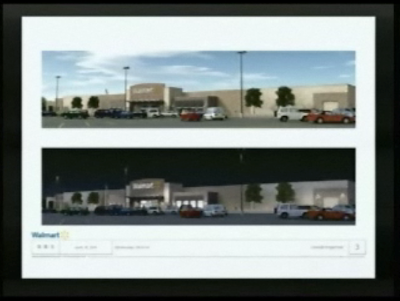
I think, by the way, the design looks good, and better than the existing design. Here are two screenshots of the proposal:

I think these photos show a more attractive façade than the one on the Walmart in Jefferson, Wisconsin, by the way.

Deals for Walmart, Rather than at Walmart. I’d guess Walmart’s thinking about expanding to make money, not as a charitable contribution to the people of Whitewater. Fine by me — prosperity on this continent has come about by private, voluntary mutual exchanges between buyers and sellers. I wouldn’t expect more of Walmart than other businesses, but I wouldn’t want less from them, either. They should accommodate parking adequately, as the City of Whitewater expects in its ordinances. Walmart should be striving to meet a required standard that other businesses have to meet, reflecting the difference only in size.

Some small merchant gets badgered about a sandwich board, or how many square feet something is, and that’s wrong. It’s doubly wrong to let Walmart skirt rules on parking when owners of other, smaller concerns get hit over their heads on that point. If there’s a requirement that in a zoning district like this (B1) for a “minimum of 30 percent of the lot to be landscaped surface area,” the Walmart shouldn’t be given a break that others would likely never get. If Walmart can show a real impact from plantings, etc., as our ordinances allow, only then should they be allowed to go below our the 30% minimum.

To offer breaks would be a kind of corporate care package that Walmart does not need, and smaller merchants wouldn’t get.

There’s a good deal to be had here, setting aside trivial concerns about aesthetics for more important matters of traffic flow and the surface area on the Walmart lot, among others.

Walmart will be back with proposal at a subsequent meeting, and it is on these matters than a serious examination should concern itself, as the basis of a good deal.

Whitewater’s Planning Commission Meeting from 5/10/10: Overview

On May 10th, Whitewater’s Planning Commission held a meeting at 6 p.m., with principal the topics being a possible expansion of our local Walmart, and an overlay to an existing residential zoning ordinance for the Starin Park neighborhood.

Recording of the meeting

Here’s the video of the meeting, which I will be using for my remarks.

(This meeting was televised on our local cable access channel, but I’d rather comment with a posted video to which readers can refer. In cases where the city does not record a video, but someone else does, I will upload and use that video. Note – the caption that appears at the beginning recording says 5/14, but it’s the 5/10 meeting. The video may have been placed online on 5/14.)

Link: http://blip.tv/file/3624624

Agenda of the Meeting and Documents Attached

Planning Commission Agenda & Attached Documents

Press coverage of the meeting, and items on agenda

Residential zoning:

Whitewater plan panel advances R-0 zoning, published May 11th, Daily Union.

Zoning proposal would limit growth of rental housing, published May 9th, GazetteXtra.com.

Neighborhood hopes to limit encroachment of student housing, posted April 9th, Walworth County Today, County Life.

Walmart:

Walmart given expansion input, published April 22nd, Daily Union.

Walmart to expand in Whitewater, published April 20th, Daily Union.

Wal-Mart plans upgrade of Whitewater store, published April 19th, GazetteXtra.com. more >>

WalworthCountyToday.com: Whitewater’s landmark buildings and places

Over at Walworth County Today, there’s a photo gallery of fourteen of Whitewater’s nineteen historic landmarks and places. The galley has photographs of the

  • Birge Fountain, 1903; 402 W. Main St.
  • First United Methodist Church, 1872-73; 145 S. Prairie St.
  • Nelson Salsbury House, 1874; 404 W. Main St.
  • Engebretsen Dorr House, 1895; 622 W. Main St.
  • G.W. Esterly House, 1876; 604 W. Main St.
  • Sanger Marsh House, 1861; 522 W. Main St.
  • J.J. Starin House, 1860; 507 W. Main St.
  • Newton M. Littlejohn House, c. 1859; 428 W. Main St
  • White Memorial Building, 1904; 402 W. Main St.
  • The restored 1890 Whitewater Passenger Depot; 310 W. Whitewater St.
  • Stone Stable, west of the depot, circa 1845
  • Indian Effigy Mounds. These effigy mounds, dating from 400 BC to AD 1500
  • Bassett House, 1857, with additions in 1858; 708 W. Main St.
  • Hamilton House, 1868, remodeled in 1881 and 1887; 328 W. Main St.

Recent Tweets, 5-9 to 5-15

Cato: Republicans unveil bold strategy to cut 0.017% from $3.7 trillion federal budget http://bit.ly/9Yi6mx Maybe they’ll round it to .02%
12:46 PM May 14th via Seesmic

No justification – RT @reasonmag: Another day, another wrong-door drug raid terrorizing an innocent grandmother http://ow.ly/1KCx5
9:44 AM May 13th via Seesmic

Name for movers, Packrat Moving & Storage – packrat.com, sounds good until one realizes it’s just encouraging people to keep, ship junk
12:27 PM May 12th via Seesmic

RT @CatoInstitute: Bailout do not solve the problems. Taxpayers bear the costs rather than banks. Spread the word. http://bit.ly/aJs3Sa
3:25 PM May 11th via Seesmic

RT @IJ: CBS Evening News features IJ clients who are fighting Louisiana’s ridiculous licensing law for florists: http://bit.ly/bfncub
11:50 AM May 11th via Seesmic

World’s finest cough drops: http://bit.ly/9mcw52
11:48 AM May 11th via Seesmic

Conservation in practice: Florida teen bets to wear same sneakers for all of high school http://bit.ly/c3PfpT
12:07 PM May 10th via Seesmic

Wisconsin State Journal: Local officials concerned that Hispanic immigrants will avoid census http://bit.ly/bADGlI
10:49 AM May 10th via Seesmic

FREE WHITEWATER on Twitter

Dodgy Science (Trying to Get) in the Courtroom

We’re an inventive people, but not every invention is reasonable simply because it’s the product of human reasoning. An good example of a bad idea is almost surely fMRI (functional magnetic resonance imaging) brain scans to detect dishonesty. Wired has published a few stories about the procedure, the results of which a defense attorney in New York unsuccessfully attempted to have admitted to show his client’s honesty.

In Lie-Detection Brain Scan Could Be Used in Court for First Time, readers learn that

Laboratory studies using fMRI, which measures blood-oxygen levels in the brain, have suggested that when someone lies, the brain sends more blood to the ventrolateral area of the prefrontal cortex. In a very small number of studies, researchers have identified lying in study subjects (.pdf) with accuracy ranging from 76 percent to over 90 percent. But some scientists and lawyers like New York University neuroscientist Elizabeth Phelps doubts those results can be applied outside the lab.

“The data in their studies don’t appear to be reliable enough to use in a court of law,” Phelps said. “There is just no reason to think that this is going to be a good measure of whether someone is telling the truth.

General fMRI data from research has been used in sentencing, but an individual’s brain scan has yet to be entered as evidence in a civil or criminal trial to help the jury determine whether someone was telling the truth. Individual fMRI evidence was offered in at least one other case by a San Diego attorney defending a father accused of sexual abuse, but the evidence was eventually withdrawn and did not make it into the record….

But even in the best of circumstances, Phelps argues that fMRI evidence should not be allowed in court, even if there are at least two companies peddling the service to the legal profession.

“I always come down hard on these companies that are selling it,” she said. “But these companies are going ahead and making claims already, based on some data that’s not so great, that they can do things that they can’t really do.”

In the New York case, the court excluded the brain scan evidence that plaintiff’s counsel sought to present, and a jury quickly found for the defendant.

Would they have been swayed if they’d heard the results of the brain scan, that purported to show the plaintiff was honest? I don’t know, but I think it better the court rejected a technique that’s based only on a very few studies. Something that’s suggestive of serious and considered science needs more testing than fMRI for lie-detection has yet shown. Much more.

Science unconfirmed under conventional conditions, and unable to be confirmed repeatedly, is no science at all. Speculative devices and techniques, merely suggestive, and unreproducible, have another name.

Witchcraft.

Update 3: A Milwaukee County Bureaucrat’s Immoral Utilitarianism

I’ve written before about the perverse and immoral policy of John Chianelli, director of Milwaukee County’s Behavioral Health Division. Chianelli has implemented a policy, by his own admission, of trading male-on-male violence among mental patients for male-on-female sexual assault. I’ve posted about Chianelii’s policy, and the shameful irresponsibility of Milwaukee County officials over it, before. See, A Milwaukee County Bureaucrat’s Immoral Utilitarianism and Update: A Milwaukee County Bureaucrat’s Immoral Utilitarianism, Update 2: A Milwaukee County Bureaucrat’s Immoral Utilitarianism.

The Journal Sentinel has more on the BHD’s Mental Health Complex, and the Journal‘s new information reveals a predictable and unquestionably wrong policy of a public entity concealing as much information as possible. Milwaukee County’s BHD even hired a private lawyer to help the county conceal its potential misconduct.

From a story entitled, “Mental Health Complex Racks Up $204,000 in Lawyer Fees,” readers learn that

A private attorney hired by Milwaukee County has cost taxpayers nearly $204,000 over the past three years to defend the county against possible lawsuits or criminal charges over shoddy care at the Mental Health Complex.

The county initially hired Mark Cameli in December 2006 at $395 an hour to help the county with a possible criminal case after the death of a patient at the county’s Mental Health Complex. Cindy Anczak died in August 2006 from complications of starvation. The state Department of Justice investigated the case, but no charges were filed….

Tim Schoewe, the county’s acting corporation counsel, said Cameli was hired for his expertise on “highly technical” state and federal regulatory issues. Cameli is a former federal prosecutor and civil litigator.

His biography on the Reinhart firm’s Web site touts Cameli’s expertise in “persuading federal and state prosecutors not to charge public officials, health care professionals and other clients, avoiding all publicity and damage to the client’s reputation.”

Cameli has advised county officials to keep quiet about the patient assaults, an admonishment closely followed by John Chianelli, the head of the county’s Behavioral Health Division. Cameli did not reply to a reporter’s phone call and e-mail for comment for this story….

Cameli’s contract is unusual because it runs through the Behavioral Health Division’s budget, rather than the corporation counsel’s budget, said Supervisor Lynne De Bruin. She was the only supervisor to oppose the contract when it came before the board in December 2006.

De Bruin said she was concerned about a single county department – the Behavioral Health Division – having a long-term contract with a private lawyer. Most other instances in which the county hires outside legal help are for specific cases, she said.

“It’s as if BHD has its own attorney on retainer,” she said.

No, never: public entities — municipal corporations that are under public control — must never be allowed to act as private entities, concealing litigation and potential misdeeds from public view. They are not, and will never be, private parties. They are public things, and are obligated to the citizens from whom their authority derives. Bureaucrats must never be allowed to act — pretend, really — that they’re private wheeler dealers, unobligated to the people they govern.

I have always argued against confidentiality in municipal litigation. See, Against Confidentiality in Municipal Litigation. Whitewater is lousy with this wrong and harmful view, where public officials seek confidentiality, and skirt simple procedures, to have their way. They act as though they have independent authority. That’s wholly false, and deeply un-American — all public authority derives from the consent of the governed. There are no exceptions, and there cannot be, in a free society.

Milwaukee County’s Behavior Health Division is behaving as one or another of Whitewater’s middling bureaucrats would behave. Better a day of a correct understanding than a lifetime as selfish bureaucrat, mired in error.

I don’t know what Chianelli’s been up to lately, except that his Behavioral Health Division was under federal investigation, a lawsuit, and a rising number of sexual assaults on female patients. He was once, however, quite a man-about-town.

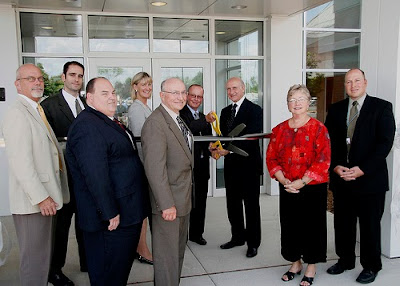
Here’s a photograph of Chianelli, from June 25th, 2008, at a ribbon-cutting ceremony at Rogers Memorial Hospital:

Chianelli, then Acting Director of Milwaukee County’s Behavioral Health Division, is third from the left, in the ill-fitting blue suit.

He seems almost jolly in the photo, although one cannot say the same for the mental patients under his care.

New Jersey’s Governor Christie on Advocacy

I’m not a member of either major party, but I admire those who are who are clear and direct. There is so much to be said for a man or woman who can speak plainly of his or her beliefs, and defend those beliefs vigorously. It’s both false and laughable to pretend that the ambiguous, the equivocal, and the nuanced represent a more evolved approach. Not at all — tepid advocacy is unremarkable, forgettable.

Here’s New Jersey’s new governor, Chris Christie, responding to the (implicitly) critical suggestion that he’s confrontational:

Well said.

Here’s the link to the video’s webpage: http://videos.nj.com/star-ledger/2010/05/gov_christie_calls_s-l_columni.html