FREE WHITEWATER

Monthly Archives: September 2007

Poverty in Whitewater, Part 4: (If we keep building new shopping centers, why does Whitewater’s poverty rate not decrease?)

[This is the fourth in a series on poverty in Whitewater. Part 1 showed that we have a family poverty rate far higher than surrounding communities. Part 2 showed that the poverty rate of our families is increasing. Part 3 showed that the problems of poverty cannot be understood through residents’ ancestries.]

We are fortunate to have some growth in Whitewater, and part of that growth has come from new shopping center development, on both sides of the city (and it is to be hoped, downtown, too). If we have that obvious growth in retail space, why has poverty among families in Whitewater been rising over the last decade?

It’s because retail growth — even much more than we’ve had — would not have a decisive, immediate impact on poverty. The stores that will lease space in these new shopping strips will employ few workers, and certainly less than a light-industrial plant would. Retail shops will create both temporary (construction) and permanent (staff and service) jobs, but not nearly so many as a new factory.

Currently, Whitewater has a problem like some ‘low-aggregate-growth’ cities have – new retail space cannibalizes old, or otherwise does not amount to a cumulative lift for the community. We have a considerable amount of vacant space in Whitewater, and much of it may be vacant long after the new shopping centers on the eastside of town are filled. These now-vacant storefronts were once filled, but we can no longer encourage new businesses to lease space in them.

New shopping centers are progress. It’s just that they’re not a comprehensive solution, and I doubt that many think they could be. They represent gains, to be sure. They should not be expected to reduce the percentage of poor families in the Whitewater. When that number drops appreciably, and consistently, year after year, we will have reason to breathe easier.

Some communities with quaint downtown areas are not suitable models for Whitewater. Delafield has a quaint downtown district, but I cannot imagine anyone thinking that Delafield’s prosperous homeowners are prosperous because Delafield has nice downtown shops. Delafield may owe its success to a downtown, it’s just not Delafield’s downtown retail district; it’s Milwaukee’s downtown office district. The combination of interstate access and a role as a bedroom community to Milwaukee gives Delafield advantages that we do not have.

Cambridge, smaller and closer, is quaint, too. Cambridge has tried to position itself a destination for art, and it’s had some success in that regard. That’s a fragile niche, though. Cambridge’s economy felt the strain of an early 2000s recession, being dependent on sales that consumers postponed during those uncomfortable times.

Some retail shops may attract more retailers, if they’re complimentary niche shops, and if the access limitations to customers (from the bypass, for example) are not too inhibiting for new prospects. Attracting light industry, though, is another matter. We could use more light factories, but the decision (a risk in any case) to build a plant somewhere puts more at stake than a pleasant downtown will satisfy.

No one I’ve ever met, though, proposes that Whitewater’s problems would be solved were it to become a destination for patrons of art. Even the biggest supporters of this sort of offering from Whitewater see that it’s only part of a broader effort at economic development.

(As for that broader effort, I’ll not venture into a tax incremental financing discussion here, except to say the several new TIF districts in the city are not development; they’re merely the authorization of municipal expenditures through debt in the hope of spurring private development, of whatever district type.)

I, and others, will benefit from many of the new shops in Whitewater, with a greater selection of choice items, specialized from green grocers, meat markets, etc. I know that there can be something delightful about shopping for specific goods, from merchant to merchant. It’s French, at least before the hypermart. It is all very quaint, but then I have the luxury of appreciating something quaint. If my wife and I pay more, for being in a lovely little town, walking about with a mesh bag for our fresh fruit and vegetables, flowers, etc., we’re surely contented. Ambiance is as legitimate a component of a market price as any other.

These small aspects of upper middle class life are just that: aspects, and made most enjoyable when all else is well. It’s not that they’re not important (they’re a matter of success or failure for the butcher, baker, etc.). A well-ordered community – that is, one with a robust, spontaneous order – will have strength and growth in several sectors of its economy simultaneously.


Poverty in Whitewater, Part 3 (Whitewater and Delavan)

[This is the third of a series on poverty in Whitewater. Part 1 showed that we have a family poverty rate far higher than surrounding communities. Part 2 showed that the poverty rate of our families is increasing.]

Over the years, I have met people — at least a dozen — who have tried to argue that Whitewater is economically troubled because it has a cultural, ethnic minority that somehow — no one ever has a clear explanation — inhibits community prosperity. Almost to a person, these few have also warned that Delavan is a dangerous example for Whitewater. They say it as though we should rue the prospect of what supposedly befell Delavan.

Then or now, comparisons between Whitewater or Delavan point (1) to the ways that Delavan has had success, not failure, and (2) show without any doubt that ancestry has not played a discernible role in the economic fortunes of that town, or ours.

In my earlier posts on poverty, I have stuck to what’s most likely to be telling and meaningful: a community’s overall poverty rate, the rate of poverty among families, and trends of those two rates.

FREE WHITEWATER is a blog of brief commentary, not lengthy policy analysis. I have not set out to blog about anything more than general commentary on Whitewater, Wisconsin. There are blogs that do handle discussion of poverty-related policy well. (A blogger like Mickey Kaus, in and apart from his kausfiles posts at Slate.com, has offered some solid analysis of welfare reform, and made a name for himself that way, for example.)

Nonetheless, if anyone wanted to venture an opinion about poverty is this town of fourteen thousand, a look at economic performance and the ancestry & ethnicity of our fellow residents would be the worst place to start. An enumeration of the different ethnic groups within Whitewater gives no insight into causes or effects. If I learn that there are a number of Norwegians in Whitewater, it’s of no help in determining economic performance in town.

Delavan is the refutation to those who think that ancestry makes a difference. We’re a community with, by the figures of the U.S. Census bureau to which the City of Whitewater links on its website, 10.6 of our residents in poverty. Yet, only about 7-8 percent of our number are ethnic minorities by the contemporary understanding of the term. Most especially, the idea that we’ve so many poor because we have an appreciable minority community in Whitewater is false, and false in a way that’s a hopeless red herring. In Delavan, using the same data that our city uses, 23 percent of people were ethnic minorities in 1999, yet Delavan had a poverty rate for families of only 5.7 percent. That’s right – a far larger minority community than ours, but far lower poverty. (Looking at it differently, one might as easily make the mistake of thinking that Delavan’s doing better because it has a larger ethnic minority community, or fewer residents of European ancestry.)

Delavan’s situation is obviously different — and better — in ways that have nothing to do with ancestry. If we’re looking for demographics that help inform an understanding of Whitewater’s economic condition, we would probably look anywhere except ancestry. (Delavan’s economic situation, by the way, is likely better since these figures, considering the overall growth that she has experienced. Yet, even years ago, when some mistakenly held Delavan out as a bad example, she had fewer impoverished residents than we did.)

Perhaps that’s why few cities list economic statistics and ancestry on their webpages. The former webpages of the CDA and the City of Whitewater didn’t do the subject justice, either. Crude statistics about ancestry (and especially about income and ancestry, as the CDA formerly posted), are nearly useless. You’ll always have a few people who will seize the ancestry figures to argue that some small groups are responsible for the town’s overall difficulties. An overall poverty rate will tell you something about how a community is faring, but trying to determine causes of poverty in a small town through a list of income by ethnic groups is just speculation. A city should not be accountable for the distorted use of its statistics; a city should be accountable for recognizing that the demographics it displays have limited or no policy value (and undermine efforts to look beyond ethnicity).

We can restore our community to broad-based prosperity by rejecting the hidebound, narrow views that hold sway among some of us. When we abandon the failed notion that we can restrict, regulate, code-enforce, and spend our way out of Whitewater’s predicament we will be able to improve our condition, and that of all our fellow residents.

Next in the series: Poverty in Whitewater, Part 4: If we keep building new shopping centers, why does Whitewater’s poverty rate not decrease?

Overheard by the Cash Register

I purchased a copy of the Whitewater Register yesterday. (I’m too old for Mad Magazine, and the Weekly World News no longer has a print edition.)

When I took the copy to the counter of a well-trafficked store, I overheard this exchange between the two clerks behind the cash register:

First clerk: “What’s this? I’ve never seen this before.”
Second clerk: “It’s the local paper.”
First clerk: “Is that the price [pointing to the 75 cents-per-copy notation]?”
Second clerk: “Yeah, 75 cents.”

Too funny. I’ll venture — on this anecdote alone — that no one at Southern Lakes newspapers will become the next Rupert Murdoch on the basis of newsstand sales.

Inbox: Reader Mail

Here are replies to several email messages that I have received recently. I will answer some of these questions and points (in each case, I have already replied privately to the person writing, but will post excerpts of my replies and elaborations here). Here are paraphrases of questions (or comments) that I’ve received recently, in black, and my replies, in blue.

Q: If the concept of affection for the city means anything to me…
A: Of course it does. As I mentioned in an email reply, I do have a heart. I don’t seem soft and sensitive to some people? (That’s surprising. I would have thought that readers would suppose that I am especially found of cute and cuddly things: Care Bears, tiny troll dolls, and anything with a Hello, Kitty logo. If I didn’t go out for lunch so often, I am sure that a Hello, Kitty lunch-box would be just the thing. For 2008, I’d like to get a wall calendar near my desk with pictures of Yorkshire terrier puppies. On my back lawn, even the squirrels frolicking in joy are especially cute, and have little bows on their heads.)

I love Whitewater, and I have a series on things that I find beautiful in Whitewater, predictably called, “Beautiful Whitewater.” I love Whitewater enough to criticize it, too, on my own terms, and without trimming my remarks to satisfy a few hyper-sensitive city officials, or pander for readers.

FREE WHITEWATER is a work of independent commentary, and does not presume to be a community bulletin board, or local newspaper. This town needs those things, but others can provide them. This blog just one medium out of many.

Q: Why do I write in a way that makes it seem that I think that most people in town are ‘idiots?’
A: I don’t see people as idiots, and I don’t commonly use the expression, or similar ones. I think most people are pretty clever, actually. It’s just a conceit to believe otherwise. I look around, and I see a world filled with amazing devices, discoveries, and creations. It took an enormous number of clever people to make all of these things happen, and to enjoy them, too. Most people are sharp and industrious. If someone’s wrong about something, in my eyes, it’s not because he’s not clever; it’s likely for some other reason of attitude or conviction. Most people can do most things really well, and if they don’t, it’s not for lack of ability. In my Tips for Meetings post, I remarked, in Tip No. 1, that I think most people are sharp.

Q: What’s so free about writing that people should have to live in town to serve on boards, or to hold city management jobs, etc?
A: As I wrote in an email reply to this question, the issue of workers in the city was actually a tough call for me. If regular-line workers would like to live somewhere else, that’s their concern. (There’s a lot of expense in having to move, and for an ordinary person trying to make ends meet, it should not be a requirement.) I find it more difficult, though, to say the same of those who take prominent, paid positions. That’s why I asked this question in a post on a City Council meeting:

When will everyone with a management job at the municipal building actually follow the principle set last night, and live within city limits? The taxes that pay their salaries come from Whitewater, and it betrays a lack of commitment to this community for them to live outside the city. If citizen-volunteers should live within the city — and I believe that they should — then those who are paid at public expense from the taxes of the privately industrious should live in Whitewater also.

I see a difference between ordinary workers (live where you want) and those on public boards (live in the city) and those in high-paying jobs (live in the city).

Q: Why do you make fun of the Register?
A: I have never, ever, doubted the usefulness of the Register to our community. It has great use and value, both for food preservation, and for small, household pets.

I dislike the Register because it’s a bad, shabby paper. My critiques of the Register may be found here, here, here, here, and here.

Q: Isn’t ‘town elite,’ ‘town faction,’ etc. a caricature, or cartoonish phrase?
A: Yes, but I am not the one who created the most commonly used expression, ‘townie.’ That’s not an expression that I have used, ever, on this blog, but it is commonly used all over town. This community commonly refers to some of its own members that way. Why? It’s not an irrational reference; people who use ‘townie’ commonly understand what it means, and it can converse with each other without asking for an enumeration of each person thereby described. We are able to use descriptions of colors like ‘blue,’ or ‘green’ with each other in a similar way. (I have used ‘town elite,’ ‘town faction,’ and ‘town clique,’ interchangeably.)

Here is something that I once posted about the town faction: “broad particulars that ultimately unite them: white, clannish, suspicious of others, ignorant of economics and business-standard practices, ill-disposed toward minorities, and determined that their views should prevail here perpetually.”

I understand that ‘townie’ may sometimes be used affectionately, so it is different from how I use my expressions. ‘Town elite,’ ‘town faction,’ and ‘town clique’ are not, for me, terms of endearment. The problem does not lie with race. (I’m white, too, and most people of each race are no better or worse than others are). It lies with all the rest: “clannish, suspicious of others, ignorant of economics and business-standard practices, ill-disposed toward minorities, and determined that their views should prevail here perpetually.”

Q: Did you go to college?
A: Yes, and to anticipate a follow-up question, I am a graduate, too.

Q: Who is your favorite poet?
A: That’s an unexpected question. How do you know that I even like poetry? I’ve read no poetry recently, but if I had to choose a favorite, I’d say Poe, although he wouldn’t be a popular choice with many. Poe was more than a poet; he wrote some great, fantastic stories, too. My father always liked Whittier, and although he would not be my preferred poet, Whittier’s anti-slavery position was admirable, and a reason for me to respect Whittier, and my father’s sentimental preference, too.

Q: Do you like America?
A: Yes, I love America. It’s a place of great freedom, and fantastic energy. No people has done so much for itself as we have, with a society that embraces free markets and liberty (to borrow two of the three principles of the Cato Institute).

Q: Why cartoons on Friday (or, from someone else, why cartoons at all)?
A: Because we love a place for all sorts of reasons, both profound and mild. America has an amazing history of animation, and artists and directors of our past, with far less than we have now, accomplished great things. (Other countries have strong traditions too, including, most notably, Japan.)

For those who say I’m too critical (and let me be the first to say that’s an absurd charge, and that each and every one of those people is full of daiben anyway), I say: although much of this blog is critical commentary, it’s more than that. I have Cartoons and Comics, and a Beautiful Whitewater feature, that I enjoy most of all. more >>

Poverty in Whitewater, Part 2 (How many of our families have been in poverty recently, since the last census data? )

[This is the second of a series on poverty in Whitewater. Part 1 showed that we have a family poverty rate far higher than surrounding communities.]

Previously, in Part 1, I used the same census data that the City of Whitewater posted on its website to show that we have a family poverty rate roughly twice that of surrounding towns. In this post, we’ll review the annual data on family poverty that the Whitewater Unified School District posts. Those data show that – each year over the last ten – family poverty in the district has stayed constant or increased as a percentage of all families.

I’ll begin with a few preliminary remarks. First, although school district data are for all the communities in the district, Whitewater is – naturally – by far the largest contributor to the data. The City of Whitewater dwarfs in size all the other communities that comprise the WUSD.

Second, the district presents annual information from the last ten years, and that gives us a good impression of the trend. Third, the district’s measure is more significant than the overall family poverty rate, because the district data pertains specifically to those families with children of school age – children being powerless to advance their own circumstances, and being especially vulnerable to the life-altering prospects of an upbringing in poverty.

From 1997-1998 through 2006-2007, there has been a marked increase in the percentage of children of impoverished families with the WUSD.:

YEAR PERCENTAGE OF CHILDREN IN POVERTY
1997-1998 21%
1998-1999 21%
1999-2000 21%
2000-2001 21%
2001-2002 23%
2002-2003 24%
2003-2004 25%
2004-2005 25%
2005-2006 26%
2006-2007 27%

From 1997-1998 to 2006-2007, the increase from 21% to 27% represents a staggering jump of over twenty-five percent in the percentage of children within the district in poverty.

In no year during the last ten did the percentage of poverty among school age children ever decline. Not once. We have made no gains against poverty levels, unless one would wish to claim dubiously that conditions might otherwise have grown even worse.

This situation should be a source of chagrin: we have more poor families by percentage than neighboring towns, and more poor families with school-age students than a decade ago. How often have you heard people in town ridicule other nearby towns, aesthetically or culturally? You know, and I know, that smug residents of Whitewater look down on Palmyra and Jefferson, etc. Our situation is – in one of the ways that should matter – so troubled that we have no reason to ridicule any other places.

America is awash in prosperity, and national poverty figures are down from the year before. America has seen year after year of economic growth, and those increases in aggregate wealth produced a decline in poverty in America. We live the most productive nation in all the world, now or ever before. Our vast commercial republic is a sophisticated, technologically advanced place, producing well over a dozen trillion dollars annually. Free markets have lifted this nation to a high peak, and produced in hundreds of millions a standard of living others seek to achieve.

Paradoxically, while America waxes, Whitewater wanes. Look around at our many advantages, and recognize the truth they reveal: even with hospitable physical conditions, and a university campus, we lag nearby towns. We’re no distant desert town, or remote Alaskan village, and yet with all we have, we’ve done less than we should have. For every salary increase, additional public-sector employee, or overly-intrusive regulatory effort, our condition has grown, in meaningful ways, no better – it’s grown worse.

Poverty in Whitewater, Part 1 (Introduction)

We are, without the slightest reasonable doubt, a beautiful but troubled city. It’s unmistakable that our economy falls short for many, and I will support this contention more conclusively than any happy, but deceptive, pictures from another website, or city publication, could suggest otherwise. We have become a proud, arrogant place, willing to trumpet chimerical economic gains while many would not eat sufficiently each night without our food pantry and local churches for support.

That’s the truth that few want to address. In the richest, most productive, vibrant nation on earth, the envy of the world, Whitewater should be thriving. Instead the over-regulated and over-managed economy in this small town is so anemic that we cannot even generate growth to keep everyone fed through their own means.

We cannot honestly be boastful and fair at the same time. During July’s Homecoming, I saw a banner stretched across Main Street, that said something to the effect of, “How Does Whitewater Look to You?” The answer was supposed to be, I suppose, “great,” or wonderful,” etc. I’d say that the parts of the town where the Homecoming trolley did not go look impoverished and hungry. That’s Whitewater, too; it’s just not the part of Whitewater that suits a boastful town faction.

I could follow the city’s lead, and rush out as a cheerleader for the status quo, but I have no inclination to pad my resume with tissue-paper accomplishments while nearly adamantine problems face us.

The City of Whitewater has helpfully linked to a U.S. Census document measuring basic conditions in Whitewater as of the last census. Thanks much, city officials: I’ll use this document as the starting point for my discussion.

At the time of the last census, the document lists our resident population as 13,437. Of that number, we are 6,569 of men, 6,868 of women, 1,656 under age 18, and 11,781 over age 18. The document lets visitors know that we are 1,207 of Norwegian ancestry, 5,620 of German ancestry, and 458 of Italian descent, as though it should matter.

So how are all those Norwegians, Germans, and Italians doing? The document tells us that 10.6 percent of Whitewater families are in poverty. Sadly and inexcusably, that’s over one in ten. We couldn’t field a football team without likely having one impoverished player on the roster. In your church, look no farther than the next pew, and you’ll find someone in poverty. When he leaves afterward, he’ll go home to a different situation from ours. (I would guess, though, that he’ll not feel the same way others might about the self-congratulatory approach that is the standard at the Whitewater Municipal Building, or in a local website.)

Let’s use the same year’s census figures, available at www.census.gov, and see how other nearby towns were faring:

Fort Atkinson: population, 3.9% of families in poverty

Jefferson: population, 5.4% of families in poverty

Delavan: population, 5.7% of families in poverty

Palmyra: population, 3.4% of families in poverty

Whitewater shows — by far — the highest rate of poverty in the area, using the same census data that the city website uses for Whitewater.

Next: Poverty in Whitewater, Part 2: How many of our families have been in poverty more recently, since the last census data?

Common Council Meeting for September 18, 2007

This was a meeting where the interesting remarks, like the devil, were subtle and in the details.

‘Death-Knell for the District.’ A councilman didn’t waste time explaining (again) that student housing is bad for the community. He described it as the “death-knell” for his district. Presumably, he feels that it would be the death-knell for any district. That leaves Whitewater with only two choices (death-knells being avoided wherever possible): confine the students to campus, or insist that they commute each evening to their home towns. Even his tone changes – and turns angry — when he describes his concerns about students, students, students encroaching on our fair city.

He’s yet to propose a bounty on students discovered outside the campus, but the academic year is young, and he’s not shy about talking and proposing…

That brings us to the subject of talking and talking and talking. Is it possible that a man, accustomed to lecture patients who cannot reply while dental instruments are in their mouths, has stopped listening to the replies or interests of others at all? Are dentists more likely to engage in irritating monologues than the rest of society? I don’t know, but it’s possible.

Downtown Whitewater. We have a new director, but we many have to wait longer for a director who commits decisively to living in Whitewater.

The Whitewater Aquatic Center and Mercy Fitness. The WAC group is trying to move the Center in the right direction, from all accounts. It can’t be an easy job, but they seem to be doing it well. There’s still room to go to reach the number of memberships for the center to break even, but the trend is favorable.

(When someone on Council asked if the WAC might consider closing for part of the year, one could only wince; a seasonal shutdown would be one of the worst choices they could make.)

Committee and Board Volunteers. Council considered and approved nominations to city boards and committees. Ms. Kienbaum is surely right that, ultimately, a board member should not be excluded for his vocation alone.

The Landmarks commission had a nominee who did not live in the city. People from many places may be interested in membership, but we should confine participation to those who reside in Whitewater. It may not be unprecedented that some non-residents have, in the past, served on local boards; it should not be the practice in the future. There are fourteen-thousand residents in the city, and we should find membership among that number. Council sensibly voted in favor of a city resident for the open spot on the Landmarks commission.

Here’s a question for city leaders: when will everyone with a management job at the municipal building actually follow the principle set last night, and live within city limits? The taxes that pay their salaries come from Whitewater, and it betrays a lack of commitment to this community for them to live outside the city. If citizen-volunteers should live within the city — and I believe that they should — then those who are paid at public expense from the taxes of the privately industrious should live in Whitewater also.

Salting Our Streets in Winter. Filling a molar does not make one an expert on salting our streets in winter.

2008 Budget Assumptions. The key assumption is presumption that, overall, it’s business as usual, only in slightly more constricted circumstances. Nothing could be farther from the truth. The assumptions are not the budget (that will come later), but they show how timid, cautious, and lacking in dynamism the current administration’s approach will likely be.

Tax Incremental Borrowing for Incremental District 4. The presentation will come later, but then or now, the question the community will confront is: (Up to ) five million dollars for what? It’s the details that matter. We’ll see.

Dateline: Moscow!

Over at the Register, there’s an account of a recent vote of the Planning Board 4-2 in favor of a conditional use, and a later vote 6-1 in favor of that same use. Counting all the votes, that’s an overwhelming 10-3 vote in favor.

Register “Editor” Carrie Dampier, apparently disappointed in those results, writes her copy from the minority side’s point of view. She uses most of that copy to vent the disappointed minority’s arguments.

Let’s take a quick stab at how Dampier’s technique would apply to a famous event, using the ‘disappointed-minority-gets-all-my support’ approach.

Moscow, USSR — July 21, 1969

Chief Soviet rocket designer Vasily Mishin commented early this morning on America’s successful moon landing yesterday. Mishin expressed surprise at the “imperialist-capitalist notion” that there had ever been a space race, or that the Soviet Union ever sought to reach the moon before the United States. Mishin’s insightful remarks called into question the euphoria in the United States, and throughout the civilized world, at the technological and scientific success of a manned landing on the moon.

“The Motherland is a purely peaceful, cooperative government committed to solidarity with all peoples and cadres. We asked Americans if they wanted to join in expedition using superior Soviet technology, but they insisted on going alone in uncooperative and impatient spirit. Advanced Soviet design for moon landing will be available no later than 2025, but edgy Americans couldn’t relax like Chairman Brezhnev and Soviet leadership.”

Mishin also cast doubt on the choice of food the Apollo 11 crew had on board their capsule, noting that the American use of Tang as a drink on the lunar expedition called into question the merit of the entire effort. “It’s well-known principle that scientific mission cannot be success with wrong choice of beverage,” scoffed Mishin, who wryly noted that he had warned American counterparts about their ignorance of “sound Soviet understanding of powered-drink standards.”

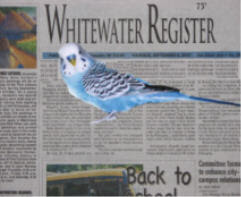
Dampier’s transparent bias is one reason, by all accounts, that the Register remains The Parakeet’s Choice!

Planning and Architectural Review Board Meeting for Monday, 9/10

Hayek thought that a well-ordered society planned to compete, but for a person who spends a lifetime as a bureaucrat, it’s more like planning to plan. He also thought that a well-ordered society was one with a vibrant spontaneous order, but after listening to the September 10th meeting of the Whitewater Planning Board, I’d say that the reliance on public regulation is so strong that spontaneity of any kind is unlikely.

Fairhaven. A local nursing home wants to replace some of its signs, and add still another. Two barriers present themselves: the Planning Board feels that it lacks definite information about Fairhaven’s signs, and a citizen — during public comment on the matter — has question after question about R1 and R3 zoning requirements, and how they might affect Fairhaven’s request.

Everyone on the Board is convinced, by all appearances — that Whitewater benefits only if the Board has exquisite detail about Fairhaven’s request. Approval waits on minute detail. They just can’t imagine a society where signs are vandalized, and the property owner replaces them own its own initiative, and with its own aesthetic judgment, without their municipal approval. They presume that situation would represent chaos and disorder and disharmony. I have no reason to think that the aesthetic judgment of the property owner in advertising its own property would ever be less developed that the cumulative judgment of the entire Board.

Sadder still is the resident who asks questions about R1 and R3 zoning requirements, and wonders if the Fairhaven proposal is in compliance. Think about the culture you’ve created: one where residents think in terms of zoning requirements, rather than property rights and aesthetic results. No one suggests the sign proposal looks bad; it’s question after question about whether the sign falls within any number of square footage requirements, lest there be inconsistency. Whitewater will not collapse if there’s a little inconsistency; on the contrary, it will be a more vital place. The worry about consistency and paperwork requirements is typical, but also an example of a petty rationality. No one on the Board seems capable of imagining a place with fewer requirements, and fewer niceties of regulation.

City Planner and His Role. In response to a question from a Board member, initially earlier, our city planner described his role. His main description lasted about eight minutes, and if anyone can glean from those eight minutes even the slightest idea of what vision the city planner actually offers, then your microscopic powers of inference are to be commended. I take it that he conceives the role, however inarticulately described, as — in part — working with applicants to make their applications more suitable to the Board’s standards. Whitewater pays a bureaucrat to facilitate discussions and proposals to a public board. It should not be so hard or intricate. It is, of course, and its one of the reasons that our economy lags neighboring cities. A planner asked a question in advance, and appearing on television to deliver his answer, should at least be able to write and read a reply that more articulate and thoughtful than what one heard. It was not confidence-inspiring.

Meeting More or Less Frequently. Less is more.

The ‘Arbiters of the Community Values.’ Oh, you must be kidding. I understand that this description — attributed to a professor of planning, of course! — refers to design values, not fundamental morality. Nonetheless, it’s an arrogant, proud boast. Not even mediators, but arbiters! Imagine the arrogance of a person so enmeshed in this way of thinking that he might actually see himself as an arbiter in this way. I doubt that many in our community intended to confer that extent of authority. Look how quickly those in public roles, or teaching others about public roles, assume that title for themselves. Arrogance, thy name is planning.

Coffee Shop and Cousins Subs

I’ve heard that a local developer is planning to turn the vacant space where KFC was located into a combination Cousins sub franchise and a coffee shop. I’ve never seen that combination before, but then I’m not sure anyone has seen that combination before. If the ambiance of a traditional coffee shop can be combined with the utilitarian character of a Cousins sub shop, then I will be the first to applaud the accomplishment.

It scarcely matters if one person, here or there, thinks the effort will succeed; it’s a strength of the market that any number of private citizens may take their chances in the marketplace, free from the presumption of the city, state, or skeptical citizens. If customers like the idea, then it will have satisfied a need, and Whitewater will be better off for it.