FREE WHITEWATER

Monthly Archives: November 2010

Daily Bread for Whitewater, Wisconsin: 11-18-10

Good morning,

The forecast for Whitewater calls for a mostly cloudy day with a high temperature of thirty-seven degrees.

It’s Market Day pickup at Lincoln School and the high school.

The Wisconsin Historical Society recalls that on this day, generations ago,

1930 – Beloit Area Home Raided

On this date federal agents and county deputies raided Otto Matschke’s home, north of Beloit, and seized an illegal still and 300 gallons of contraband moonshine. [Source: Janesville Gazette November 19, 1930, p.1]

For Bush, ‘Free-Market’ Conservatism Was Situational : It’s All Politics : NPR

This seems an apt assessment —

Bush’s self-perception and political brand was that of a free-market conservative. But he had to ditch that when he concluded in the frightening days of 2008 that only the federal government was big enough to save the U.S. financial system.

He doesn’t say this but he essentially was a free-market conservative when the economy was on the way up, and an interventionist when it was on the way down.

It’s a variation of the criticism of Wall Street heard in recent years; financial executives sought to privatize the profits while socializing the losses….

Via For Bush, ‘Free-Market’ Conservatism Was Situational : It’s All Politics : NPR.

Watch the Leonid Meteor Shower – Wired How-To Wiki

The 2010 Leonid meteor shower runs from Wednesday, Nov. 10, through Sunday, Nov. 21. The peak will be the nights between the 17th and the 19th.

The Leonids are famous for being spectacular storms — since the orbit of the Temple-Tuttle comet intersects with that of Earth, the debris cloud our planet passes through each year is dense and full of particles and meteoroids. In optimal viewing conditions on a good year, you can see between 15 and 30 meteors per hour streaking across the sky during the peak.

Whitewater’s conditions aren’t (!) likely to be optimal, but you way have better conditions in your own area.

Via Watch the Leonid Meteor Shower – Wired How-To Wiki.

Daily Bread for Whitewater, Wisconsin: 11-17-10

Good morning,

Today’s forecast calls for a rainy day for Whitewater.

Whitewater’s Police Commission will meet tonight at 7 p.m. The agenda is available online.

At ScienceNews.org, there’s a story with a warning for traveling hamsters, and presumably humans, too: Jet Lag Makes Hamsters Dumb. Here’s the scoop —

In addition to making you groggy and dazed, jet lag may make you stupid. A study presented November 15 at the annual Society for Neuroscience meeting finds that hamsters suffering extreme, chronic jet lag had about half the normal rate of new neuron birth in a part of the brain. What’s more, these animals showed deficits in learning and memory.

Jet lag poses a serious health threat, said study coauthor Erin Gibson of the University of California, Berkeley. Studies have shown that people with work schedules that require them to frequently change their sleep patterns have higher rates of cardiovascular diseases, diabetes and cancer.


U.S. Supreme Court Considers Whether to Hear IJ’s Challenge to Arizona’s “Clean Elections” Scheme

Think that ‘clean’ elections laws keep elections, well, fair and clean? You might be surprised. The U.S. Supreme Court is considering an Institute for Justice challenge to the fairness of Arizona’s supposedly clean election laws.

Here’s a video from the IJ entitled, “The Dirty Game of AZ’s “Clean Elections.” Below the video, I have placed the part of the text of a web release about what’s a stake: privately-funded candidates lose out as taxpayer money drowns out the message of candidates who rely on their own supporters’ voluntary contributions rather than government money.


Arlington, Va.—On, Tuesday, Nov. 23, 2010, the U.S. Supreme Court is scheduled to decide whether to hear a challenge by the Institute for Justice to Arizona’s “Clean Elections” Act in the case of Arizona Free Enterprise Club’s Freedom Club PAC v. Bennett. Actions taken by the High Court earlier this year lead many to believe there is a better-than-average chance the Court will accept this case for review.

For a brief, funny video explaining how the “Clean Election” system rigs political races in favor of government-funded candidates, visit: www.ij.org/AZCleanElectionsVideo.

Arizona’s “Clean Elections” Act gives public money to politicians to run for office and squelches the free speech of independent groups, as well as candidates who choose to forgo taxpayer dollars and instead raise their own funds for their campaigns. For every dollar an independent group opposing a publicly financed candidate or a traditionally funded candidate spends above a certain amount, the government hands taxpayer dollars over to the publicly financed candidates in the race. This allows the government-subsidized candidate to “match” the spending—and thus the speech—of the independent group or privately funded candidate opposing him. The harder an independent group or traditionally financed candidate works, the more the government-subsidized candidate benefits. The Act curbs speech, discourages participation and limits what voters will hear about politics.

See, Arizona Campaign Finance from the Institute for Justice. more >>

On Whitewater, Wisconsin’s 2011 Municipal Budget

Whitewater’s lengthy budget process draws to a close. I offer proposed changes as a longstanding objection to current policy; I don’t expect that any of these changes will be implemented this year. In time, though, Whitewater will have to make drastic reductions, and the longer they’re put off, the worse they’ll be.

There are four points to consider: our current economic situation, our current fiscal (municipal budgetary) policy, changes to make, and the advantage of those changes.

Whitewater’s economy.

We’re a struggling town, with child poverty above of average of other towns — that’s the truth that town squires refuse to discuss. Our current policies have left thousands, in a small city, with no advantage or opportunity. Whitewater’s municipal manager has his Potemkin Village, useful to no one. Each year this persist, Whitewater draws closer to a permanent, but ignored, underclass.

A few striving bureaucratic men, eager to justify their paltry accomplishments as greatness, trumpet empty schemes over lasting prosperity. No proud project, no vainglorious vision, has improved the condition of those now distressed. On the contrary, there are likely more residents living in poverty in Whitewater today than in decades.

Municipal Finances.

Our city manager presides over a city more impoverished than when he first took office, and a municipal government whose future fiscal
prospects are precarious. The City of Whitewater’s own financial analysis paints a stark, bleak landscape. See, Whitewater’s Fiscal Trend Analysis. Whitewater’s prospects are troubled, as I have written then:

Municipal government’s revenues per capita.
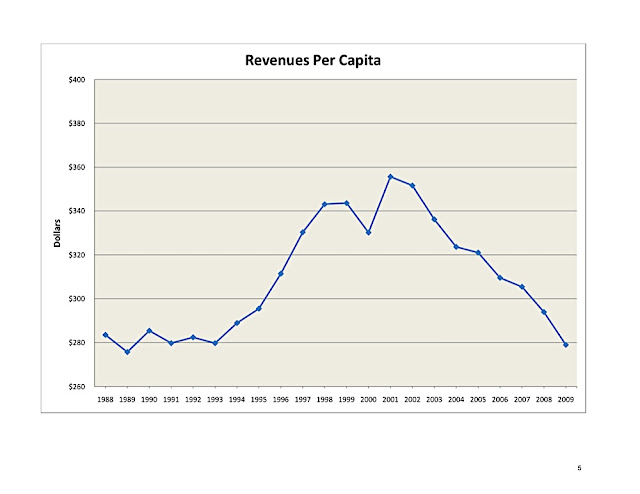
Page 5 tells the tale on revenues per capita, from 1988 to 2009. Beginning in 2001, revenues per capita begin a precipitous plunge, as the city gets less each year in revenue. The city’s analysis, following the graph, is telling:

The warning trend is that there is a decrease in net operating revenues per capita occurring in Whitewater. Over the studied 21 year period, adjusting for inflation, revenues per capita has varied from $275.2 (1989) to $355.66 (2001). For 2009, the Revenue Per Capita equals $278.97. Since 2001, revenues per capita has been steadily declining. This reclects [sic] lack of growth in the City’s major revenue source, – state shared revenues.

It’s true, of course, that the ground on which so much relies has been the shifting (simply eroding, really) sand of shared revenues. In this critical respect, we are considerably different from most of Wisconsin communities of similar size. I’ve written on this topic before.

Municipal government’s net direct debt service.
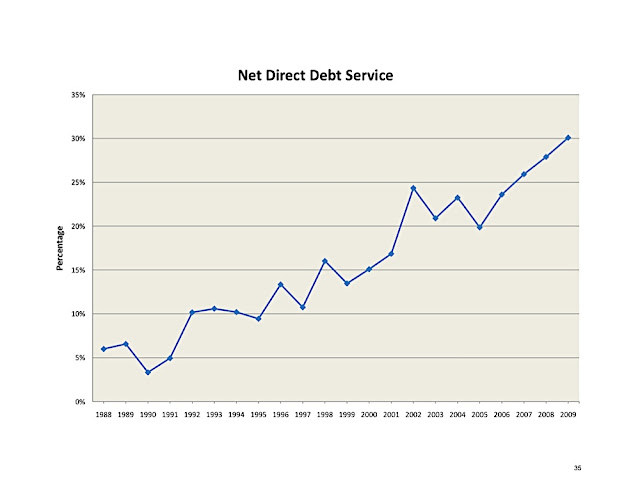
Page 35 shows how the city’s net direct debt service has been rising markedly from 2005 through 2009. Here’s the city’s analysis:

According to credit industry standards, debt service on net direct debt exceeding 20 percent of operating revenues is considered a potential problem. Ten percent is considered acceptable.

In analyzing this trend, the City in 2006 had a percentage of 24.35% which is considerably above the credit industry standard.

However, because the City has issued $ 3,618,622 in new debt for TID#4 in 2005, $500,000 in 2006, and $5,600,000 in 2008, this percentage will be increasing. The general fund has only a small portion of the total debt service outstanding for the City. 85% of the net direct debt service is due to borrowings for TID #4. The balance of 15% is supported by the shared revenue utility payment from the power plant.

Policy statements should be developed by the City that would indicate desirable levels of debt service as well as procedures for analyzing future debt service. Suggested policies are that 1) total debt service for general obligation debt will not exceed 10 percent of annual operating revenues and 2) before bonded long-term debt is issued, the impact of debt service on total annual fixed costs will be analyzed.

Our municipal administration relies on a drying stream of state shared revenues. We rely on this more than most cities of similar size. See, The City Manager’s Selective and Deceptive Use of Data. Even as the city’s reliance on Madison proves imprudent, city manager Brunner has committed this small, struggling town to a tech park project that “relies on millions in public grants, millions in subsidized public bonds, will use a third of its space for a publicly-funded tenant, has no clear private purpose, violated commonsense competitive principles in awarding contracts, was once shut down for federal violations of obvious competitive rules, takes place in a town that has high poverty that the project has no hope of alleviating, and that’s nearly certain to fail as other projects of its kind typically do.” See, Whitewater’s Innovation Center: Good for Producing Innovative, ‘International’ Fairy tales.

For it all, what kind of budget does our city manager produce for 2011? Nothing but a status quo, kick-the-can-down-the-road effort. Here’s how, with America, Wisconsin, and Whitewater facing hard times, city manager Brunner describes his budget:

This slight increase in the tax rates won’t really put much of an impact on residents….

We try to sail a lean ship by producing a high level of services at the lowest tax rate possible.

Madison’s significant but dwindling shared revenues to Whitewater are responsible for this; the city manager’s budget is balanced through others’ earnings, not his own.

If our situation is troubled — and it is — Brunner can’t seem to grasp that whatever our relationship to other cities now, we need to improve our position. That means lower taxes and less spending. Brunner’s budget is about trudging along, preserving as much of government as possible, and hoping like mad that his administration can rely on grants and shared revenue for as long as possible, to keep going and generate publicity for showy projects.

Seeing how many plates a man can keep spinning at once isn’t prudent policy or good government; it’s a circus act.

Changes in Spending from the Proposed Budget.

I believe in a much smaller budget, with a minimum burden on taxpayers, and with preservation of services that recognize the community in which we actually live. Significantly, though, I am opposed to spending cuts that affect services disproportionately benefitting the disadvantaged. I also strongly oppose the city’s grand projects that, in the end, will either prove ineffectual, or a kind of corporate welfare (itself a mistake and disincentive to efficiency).

Here’s a copy of the 2011 proposed budget, with recommended spending reductions and a memo in reply from Whitewater’s police chief, Jim Coan, that I have attached at the end.

2011 Municipal Budget Proposal with Amendments. (pdf opens in new window)

One quick note: For all the millions involved, only two council members took the time to propose additional savings. Only two. That no others on our Common Council could find suggestions of their own to add to this list, is astonishing. Those two who have offered suggestions should be commended. They did the good work others have ignored.

Spending changes (either more or less):

1. Support all the proposed reductions in spending that council members Singer and Butler have, separately, proposed, with the change to police force reductions as note below. (Reductions over present.)

2. Establish a permanent position overseeing our food pantry and services for the needy. (Increase over present.) Principal task is to develop a modern and professional method of food distribution for the poor of Whitewater. Significant emphasis on finding a better location and contemporary standards for food distribution. This should be a three-year position, at a minimum. City to provide effective assistance to overcome objections. Rome was not built in a day.

3. Restore library hours. (Restoration over present proposed reduction.) These cuts disproportionately affect the disadvantaged. Those who have more should feel cuts first.

4. Keep parks and recreation fees where they are. (Restoration over proposed fee increase.) This idea is a diffident man’s cut, asking other people to pay more while unnecessary bureaucrats keep their jobs. A city manager who advocates cuts like this is more concerned about preserving an institutional status quo than making true reforms. (That’s a joke, of course — there’s not a reformist element anywhere in this municipal administration. It’s all status quo now, status quo tomorrow, status quo forever.)

5. Eliminate two administrative posts, effective March 31, from among the following four: assistant to the city manager, director of finance, director of neighborhood services, director of public works. One subordinate from these groups would become a team leader (if there are subordinates). (Reductions over present.) Which leader occupies these post is a concern of others; that we have too much administration is clear.

6. Return to the city any and all compensation the city manager receives for work on the Community Development Authority. (Reductions over present.) The best course would be to remove the city manager from this role, as it creates conflicts and allows only the speedier propagation and adoption of bad ideas.

7. Eliminate one FTE in the police department, as proposed, but for the administrative lieutenant’s position within the department. (Reductions over present.) These duties would become those of the police chief. We’re a small town – we don’t need that much administration. Which leader occupies the post is a concern of others; that we have too much administration is clear.

8. Reduce consulting expenses 25% over proposed budget. (Reductions over present.) Those leaders working in the administration should be expected to know and manage planning within their areas of responsibility. Those leaders who require significant assistance from outside consultants should not be retained.

Result: More services for the needy, while returning all remaining amounts to the taxpayers who, through their own efforts, earned them. We would have both a leaner and more humane municipal government. The arrogance of big projects in a small town has come only at the expense of ordinary residents.

For these changes, Whitewater would save hundreds of thousands dollars, offer more to residents, and bring this administration away from public relations and closer to worthy governance.


Wisconsin Dem lawmaker says Walker should sell or lease mansion – JSOnline

It’s a fine idea — our governor does not need a mansion.

A Democratic Wisconsin state senator says Republican Gov.-elect Scott Walker should sell or lease the governor’s mansion to send a message to voters that he’s serious about cutting waste.

Sen. Bob Wirch of Pleasant Prairie made the same request eight years ago after Democratic Gov. Jim Doyle was elected.

See, Dem lawmaker says Walker should sell or lease mansion – JSOnline.

Bed Bug Busters: Actors or a Beagle Named Max?

Over at the Wall Street Journal, there’s a story about an anti-bed bug service that uses out-of-work actors to hunt for bed bugs. Here’s the owner’s justification for employing actors:

Actors have great personalities and follow directions well,” says Janet Friedman, owner of Bed Bug Busters NY, who employs many people from the theater world to clean up the vermin. She favors entertainers, she says, because they can improvise, work quickly and are used to the drama of a stressful situation.

The WSJ has a video interview with Friedman, describing her company:


See Who You Gonna Call? For Bedbugs, an Out-of-Work Actor – WSJ.com.)

For hunting beg bugs, though, I’d put my money on a beagle named Max:

If people in Wisconsin are sleeping tight these days, they might have a dog named Max to thank.

The 22-pound beagle is the latest, and possibly most efficient, way of detecting bed bugs for Wil-Kil Pest Control. The tiny insects have made an unwelcome comeback in the past decade.

That means the phrase “don’t let the bed bugs bite” is less of a children’s rhyme and more of a potential liability issue for hotels, apartments and a possible problem in any situation where people move from place to place….

A 2008 University of Florida study reported that trained dogs were 98 percent successful in finding bed bugs.

See, Bed bug problem? Call a dog named Max. more >>

Rep. Paul Ryan on Tax Increases

Here’s Rep. Paul Ryan of Wisconsin’s first congressional district, on federal taxation, as his remarks appeared on Monday, November 15th in USA Today. Ryan is set to become chairman of the House Budget Committee in the new Congress


Stop the Tax Hikes
By Paul Ryan

Congress should act now to prevent across-the-board tax increases from hitting nearly all Americans on Jan. 1. Sustained job creation and economic growth are urgently needed — higher tax rates are not. The failure to take decisive action on this issue further heightens the uncertainty holding our economy back.

It would be a mistake to increase taxes on any American family, worker or job creator. President Obama continues to make the case for raising the top two income tax rates, and raising tax rates on capital gains and dividends. Class warfare might make for good politics, but it results in terrible economics.

Misguided efforts to “soak the rich” would impact roughly half of all small-business income, as many small businesses file as non-corporate businesses and pay individual income tax rates. The president’s tax plan dampens incentives for small businesses to invest and expand, puts us at a competitive disadvantage in today’s global economy, and makes it more difficult for our economy to create jobs.

There is no question that the $13.7 trillion national debt represents a dangerous anchor on the economy going forward. To address the federal government’s fiscal imbalance, we need both economic growth and serious spending restraint.

Policymakers cannot continue to chase ever-higher levels of government spending with ever-higher tax rates. Increasing the government’s take from the economy hinders growth and avoids the necessary spending cuts. It is critical we match opposition to tax increases with a fervent commitment to spending restraint and reform.

This contentious issue provides an opening for a conversation on pro-growth tax reforms, reorienting a simpler, more competitive tax code to raise revenue needed to meet government’s priorities, while maximizing economic growth.

Altogether, Congress must get the pro-growth economic fundamentals right. Economic policies must restore the basic foundations of growth: low tax rates; sound and honest money; fair, predictable and reasonable regulations; spending restraint and government reform.

Americans reject the “new normal” of high unemployment, stagnant growth and excessive government overreach. Stopping these tax hikes is a critical first step to restoring the promise and prosperity of our exceptional nation.

Walworth County Genealogical Society Christmas Party: Tuesday, December 7th

Here’s a press release from the Walworth County Genealogical Society

WCGS ANNUAL CHRISTMAS PARTY

The Annual Walworth County Genealogical Society Christmas Party will be held on Tuesday, December 7, 2010, 6:00 PM at the Community Centre, 826 E. Geneva Street, Delavan. The festivities will start out with a holiday pot-luck supper with each family bringing a dish to pass. The Society will provide barbecues and tableware.

There will be a German Christmas display table with books, decorations and items pertaining to the German culture. Enjoy some samples of Spekulatius, a German spiced cookie. Diana Bird will tell about the Christkindlmarkt she attended.

Everyone is asked to bring a wrapped item with a value of $5 to be used for Bingo prizes. Also requested are canned goods and grocery items for the local food pantry.

Just a reminder there will not be a meeting in January. Also the WCGS Library in the Matheson Memorial Library will be closed from December 15 through January 10.

Enjoy the Holidays!

For information, please call 275-2426.

Daily Bread for Whitewater, Wisconsin: 11-16-10

Good morning,

It’s a day of increasing clouds ahead for Whitewater, with a high temperature of fifty-two.

Whitewater’s Common Council meets tonight, to consider the 2011 City of Whitewater municipal budget. The meeting agenda is available online. The municipal government’s budget only a part of it the greater community’s economy and well-being. I will post on the budget today, not because writing on it has the slightest chance of changing an outcome, but because a common person has a right to commentary.

Over at ScienceNews.org, there’s a story from Laura Sanders about robots entitled, Robots can use coffee as a picker-upper: Gripper made of bag of loose grains helps machines get a grip.

She reports that

A small bag filled with coffee grounds is lending robots a fingerless hand. The new kind of gripper, described online the week of October 25 in the Proceedings of the National Academy of Sciences, is capable of grasping all sorts of different objects with ease….

The simple gripper is made of a bag of coffee grounds and a vacuum, though other grains such as couscous and sand also work, says study coauthor Eric Brown of the University of Chicago. To pick something up, the bag of loose grounds first melds around the object. Then as a vacuum sucks air out of the spaces between grains, the gripper stiffens, packing itself into a hard vise molded to the outline of the object. Reducing the bag’s starting volume by just a teeny amount — less than 1 percent of the total — was enough to make the gripper latch on, the team found.

Here’s a video of the robot in action (picking up an egg and pouring water are my favorites):


QUICKER PICKER UPPER from Science News on Vimeo.


more >>