FREE WHITEWATER

Monthly Archives: October 2012

Boo! Scariest Things in Whitewater, 2012


Here’s the FREE WHITEWATER list of the scariest things in Whitewater for 2012. The 2007, 2008, 2009, 2010, and 2011 editions are available for comparison.

The list runs in reverse order, from mildly frightening to super scary.

10. On Time. It’s been a challenge these last years for simple road projects to finish on time. Here’s hoping that next year is better. Rome wasn’t built in a day, but Whitewater’s roads and bridges should be finished within the same year.

9. Modernization. It won’t hurt us one bit to adopt best practices from other cities, but there are still needless worries about this. Those who are looking at model ordinances, and comparing our policies with those of other cities, are making life here better for everyone. The world should be our oyster.

8. ‘Out of Control’ Behavior. Oh, please – when your politics is one of accusing your opponents of wild behavior, yet all the people of your area know better, you’ve simply embarrassed yourself.

7. State Educational Testing. Last year we saw federal No Child Left Behind stats for Whitewater, this year it’s a state report card (in lieu of NCLB). Madison’s closer than the District of Columbia, but we could do even better with more innovative approaches that mostly ignore a simple score for ideas from successful communities wherever they might be.

6. Diligence. The more up-front analysis there is, and the more of that analysis that gets posted online, the better our politics will be. An open approach is good for everyone, including officeholders.

There’s a value not merely to stability, but stable progress and growth.

5. Revisionist History. A perennial. One still hears a powerful nostalgia for the past as a golden age, the reinterpretation of past mistakes as successes, or insistence that ideas only recently advanced were, truly, the accomplishments of someone from a decade ago.

Listening to these contentions, one feels as though one fell into an alternative reality:

4. Snow. Last year was mild. That won’t last. At least there’ll be some good snowshoeing.

3. Tax Incremental Districts. Anchor, albatross, millstone: take your pick.

2. Emerald Ash Borer. If they arrive in numbers and destroy hundreds or thousands of area trees, they’ll have left the city less attractive, less pleasant. So many dead trees will cost dearly for removal, and no expense for replacement trees will restore the same natural look.

1. Snakes. A silly ending to the list. Boa constrictors, anacondas, pythons, whatever. They own this place now. We’re all just passing through. Only bright side – they’ll get rid of our overabundance of squirrels.

Wait a few years, and this won’t be a movie trailer; it’ll be a local documentary:


Gazette Endorses Rep. Andy Jorgensen in 43rd Assembly Race

In today’s Janesville Gazette, one finds that the paper endorses Andy Jorgensen for the 43rd Assembly District. That’s a change from the 2010 election, when Wynn received the paper’s endorsement.

The endorsement is in the print edition; I’d encourage readers to purchase a copy to read the full text. Here’s just a part, that describes Jorgensen well:

He might be the most accessible lawmaker we’ve ever seen. He attends many local functions. He wants to be known as someone who’s always there to listen, and it shows. He has held more than 500 listening sessions, some of which spurred ideas for legislation, including ways to help small businesses.

‘I don’t have all the answers, ‘ he says, ‘but a lot of these people do have good ideas. Why not listen?’

The Gazette observes that “Jorgensen is smart, sincere, enthusiastic and full of energy. He has proven himself a capable lawmaker.”

True, all around.

A Libertarian’s View of the WI 43rd Assembly Race: Debate Recap

Over a hundred people attended a debate at Hyland Hall between Reps. Andy Jorgensen and Evan Wynn in the 43rd Assembly race. The Whitewater-Area League of Women Voters and UW-Whitewater Student Government co-sponsored the forum.

Two candidates, two lecterns, brief candidate biographies, opening and closing statements, with over a dozen questions for both candidates in between. Rep. Wynn chose a heather coat with open collar; Rep. Jorgensen wore a dark blue suit with a medium blue tie. Jorgensen is the more relaxed, conversational speaker, and offered his opening and closing remarks without looking at notes; Wynn read well but from written remarks. Both answered questions in a conversational manner.

The audience was attentive and respectful: there were no outbursts, no heckling.

I hope there’s a video that goes online; if it’s available I’ll add it to this post.

A few observations:

Education. Although Wynn rightly contends that one can do more with less, he came up short on the opening question about education cuts in the latest biennial budget. Wynn wanted to contend that he supported a tuition cap; Jorgensen rightly replied that Wynn supported only a cap in the rate of increase for tuition costs, but not a cap on the costs themselves.

Either Wynn didn’t see the distinction (unlikely) or he didn’t think he’d get caught out in an error. Wynn also made the mistake of suggesting that cuts to education were cuts in administration; again, Jorgensen corrected him by saying that only about 20% of the recent cuts to education came from administrative costs. It’s hard to believe that Wynn really believes he can convince someone that cuts of over a billion were purely administrative. People listen and think: it’s just a talking point.

A better answer would have been to show how much Wisconsin spends, right now under the current budget, on education. How much per pupil, and how much in particular areas and fields? One might then show how this compares to nearby states, and to our level of spending a generation ago.

Wynn didn’t make that case, and if an incumbent representative who claims a particular interest in education won’t even try, he doesn’t deserve any help (from libertarians or others).

Money in Politics. Both candidates bemoan money in politics (WEAC spends too much, corporations give too much), but money makes political speech meaningful and effective. If members of a union want their dues to go to political contributions, why shouldn’t they? If stockholders of a corporation want the organization they collectively own to give money to a candidate, that’s not wrong – it’s a peaceful expression of political views.

Gov. Romney once said that corporations are people. He was half-right: corporations (and unions) are composed of people, and those people should be able to pool their resources to fund political speech.

Collective bargaining. Wynn opposes for public workers; Jorgensen supports for anyone. Oddly, Wynn seems to think that public-sector collective bargaining doesn’t work because some public officials are beholden to unions and not taxpayers. His argument is that their supposed union obligation denies taxpayers a say in the outcome of public-sector collective bargaining.

Wisconsin holds regularly-scheduled elections, and Rep. Wynn is an incumbent running for re-election in one of them now. If taxpayers didn’t have a say, then we’d have the same representative that we have always had.

Wynn places a needless, but severe limitation, on workers’ freedom association while ignoring the power of voters to respond to budgets they dislike by simply removing profligate legislators. (Wynn might look in the mirror in this regard: the majority didn’t cut government so much as shift it from one direction to another. Real change comes with eliminating the overall size of government by meaningful amounts, not shifting funding to one’s preferred political interests.)

Voter ID. Rep. Jorgen supported an earlier version of voter ID restrictions from 2007, Rep. Wynn supports the current law (now declared unconstitutional and on appeal), but I would support neither.

In any event, Rep. Wynn’s theory behind supporting the latest, severe restrictions is that it doesn’t matter how hard or how long it is for a lifelong citizen to get an ID to prove he’s a citizen, since without IDs for all someone may still vote in that citizen’s place, making the wait meaningless.

These are different harms: in the one case, hundreds of thousands of existing citizens are forced to pay and struggle to maintain the right to vote they’ve always had, but in the other Wynn offers only a few people who may have committed fraud. (He’s can’t always prove, even, that some of these cases were not accidents, wholly apart from the lack of a photo ID, by the way.)

If you’re a voting-age citizen without a photo ID – like 300,000 people in Wisconsin — Rep. Wynn doesn’t care to what trouble you have to go, in response to his new, restrictive legislation for a supposed problem he can only describe by anecdote.

Not So Different After All. Rep. Wynn ran two years ago as a different kind of politician, one who had an undoubtedly honorable record of military service. Now that he’s an incumbent, he’s suddenly much fussier and less willing to accept protest and debate than when he was a candidate.

Twice during the evening, Wynn repeated the absurd contention that Rep. Jorgensen was somehow out of control, shameful, etc. There’s your ‘bipartisan’ representative, Evan Wynn: he’ll double down on a smear to stay in office.

Wynn’s actually upset because, during a one o’clock in the morining debate between legislators at the Capitol, Rep. Jorgensen and others were protesting the majority’s closing down of debate in contravention to legislative procedure.

That’s it – a bunch of legislators debating and speaking, at the Capitol, and Evan Wynn wants to make it seem like Andy Jorgensen’s a soccer hooligan. What an embarrassment to Wynn and his campaign. Andy Jorgensen has held hundreds of listening sessions across the area, and although I do not support all Jorgensen’s positions (I’m not a Democrat), it’s a laughable to say Jorgensen has ever been out of control.

It’s a measure of how out of touch – or desperate – Wynn is to offer this as a believable accusation. Even those who disagree with his policies know that Jorgensen is well-liked and respected.

Wynn came in with the promise of a new politics, and now after just two years’ time as an incumbent, he’ll say even the most ridiculous thing to stay in office. Republican candidates elsewhere haven’t campaigned this way; he’s set a lower standard, all the while insisting that his conduct represents ‘professionalism.’

No, Rep. Wynn, that’s just ambition.

Daily Bread for 10.31.12

Good morning.

Halloween in Whitewater will offer mostly sunny skies with a high of forty-five. During trick or treating, from 4 to 7 PM in the city, temperatures are likely to begin at 45 and fall to about 40 degrees.

A technology website, in the mood for the day, helpfully collected some stories about spiders:

The French, by the way, think spiders as bad luck in the morning, and good luck in the evening (‘araignée du matin, chagrin, araignée du soir, espoir’). I’ll go for good luck all the time, as they eat insect pests.

Google’s daily puzzle greets the day with a geography question: “To whom is the NOLA park at 901 North Rampart Street dedicated?”

A Libertarian’s View of the WI 43rd Assembly Race: Voter ID

Wisconsin has thousands of laws, for all manner of restrictions, prohibitions, requirements, limitations, bans, etc. Considering this foundation, there are two ways to look at adding new laws.

Some people will say that more laws are needed to shape and mold conduct in the right direction, to guide society to a better way of thinking and acting. Others will contend that additional laws should be a matter of last resort, and enacted only after meeting a burden of necessity.

Libertarians fall in the second group.

New Voter ID Requirements. These recent years have seen worrying about the integrity of Wisconsin’s elections. There are fears that our elections allow fraudulent voting, of a kind that’s noticeable and significant. For this reason, some would like us to enact new voter ID laws.

In all Wisconsin, where is the compelling evidence of significant harm from supposed voter fraud that would justify new voting requirements?

There isn’t any. Wisconsin doesn’t have a voter fraud problem that justifies changes in our law. There’s talk about fraud, but there’s no evidence that it is an actionable problem.

There is compelling academic evidence that new voter ID laws would place hurdles before hundreds of thousands of Wisconsinites:

But [Circuit Court Judge] Flanagan noted that birth certificates are required to get the IDs and voters who don’t have them must pay for them. He said more than 300,000 voters do not have an acceptable form of ID.

“The cost and the difficulty of obtaining documents necessary to apply for a (Division of Motor Vehicles) photo ID is a substantial burden which falls most heavily upon low-income individuals,” his decision said.

A demographer who testified for the state, Peter Morrison, argued virtually all eligible voters had a photo ID, but University of Wisconsin-Madison political scientist Kenneth Mayer estimated more than 301,000 do not have a driver’s license or state ID card. That’s 9.3% of registered voters.

Some Republicans, some conservatives, and some members of Tea Party groups worry about how supposed voter fraud might influence our elections. They would do better to consider our own electoral history, during a time (as now) when voter ID laws were not in force.

Gov. Thompson, Sen. Johnson, Atty. General Van Hollen, and Gov. Walker (twice in a year and a half) won statewide office without voter ID laws in force. The absence of additional restrictions on voting didn’t keep them from victory. The fear that fraud threatens GOP success in Wisconsin is unfounded, and almost embarrassingly overwrought.

Republicans can and do win here (often by solid margins); they’re not being disadvantaged. If anything, they’ve been on a winning streak.

The Left’s version of these concerns is the suspicion that voting machines in places like Ohio have been rigged. There’s a cottage industry built on the proposition that voting machines in Ohio in 2004 were somehow rigged in George W. Bush’s favor.

They weren’t. George W. Bush won Ohio because more people in that state voted for him.

Rep. Wynn, in his campaign flyer taxpayer-funded newsletter from last year highlights his commitment to new voter ID laws.

It’s actually a commitment to make it harder for citizens to vote.

When Rep. Wynn attends a candidate forum later tonight, or when he travels throughout the 43rd District, perhaps he’ll look out and consider how many of the people he sees would have a harder time voting because of the additional restrictions he supports.

The Candidates’ Questionnaire Responses. Over at the Whitewater-Area League of Women Voters’ website, there are answers from both candidates to a questionnaire from the League.

Candidate Forum. Tonight at 7:30 PM, the two candidates for the 43rd Assembly District will be at Timmerman Auditorium in Hyland Hall, on the UW-Whitewater campus.

Tomorrow: Debate recap.

Daily Bread for 10.30.12

Good morning.

Whitewater’s Tuesday brings partly sunny skies, a high near 46, and north winds at 15 to 25 miles per hour.

This evening in Whitewater, at 7:30 PM in Timmerman Auditorium (Hyland Hall) on the UW-Whitewater campus, there will be a forum with Rep. Evan Wynn and Rep. Andy Jorgensen, candidates for the 43rd Assembly District. (Update: Now corrected, thanks to a kind reader’s note, to post both candidates’ names. It’s a two-person forum: one won’t be debating himself.)

On this day in 1938, Orson Welles scares America:

Orson Welles causes a nationwide panic with his broadcast of “War of the Worlds”—a realistic radio dramatization of a Martian invasion of Earth.

Orson Welles was only 23 years old when his Mercury Theater company decided to update H.G. Wells’ 19th-century science fiction novel War of the Worlds for national radio. Despite his age, Welles had been in radio for several years, most notably as the voice of “The Shadow” in the hit mystery program of the same name. “War of the Worlds” was not planned as a radio hoax, and Welles had little idea of the havoc it would cause.

The show began on Sunday, October 30, at 8 p.m. A voice announced: “The Columbia Broadcasting System and its affiliated stations present Orson Welles and the Mercury Theater on the air in ‘War of the Worlds’ by H.G. Wells.”

Sunday evening in 1938 was prime-time in the golden age of radio, and millions of Americans had their radios turned on. But most of these Americans were listening to ventriloquist Edgar Bergen and his dummy “Charlie McCarthy” on NBC and only turned to CBS at 8:12 p.m. after the comedy sketch ended and a little-known singer went on. By then, the story of the Martian invasion was well underway.

Welles introduced his radio play with a spoken introduction, followed by an announcer reading a weather report. Then, seemingly abandoning the storyline, the announcer took listeners to “the Meridian Room in the Hotel Park Plaza in downtown New York, where you will be entertained by the music of Ramon Raquello and his orchestra.” Putrid dance music played for some time, and then the scare began. An announcer broke in to report that “Professor Farrell of the Mount Jenning Observatory” had detected explosions on the planet Mars. Then the dance music came back on, followed by another interruption in which listeners were informed that a large meteor had crashed into a farmer’s field in Grovers Mills, New Jersey.

Soon, an announcer was at the crash site describing a Martian emerging from a large metallic cylinder. “Good heavens,” he declared, “something’s wriggling out of the shadow like a gray snake. Now here’s another and another one and another one. They look like tentacles to me … I can see the thing’s body now. It’s large, large as a bear. It glistens like wet leather. But that face, it… it … ladies and gentlemen, it’s indescribable. I can hardly force myself to keep looking at it, it’s so awful. The eyes are black and gleam like a serpent. The mouth is kind of V-shaped with saliva dripping from its rimless lips that seem to quiver and pulsate.”

The Martians mounted walking war machines and fired “heat-ray” weapons at the puny humans gathered around the crash site. They annihilated a force of 7,000 National Guardsman, and after being attacked by artillery and bombers the Martians released a poisonous gas into the air. Soon “Martian cylinders” landed in Chicago and St. Louis. The radio play was extremely realistic, with Welles employing sophisticated sound effects and his actors doing an excellent job portraying terrified announcers and other characters. An announcer reported that widespread panic had broken out in the vicinity of the landing sites, with thousands desperately trying to flee. In fact, that was not far from the truth.

Here’s that full radio program:

Google’s daily puzzle asks a question of literature: “Which nobel prize winning author explored philosophy through the point of view of English literature’s earliest monster?”

A Libertarian’s View of the WI 43rd Assembly Race: Protectionism

No American ever became popular defending Chinese manufacturing. But purchases of less-expensive foreign goods free comsumers and communities to invest and spend on higher-end American products. That’s why I’m opposed to Rep. Jorgensen’s proposal to limit Wisconsin communities’ purchases of infrastructure goods produced in China (or anywhere else).

Protectionism is the wrong direction for the 43rd, or anywhere else.

I’m sensitive that people are legitimately worried about their jobs, and that those who have lost jobs are scarcely optimistic about free trade. It’s still a good policy.

Forcing communities to buy American, at higher prices, limits their ability to purchase other American goods or services.

(China is unpopular, and there are two reasons that she should be. Her government oppresses political dissenters, and so is a threat to her own people’s safe, free expression. That same government also bullies its immediate neighbors, and threatens their freedom of navigation in the South China Sea with wildly excessive territorial claims.)

But that’s not a policy of Chinese businesspeople, and we’ve no reason to respond to the Chinese government’s actions with policies that limit purchases by American cities, businesses, or consumers.

Rep. Wynn wrote in reply to Jorgensen’s proposal that, after all, it may be a violation of existing trade treaties.

Perhaps, but that’s not half of why the proposal’s a mistaken one. It’s a mistaken one – a bad idea that will make prices and costs higher – as a fundamental misunderstanding of the benefits of free trade. Really, it’s a misunderstanding of the benefits of free exchange with anyone, whether here or abroad.

One sees that almost everyone – Pres. Obama, Gov. Romney, U.S. Senate & House candidates, Wisconsin legislative candidates, one and all, etc. – wants to show a strong hand against Chinese manufacturing.

What’s American, By the Way? When someone buys an iPhone, she buys something ‘Designed in Cupertino, but Assembled in China.’ Is that American or Chinese? Apple’s an American company that rose to the top of the tech world by developing mutually productive relationships with foreign manufacturers.

No one forced those arrangements on them – Apple and FoxConn, for example, freely chose to transact business.

What’s Infrastructure? Roads, bridges, etc., one hears. Sure enough, that’s true. But is that infrastructure any more important to America than the computers, phones, or cars that are often assembled abroad? They’re critical to our success and prosperity, too: we’re richer and more productive and happier for them.

Infrastructure sounds important, but so are all those other goods Americans enjoy.

A Little Candor About Trade and Outsourcing. What most candidates at the federal, state, or local level won’t say, but libertarians will:

Trade policy’s reached all the way to the WI 43rd Assembly race. No matter how pressing the topic for voters, an approach that limits purchases from abroad is short-sighted and expensive for Americans.

Daily Bread for 10.29.12

Good morning.

Whitewater’s week begins with a sunny day and a high of forty-eight.

On this day in 1998, a pioneering astronaut returned to space, almost forty years later:

Glenn, a lieutenant colonel in the U.S. Marine Corps, was among the seven men chosen by the National Aeronautics and Space Administration (NASA) in 1959 to become America’s first astronauts. A decorated pilot, he had flown nearly 150 combat missions during World War II and the Korean War. In 1957, he made the first nonstop supersonic flight across the United States, flying from Los Angeles to New York in three hours and 23 minutes.

In April 1961, Soviet cosmonaut Yuri Gagarin was the first man in space, and his spacecraft, Vostok 1, made a full orbit before returning to Earth. Less than one month later, American Alan B. Shepard, Jr., became the first American in space when his Freedom 7 spacecraft was launched on a suborbital flight. American “Gus” Grissom made another suborbital flight in July, and in August Soviet cosmonaut Gherman Titov spent more than 25 hours in space aboard Vostok 2, making 17 orbits. As a technological power, the United States was looking very much second-rate compared with its Cold War adversary. If the Americans wanted to dispel this notion, they needed a multi-orbital flight before another Soviet space advance arrived.

On February 20, 1962, NASA and Colonel John Glenn accomplished this feat with the flight of Friendship 7, a spacecraft that made three orbits of the Earth in five hours. Glenn was hailed as a national hero, and on February 23 President John F. Kennedy visited him at Cape Canaveral. Glenn later addressed Congress and was given a ticker-tape parade in New York City.

Out of a reluctance to risk the life of an astronaut as popular as Glenn, NASA essentially grounded the “Clean Marine” in the years after his historic flight. Frustrated with this uncharacteristic lack of activity, Glenn turned to politics and in 1964 announced his candidacy for the U.S. Senate from his home state of Ohio and formally left NASA. Later that year, however, he withdrew his Senate bid after seriously injuring his inner ear in a fall from a horse. In 1970, following a stint as a Royal Crown Cola executive, he ran for the Senate again but lost the Democratic nomination to Howard Metzenbaum. Four years later, he defeated Metzenbaum, won the general election, and went on to win reelection three times. In 1984, he unsuccessfully sought the Democratic nomination for president.

Google’s daily puzzle as about a particular competitor: “Who is the competitive eater who has been nicknamed after one of two poisonous spiders found in the U.S?” more >>

A Libertarian’s View of the WI 43rd Assembly Race: Collective Bargaining Changes of Act 10

Wisconsin discussed, debated, protested for or against, and saw legislative & gubernatorial recall elections over Gov. Walker’s collective bargaining changes. It was, in fact, a national and international story. These changes were easily the biggest political issue for Wisconsin in a generation – with protests and recall elections unprecedented in our history.

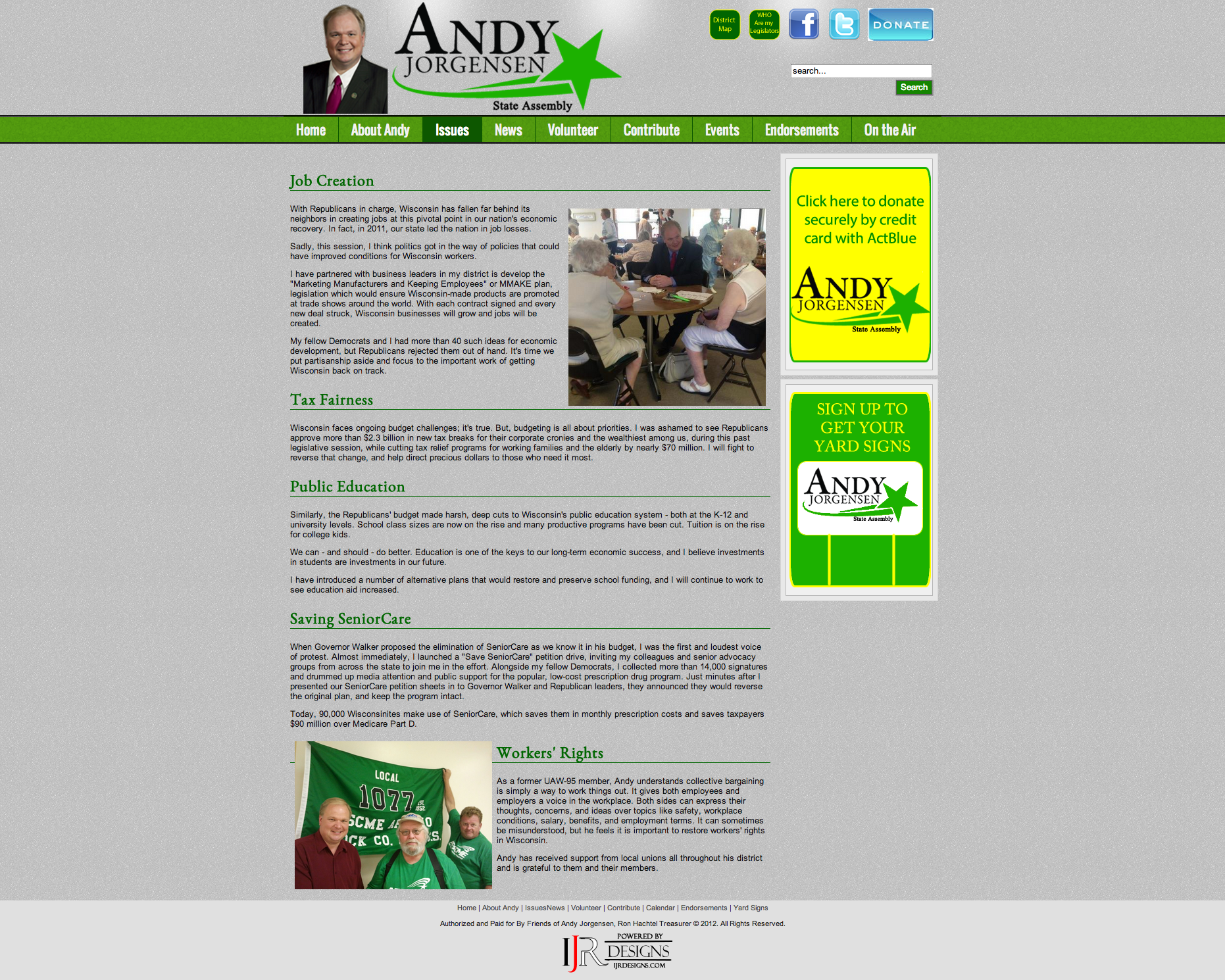
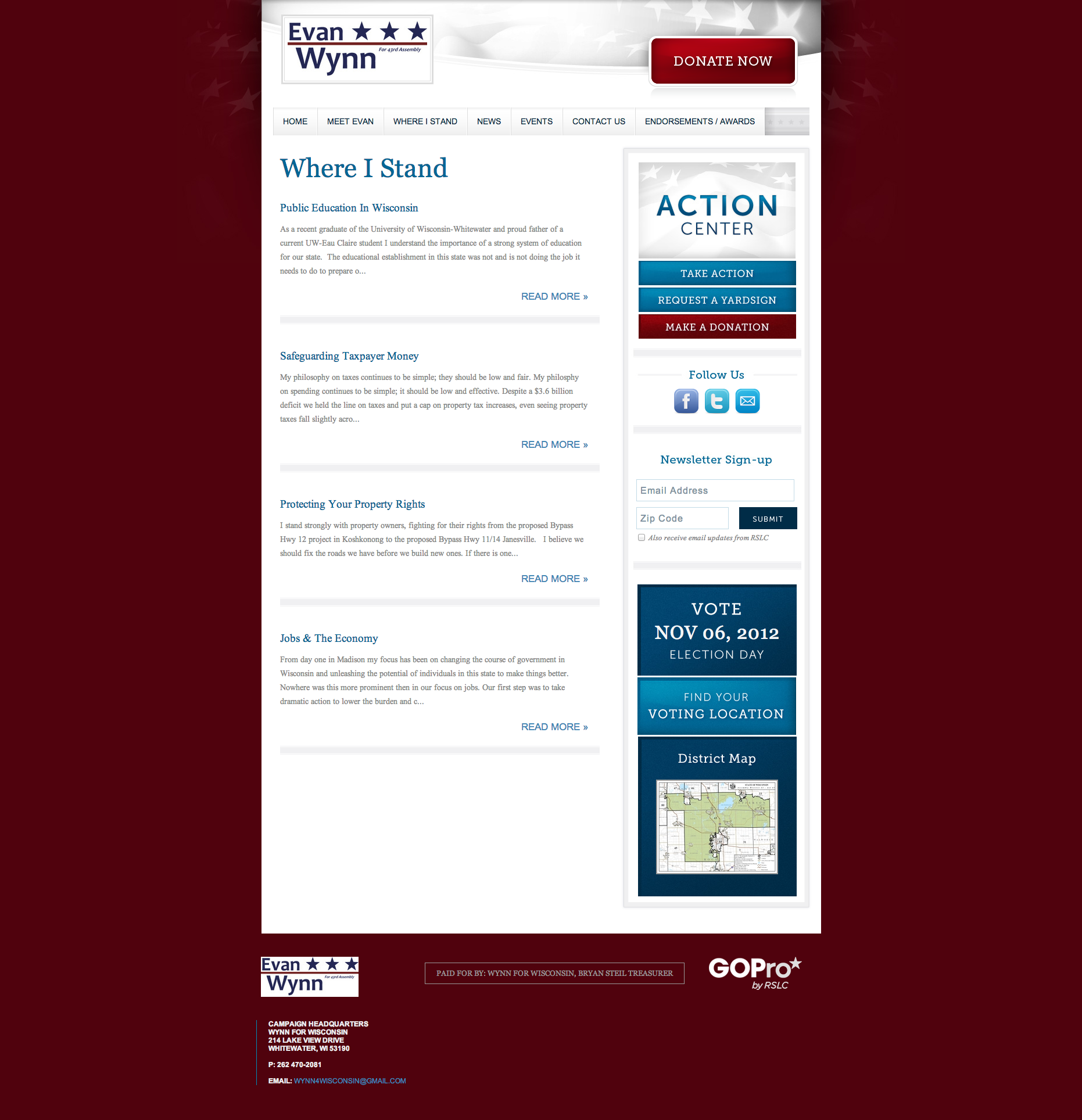
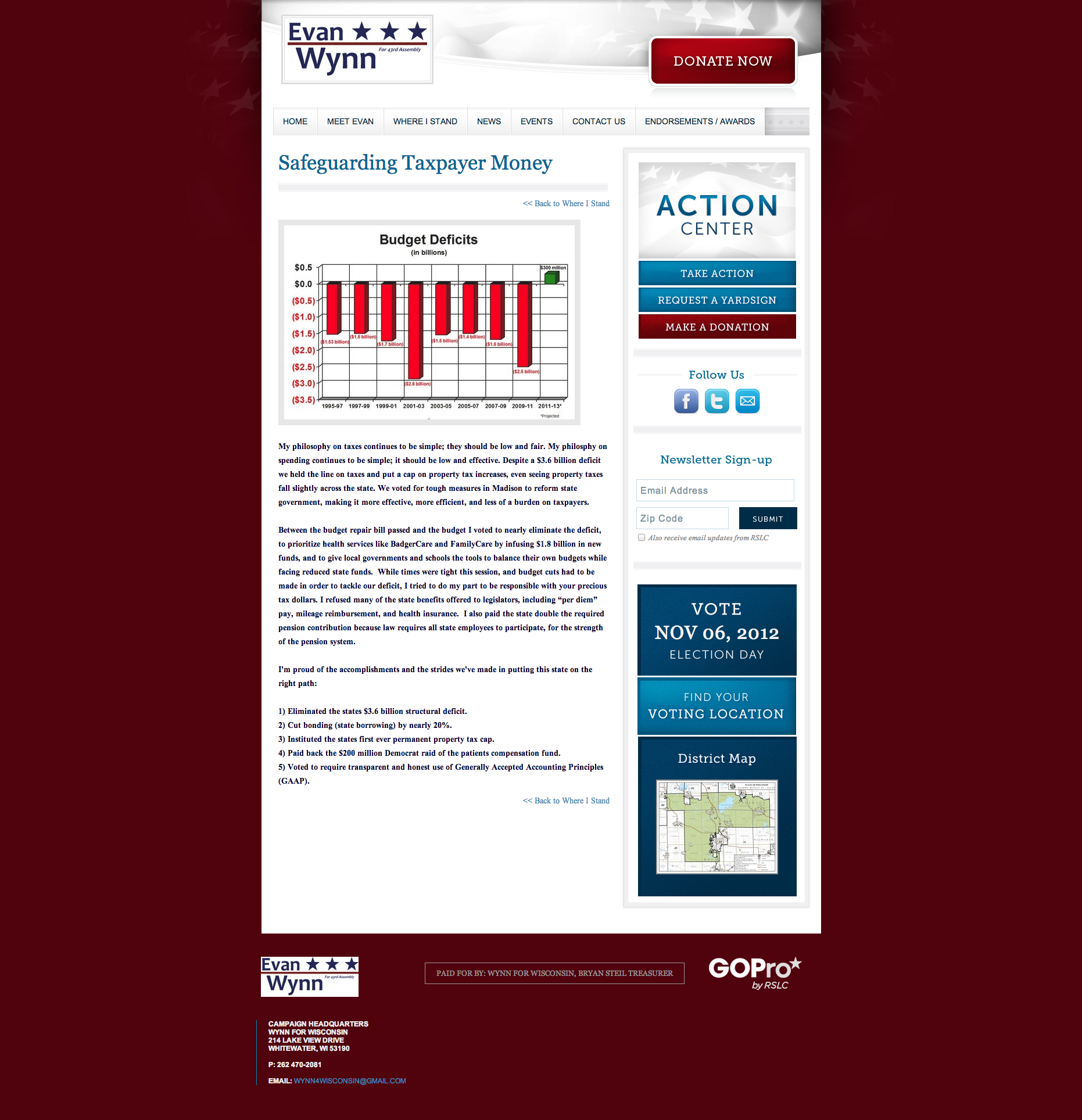
How odd, then, that of the two candidates running for the WI 43rd Assembly District, only one even mentions clearly and expressly on his campaign website restrictions placed on workers’ collective bargaining.

Andy Jorgensen – but not Evan Wynn — refers plainly to these changes on the ‘Issues/Where I Stand’ section of his campaign website?    Perhaps Rep. Wynn doesn’t remember what he was doing on April 6, 2011.  Allow me to refresh his memory:

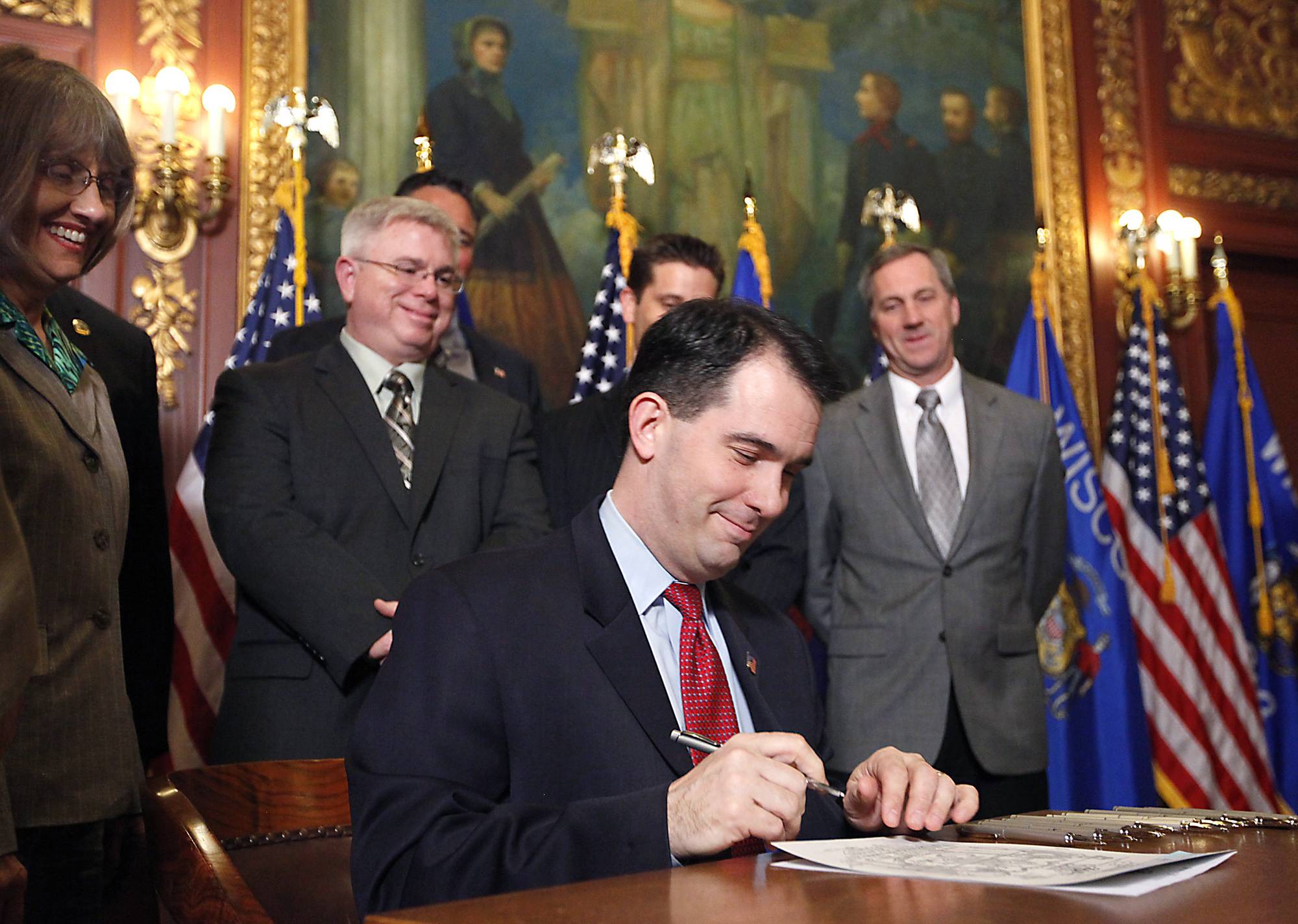
Rep. Evan Wynn stands with Wisconsin Governor Scott Walker at a ceremonial signing of his budget repair bill at the State Capitol building in Madison, Wisconsin on Wednesday, April 6, 2011. The bill repealed most collective bargaining options of public employees. (AP Photo/Wisconsin State Journal, John Hart)
 

I hold an AP license to this photo, as it speaks a thousand words, while about collective bargaining on his website (as of this post, so very close to the election) Rep. Wynn still provides not even one direct, clear word.

(See, Jorgensen’s issues page and Wynn’s issues page and budget highlights. I’ve saved screenshots of the candidates’ respective campaign websites, as of this post, which any American may do of any campaign site as fair use. It’s a right worth exercising and defending.)

Although I support significant and permanent reductions in the size of government, I did not support reductions in (to my mind) all workers’ legitimate rights of association. Some libertarians supported Gov. Walker’s enacted, collective bargaining restrictions, others opposed them. (A solid summary of libertarian view of workers’ union rights, recognizing the competing needs and interests involved, is available from Jacob Levy in a post entitled, ‘Thoughts on unions.’)

To Gov. Walker’s credit, when he ran in the 2012 recall, he ran on all his programs, including express mention of his reductions to workers’ bargaining rights. He held this position throughout the recall elections, and espoused it both in Wisconsin and across America. For his open and express defense of Act 10, he gained loyal Republican supporters in Wisconsin and places far beyond. He might have said the same before the 2010 election, but he was certainly upfront in June 2012.

Although I disagree with his restrictions, I respect that he ran on them plainly in 2012, and I think most Wisconsinites do, too.

In the end, one doesn’t win with people, but on issues, forthrightly stated.

Tomorrow: China and the WI Assembly Race.