FREE WHITEWATER

Monthly Archives: October 2012

Daily Bread for 10.11.12

Good morning.

It’s a breezy day ahead for Whitewater, with a high of sixty-one.

On this day in 1968, America launched the first Apollo manned mission, with astronauts Wally Schirra, Donn Fulton Eisele and R. Walter Cunningham.

Google’s daily puzzle asks about a toy’s inventor: “In his day, a 14th Century rector was famous for discovering the healing quality of the waters at Schorne Well. Today he’s remembered for inspiring a children’s toy. What toy?”

Daily Bread for 10.10.12

Good morning.

Whitewater’s Wednesday looks to be sunny, with a high of forty-eight.

There will be a meeting about the emerald ash borer at 7 PM this evening at the Blackhawk Manor Apartments’ Community Room, 1155 W. Blackhawk Drive, Whitewater, WI 53190.

On this day in 1973, Vice President Spiro Agnew pled guilty to one count of tax evasion, and resigned from office:

Spiro T. Agnew resigned as Vice President of the United States today under an agreement with the Department of Justice to admit evasion of Federal income taxes and avoid imprisonment.

The stunning development, ending a Federal grand jury investigation of Mr. Agnew in Baltimore and probably terminating his political career, shocked his closest associates and precipitated an immediate search by President Nixon for a successor.

“I hereby resign the office of Vice President of the United States, effective immediately,” Mr. Agnew declared in a formal statement delivered at 2:05 P.M. to Secretary of State Kissinger, as provided in the Succession Act of 1792.

On this day in Wisconsin history, in 1982 the Brewers won the AL penant:

1982 – Brewers Win the Pennant

On this date the Brewers won the American League Pennant, securing their spot in the 79th World Series against the National League’s St. Louis Cardinals. The Brewers bounced back from a poor start in the series to become the first team ever to win the League Championship Series after being down 0-2 in the five day series. [Source: Milwaukee Brewers]

Google’s daily puzzle asks a question about geography: “What city would you visit to tour the only royal palace found in the United States?”

The Crude Illegitimacy of Vandalism

There’s a story today that a large, illuminated American flag display in Whitewater was vandalized. The worst crimes are, surely, crimes of violence against people. Yet among property crimes, not involving harm to a person, there’s a particularly crude aspect to vandalism. It’s a purely destructive property crime.

The large display that was damaged this week was years old, had been in numerous parades, and on display throughout the year. It was a non-partisan symbol of support for this country, for our resilience after attack, and for America’s ongoing promise for hundreds of millions.

One has myriad reasons to believe (as I do) in America, for what’s possible on this continent, and through our peaceful relations with friendly nations beyond these shores.

And yet, and yet, even if one doubted these things, it would still be wrong to destroy others’ property, wrong under the law, and wrong even if there were no criminal law at all.

There’s a sad irony in this, too.

The society that has fostered and rightly protected free and peaceful expression in print and online, through newspapers, magazines, books, television, radio, mobile phones, websites, blogs, Facebook, Twitter, and text messages, etc., still has among its number a few who reject these many legitimate means of expression for crude vandalism.

We are right to be disappointed in, frustrated by, and resolute against these crimes.

Daily Bread for 10.9.12

Good morning.

Tuesday brings a high of sixty-one, with showers likely in the late afternoon.

On this day in 1967, Bolivian soldiers killed Cuban revolutionary Che Guevara:


On this day in 1861, the Wisconsin 1st Infantry readied to leave for Louisville:

1861 – (Civil War) 1st Wisconsin Infantry Musters In
The 1st Wisconsin Infantry mustered in on October 9, 1861. It left Wisconsin for Louisville, Kentucky, and moved gradually through Tennessee, Alabama, and Georgia during the war. It would participate in the battles of Perryville and Chickamauga and the Siege of Atlanta. It would lose 300 men during its service. Six officers and 151 enlisted men were killed in combat and one officer and 142 enlisted men died from disease.

Google’s daily puzzle asks about a fictional brand of cigarettes: “What is the brand of government issued cigarettes and gin distributed to the Party members in the George Orwell novel “1984”?”

Waste Digesters and the Ledge Guardians

Nearly one-hundred fifty miles from Whitewater, in Maribel, Wisconsin and surrounding communities, hundreds of residents are organized and committed against a large, commercial waste digester in their area.

They’ve an impressive website on behalf of their dedicated efforts: Ledge Guardianswww.ledgeguardians.com.

There are sound arguments against waste digesters, against how they really work, what they bring into a community, what they spew out into a community, against their empty claims of economic benefit, how the contents of them are described dishonestly, and how those out-of-town interests pushing them never live nearby (but expect others to do so).

A specific proposal for Whitewater, one from which Whitewater’s Community Development Authority rightly turend away, was among the worst projects ever advanced for our city.

One wishes the Ledge Guardians ongoing support to keep their community safe, clean, prosperous, open, and honest.

Daily Bread for 10.8.12

Good morning.

Whitewater’s Columbus Day will be breezy, with a high of fifty-seven.

This evening, Whitewater’s Planning Commission meets at 6 PM, and the Library Board meets at 6:30 PM.

In honor of Columbus Day, the History Channel offers 10 Things You May Not Know About Christopher Columbus. Number 9 is particularly unexpected:

9. Even in death, Columbus continued to cross the Atlantic.

Following his death in 1506, Columbus was buried in Valladolid, Spain, and then moved to Seville. At the request of his daughter-in-law, the bodies of Columbus and his son Diego were shipped across the Atlantic to Hispaniola and interred in a Santo Domingo cathedral. When the French captured the island in 1795, the Spanish dug up remains thought to be those of the explorer and moved them to Cuba before returning them to Seville after the Spanish-American War in 1898. However, a box with human remains and the explorer’s name was discovered inside the Santo Domingo cathedral in 1877. Did the Spaniards exhume the wrong body? DNA testing in 2006 found evidence that at least some of the remains in Seville are those of Columbus. The Dominican Republic has refused to let the other remains be tested. It could be possible that, aptly, pieces of Columbus are both in the New World and the Old World.

Daily Bread for 10.7.12

Good morning.

Sunday will be a day of decreasing clouds, a high of forty-nine, and northwest winds from 5 to 10 MPH.

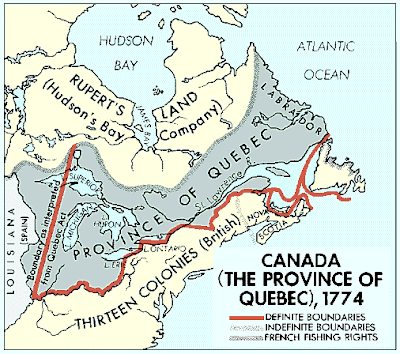
On this day in 1774, Wisconsinites all became a bit more French:

1774 – Wisconsin Becomes Part of Quebec

On this date Britain passed the Quebec Act, making Wisconsin part of the province of Quebec. Enacted by George III, the act restored the French form of civil law to the region. The Thirteen Colonies considered the Quebec Act as one of the “Intolerable Acts,” as it nullified Western claims of the coast colonies by extending the boundaries of the province of Quebec to the Ohio River on the south and to the Mississippi River on the west. [Source: Avalon Project at the Yale Law School]


Puzzle-lovers will enjoy the Smithsonian’s Great American History Puzzle:

George Washington’s spies used invisible ink during the Revolution. Abraham Lincoln’s young cryptanalysts cracked the Confederacy’s “Vicksburg Square” cipher during the Civil War. The United States entered World War I after Britain decoded an encrypted message from the Germans inviting Mexico to wage war on America—the so-called “Zimmermann Telegram.” In World War II, the Marines’ Navajo “code-talkers” were crucial to victories in the Pacific theater.

Because puzzle-solvers and code breakers have long been heroes of American history, we present the Smithsonian Great American History Puzzle. The puzzle is a month-long contest conceived by the puzzle master and “Jeopardy!” champion Ken Jennings. The first person to correctly follow all the clues, avoid all the red herrings and uncover all the secrets will win the grand prize: a free trip to Washington, D.C. and a “Secrets of the Smithsonian” tour (created by Smithsonian Journeys and valued at $10,000) behind the scenes of the world’s largest museum and research complex.

Daily Bread for 10.6.12

Good morning.

Saturday in Whitewater will be mostly sunny and windy, with a high of sixty-three.

On this day in 1866, America saw the first robbery of a moving train:

On this day in 1866, the Reno gang carries out the first robbery of a moving train in the U.S., making off with over $10,000 from an Ohio & Mississippi train in Jackson County, Indiana. Prior to this innovation in crime, holdups had taken place only on trains sitting at stations or freight yards….

As for the Reno gang, which consisted of the four Reno brothers and their associates, their reign came to an end in 1868 when they all were finally captured after committing a series of train robberies and other criminal offenses. In December of that year, a mob stormed the Indiana jail where the bandits were being held and meted out vigilante justice, hanging brothers Frank, Simeon and William Reno (their brother John had been caught earlier and was already serving time in a different prison) and fellow gang member Charlie Anderson.

In Wisconsin history, in 1917 Sen. La Follette delivered a Senate-floor defense of free speech:

1917 – Robert La Follette Supports Free Speech in Wartime
On this date Senator Robert La Follette gave what may have been the most famous speech of his Senate career when he responded to charges of treason with a three hour defense of free speech in wartime. La Follette had votedagainst a declaration of war as well as several initiatives seen as essential to the war effort by those that supported U.S. involvement in the first World War. His resistance was met with a petition to the Committee on Privileges and Elections that called for La Follette’s expulsion from the Senate. The charges were investigated, but La Follette was cleared of any wrong doing by the committee on January 16, 1919. [Source: United States Senate]

Google’s daily puzzle asks about English monarchical intrigue: “The first king to rule the House of Lancaster chose a wife who became unpopular with the people. For what crime was she convicted?”