
FREE WHITEWATER

Monthly Archives: February 2015

About UW-Whitewater Dean Mary Beth Mackin’s Drug War Defense

There’s someone with whom UW-Whitewater’s Dean of Students, Mary Beth Mackin, might wish to speak: Tammy Sadek, mother of the late Andrew Sadek.

Readers may recall that in October, I wrote about Dean of Students Mary Beth Mackin’s defense of using students ensnared in low-level drug stings as confidential informants.  (See, The Dean’s Drug-War Equality Argument.)

Andrew Sadek was a twenty-year-old college student in North Dakota killed after being pressured into a role as confidential informant:

Andrew Sadek, a 20-year-old student at North Dakota State College of Science in Wahpeton, agreed to work as an informant for the Southeast Multi-County Agency Drug Task Force (SEMCA) after he was arrested for selling pot on campus in 2013. His death calls to mind similar cases in which young drug offenders facing draconian penalties were forced into dangerous undercover work, including Rachel Hoffman, a Florida college student who was murdered in 2008 after agreeing to arrange the purchase of MDMA, cocaine, and a gun for $10,000.

Sadek himself was entrapped by a C.I. who bought marijuana from him on two occasions. Although the total value of the sales was just $80, Sadek faced up to 20 years in prison because the sales occurred in a “school zone.” He agreed to do to others what had been done to him, buying marijuana at SEMCA’s direction from two dealers at his school on three occasions from November 2013 to January 2014. Each time Sadek bought an eighth of an ounce for $60. According to the BCI report, he had to buy from two more dealers “to fulfill his obligation in resolving the charges he had been facing.” But at that point Sadek stopped communicating with his handler at SEMCA, which therefore charged him with two felonies and a misdemeanor on May 9.

That was a week after Sadek was reported missing. On June 27 his body was found in the Red River near Breckenridge, Minnesota, with a gunshot wound to the head.

Dean Mackin supports a policy of using confidential informants, and argues that it should be applied to college students as well as non-college students (“I think the important thing is this is not an anomaly to a college campus,” Mackin said. “It’s the same thing that happens to 19-year-old who has not come to college, who’s working somewhere out in society.”)

Hers is a malicious equality argument, encouraging the extension of misery to more, rather than fewer, people. 

(Perhaps she considered herself clever to have advanced that argument; I’ve no idea if she’s able to see how dull and easily overturned her argument truly is.  On a campus with so many talented students and faculty, there must be better prospective administrators.)

At the time, I suggested that Mary Beth Mackin go to an inner-city neighborhood, and ask residents there if they felt better about the effects of the Drug War because she supported that effort on her rural campus. 

Dean Mackin needn’t trouble herself with a visit to an urban area.  Tammy Sadek’s late son attended a rural campus in North Dakota. 

If Ms. Mackin believes so truly and deeply, perhaps she’ll deliver her views to Ms. Sadek, directly. 

Dean Mackin might wish a bit of preparation before that call. 

In the radio interview below, Andrew Sadek’s surviving mother Tammy describes what equal application of Draconian policies feels like:

Tammy Sadek radio interview at KFGO

See, also, UW Campuses Use Undercover Student Informants In Drug Busts.
Daily Bread for 2.3.15

Good morning, Whitewater.

We’ll have a few inches of snow later this afternoon and evening, on a day with a high of nineteen degrees. Sunrise is 7:06 AM and sunset 5:11 PM, for 10h 04m 53s of daytime. We’ve a full moon today.

There are three principal public meetings scheduled for today. Downtown Whitewater’s board meets this morning at 8 AM, the Alcohol and Licensing Committee at 6:15 PM, and Common Council at 6:30 PM.

On this day in 1781, Gen. Nathaniel Greene successfully evades Gen. Charles Cornwallis:

On the evening of February 3, 1781, American General Nathanael Greene and his troops successfully cross the Yadkin River to evade General Charles Cornwallis. The crossing followed consecutive Patriot losses at the Catawba River and at Tarrant’s Tavern, as well as heavy rainfall on February 1, which Greene feared would soon make the river impassable.

Although contradictory evidence exists, it is likely that the efforts of Polish engineer and military advisor Thaddeus Kosciusko made the crossing possible. Kosciusko had made a canoe expedition up the Catawba and Pedee Rivers, assessing Greene’s options, in December 1780. He then built a fleet of flat-bottomed boats for General Greene to use as a means of transporting his men across the water without having to waste time on manual portage, which would have involved soldiers removing the boats from the water and carrying them on their shoulders over land. The boats could be loaded into the Southern Army’s wagons for transport between river crossings. Kosciusko’s study of the rivers also allowed Greene to accurately predict the two-day interval between a heavy rainfall and rising river water.

Greene had ordered the Kosciusko-designed boats to be waiting for his men at the Yadkin. Thus, despite the flood of refugees clogging North Carolina’s roads in a desperate rush to leave before notoriously cruel British Lieutenant Colonel Banastre Tarleton arrived, Greene was able to move his troops to the river and cross it. Although Cornwallis caught the tail-end of the Patriot crossing and shelled Greene’s camp on the far side of the river on February 4, he was not able to cause major damage or disruption.

Greene’s timing was impeccable–Cornwallis was unable to ford the quickly rising Yadkin behind him. Instead, Cornwallis was forced to march his men to the aptly named Shallow Ford and did not finish crossing the Yadkin until the morning of the February 7, by which time Greene and the Southern Army had a two-day lead in the race towards the Dan River and safety in Patriot-held Virginia.

On this day in 1959, an accident claims popular musicians’ lives:

Bad winter weather and a bus breakdown prompted rock-and-roll musicians Buddy Holly, Ritchie Valens, and the Big Bopper to rent a plane to continue on their “Winter Dance Party” tour. Icy roads and treacherous weather had nearly undermined their performances in Green Bay and Appleton that weekend, so after a show at the Surf Ballroom in Clear Lake, Iowa, on February 2, 1959, they boarded a four-seat airplane. The three performers and pilot Roger Peterson perished when the plane crashed about 1:00 AM on Monday, February 3rd (“The Day the Music Died,” according to singer Don McLean in his song “American Pie”) . [Source: Mark Steuer; Wikipedia]

Google-a-Day asks about a virus:

What virus is believed to have caused the destruction of hundreds of thousands of honey bee colonies across North American and Europe in 2007?

Daily Bread for 2.2.15 (Groundhog Day Edition)

Good morning, Whitewater.

After a snowy weekend, Monday brings a mostly sunny day with a high of thirteen. Sunrise is 7:07 AM and sunset 5:09 PM, for 10h 02m 26s of daytime. The moon is a waxing gibbous with 98% of its visible disk illuminated.

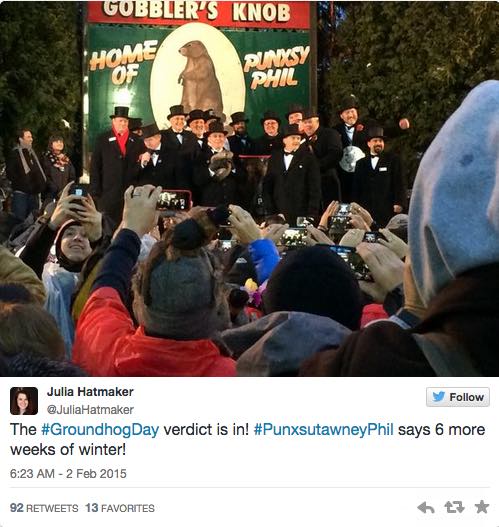
The world’s leading meteorologist, Punxsutawney Phil, predicts that we will have six more weeks of winter.

GroundhogDay2015

America’s first Groundhog Day takes place on this day in 1887:

The date of Phil’s prognostication is known as Groundhog Day in the United States and Canada, and has been celebrated since 1887….

A select group, called the Inner Circle, takes care of Phil year-round and also plans the annual ceremony. Members of the Punxsutawney Groundhog Club’s Inner Circle are recognizable by their top hats and tuxedos.

Prior to 1952, a groundhog named Pete was Punxsutawney’s groundhog. Pete’s downfall was caused by one William A. Swartworth, a rookie newsman in the Pittsburgh bureau of the Associated Press.
As the newest staffer, Swartworth was assigned to write the bureau’s annual Groundhog Day story on February 2, 1952. Veteran newsmen disdained the task, feeling it was simply an exercise of the imagination, the more fanciful the better, fabricated from three basic elements- groundhog emerges from his burrow at sunrise; if he sees his shadow, it’s six more weeks of wintry weather; if not, spring is ready to burst forth.
Swartworth did his job, with one exception. He changed the groundhog’s name from Pete to Phil. Minutes after the story hit the news wires, the AP’s Philadelphia bureau (control point for the state) sent a message challenging accuracy of the groundhog’s name. Swartworth then fired off this historic reply: “Pete died. Phil is his son.” Swartworth chose the name Phil after the notorious con man from the 1950s dubbed Pittsburgh Phil. And so to this day Phil remains the world’s most famous groundhog weather forecaster. [2]

Punxsutawney Phil fans say that there is only one Phil, and that all the other groundhogs are impostors. It is claimed that Pete/Phil has made weather prognostications since 1887, making the Punxsutawney groundhog a legendary rather than factual figure, since groundhogs only live up to six years.[3] It is publicly unknown how many groundhogs have actively played Phil.

According to the Groundhog Club, Phil, after making the prediction, speaks to the Club President in “Groundhogese”, which only the current president can understand, and then his prediction is translated for the entire world.

The Groundhog Day celebration is rooted in a Celtic tradition that says if a hibernating animal casts a shadow on February 2, the Pagan holiday of Imbolc, winter will last another six weeks. If no shadow was seen, legend says spring would come early.
The ties in Pennsylvania may actually come from Germans, when clear skies on Candlemas Day, February 2, were said to herald cold weather ahead. In Germany, the tradition morphed into a myth that if the sun came out on Candlemas, a hedgehog would cast its shadow, predicting snow all the way into May. When German immigrants settled in Pennsylvania, they transferred the tradition onto local fauna, replacing hedgehogs with groundhogs.

On this day in 1905, Wisconsin gets professional baseball:

On this date the Wisconsin State League was formed, bringing professional baseball to five Wisconsin cities. The six-team league began play the following summer with franchises in Beloit, Green Bay, La Crosse, Oshkosh, Wausau, and Freeport, Illinois. The league lasted through 1914, although its named was changed to Wisconsin-Illinois in 1908.

Google-a-Day asks a question about academic standing:

What was the class rank upon graduation from West Point of the man who, until his dispute with the president, was commander of the U.N. troops in Korea?

Daily Bread for 2.1.15

Good morning, Whitewater.

A new month begins with for a snow-covered Whitewater. We’ll have a high of twenty-one today, and an additional accumulation of three to five inches. Sunrise is 7:08 AM and sunset 5:08 PM, for 10h 00m 00s of daytime. The moon is a waxing gibbous with 94.7% of its visible disk illuminated.

Here’s a feline who, on January 24th, made good use of a snowy day in her backyard:

Friday’s FW poll asked which team respondents thought would win the Super Bowl XLIX. A majority of respondents (56%) picked the Patriots.

Google’s Doodle celebrates the 113th birthday of Langston Hughes:

On this day in 1926, Gen. Mitchell resigns:

1926 – General Billy Mitchell Resigns
On this date General William “Billy” Mitchell resigned from the United States Air Service after he was found guilty of insubordination at a court martial hearing. He was suspended from active duty for five years. A Milwaukee native, Mitchell vigorously opposed the Army’s concentration on maritime power instead of air power. Mitchell devoted his life to the study and execution of air power, and was recognized as the top American combat airman of World War I. There was one dissenter in the court martial hearing – General Douglas MacArthur, an old Milwaukee friend. [Source: American Airpower Biography]