FREE WHITEWATER

Monthly Archives: September 2017

Daily Bread for 9.11.17

Good morning.

Monday in Whitewater will be sunny with a high of seventy-five. Sunrise is 6:31 AM and sunset 7:10 PM, for 12h 39m 04s of daytime. The moon is a waning gibbous with 70% of its visible disk illuminated. Today is the {tooltip}three hundred sixth day.{end-texte}Days since Trump’s election, with 11.9.16 as the first day.{end-tooltip}

Whitewater’s Planning Commission meets this evening at 6:30 PM.

Today is the sixteenth anniversary of coordinated Al Qaeda terrorist attacks on the continental United States. On this day in 1903, auto racing rebuts at the Milwaukee Mile.

Recommended for reading in full

Jeffrey Goldberg ponders The Autocratic Element (“Can America recover from the Trump administration?”):

Like many people, I’ve lately been preoccupied by the mayhem-makers of the radical right, and by those in power who abet their work. But even as Nazis were invading Charlottesville, Virginia, in August, I found myself worrying about a more subtle, but still substantially pernicious, manifestation of democratic decay. This is the apparently deathless attempt by certain rightist Republicans to bring Hillary Clinton to “justice,” a cause rationalized this way by one such Republican, a freshman congressman from Florida named Matt Gaetz: “Just because Hillary Clinton lost the election doesn’t mean we should forget or forgive conduct that is likely criminal.”

Let us lay aside the question of whether the charges of criminality leveled against Clinton are specious (they certainly seem to be) and focus instead on the novelty of Gaetz’s mission. The idea he is endorsing—if not on behalf of Donald Trump, then in the spirit of Donald Trump—is that the political party that wins power is duty-bound to hound to the point of actual prosecution the losing party.

This is un-American, and I mean that in a very specific way. I’ve spent much of my reporting career covering countries that are not ruled by law, and that do not venerate the democratic norms of restraint, moderation, forgiveness, and compromise. It is common for autocratic rulers, even those who took office through ostensibly democratic elections, to persecute the individuals and parties that they have vanquished, for reasons ranging from paranoia to simple vindictiveness. America, though, has been different. It is not uncommon in the U.S. for the losers to challenge the victories of the winners, and this is as it should be. But it is a dangerous innovation to use the instruments of state power to harass powerless, defeated political foes. The fractures that this sort of behavior causes are not easily healed….

(Even at best, we’ve a long road ahead.)

Adam Bates contends Trump’s Decision on Military-Style Weapons Will Harm Communities:

In 2004, then-Sheriff Joe Arpaio’s SWAT team in Maricopa County, Ariz., raided a suburban home looking for illegal firearms.

The raid was a comedy of ineptitude.

The officers drove their armored vehicle into a parked car on the street. They changed into military-style uniforms on the lawn, leading a neighbor to conclude that they might have been amateur paintballers or even gang members. One of the many tear gas canisters police fired into the home apparently sparked a fire and set the home ablaze. A dog trying to flee the fire was scared back into the home, where it died.

Instead of a cache of illegal weapons, the raid recovered an antique shotgun and a legally owned 9mm handgun, and officers made only one arrest — for a failure to appear in court over traffic violations.

It should go without saying that military weapons and tactics should be reserved for the most pressing circumstances. Yet the Trump administration is taking the country backward by again giving police departments access to the most dangerous artillery that is often unnecessary for local officers….

Monika Bauerlein and Clara Jeffrey write that Trump’s Signals to White Supremacists Aren’t Dog Whistles. They’re Flares:

“They may not be ready for the Ku Klux Klan yet, but as anti-white hatred escalates, they will.”

That was Rachel Pendergraft, a spokeswoman for the political arm of the Ku Klux Klan (yes, this exists), talking last year about the way the Trump campaign was helping racist and white supremacist groups reach a growing audience. Mother Jonesinterviewed her as part of a big investigation, which found that these extremists were seeing Trump as legitimizing their once-hidden views.

Hearing people like Pendergraft talking this way—taking off the hood, as it were—was shocking enough. But here’s what really stunned us in reporting out that story: Not only were extremists excited by Trump’s campaign. Not only were they using it to recruit on a scale they hadn’t imagined before. They felt that the campaign was signaling to them actively and deliberately—and the more we dug, the more we realized they were right….

Sen. Jeanne Shaheen warns of The Russian Company That Is a Danger to Our Security:

MADBURY, N.H. — The Kremlin hacked our presidential election, is waging a cyberwar against our NATO allies and is probing opportunities to use similar tactics against democracies worldwide. Why then are federal agencies, local and state governments and millions of Americans unwittingly inviting this threat into their cyber networks and secure spaces?

That threat is posed by antivirus and security software products created by Kaspersky Lab, a Moscow-based company with extensive ties to Russian intelligence. To close this alarming national security vulnerability, I am advancing bipartisan legislation to prohibit the federal government from using Kaspersky Lab software.

Kaspersky Lab insists that it has “no inappropriate ties with any government.” The company’s products, which are readily available at big-box American retailers, have more than 400 million users around the globe. And it provides security services to major government agencies, including the Department of State, the National Institutes of Health and, reportedly, the Department of Defense….

(Kaspersky isn’t the only Russian company with state-security ties to Putin, to be sure.)

A dog meets a bear, and the dog wins the field:
Daily Bread for 9.10.17

Good morning.

Sunday in Whitewater will be sunny with a high of seventy-one. Sunrise is 6:30 AM and sunset is 7:12 PM, for 12h 41m 55s of daytime. The moon is a waning gibbous with 79.4% of its visible disk illuminated. Today is the {tooltip}three hundred fifth day.{end-texte}Days since Trump’s election, with 11.9.16 as the first day.{end-tooltip}

On this day in 1913, Oliver Hazard Perry achieves an American victory over Britain at the Battle of Lake Erie, capturing six British vessels. The victory “ensured American control of the lake for the rest of the war, which in turn allowed the Americans to recover Detroit and win the Battle of the Thames to break the Indian confederation of Tecumseh. It was one of the biggest naval battles of the War of 1812.” On this day in 1863, “Union forces, including 27th and 28th Wisconsin Infantry regiments, [win] engagements at Bayou Fourche and Little Rock, Arkansas.”

Recommended for reading in full —

Scott Bauer reports that Lawmakers add $4 million for tiny Wisconsin airport near golf course:

A tiny airport in central Wisconsin that’s seen an influx of private jets since a Republican donor’s world-class golf course opened nearby would get $4 million in improvements under funding slipped into the state budget this week.

The Republican-controlled Joint Finance Committee approved the funding after the developer of the Sand Valley Golf Resort, Michael Keiser, donated $25,000 to the state Republican Party in February, records reviewed by The Associated Press show.

That donation was three weeks after Gov. Scott Walker released his budget without funding for Wisconsin Rapids’ Alexander Field. Keiser has given at least $65,000 to Walker and Wisconsin Republicans since 2012….

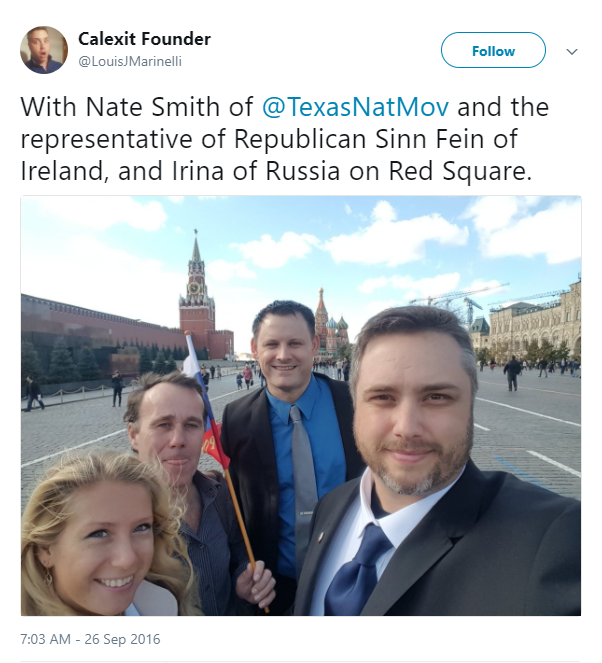
Casey Michel reports How Russia Created the Most Popular Texas Secession Page on Facebook:

….Moscow’s ties to the California secession movement, which received a boost following Donald Trump’s election, have seen the greatest coverage?—?understandably so, given the former #Calexit leader’s willingness to highlight his links to the Moscow-funded Anti-Globalization Movement of Russia (AGMR) at every turn. Only so many people would be willing to open a “California Embassy” in Moscow, after all. (For my own writings on #Calexit’s myriad ties to Russia, in addition to the links above, click here, here, or here.) As Jonathon Morgan, the founder of Data for Democracy, noted a few months back in detailing the online footprint of Russia and California secessionists, the primary group pushing #Calexit was further “amplified by many of the same accounts that infiltrated conservative Twitter communities and promoted a pro-Trump, white nationalist agenda.” Not exactly an organic upswell.

#Calexit was further “amplified by many of the same accounts that infiltrated conservative Twitter communities and promoted a pro-Trump, white nationalist agenda.”

But for all of the egregious links between Russia and California separatists, the earliest foray into ties between Moscow-linked actors and American secession movements, per my research, was found in my former home: Texas. Back in 2015, I put together a piece for POLITICO Magazine detailing the ties between Lone Star secessionists and Russia, dovetailing off a recent visit from the Texas “foreign minister” to St. Petersburg, where the Texan turned to Russian media to fan the flames of secession. As local Russian officials were threatening to deliver arms to Mexico (and unidentified “guerrillas”) to allow Mexico City to reclaim Texas, Texas secessionists themselves were finding sympathetic ears in Moscow.

Then, in 2016, the same “foreign minister,” the Texas Nationalist Movement’s (TNM) Nathan Smith, returned to Russia, attending the same pro-secession conference as the California secessionists?—?and, this time, with the AGMR, the group behind the conference, receiving funding from the Kremlin. In the time since, it’s come out that the AGMR also helped fund the Texan’s travel to Russia….

Ron Synovitz reports that Facebook Manipulation Echoes Accounts From Russian ‘Troll Factory’:

A Facebook official on September 6 told The Washington Post there was evidence that fake accounts used to promote the Russian-bought Facebook ads were linked to the International Research Agency.

Past RFE/RL interviews with former employees of the Internet Research Agency’s operations paint a picture of a hard-charging operation that relies on a combination of methods — from generating fake news, disinformation, and memes to building up networks of fake social-media accounts run by “troll” employees who flood web forums with posts in an attempt to manipulate public opinion.

Lyudmila Savchuk told RFE/RL in 2015 that the firm was targeting Russian and English-language social-media sites at the time. “There are hundreds of people, operating around-the-clock, writing thousands of comments, texts, and posts on all social-media sites and blogs,” she recounted.

“They comment on media articles and write for social-networking sites, pretending to be ordinary people,” Savchuk said. “They run blogs under false pretenses. They promote ideas they were given through verbal or written instructions.”

Stand Up Republic shares Combating Fake News: 4 Strategies to Separate Fact from Fiction:

As our society adapts to this new landscape —one the President aggravates by labeling any media that challenges him as “the enemy” or “fake news” — foreign adversaries look to spread their own propaganda. Their disinformation campaigns exploit our free and open media, sowing chaos and eroding democracy in the process.

When consuming media from any source, and in particular online, one must navigate our digital world carefully. Know what to look for, and help your family and friends avoid spreading misinformation too.

Here are four strategies to help you identify fake news:

1. Examine the source

First, look at the URL: have you ever heard of breakingnews365.net before? If you haven’t, be wary of the site’s contents….

2. Check your shock level

Did the article you just read shock you because it’s inconsistent with known facts? Did it seem designed to play on your emotions? If a claim or story seems outrageous, don’t take it at face value. It’s possibly twisted to confirm your worst fears and suspicions, or simply made up altogether….

3. Consult Google (or maybe Bing?)

….Example: Fox News, MSNBC and the New York Times each published an article about President Trump and Steve Bannon around August 15, 2017. While each source frames the story differently, it’s probably safe to conclude that this is real news….

4. Compensate for media bias

….Where do you gather your news, generally speaking? If it’s largely through TV, consider reading a newspaper. If you typically read Fox News articles online, consider watching CNN….

(On this last point, I’d suggest skipping Fox entirely; one can balance other networks adequately. Still, the point holds generally.)

James Gorman and Mae Ryan describe how Wild Dogs Sneeze to Hunt:

Daily Bread for 9.9.17

Good morning.

Saturday in Whitewater will be sunny with a high of seventy-one. Sunrise is 6:29 AM and sunset 7:14 PM, for 12h 44m 46s of daytime. The moon is a waning gibbous with 87.5% of its visible disk illuminated. Today is the {tooltip}three hundred fourth day.{end-texte}Days since Trump’s election, with 11.9.16 as the first day.{end-tooltip}

On this day in 1776, the Second Continental Congress makes official the term ‘United States,’ replacing ‘United Colonies.’ On this day in 1864, the 20th Wisconsin Infantry and 4th Wisconsin Cavalry participate in an expedition from Mobile Bay to Bonsecours and Fish River, Alabama.

Recommended for reading in full —

Gloria Borger and Marshall Cohen report Document details scrapped deal for Trump Tower Moscow:

Washington (CNN) Around the time presidential candidate Donald Trump was touting his real estate dealings at a Republican primary debate, a proposal was in the works to build a Trump Tower in Russia that would have given his company a $4 million upfront fee, no upfront costs, a percentage of the sales, and control over marketing and design. And that’s not all: the deal included the opportunity to name the hotel spa after his daughter Ivanka.

An internal Trump Organization document from October 2015, obtained by CNN on Thursday, reveals the details of a 17-page letter of intent that set the stage for Trump’s attorney to negotiate a promising branding venture for Trump condominiums, a hotel and commercial property in the heart of Moscow. Trump signed the document later that month, according to Michael Cohen, his corporate attorney at the time. The document CNN obtained does not have Trump’s signature because it is a copy of the deal that Cohen brought to Trump to sign….

Trump did not mention during the presidential campaign that his company explored the business deal in Russia. Instead, he insisted that he had “nothing to do with Russia.” Even when talking about his past dealings with Russians — like the Miss Universe pageant he held in Moscow in 2013 — Trump never referred to the prospective licensing deal that fell through a few weeks before the Iowa caucuses….

Ryan Lizza writes how Donald Trump, Jr., Attempts to Explain That Russia Meeting:

….Over the course of five hours of private testimony and in a nearly eighteen-hundred-word public statement, Trump, Jr., tried to offer a more definitive account of the June, 2016, meeting held at Trump Tower between senior members of his father’s Presidential campaign and a group of Russians promising opposition research about Hillary Clinton. In the statement, Trump, Jr., denied that any collusion occurred, and painted himself as distracted by the “maelstrom” of the campaign and by running the family business. He played down his interest and understanding of an associate’s offer of information from the Russian government. “I did not quite know what to make of his email,” Trump, Jr., said. “I had no way to gauge the reliability, credibility or accuracy of any of the things he was saying.”

Trump, Jr., is now the third person who has testified to Congress about the meeting. Paul Manafort, the campaign chairman, and Jared Kushner, the President’s son-in-law and in many ways the de-facto campaign manager, both testified before congressional committees in July. All of the testimony occurred behind closed doors. Manafort, who turned over notes about the Trump Tower meeting to the Senate Intelligence Committee, has been silent about what he told Congress, while Kushner publicly released the opening statement he made to the committee.

One of the questions raised by the three men’s testimonies is the extent to which their accounts of the meeting are consistent. Kushner’s July statement to congressional investigators was notable for how much he assigned responsibility for the meeting to his brother-in-law. “In June 2016, my brother-in-law, Donald Trump Jr. asked if I was free to stop by a meeting,” Kushner said in his statement. He insisted that the meeting was “a waste of our time” and that he had forgotten about it until it was raised in the press this year….

Renato Mariotti offers his assessment of Trump’s written statement in A Former Federal Prosecutor Dissects Donald Trump Jr.’s Statement to Congress:

Unlike the prior statements of Donald J. Trump Jr., which drew criticism and may have created potential liability for him and others, his Statement to the Senate Judiciary Committee appears to have been created with the assistance of counsel. Nonetheless, the prior statements limited what Trump Jr. could say here without creating contradictions that could be used against him. In this statement to Congress, the stakes are very high for Trump Jr., because lying to Congress is a federal crime. By carefully examining what he said, and what he didn’t say, we can gain insight into his legal strategy.

STATEMENT OF DONALD J. TRUMP JR.
September 7, 2017

I welcome the opportunity to share this prepared statement in an effort to set forth the sum and substance of what I know regarding a meeting I attended on June 9, 2016[1]. I am thankful for the opportunity to meet with you today and look forward to answering all of your questions. As will become clear, I did not collude[2] with any foreign government[3] and do not know of anyone who did[4].

[1] This is meant to limit the scope of his statement. He might know things about other meetings, and his failure to volunteer them in this statement will be attributed to this clause.

[2] The term “collude” has no legal significance whatsoever. What matters legally is whether he agreed to commit a crime with someone else, whether he knew about a crime and helped make it succeed, or whether he actively concealed a crime. So Trump Jr. is not denying that he committed a crime. Whether his denial is broader or more narrow than that depends on what exactly is meant by “collude” in this statement, which we don’t know.

[3] Does this include individuals who were associated with a foreign government, or who held themselves out to be? He could potentially make this statement even if he “colluded” with individuals at the Trump Tower meeting. He would simply deny they were officials of a foreign government. And the full statement scrupulously avoids any mention of the Russian government, which leaves room for him to claim they were not involved in the events in question or that he had no belief of their involvement.

[4] This doesn’t mean much, for two reasons. First, as discussed above, “colluding with a foreign government” is a vague and potentially narrow phrase. Second, just because Trump Jr. claims he knows no one who “colluded” doesn’t mean he doesn’t have knowledge that could be evidence of a crime. Criminals don’t always announce their crimes to others or reveal all parts of their crimes to others….

(I’d particularly invite readers to review Atty. Mariotti’s assessment in full. It’s how a capable attorney would assess a statement within his or her field. Sophistry on Fox News or Breitbart ignore or distort centuries of legal tradition. Neither Trump nor his family have successfully overturned that tradition, of which they show neither respect nor understanding.)

Casey Newton contends that Why we can’t trust Facebook’s story about Russian ads:

….Independently of the Russia inquiry, Facebook has suffered a series of embarrassing revelations this year about its advertising metrics, requiring the company to apologize at least three times. In one case, it admitted to overestimating the average viewing time for video ads for two years; in another, it admitted to inflating the number of visitors to businesses’ pages. Another glitch resulted in some advertisers being overcharged. On the same day as the Russian ad buy revelation, an analyst said Facebook overstated the number of people its ads reach by at least 10 million, using US Census data as a reference point. (Facebook said the estimates “are not designed to match population or census estimates.”)

On one level, the glitches have little to do with Facebook’s ability to track the purchase of ads by Russian agents. But they suggest a sloppiness with data practices that places anything Facebook says about ad-buying efforts — the number of ads bought by fake pages, for example — under a cloud of suspicion. The fact that Facebook initially found no evidence of Russian involvement in the ad-targeting scheme has lessened the credibility of its subsequent disclosures.

Finally, and perhaps most consequentially, there’s Facebook’s reluctance to share relevant information about political advertising on the platform. The company refused to release any of the Russian ads it found, saying that doing so would violate its data policy and federal law. (It did not specify which law. In fact, political ads that air on television and radio are required to be made available for public inspection.)….

Tech Insider explains that most hurricanes that hit the US come from the same spot in the world:

Trump’s Stifling Techniques

Consider three basic rhetorical techniques that Trump (borrowing from the Soviets and Putin) so often uses (blatant lies, whataboutism, and that a given contention is obvious) and one finds that each technique is designed to avoid discussion, to avoid inquiry, to end debate.

He aims to stifle.

1. Blatant falsehoods. Trump lies or makes false statements repeatedly, now numbering in the hundreds just since January 20th. Daniel Dale of the Toronto Star has a running tally of Trump’s lies, from small to big. Often, these lies are also absurdities, simply nutty & false.

Example: Trump claims “As you know, Mexico has a tremendous crime problem – tremendous – one of the number two or three in the world.” Fact: “According to United Nations homicide-rate figures, Mexico is not even in the 15 deadliest countries in the world. Trump appeared to be referring to a study he previously shared on Twitter, which concluded that Mexico had the second-most “armed conflict fatalities” in the world in 2016. But its methodology and conclusion were widely questioned, and the organization behind the study, the International Institute for Strategic Studies, later acknowledged it had made an error. “We accept there was a methodological flaw in our calculation of estimated conflict fatalities that requires revision. Our researchers are working to rectify this and we will share the results in due course,” the organization said in a statement in June.”

Trump’s goal: Persuade low-information, gullible followers to accept what he says at face value. He typically throws a bogus or distorted ranking into his claim (e.g., “number two or three in the world”) to make his statement seem considered, measured, accurate. His hope is that dupes won’t research his contentions. They’re designed to be accepted initially, immediately, and unquestioningly.

2. Whataboutism. This is a Soviet-era technique that Trump and Putin now use frequently. When confronted with an accusation of misconduct or wrong-doing, the user quickly tries to shift the focus to another subject rather than his or her own misconduct.

Examples: If someone questioned Soviet human rights conduct at the time, the Soviets would ask “what about Indian reservations in America?” If someone rightly questions Trump’s many conflicts of interest, he’ll try to divert attention to Hillary Clinton’s emails, the Clinton Foundation, etc.

Needless to say, past or concurrent injustices elsewhere do not exonerate a wrongdoer for his own, immediate misdeeds. That tribes were mistreated, or that Clinton had problems with an email server, would not justify Soviet brutality of Trump family self-dealing.

Trump’s goal: Stop consideration of his own misconduct, there and then, by blaming someone else for something, anything. Point to an unconnected out-group to divert attention from his own in-group conduct.

3. Obviousness. Simply declare something a matter of common sense, merely insist it’s obvious. Deny that there might be a relevant and material objection to what’s being said. David Graham discusses this at length in Why Trump Invokes ‘Common Sense’ (“It serves as a justification for his policies and as an antidote to expert opinion.”)

Example: Here’s an example, that Graham uses in his essay:

It is common sense [to Trump] that the only way to keep people and drugs from crossing the Mexican border is to build a wall from ocean to gulf. But experts reject that, noting the physical impossibility of sealing some parts of the border and pointing out that unauthorized immigrants and illegal drugs get through the border by various measures—semi truck, for example. (Ironically, border crossings have declined sharply since Trump’s inauguration, offering evidence against the notion that illegal immigration can be controlled only with a wall.)

Aside: Graham notes that Thomas Paine, in Common Sense, used the term knowingly, in a way more insightful than Trump ever has: “The title of Thomas Paine’s Common Sense appealed to the wisdom of people in governing themselves, but it cracked an implicit joke, too: The idea of democratic governance was decidedly not commonsensical for the era.” In any event, Paine didn’t merely offer a contention – he produced a reasoned, lengthy argument in support of it. Trumpism, like Putinism, is the opposite: it seeks to inhibit debate in favor of servile, unthinking, immediate acceptance.

Trump’s goal: Swallow what he says without question. Don’t look to studies or inquiries. Take his world for it.

By each of these three techniques, Trump aims to stifle relevant debate. He seeks only one-round of statements – his own – and then only enthusiastic applause (or silent acceptance) in reply.

Friday Catblogging: Nursery

LOS ANGELES — They are brought into shelters in crates, boxes and flower pots at this time of the year: Tiny, mewing kittens with eyes barely open, with pink, toothless mouths — and usually with no mother to nurse them.

And here’s what it takes to keep them alive: people to hand-feed formula through a syringe or tiny bottle every two to three hours around the clock, until the newborns are 4 weeks old. Most shelters do not have the resources to do this, so kittens younger than 8 weeks — the earliest age of adoption — are typically euthanized.

Not so at a stucco-sided facility on the north side of Los Angeles. Sophia Lim, one of its many volunteers, knows the routine. Hands clad in blue surgical gloves on a spring afternoon, she gingerly weighs a 4-week-old beige kitten named Osbourne on a small tabletop scale, then places him belly-down on her chest and holds a travel shampoo-sized bottle to his lips. A few minutes later, she moves on to one of the other 81 unweaned kittens who needed to eat….

Via A kitten nursery saves tiny lives in a city aiming to become ‘no kill’ @ Washington Post.

Daily Bread for 9.8.17

Good morning.

Friday in Whitewater will be increasingly sunny with a high of sixty-five. Sunrise is 6:28 AM and sunset 7:15 PM, for 12h 47m 37s of daytime. The moon is a waning gibbous with 93.9% of its visible disk illuminated.Today is the {tooltip}three hundred third day.{end-texte}Days since Trump’s election, with 11.9.16 as the first day.{end-tooltip}

On this day in 1504, Michelangelo’s David is unveiled in Florence. On this day in 1862, the 4th Wisconsin Infantry participates in a fight at St. Charles Court House in Louisiana.

Recommended for reading in full —

Ben Collins, Kevin Poulsen, and Spencer Ackerman report Russia’s Facebook Fake News Could Have Reached 70 Million Americans (“Facebook acknowledged that Russian propagandists spent $100,000 on election ads. It neglected to mention how many millions of people those ads reached.”):

Russian-funded covert propaganda posts on Facebook were likely seen by a minimum of 23 million people and might have reached as many as 70 million, according to analysis by an expert on the social-media giant’s complex advertising systems. That means up to 28 percent of American adults were swept in by the campaign.

On Wednesday, Facebook’s chief security officer, Alex Stamos, revealed that Russia had “likely” used 470 fake accounts to buy about $100,000 worth of advertising promoting “divisive social and political messages” to Americans. It was Facebook’s first public acknowledgment of the role it unwittingly played in the Kremlin’s “active measures” campaign. Stamos’ statement was also conspicuous by what it omitted: Facebook has refused to release the ads. More significant, it hasn’t said what kind of reach Russia attained with its ad buy.

There may be a reason for that. On the surface, $100,000 is small change in contemporary national politics, and 3,000 ads sounds like a drop in the pond when Facebook boasts 2 billion monthly users. But it turns out $100,000 on Facebook can go a surprisingly long way, if it’s used right. On average, Facebook ads run about $6 for 1,000 impressions. By that number, the Kremlin’s $100,000 buy would get its ads seen nearly 17 million times….

Scott Shane reports on The Fake Americans Russia Created to Influence the Election:

….An investigation by The New York Times, and new research from the cybersecurity firm FireEye, reveals some of the mechanisms by which suspected Russian operators used Twitter and Facebook to spread anti-Clinton messages and promote the hacked material they had leaked. On Wednesday, Facebook officials disclosed that they had shut down several hundred accounts that they believe were created by a Russian company linked to the Kremlin and used to buy $100,000 in ads pushing divisive issues during and after the American election campaign.

On Twitter, as on Facebook, Russian fingerprints are on hundreds or thousands of fake accounts that regularly posted anti-Clinton messages. Many were automated Twitter accounts, called bots, that sometimes fired off identical messages seconds apart — and in the exact alphabetical order of their made-up names, according to the FireEye researchers. On Election Day, for instance, they found that one group of Twitter bots sent out the hashtag #WarAgainstDemocrats more than 1,700 times….

Given the powerful role of social media in political contests, understanding the Russian efforts will be crucial in preventing or blunting similar, or more sophisticated, attacks in the 2018 congressional races and the 2020 presidential election. Multiple government agencies have investigated the Russian attack, though it remains unclear whether any agency is focused specifically on tracking foreign intervention in social media. Both Facebook and Twitter say they are studying the 2016 experience and how to defend against such meddling….

David Graham ponders What the Russian Facebook Ads Reveal:

The news that Facebook ran tens of thousands of dollars worth of ads from a Putin-linked Russian troll farm is the latest evidence that the Kremlin has proved adept at turning those features of the American system it most detests into advantages for itself. Although Putin is an apostle of illiberalism, he has picked up on U.S. freedom of the press as a useful tool for Russian messages. In this case, propagandists for the nationalist Russian state are working to turn America’s diversity against it, using potent wedge issues to create and widen social fissures.

Foreigners are prohibited from spending to influence an election, so there could be a violation of law and Federal Election Commission guidelines, but it’s not like Russia is going to extradite anyone to the U.S. to face campaign-finance charges. The ads could only be further evidence of Russian attempts to interfere in the election, which at this point is acknowledged by nearly everyone save the president. But if, as Senator Mark Warner and others have implied, the Russians might have received guidance on who to target with the ads, it might point closer to the elusive smoking gun proving collusion between the Trump campaign and the Russian government. There’s also no way to know whether the estimated $100,000 buy, a relative pittance by campaign-spending standards, is the end of the splurge or just the start….

The exploitation of the free press as a means to advance the Kremlin’s ends is not a new tactic. RT, the television channel formerly known as Russia Today, is a hybrid of an actual news-gathering operation with a propaganda outlet. But a report from the Office of the Director of National Intelligence on Russian interference in the election, issued in January, focused on the ways the Russian government used both traditional media and social-media trolling to further its goals in the election, and singled out the Internet Research Agency. That report cited a riveting 2015 article by Adrian Chen on the company, which describes how it functions as a troll farm for pro-Putin propaganda, as well as to advance the interests of commercial clients….

Denise Clifton reports Disturbing New Evidence of How Trump Is Boosting Misinformation and Propaganda:

The signs started popping up on the margins of social media as far back as 2010: Like-minded conspiracy theories spread by far-right sites like InfoWars and Russian government-controlled media like RT [Russia Today, a Putin-controlled propaganda mill]. Tweets that accused mainstream media organizations of reporting “fake news.” And later, social media networks that appeared to follow both white nationalist and Wikileaks-related accounts.

Initially, University of Washington professor and researcher Kate Starbird was studying how rumors spread on social media after disasters; they typically began with high volume after a crisis and then dissipated as news reports confirmed what happened. Then, in 2013, sorting through data after the Boston Marathon bombings, Starbird and her students noticed another kind of rumor—a kind that gained traction and volume over a longer period of time, in spite of facts confirmed in news reports. These longer-lasting rumors often intersected with politicized content. In the sustained chatter about the Boston terrorist attack, they noticed Twitter accounts pushing an alternative narrative, a conspiracy theory that Navy SEALS had bombed the race, not the Tsarnaev brothers.

Starbird mostly dismissed these kinds of alternative narratives as outliers, a conclusion she would later regret. Then came 2016, when hyper-politicized disinformation that spread in the aftermath of mass shootings and the Paris terrorist attacks was impossible to ignore. She and her team were compelled to dig deeper into the data. And as the “fake news” language of far-right and Russian media conspiracy theorists was embraced by Donald Trump and his presidential campaign, Starbird realized the phenomenon was going mainstream….

Margaret Sullivan observes that Facebook’s role in Trump’s win is clear. No matter what Mark Zuckerberg says:

….It’s even more obvious now after Wednesday’s news that Facebook sold ads during the campaign to a Russian “troll farm,” targeting American voters with “divisive social and political messages” that fit right in with Donald Trump’s campaign strategy.

The news, reported Wednesday by The Washington Post, fits right in with the findings of a fascinating recent study by Harvard’s Berkman Klein Center for Internet and Society. Analyzing reams of data, it documented the huge role that propaganda, in various forms, played in the 2016 campaign.

“Attempts by the [Hillary] Clinton campaign to define her campaign on competence, experience, and policy positions were drowned out by coverage of alleged improprieties associated with the Clinton Foundation and emails,” the study said.

The Trump campaign masterfully manipulated these messages. Truth was not a requirement.

And Facebook was the indispensable messenger. As the Harvard study noted: “Disproportionate popularity on Facebook is a strong indicator of highly partisan and unreliable media”….

Tech Insider contends here’s why people are afraid of clowns:

The Catholic Church Catches a Break…from Steve Bannon

I’m from a Lutheran & Catholic family, and believe that there are sound, religious reasons to support immigration, and especially to support Dreamers’ continued residency in America. (Indeed, the are sound reasons of free markets in labor to support an immigration policy as open as possible.)

For today, though, let’s consider – as a purely political matter – the huge break that Steve Bannon has offered the Catholic Church in America. The American church has faced all manner of self-inflicted moral and political wounds in the last generation, abuse scandals primary among them. (I would not look aside or set aside any of those inflicted injuries – each one should be redressed, so much as one can redress any grievous harm.)

Now, along come the modern-day Know Nothings, looking to keep out as many non-whites as they can, Steve Bannon and Breitbart being in the vanguard of that group. A report this morning contends that, in an upcoming 60 Minutes interview with Charlie Rose, Bannon will hit the Church on immigration:

Bannon: The bishops have been terrible about this. By the way, you know why? You know why? Because unable to really – to – to – to come to grips with the problems in the church, they need illegal aliens, they need illegal aliens to fill the churches. That’s – it’s obvious on the face of it. That’s what – the entire Catholic bishops condemn him. … They have – they have an economic interest. They have an economic interest in unlimited immigration, unlimited illegal immigration. And as much as –

Rose: Boy, that’s a tough thing to say about your church.

Bannon: As much as I respect Cardinal Dolan and the bishops on doctrine, this is not doctrine. This is not doctrine at all. I totally respect the pope and I totally respect the Catholic bishops and cardinals on doctrine. This is not about doctrine. This is about the sovereignty of a nation. And in that regard, they’re just another guy with an opinion.

(Obvious point: the Church does point to doctrine on immigration, clearly, exhaustively,  and repeatedly. Bannon surely knows this – he’s simply lying.)


But consider this politically for a moment: if one had to pick an adversary, right out of central casting, what better foe than a broken-down bigot with a horde of lumpen followers?

Jennifer Rubin was right about Trumpism, and that these times are about Trump vs. an America that works:

….We don’t think it is a coincidence that in the election Trump lost the most economically productive areas of the United States. Brookings found,“The less-than-500 counties that Hillary Clinton carried nationwide encompassed a massive 64 percent of America’s economic activity as measured by total output in 2015. By contrast, the more-than-2,600 counties that Donald Trump won generated just 36 percent of the country’s output—just a little more than one-third of the nation’s economic activity.” To be clear, Clinton carried the most diverse, most cosmopolitan and most successful parts of America. (“Her base of 493 counties was heavily metropolitan. By contrast, Trumpland consists of hundreds and hundreds of tiny low-output locations that comprise the non-metropolitan hinterland of America, along with some suburban and exurban metro counties”)….

A reasonable person wouldn’t want a fight over immigration, knowing that free markets in labor are beneficial to society. A fair person wouldn’t displace children.

If one had to face a fight with nativists, however, one could not have found more desirable opponents. A fight with Bannon puts the Church squarely in the camp of the most dynamic parts of the country, against stagnant ones. Bannon and his ilk have forced this issue, but on terms favorable not to themselves, but favorable instead to the pro-immigration forces of which the Church is a key part.

Daily Bread for 9.7.17

Good morning.

Thursday in Whitewater will be partly cloudy, with a one-third chance of showers in the afternoon, and a high of sixty-five. Sunrise is 6:27 AM and sunset 7:17 PM, for 12h 50m 27s of daytime. The moon is a waning gibbous with 98.1% of its visible disk illuminated. Today is the {tooltip}three hundred second day.{end-texte}Days since Trump’s election, with 11.9.16 as the first day.{end-tooltip}

Whitewater’s Fire Department has a scheduled business meeting at 6 PM, and her Landmarks Commission also has a meeting scheduled at 6 PM.

On this day in 1927, television pioneer Philo Farnsworth achieves a breakthrough: “On September 7, 1927, Farnsworth’s image dissector camera tube transmitted its first image, a simple straight line, to a receiver in another room of his laboratory at 202 Green Street in San Francisco.[22] Pem Farnsworth recalled in 1985 that her husband broke the stunned silence of his lab assistants by saying, “There you are — electronic television!”[22] ” On this day in 1977, Wisconsin has her first judicial recall election: “Dane County citizens voted Judge Archie Simonson out of office. Simonson called rape a normal male reaction to provocative female attire and modern society’s permissive attitude toward sex. He made this statment while explaining why he sentenced a 15-year-old to only one year of probation for raping a 16-year-old girl. After the recall election, Simonson was replaced by Moria Krueger, the first woman judge elected in Dane County history. ”

Recommended for reading in full — 

Vindu Goel and Scott Shane report that Fake Russian Facebook Accounts Bought $100,000 in Political Ads:

SAN FRANCISCO — Providing new evidence of Russian interference in the 2016 election, Facebook disclosed on Wednesday that it had identified more than $100,000 worth of divisive ads on hot-button issues purchased by a shadowy Russian company linked to the Kremlin.

Most of the 3,000 ads did not refer to particular candidates but instead focused on divisive social issues such as race, gay rights, gun control and immigration, according to a post on Facebook by Alex Stamos, that company’s chief security officer. The ads, which ran between June 2015 and May 2017, were linked to some 470 fake accounts and pages the company said it had shut down.

Facebook officials said the fake accounts were created by a Russian company called the Internet Research Agency, which is known for using “troll” accounts to post on social media and comment on news websites….

Michelle Castillo reports that Facebook gave special counsel Robert Mueller data on Russian ads, report says:

Facebook has turned over all information about ads “likely” purchased by Russian operatives to special counsel Robert Mueller, according to a report.

A source familiar with the matter told Reuters on Wednesday that the social media giant had sent the former FBI director data including copies of the ads and the identity of the buyers. That report followed news that an internal Facebook investigation found it is agents of the Kremlin may have spent $100,000 on ads with “divisive messages” between June 2015 and May 2017.

A Facebook blog post published on Wednesday said the operation involved 3,000 separate ads over a two-year period and was likely to have been run out of Russia. In addition, Facebook found 470 affiliated fake accounts and pages….

Meanwhile, Lara O’Reilly reports that Facebook’s Claimed Reach in the U.S. Is Larger Than Census Figures, Analyst Finds:

Facebook ’s FB 0.80%? measurement metrics face scrutiny again after a research analyst found the social network’s advertising platform claims to reach millions more users among specific age groups in the U.S. than the official census data show reside in the country.

Pivotal Research analyst Brian Wieser found Facebook’s Ad Manager claims to reach a potential audience of 41 million 18- to 24-year-olds in the U.S., whereas census data, most recently updated with a population estimate in 2016, indicates there are only 31 million people of that age group.

Similarly, among the 25- to-34-year-old age group, another key demographic for advertisers, Facebook’s potential reach estimate is also out of whack with census data. Facebook claims its platform can reach 60 million people in the U.S. in that category, while the census figure is 45 million.

In a statement, a Facebook spokeswoman said the company’s audience reach estimates “are based on a number of factors, including Facebook user behaviors, user demographics, location data from devices, and other factors.” She added, “They are not designed to match population or census estimates. We are always working to improve our estimates”….

(If Facebook should be struggling with basic metrics, it may not have a firm understanding of the true number of secretive Russian trolls who’ve used the platform to propagandize.)

From March, Alexey Kovalev reports that Russia’s Infamous ‘Troll Factory’ Is Now Posing as a Media Empire (“A Russian ‘troll factory’ rebranded itself as a network of legitimate news sites. But hasn’t quite abandoned its old ways”):

Russia’s infamous troll factory — the most successful weapon in its information war arsenal — has rebranded itself as an emerging media conglomerate, an investigation by the Russian news website RBC has revealed.

The secretive troll factory, which garnered massive scrutiny from news organizations both at home and abroad in the past two years, now consists of several websites that produce original reporting and analysis with a strong “patriotic” slant, RBC reported.

The hub of these media operations is a website called FAN (Federal News Agency) whose offices in St. Petersburg are just a stone’s throw from the troll factory’s original location on Savushkina street….

Astro Teller speaks on Why Artificial Intelligence Is Not Scary:

A Telling Comparison

local scenePeople in small towns, nearly everywhere in this country, have access to national programming & news on television and online. As easily as one could subscribe online to something like the Janesville Gazette, one could subscribe to the Chicago Tribune or Washington Post.

Imagine, then, a choice between editorials in the Gazette and the Post on the state of labor in America. Just a few days ago, both papers published on this national topic: the Gazette in a Sunday editorial, the Post in a guest article from Lawrence Summers, former Secretary of the Treasury, and a longtime academic (for president, current professor, of Harvard).

The Gazette offers Economy, not unions, boosts labor, a 500-word editorial that contends that union membership has declined in the Janesville area, yet that the paper’s editorial board “cannot claim that the economy is worse off for membership declines. Indeed, poverty rates statewide have fallen to the lowest level in years, while unemployment rates are also near record lows. The labor market now favors skilled workers employers are competing for and struggling to find.”

I hold no brief for unions, although I think that they should be a robust choice available to workers, at any worksite, should they choose. The problems with the Gazette‘s use of these simple measures are obvious. Poverty is a measure of economic sickness, but its decline is no assurance of overall health. (Cancer rates might be low, for example, but a population still beset by anemia, high-blood pressure, alcoholism, for example.) The absence of the severe does not assure the presence of temperate. A low unemployment rate still begs the question of overall productivity and employee gains. Finally, a labor market that favors skilled workers (under the Gazette‘s implication that that’s Janesville) still doesn’t answer how many workers are skilled, how many are non-skilled, and how both groups are faring.

Look, instead, at the analysis that Summers offers in the Post. (Summers isn’t a libertarian, to be sure, but that’s not significant. What’s significant is how Summers presents a strong argument, even if one disagrees.) Here’s Summers on the state of labor, in It’s time to balance the power between workers and employers:

….Surely related to middle-class anxiety is the slow growth of wages even in the ninth year of economic recovery. The Phillips curve — which postulates that tighter labor markets lead to an acceleration of wage growth — appears to have broken down. Unemployment is at historically low levels, but the Bureau of Labor Statistics reported Friday that average hourly earnings last month rose by all of 3 cents — little more than a 0.1 percent bump. For the past year, they rose by only 2.5 percent. In contrast, profits of the S&P 500 are rising at a 16 percent annual rate.

What is going on? Economists don’t have complete answers. In part, there are inevitable year-to-year fluctuations (profits have declined in several recent years). And in part, BLS data reflects wages earned in the United States, even though a bit less than half of profits are earned abroad and have become more valuable as the dollar has declined relative to other currencies. And finally, wages have not risen because a strengthening labor market has drawn more workers into the labor force.

But I suspect the most important factor is that employers have gained bargaining power over wages while workers have lost it. Technology has given some employers — depending on the type of work involved — more scope for replacing American workers with foreign workers (think outsourcing) or with automation (think boarding-pass kiosks at airports) or by drawing on the gig economy (think Uber drivers). So their leverage to hold down wages has increased.

On the other hand, other factors have decreased the leverage of workers. For a variety of reasons, including reduced availability of mortgage credit and the loss of equity in existing homes, it is harder than it used to be to move to opportunity. Diminished savings in the wake of the 2008 financial crisis means many families cannot afford even a brief interruption in work. Closely related is the observation that workers as consumers appear more likely than years ago to have to purchase from monopolies — such as a consolidated airline sector or local health-care providers — rather than from firms engaged in fierce price competition. That means their paychecks do not go as far….

These two analyses aren’t the same in depth: the local editorial misses key points, either through ignorance or sophistry, that Summers easily covers in his succinct, general-readership essay.

Those reading Summers – even if in disagreement, and perhaps especially if so – will gain something from his observations. Those reading the Gazette will find only shallow contentions.

In a small town, one could read either. In a school district, one could teach either. At university, one could research either.

Why settle for less, why teach a new generation to accept less, when one could engage and think at a competitive national level, just as easily as any other person in America? Summers and others are as accessible to us as the Gazette, and offer so much more.

Anything less is short-changing onself and one’s community.

Advocacy Seldom Reaches Chocoholics

local scene A necessary element of writing or speaking – if it is to be enjoyable and sustained – is to believe what one writes or says, and to express those beliefs as one naturally would. (Even more important, of course, is to hold sound ideas, but here I’m writing about the underlying feeling of expression.)

Writing what one believes, in the style one would naturally speak, is different from writing to please. Some may be persuaded, others not. It’s notable, however, that some are probably beyond persuasion. That’s not surprising; it would be surprising if all people were persuadable.

Consider Augustus Gloop, the unfortunate chocoholic from Roald Dahl’s 1964 Charlie and the Chocolate Factory, and the later, excellent 1971 film Willy Wonka and the Chocolate Factory.

Gloop stuffed himself with chocolate for much of his young life, and probably had been rebuked for over-eating now and again. Yet, in the film, he just couldn’t stop gorging, at the risk of an accident, even as Frau Gloop recommended moderation in Augustus’s habits (“save some room for later”):

Someone writing to Augustus with words of caution would surely get nowhere: the porcine German boy was willing to eat to the point of calamity. Gloop was gluttonous even as a child. Had he been not a boy, but an adult German chocoholic with many decades of gorging, one could guess he would have, by then, been even more resistant to warnings.

One doesn’t write for Gloop, but of what one believes, and for those who are not yet in the grip of a ravenous craving like the one that held Gloop.

Daily Bread for 9.6.17

Good morning.

Midweek in Whitewater will be mostly cloudy with a one-third chance of afternoon showers. Sunrise is 6:26 AM and sunset is 7:19 PM, for 12h 53m 18s of daytime. The moon is full today, with 99.9% of its visible disk illuminated. Today is the {tooltip}three hundred first day.{end-texte}Days since Trump’s election, with 11.9.16 as the first day.{end-tooltip}

On this day in 1916, the first self-service grocery store – a Piggly Wiggly – opens in Memphis, Tennessee. On this day in 1864, the 25th Wisconsin Infantry leaves a fortified position at Lovejoy’s Station to rejoin Sherman’s army in Atlanta.

Recommended for reading in full — 

David A. Graham reminds that Only Mueller’s Team Knows What It’s Actually Doing:

Washington sometimes comes to resemble the sitting president. Like Donald Trump, the political and media establishments of the moment have come to expect—nay, demand—instant gratification. Trump’s chaotic style have produced an unintentional experiment in unprecedented White House transparency, in which a senior aide can barely sneeze without seven colleagues telling The Washington Post about it. This in turn has created the expectation that any new development will soon be explained with detailed accounts of what the major players are thinking and what their motivations are—sometimes relayed by anonymous sources, but occasionally, as with Anthony Scaramucci, delivered in shockingly vivid terms by the principals themselves.

In this strange new normal, Special Counsel Robert Mueller’s investigation seems especially odd. Such a probe—with the power to alter or even end the path of a presidency—would always be the subject of fascination, but combined with expectation of instant answers, the secretiveness of Mueller’s team has made the few crumbs which have emerged the subject of particularly fevered speculation….

Notably, they aren’t talking. The public knows a decent amount more about the Mueller investigation now than it did two weeks ago, but most of those revelations have come when Mueller has had to work with other agencies—the FBI, which conducted the Manafort raid, the New York attorney general’s office, the IRS, or someone else. Even with all the new information, the Mueller probe remains highly opaque. That’s unlikely to change anytime soon, but neither is the importance of the probe or the desire to figure out where it’s going. That means the summer of speculation is about to give way to an equally feverish autumn of apparent augury.

(This is a sign of Mueller’s team’s discipline.)

McKay Coppins and Elaine Godfrey write, on 8.24.17, that The Republican Establishment Stands Behind Trump:

In the wake of the violence in Charlottesville, The Atlantic reached out to 146 Republican state party chairs and national committee members for reaction to Trump’s handling of the events. We asked each official two questions: Are you satisfied with the president’s response? And do you approve of his comment that there were “some very fine people” who marched alongside the Ku Klux Klan and neo-Nazis?

The vast majority refused to comment on the record, or simply met the questions with silence. Of the 146 GOP officials contacted, just 22 offered full responses—and only seven expressed any kind of criticism or disagreement with Trump’s handling of the episode. (Those seven GOP leaders represent New Mexico, Texas, Virginia, North Dakota, Alaska, Massachusetts, and North Carolina.) The rest came to the president’s defense, either with statements of support or attempts at justification.

Rachel Kaadzi Ghansah writes of A Most American Terrorist: The Making of Dylann Roof:

….I had come to Charleston intending to write about them, the nine people who were gone. But from gavel to gavel, as I listened to the testimony of the survivors and family members, often the only thing I could focus on, and what would keep me up most nights while I was there, was the magnitude of Dylann Roof’s silence, his refusal to even look up, to ever explain why he did what he had done. Over and over again, without even bothering to open his mouth, Roof reminded us that he did not have to answer to anyone. He did not have to dignify our questions with a response or explain anything at all to the people whose relatives he had maimed and murdered. Roof was safeguarded by his knowledge that white American terrorism is never waterboarded for answers, it is never twisted out for meaning, we never identify its “handlers,” and we could not force him to do a thing. He remained inscrutable. He remained in control, just the way he wanted to be.

And so, after weeks in the courtroom, and shortly before Dylann Roof was asked to stand and listen to his sentence, I decided that if he would not tell us his story, then I would. Which is why I left Charleston, the site of his crime, and headed inland to Richland County, to Columbia, South Carolina—to find the people who knew him, to see where Roof was born and raised. To try to understand the place where he wasted 21 years of a life until he committed an act so heinous that he became the first person sentenced to die for a federal hate crime in the entire history of the United States of America….

Ashley Luthern and Gina Barton report Trust damaged between Milwaukee police and community, Department of Justice draft report says:

The Milwaukee Police Department fails the community and its own officers by not communicating clearly, making too many traffic stops and applying inconsistent standards when disciplining officers, according to a draft of a federal report obtained by the Milwaukee Journal Sentinel.

The draft report offers a particularly damning critique of Chief Edward Flynn’s reliance on data, a signature component of his strategy since he took over the department in 2008. Federal evaluators found this approach is having a damaging, if unintended, effect on police-community relations.

“MPD’s attention to crime data has distracted the department from the primary tenet of modern policing: trust between law enforcement agencies and the people they protect and serve,” the draft report states.

What’s more, many officers don’t know what community policing is and don’t think it’s part of their jobs — even though Flynn promised when he was sworn in nine years ago that the department would implement it….

(Ignorance of genuine community policing is probably common in many cities & even small towns: it’s become mostly an ill-grasped slogan for poorly trained officers.)

Tech Insider introduces The Man Who Invented the Super Soaker:

One City, Two Presentations of the Same Regulation (Follow Up)

local sceneLast week I wrote about the differences between a City of Whitewater announcement and the Whitewater Banner‘s reworking of that same message. See One City, Two Presentations of the Same Regulation. A local reporter shared some thoughts with me about the relationship between the municipal government and the Banner.

My main contention was that the Banner‘s reworking was amateurish, and somewhat more hectoring, than the municipal version. The local reporter pointed out that, most likely, city officials saw  an advantage in the Banner‘s version: it delivered the sterner message that they probably wanted to deliver (but that they knew would be unprofessional & off-putting). The use of the city’s logo above the message seemed the clincher, as the reporter followed up to say that other municipalities would have fought against the use of the logo in a re-worked message (and have sometimes done so). Either Whitewater hasn’t done so, or has done so only ineffectually.

(As you can see in the versions that embedded below – click for larger images – the Banner‘s version changes the words and style of the city’s original but still places the altered version under the imprimatur of a municipal logo.)

Under my assessment, the Banner‘s version was of lesser quality than the original. There’s another way, however, to look at this, beyond the idea of a less competent version of an original: perhaps the city wanted a second version, to drive home a restriction more bluntly (if also more awkwardly, with disparate fonts and different usage).

The Existential (Imagined and Real)

It was Michael Anton (writing as Publius Decius Mus) who exactly one year ago famously declared that 2016 was “The Flight 93 Election,” an existential fight for survival for state-loving conservatives:

2016 is the Flight 93 election: charge the cockpit or you die. You may die anyway. You—or the leader of your party—may make it into the cockpit and not know how to fly or land the plane. There are no guarantees.

Except one: if you don’t try, death is certain. To compound the metaphor: a Hillary Clinton presidency is Russian Roulette with a semi-auto. With Trump, at least you can spin the cylinder and take your chances.

To ordinary conservative ears, this sounds histrionic. The stakes can’t be that high because they are never that high—except perhaps in the pages of Gibbon. Conservative intellectuals will insist that there has been no “end of history” and that all human outcomes are still possible. They will even—as Charles Kesler does—admit that America is in “crisis.” But how great is the crisis? Can things really be so bad if eight years of Obama can be followed by eight more of Hillary, and yet Constitutionalist conservatives can still reasonably hope for a restoration of our cherished ideals? Cruz in 2024!….

The Flight 93 Election, Claremont Institute, http://www.claremont.org/crb/basicpage/the-flight-93-election/

Anton now serves in the Trump Administration (“Deputy Assistant to the President for Strategic Communications”), so he may content himself with avoiding a figurative plane crash at the price of electing a man who received three million fewer votes than the leading candidate.

Anton saw an existential threat, with conservatism on the brink, yet he should have stopped at the observation that others might see his claims as histrionic: they were and are exactly that. Had Clinton won, conservatism would have gone on well enough, perhaps even a bit better, in a politics of sometime gridlock and sometime compromise between a Democratic executive and a Republican legislature. America would have seen a world of conventional politics, not of existential threat to either conservatives or liberals. For better or worse, Clinton (and Ryan and McConnell) would have held office in times mostly of business as usual, not of extreme dangers.

Contra Anton, whose false claims of existential threats look truly histrionic a year later, it’s Trump’s election that now brings America to an existential crisis: Trump daily manifests authoritarianism, bigotry, xenophobia, ignorance, subservience to a Russian dictator, and serial conflicts of interest and self-dealing.

Those who opposed Trump, had we seen Trump defeated, would have been no dire threat to anyone who supported him. Now in power, Trump and his remaining cultish operatives are, however, manifestly a threat to American liberty, to centuries of constitutional and political development on this continent.

Anton had it exactly backwards: it’s Trump’s rise to power that represents an existential threat to our ordered and civilized way of life. We are now in an existential struggle, one that Trump has forced upon us.

This struggle is fought daily in the vast space between two great oceans, gripping over three hundred million within that territory, and billions beyond for whom the outcome matters immensely.

While the field of conflict is continental, it is not – indeed cannot be – national everywhere and yet local nowhere. Much of the decaying matter from which Trumpism springs (a love of authority, entitlement, grandiosity, mediocrity, conflicts of interest) exist in even the most beautiful small towns. It’s a candid admission that many of us – and here I count myself – have not done enough to challenge these local vices that have engendered a national sin.

No doubt we had excuses for our indolence even as we saw the local fuel that now feeds this national fire, reassuring ourselves that those of that ilk were doddering & bumbling, irritating & ignorant, yet mostly harmless.

We were unwise – foolishly rationalizing our neglect as generosity. We’ve now local and national hazards before us, with neither setting able to compensate for the challenge of the other. One would think, as was rightly said during another national conflict, that ‘one war at a time is enough.’ We’ve not that compensation; we’ve both problems now, both of our own neglect.

Multitudes will see loss and suffering before all this is over. Innocent people ruined at the hands of a bigoted, fanatical nationalism.

There is, however, this advantage: those of us in opposition and resistance are holding our own even now, and we have not yet given our best. Principle and perseverance will favor us.

However late to having come to see it, this threat is unmistakable now.

Daily Bread for 9.5.17

Good morning.

Tuesday in Whitewater will see a high of sixty-four and a four-in-ten chance of showers. Sunrise is 6:25 AM and sunset 7:21 PM, for 12h 56m 07s of daytime. The moon is nearly full, with 99.4% of its visible disk illuminated. Today is the {tooltip}three hundredreth day.{end-texte}Days since Trump’s election, with 11.9.16 as the first day.{end-tooltip}

Whitewater’s Alcohol and Licensing Committee meets at 6:10 PM, and her Common Council at 6:30 PM.

On this day in 1774, the First Continental Congress assembles in Philadelphia. On this day in 1864, the “12th, 15th, 16th, 17th, 24th, 25th and 32nd Wisconsin Infantry regiments along with the 10th Wisconsin Light Artillery” take part in a standoff at Lovejoy Station, Georgia.

Recommended for reading in full —

Jennifer Rubin observes that Ending DACA would be Trump’s most evil act:

First, let’s not think Trump — who invites cops to abuse suspects, who thinks ex-sheriff Joe Arpaio was “doing his job” when denying others their constitutional rights and who issued the Muslim ban — cares about the Constitution (any of the “twelve” articles). Trump says, “We love the dreamers. … We think the dreamers are terrific.” But in fact he loves the applause he derives from his cultist followers more than anything. Otherwise he’d go to the mat to defend the dreamers and secure their legal status.

To begin with, surely Trump could talk the nine Republicans attorneys general out of the suit they are contemplating, or at least try his hand in court (as he has done repeatedly with the Muslim ban and sanctuary city order). In any event, he could wait for a final adverse ruling that could be months or years from now rather than end the executive order on his own. Needless to say, longtime anti-immigrant extremists Attorney General Jeff Sessions and senior adviser Stephen Miller have no interest in explaining any of that to the president. (When a president is as thoroughly ignorant and non-analytical as this one is, his aides have ample opportunity to lead him around by the nose.)

Moreover, if Trump really thought he had to end DACA for constitutional reasons, how can he justify a six-month extension? (Why not 12 months? Two years?) And surely, if he really wanted Congress to act, he could insist it be tied (like Harvey funding) to the debt ceiling or, alternatively, to the funding bill to keep the government operating.

No, if Trump cancels DACA, it will be one more attempt to endear himself to his shrinking base with the only thing that truly energizes the dead-enders: vengeance fueled by white grievance. And it will also be an act of uncommon cowardice. (“Should Trump move forward with this decision, he would effectively be buying time and punting responsibility to Congress to determine the fate of the Dreamers,” writes The Post.) Dumping it into the lap of the hapless Congress, he can try evading responsibility for the deportation of nearly 800,000 young people who were brought here as children, 91 percent of whom are working. (And if by chance Congress should save DACA, it will be Trump who is the villain and they the saviors, an odd political choice for a president who cares not one wit about the party.)….

Noah Lanard predicted last week that Trump Looks Likely to End Protections for Dreamers. Here’s What Would Happen Next:

The fate of roughly 800,000 immigrants who came to the United States as children has never been more precarious. President Donald Trump is likely to end protections for the young adults, known as Dreamers, who were given permission to work and study in the country in 2012 by President Barack Obama, multipleoutlets are reporting. The decision, which could come as soon as this week, could lead thousands of Dreamers to be deported and many more to stay illegally in the United States, living with the fear they faced before Obama issued his order.

Ten state attorneys general have promised to sue the federal government on September 5 to force the courts to block Obama’s order, known as Deferred Action for Childhood Arrivals (DACA), if Trump doesn’t scrap it by then. That means that one way or another, the program is likely to meet its demise soon. If Trump decides not to end DACA himself, then in order to keep it alive in the face of a lawsuit, he would have to overrule his attorney general, who opposes the program, and force him to defend it in court. The lawsuit would then be heard by a federal district court judge in Texas who is unlikely to be sympathetic to DACA. The judge, Andrew Hanen, already blocked a similar executive action by Obama that protected undocumented parents of citizens and legal residents.

If the fate of DACA is coming into focus, what will happen to Dreamers is less clear. Obama’s executive action let Dreamers work in the United States, instructed immigration agents not to detain them, and changed their status to “lawfully present.” To get those protections, Dreamers have to prove they’ve been in the country since 2007, arrived before they turned 16, and have not committed serious crimes. After getting DACA, they can renew their status for two-year increments. So far, the Trump administration has approved DACA applications at about the same rate as the Obama administration.

Trump, or the courts, could opt for a quick or slow phaseout of DACA’s protections from detention and deportation. As the libertarian Cato Institute, which supports less restrictive immigration policies, recently explained, when John Kelly—then the homeland security secretary and now Trump’s chief of staff—ended protections for parents of US citizens and legal residents in June, he explicitly stated that Dreamers would not be affected. A memo ending DACA could spare current Dreamers again—until their two-year protections expire and they become eligible to be detained by US Immigration and Customs Enforcement (ICE). The last Dreamers would then lose their protections about two years from now….

Greg Sargent cautions Don’t buy the latest round of laughable Trump White House spin:

It is a truly shocking coincidence that the same advisers who are telling Trump that DACA is unconstitutional were also the ones most responsible for the disguised Muslim ban and also pushed Trump to pardon Joe Arpaio. Bannon and Miller were key drivers of the ban’s original rollout. They both reportedly favored pardoning Arpaio. My point is not just that this strongly suggests their view of DACA’s constitutionality is rooted in their hostility to immigrants, though it does.

It’s also that this hints at an amusing double standard on the part of the White House’s immigration hard-line faction when it comes to the care with which they approach Trump’s exercise of his authority. Bannon and Miller’s haste to rush out the travel ban led them to trample all over the proper legal process for such measures, which in turn helped lead to its initial blockage by the courts. Bannon and Miller also appear to have privately told Trump that pardoning Arpaio would please his base, which only underscores how cavalier they were about a major decision with serious separation-of-powers implications. While Trump’s pardon power is quasi-absolute, there is widespread agreement that this nonetheless constituted an abuse of his power, something that plainly did not concern Bannon and Miller.

Nor was Trump remotely concerned about the legal details surrounding his use of executive authority to institute the veiled ban on Muslims, or about the prospect that pardoning Arpaio might constitute an abuse of his power. And do we really need to remind you of Trump’s abuses of power and lawlessness in other areas — the emoluments clause violations; the firing of the FBI director over the Russia probe after demanding his loyalty; the rage at his attorney general for failing to protect him from that probe; and the obvious use of the Arpaio pardon to signal that more pardons on Russia may be coming?….

Glenn Thrush tweets that “Sheriff Clarke, shut out by [Chief of Staff] Kelly, going to Trump PAC, via sources.”

(There’s a dispute about the reason Clarke is stuck in secondary role with a PAC – an alternative explanation says Kelly didn’t play a dispositive role; it was Clarke’s dishonesty about his academic work that would have kept him out in any event. Either way, he’s heading to the minor leagues.)

NASA SPoRT (Short-Term Research Prediction and Transition Center) shows what Hurricane Irma looks like from above: