
FREE WHITEWATER

Author Archive for JOHN ADAMS

Daily Bread for 8.27.21: Defining Populism

Good morning.

Friday in Whitewater will be partly sunny with scattered thundershowers and a high of 91. Sunrise is 6:15 AM and sunset 7:36 PM, for 13h 21m 08s of daytime.  The moon is a waning gibbous with 75.5% of its visible disk illuminated.

 On this day in 1832, Black Hawk, leader of the Sauk, surrenders to U.S. authorities, ending the Black Hawk War.


 This summer, Isaac Chotiner interviewed Jan-Werner Müller, author of What Is Populism?, on a definition (or in Chotiner’s formulation, a re-definition of populism. Excerpts from the interview with Müller appear immediately below:

Given the ways the world has changed over the past five years, has your conception of populism changed as well?

My understanding of populism has always deviated somewhat from the inherited American understanding of that term, which goes back to the late nineteenth century, and the sense that it is about Main Street versus Wall Street. Partly against the background of a European understanding of politics, I essentially want to argue that populism is really not just about criticizing élites or being somehow against the establishment. In fact, any old civics textbook would have told us up until recently that being critical of the powerful is actually a civic virtue, and now there’s much more of a sense that, well, this could actually somehow be dangerous for democracy.

So it isn’t as simple as that. It’s true that, when in opposition, populist politicians and parties criticize sitting governments and other parties, but for me what’s crucial is that they tend to allege that they and only they represent what they often call the “real people” or, also very typically, the “silent majority.”

….

But it indeed does have two detrimental consequences for democracy. The obvious one is that populists are going to claim that all other contenders for power are fundamentally illegitimate. This is never just a disagreement about policies or even about values, which after all in a democracy is completely normal, ideally maybe even somewhat productive. No, populists always immediately make it personal and they make it entirely moral. This tendency to simply dismiss everybody else from the get-go as corrupt, as not working for the people, that’s always the pattern.

Then, second, and less obviously, populists will also suggest that anybody who doesn’t agree with their conception of the real people, and therefore also tends not to support them politically—that with all these citizens you can basically call into question whether they truly belong to the people in the first place. We’ve seen this with plenty of other politicians who are going to suggest that already vulnerable minorities, for instance, don’t truly belong to the people.


Long story short, for me populism isn’t about anti-élitism. Any of us can criticize élites. It doesn’t mean we’re right, but this is not in and of itself anything dangerous for democracy. What’s dangerous for democracy, and what I take to be critical to this phenomenon, is basically the tendency to exclude others. Some citizens don’t truly belong, and we see the consequence of that on the ground in India and Turkey and Hungary and in many other countries.

(Emphasis added.)

This tendency of the right-wing populists to exclude others leads them to the fallacy that the greater includes the lesser: in their thinking, if they can banish someone, so to speak, they can do whatever they want to him or her prior to banishment.  They do not observe traditional moral or ethical limits on their own claims or actions against others. They reject traditional expectations of self-control or responsibility if applied to them. See Jane Jacobs with Useful Advice on Responsibility (for Whitewater, Richmond Township, Delavan, Etc.).

A part of their approach — and this is true of Trump and his ilk — is that they accuse others of the very deficiencies so evident in them.  So, hysterical right-wing populists accuse their opponents of being hysterical, etc. Trump, himself, no longer recognizes the concept of lying if applied to him: he contends that anything he says is a legitimate disinformation effort.

A recent school board meeting in Oshkosh shows what happens when these right-wing populists don’t like a lawfully imposed regulation: Oshkosh School Board meeting postponed after protesters disrupt it, argument breaks out.  (There is a reason that the Fort Atkinson School Board had two police officers on duty in the room during a recent discussion of COVID-19 protocols. It was a sensible precaution.)

Although for now there are different kinds of conservatives in Whitewater, it’s a fading distinction —  every kind of conservative will have to adopt a populist line or the populists will replace him or her with one of their own, true-red kind. In effect, populism will not accept even different kinds of conservatives. (They see others outside their ranks in crude, simple-minded ways, conflating terms so that a single opponent becomes simultaneously a “liberal, progressive, socialist, Marxist.”

(Note well, Whitewater: Using these four terms indistinguishably is a measure of a disqualifying lack of knowledge or of sheer indifference. There is, however, a fitting term for someone who so misuses these distinct categories: ignoramus.)

Can CRISPR cure Sickle-cell Disease?:

Daily Bread for 8.26.21: Waukesha School District Fails Even Before the Day Begins

Good morning.

Thursday in Whitewater will be mostly sunny with a high of 86. Sunrise is 6:14 AM and sunset 7:38 PM, for 13h 23m 53s of daytime.  The moon is a waning gibbous with 83.2% of its visible disk illuminated.

Whitewater’s Community Development Authority meets at 5:30 PM.

 On this day in 1883, the eruption of Krakatoa begins its final stage.


 In Waukesha, the local school board has voted against participating in the federal government’s free school-meal program. Emily Files reports Waukesha Is Only Wisconsin School District To Opt Out Of Federal Free Meals Program:

But Waukesha school board members oppose the idea. At a May meeting, Karin Rajnicek said families that can afford to feed their children should.

“I had three kids, I had them and so I’m going to feed them. I feel like that’s the responsibility of the adult,” Rajnicek said. “I feel like this is a big problem, and it’s really easy to get sucked into and become spoiled and think, it’s not my problem any more, it’s everyone else’s problem to feed my children.”

Waukesha district CFO Darren Clark agreed, saying he doesn’t want families to become dependent on free meals.

“That’s my fear is that it’s the slow addiction of this service,” Clark said. “There is that concern — free is a funny thing.”

The board voted unanimously in June to return to the National School Lunch Program, which requires families to fill out an application to qualify for free or reduced-price lunch. Board members said going back to this program will still provide help to the families who need it.

The decision alarmed people working to keep kids from going hungry. Waukesha County Food Pantry Executive Director Karen Tredwell says school meals are a vital source of nutrition for children. She argues that participating in the federally-funded program has no downside for the community.

“My concern is that not only are they not participating in a program that could greatly benefit their students, there is not going to be any positive benefit to taxpayers in the county if they don’t participate,” Tredwell says.

As Krista Ruffini writes in Schoolwide free-meal programs fuel better classroom outcomes for students, the case for free meals (in the easiest way possible) is overwhelming:

The federal school-meals program is the largest form of nutritional assistance to school-age children, accounting for half of the food consumption among children who participate and subsidizing free or reduced-price meals for more than 22 million students in the 2018-19 school year (approximately 40% of children ages 5-17). Known as the National School Lunch Program, it has substantially changed over the past decade: Historically, only students from low-income families received free meals, but schoolwide free-meal programs—in which all students in a school receive free meals regardless of their own families’ income—are becoming increasingly common. In the 2018-19 school year, more than one-quarter of students attended a school that provided breakfasts and lunches to all students at no cost.

….

This framework allows me to compare changes within a district or school before and after CEP adoption, relative to other areas that eventually participated in CEP but did so in a different year. There are three takeaways from this work:

First, schoolwide free meals increase the number of school breakfasts and lunches served. Using administrative data collected from state departments of education on the number of meals served at each school, I find that this measure increases in schools where many students became newly eligible for free meals after CEP, as well as in schools that previously had high rates of free-meal eligibility. This pattern is consistent with the schoolwide nature of free-meal programs reducing stigma and facilitating greater access, as found in other work.

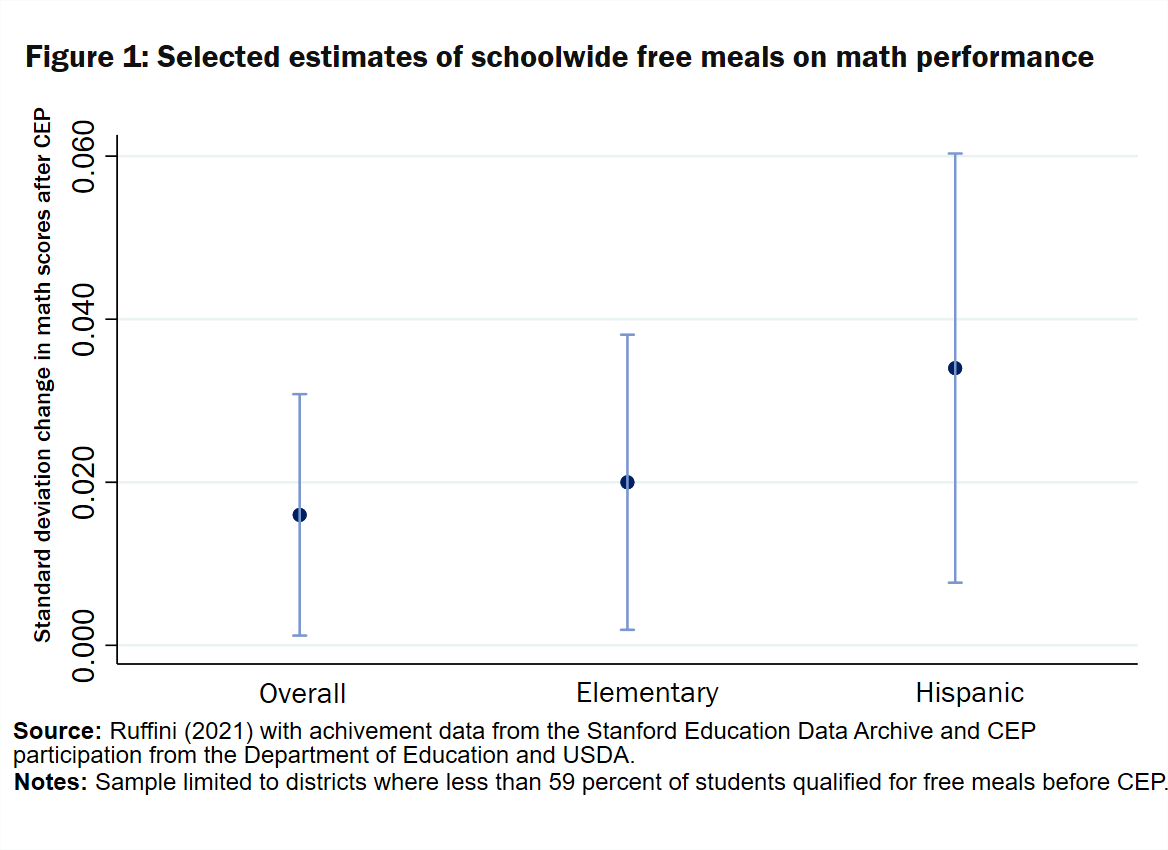
Second, schoolwide free meals improve math performance in districts where relatively few students qualified under the income-based program. Within these districts, elementary and Hispanic students experience the largest academic improvements. Figure 1 summarizes how free meals through CEP affect math performance among different groups of students in these districts with low free-meal participation before CEP. In this figure, the height of the bars shows the estimated impacts and the vertical lines shows the 90% confidence interval. I find that overall math performance improved about 0.016 standard deviations. Elementary students improved more than average, about 0.020 standard deviations. Finally, Hispanic students’ performance improved the most among all racial/ethnic groups—about 0.034 standard deviations.

F1 Selected estimates of schoolwide free meals on math performance

Third, schoolwide free-meal programs significantly reduce suspensions among white male elementary students. In work co-authored with Nora Gordon, we find CEP reduced the number of out-of-school suspensions among white male elementary students by approximately 17%. Our estimates for other elementary subgroups suggest fewer suspensions, but these results are smaller in magnitude and generally insignificant.

That improved math performance and fewer suspensions are found in areas and among subpopulations with low free-meal participation before CEP is consistent with the nature of the program. Specifically, schoolwide free-meal programs increase access for families who don’t qualify under the income-based formula—both families with income above 130% of the poverty line, as well as families that do not complete income questionnaires that determine eligibility.

These conservatives of Waukesha express concern for government spending, but they lack the judgment to distinguish between kinds of spending. The Waukesha School District’s chief financial officer sanctimoniously decides that children’s meal programs are the place to draw the line.

Narrow of mind and small of heart.


What It Takes to Fly The C-17 Globemaster III:

Daily Bread for 8.25.21: Thompson Dares Nass in Front of 5.8 Million People

Good morning.

Wednesday in Whitewater will be partly sunny with a high of 90. Sunrise is 6:13 AM and sunset 7:39 PM, for 13h 26m 38s of daytime.  The moon is a waning gibbous with 90.2% of its visible disk illuminated.

Whitewater’s Pedestrian and Bicycle Committee meets at 5 PM

 On this day in 1812, the American frigate, USS United States, commanded by Stephen Decatur, captures the British frigate HMS Macedonian.


Devi Shastri and Molly Beck report Tommy Thompson spurns the GOP attempt to control, block COVID rules on campuses:

University of Wisconsin System interim President Tommy Thompson said Tuesday the System will not follow a directive by Republican lawmakers to seek legislative approval for COVID-19 rules, essentially daring members of his own party to take the now month-long fight to the courts.

In a statement and an interview with reporters Tuesday, Thompson said the Joint Committee for Review of Administrative Rules’ attempt to control and block campus COVID-19 prevention protocols was “both wrong on the law and wrong as a matter of public policy.”

The motion, proposed by state Sen. Steve Nass, R-Whitewater, and passed on a party-line vote Aug. 3, requires UW to seek permission from the rules committee for policies such as those that require students and visitors to wear masks or get regularly tested for COVID-19. The committee, which is made up of six Republicans and four Democrats, could then vote to block some or all of the rules.

“Had this happened last academic year, the university might never have been able to set up community testing and vaccination sites, or even isolate sick students,” Thompson said. “It would have been a disaster.”

On Tuesday, Thompson said the System won’t seek approval from the committee and vowed to take any legal fight up to the state Supreme Court if necessary.

“I’m fairly confident we’re going to win. I have no doubts (of) that if the Legislature sues us,” Thompson said. “I don’t think they will, but if they do, so be it. I’m not abdicating my responsibility. We will contest it. I don’t want a fight with the Legislature, but we will contest it aggressively, whether it be the circuit court, the Court of Appeals or the Supreme Court.”

….

Thompson said UW’s situation is grounded in different legal arguments than the Wisconsin Supreme Court case that struck down the statewide mask mandate. UW System’s independent authority to run the schools is enshrined in Chapter 36 of the state statute, he said.

Nass fired back Tuesday, railing against UW’s “Ivory Tower administrators” who he claims are using pandemic rules “to control every adult that dares to walk on their campuses.”

If UW did not comply with the rule by Sept. 2, he said, he would ask Republican state Assembly and Senate leadership to take legal action “to force the UW System to comply with state law.”

Nass’s rhetoric (or, to be more precise, the words Mike Mikalsen may have written for Nass) won’t be enough. Nass will have to persuade the legislature to sue to enforce its claimed authority. If they won’t sue, or if legislative leaders reach a deal with Thompson on Thompson’s terms, then Nass will meet the limits of his reach — a right-wing base, but no more.

Thompson’s position against Nass is institutional, legal, and (doubtless) personal, too: few outside Nass’s base respect him. Some politicians in a vocal minority are respected; Nass isn’t one of them.

See also Steve Nass: Troll-King in Autumn and Daily Bread for 8.8.21: Nass, Again.


Massive waterspouts spotted near Florida beach:

An eyewitness captured footage of at least two waterspouts spinning simultaneously off North Redington Beach in Florida.

Daily Bread for 8.24.21: Ron Johnson’s Push for Ivermectin

Good morning.

Tuesday in Whitewater will see afternoon thundershowers with a high of 91. Sunrise is 6:12 AM and sunset 7:41 PM, for 13h 29m 20s of daytime.  The moon is a waning gibbous with 95.5% of its visible disk illuminated.

Whitewater’s Finance Committee meets at 4:30 PM. 

 On this day in 1909, workers start pouring concrete for the Panama Canal.


Bill Glauber and Mark Johnson report ‘You are not a horse. You are not a cow’: FDA issues blunt warning on taking ivermectin, drug promoted by Ron Johnson to treat COVID-19:

For months, Republican U.S. Sen. Ron Johnson has been talking up the anti-parasitic drug ivermectin as part of a cocktail of repurposed drugs for early treatment of COVID-19.

Johnson’s push even earned him a week-long suspension from YouTube.

On Saturday, the Food and Drug Administration issued a blunt warning for people not to use ivermectin to treat COVID-19.

The move by the FDA came amid reports that an increasing number of people in Mississippi and Louisiana were self-medicating with ivermectin intended for livestock.

In Wisconsin, a handful of people have called UW Health in Madison after taking the drug for COVID-19, said Nasia Safdar, the health care system’s director of infection control. Most experienced gastrointestinal side effects after taking the drug, and called because they were worried.

“I would say that we do not recommend it,” Safdar said, “and it is a danger to use it.”

The FDA made much the same point in a tweet: “You are not a horse. You are not a cow. Seriously, y’all. Stop it.”

Jonathan Yardley, an associate professor at Ohio State University College of Veterinary Medicine, said ivermectin is used to kill worms in horses and cows, but is quite powerful.

There is no evidence that ivermectin will help treat or prevent COVID-19, said Amesh Adalja, a senior scholar at Johns Hopkins Center for Health Security. “The clinical data is very weak and there is no confidence in it.”

Worse, Adalja said, some people are using the drug instead of getting vaccinated, and are taking the higher-dose veterinary ivermectin instead of the version that would be used to treat a human.

“I think the misinformation has been great,” Adalja said, singling out Johnson’s hearing for promoting a conspiracy that the drug is being suppressed.

He added: “I get some of the most voluminous amounts of hate mail every time I speak out against ivermectin.”

The same question about Johnson, posed before, applies now: Ambitious, Compromised, or Crackpot? The same answer applies: Whether Ambitious, Compromised, or Crackpot, Sen. Ron Johnson Doesn’t Disappoint.

Johnson’s push for snake oil cures may simply be an effort to undermine any legitimate medical research to which his fanatical supporters object. (Johnson, himself, may not prefer one bogus alternative therapy over another. His goal may be to ingratiate himself with those who doubt conventional medicine.)

America’s vaccines are among the most effective in the world; it serves enemies foreign and domestic to denigrate baselessly American medical science, and to push absurd alternative ‘preventatives.’

Dr. Amesh Adalja’s point about hate mail should not be overlooked. The right-wing populists are emotional, impulsive, and impatient. They disrupt meetings when they hear something they don’t like, and threaten advocates of views contrary to their own. They may describe themselves as possessed of ‘common sense,’ but to a majority watching them, the conservative populists look, sound, and act like crude, threatening adolescents.  (Trump, with his puerile insults, is the model for this ilk.) They prey on a reserved, reticent majority.

It’s a strategy that produces occasional local victories but frequent national contempt.


How Scientists Find, Tag, and Get Rid of ‘Murder Hornets’:

Daily Bread for 8.23.21: Productivity

Good morning.

Monday in Whitewater will be partly cloudy with a high of 89. Sunrise is 6:11 AM and sunset 7:43 PM, for 13h 32m 03s of daytime.  The moon is a waning gibbous with 98.8% of its visible disk illuminated.

The Urban Forestry Commission Arboretum Sponsorship Subcommittee meets at 4:30 PM. Whitewater’s School Board meets for a workshop and open session beginning at 5:30 PM and 7 PM, respectively (with a closed session, to return to open session later in the evening). Downtown Whitewater, Inc. meets at 6 PM,

 On this day in 1939, Nazi Germany and the Soviet Union sign a non-aggression treaty, the Molotov–Ribbentrop Pact. In a secret addition to the pact, the Baltic states, Finland, Romania, and Poland are divided between the two nations.


 Heather Long writes The U.S. could be on the verge of a productivity boom, a game-changer for the economy:

The United States is currently experiencing a surge in worker productivity that could rival that of the tech boom 20 years ago — if it lasts.

As companies and customers embrace new technologies, making it easier for Americans to produce more with fewer workers, a growing number of economists say this is not a blip and could turn into a boom — or, at least, a “mini boom” ? with wide-ranging benefits for years to come.

Higher productivity is the economy’s special sauce. Productivity refers to how much output a worker can do in an hour. When workers have better tools or the help of robots and artificial intelligence, they can make cars or process data much faster. Higher productivity typically leads to more goods and services available at a lower cost and increases in wages. Without it, economic growth is sluggish.

The early data in this recovery is promising. Worker productivity grew 4.3 percent in the first quarter, one of the highest rates in years, according to the Labor Department. Second quarter productivity slowed to 2.3 percent growth, but that’s still nearly double the anemic productivity the nation experienced in the decade after the financial crisis — an average of just 1.2 percent.

….

Conditions are ripe for productivity to remain elevated for years to come, according to analysts from Goldman Sachs and the McKinsey Global Institute. As policymakers run the economy hot, there’s heavy demand for products and services. There is also a worker shortage, which is forcing companies to innovate even more as they struggle to find enough employees to fill a record 10 million job openings. If a robot can do someone’s job, companies are trying it.

….

“It looks like we’re on the cusp of a productivity boom, but you have to see it to believe it,” said David Beckworth, a senior fellow at the Mercatus Center at George Mason University. “The statistics coming out so far in this recovery show a productivity surge. Will that continue? It’s too early to know for sure.”

A national-average productivity boom may await America; some parts of the country will be better suited to it than others. There are parts of America still convinced that adding a building or a business is necessarily a sign of progress. Productivity, obviously, isn’t the same as mere production; it’s building more efficiently per worker.


Wild horse round-up in drought-stricken West sparks debate:

Daily Bread for 8.22.21: ‘Defund the Police’ Was a Molehill

Good morning.

Sunday in Whitewater will be mostly sunny with a high of 80. Sunrise is 6:10 AM and sunset 7:44 PM, for 13h 34m 45s of daytime.  The moon is full with 100% of its visible disk illuminated.

 On this day in 1963, X-15 Flight 91 reaches the highest altitude of the X-15 program (67.08 mi).


 Bruce Murphy writes Police Were Defunded Before George Floyd (‘253 municipalities in state cut police funding in 2019 for budget reasons, report finds’):

The call for police defunding, which arose in the wake of George Floyd‘s killing in May 2020 by a police office in Minneapolis, has created controversy across the nation. In Wisconsin, Republicans passed legislation, which was vetoed by Democratic Gov. Tony Evers, which would have reduced state shared revenue payments to municipalities that decreased their spending on police and fire departments.

But in fact, hundreds of local governments across the state had already reduced funding for police departments in 2019, as a new report by the Wisconsin Policy Forum reveals. “The data show 253 municipalities decreased the dollar amount spent on all law enforcement activities,” the  report noted. “This includes large cities (Milwaukee, Green Bay), suburbs (Bayside, Grafton, Stoughton, Verona), and a number of very small communities, including 144 municipalities with fewer than 2,000 residents. In fact, all but 10 of Wisconsin’s 72 counties had at least one municipality that decreased its police budget in 2019. ”

Total spending on law enforcement for all municipalities actually increased by 1.3%, from $1.21 billion in 2018 to $1.23 billion in 2019, with 461 municipalities increasing their spending on police, the report found. But the 253 local governments that did cut funding in 2019 shows that this is commonly done by communities, not to reform police departments, but to balance their budgets.

“Wisconsin municipalities have been operating under strict property tax limits for more than a decade,” the report notes. Meanwhile, state-shared revenue has been declining for about 20 years. This has squeezed local budgets across the state and “likely [has] contributed to the difficulties faced by municipalities in maintaining police and fire department budgets and staffing,” the report finds.

That, in turn, impacted police staffing. “From 2018 to 2019, 79 Wisconsin police departments reported increasing their sworn officers, while 59 decreased them,” the report found.

Whitewater, for example, saw a decrease (2018-2019) in funding before George Floyd was murdered. It wasn’t ideology that drove those cuts; it was the pressure of budgetary constraints the city faces. Indeed, the Wisconsin Policy Forum remarks that

“In both Dollar for Dollar and a report we released last September, we noted that as municipal budgets have tightened for various reasons, local officials have attempted to shield police departments from cuts. As a result, those departments now take up a larger share of municipal budgets than a generation ago.”

I’ve never supported a political effort to defund the police, as against simply balancing a municipal budget.

Whitewater’s residents who worried, by the way, about ideological defunding of the police department were overwrought (and politically ignorant of the city’s actual politics). Whitewater was never going to defund her police department for ideological reasons, and any right-wing populist or two thinking otherwise could fittingly be described as politically obtuse. See Built Against Substantive Change.  

The issue has faded nationally, as major figures in the Democratic Party have opposed the idea. (Biden, for example, never took up that cause.)  Defunding is so weak that Sen. Cory Booker (D-NJ) could recently turn GOP Sen. Tommy Tuberville’s (R-AL) attempt to re-ignite the issue into a 99-0 vote against defunding:

‘Defunding the police’ was a molehill (which, for those who need a reminder, looks nothing like a mountain).


How High-Quality Japanese Cutlery Is Made:

Daily Bread for 8.21.21: Hundreds of Wisconsin Police Officers Back on the Job after Being Fired or Forced Out

Good morning.

Saturday in Whitewater will be variably cloudy with scattered thunderstorms and a high of 81. Sunrise is 6:08 AM and sunset 7:46 PM, for 13h 37m 26s of daytime.  The moon is a waxing gibbous with 98.9% of its visible disk illuminated.

 On this day in 1911, the Mona Lisa is stolen by Vincenzo Peruggia, a Louvre employee.


Peter Cameron writes Nearly 200 Wisconsin police officers back on the job after being fired or forced out:

One officer was accused by a supervisor of snoozing in his squad car while on duty. Another had multiple drunken run-ins with police, including after bar fights. A third repeatedly sent lewd photos to a female officer.

All of them were fired or forced out. And all of them are back working in law enforcement in Wisconsin.

Nearly 200 law enforcement officers currently employed in the state were fired from previous jobs in law enforcement, resigned before completion of an internal investigation or in lieu of termination, according to data from the Wisconsin Department of Justice obtained through an open records request.

….

A huge study in The Yale Law Journal titled The Wandering Officer found that Florida cops who had been fired from a previous law enforcement job were more likely to be fired from their next job or to receive a complaint for a “moral character violation,” compared to rookies and officers who have never been fired.

The study analyzed nearly 100,000 full-time law-enforcement officers from almost 500 agencies in Florida over a 30-year period. The study concluded that “wandering officers may pose serious risks, particularly given how difficult it is to fire a police officer.”

Union contracts can give police officers strong job security, sometimes even when misconduct is committed. The controversial Act 10 legislation passed by Republicans in 2011 crippled organized public-sector labor in Wisconsin, but largely left police and fire unions, groups that lean to the political right, untouched.

A profession —properly understood — has substantive and ethical standards for membership that the profession requires and consistently enforces against its own members. Many occupations are styled as professions, but genuine professions monitor and discipline their own members. 

Across America, traditional professions like medicine, law, and the clergy find in their respective institutions a willingness to overlook, excuse, and even reward (through promotion) misconduct.

This willingness to overlook inadequacy, misconduct, and outright criminality belies talk about ‘excellence,’ ‘service,’ ‘honor,’ etc.

Cameron writes that a “bill that would require law enforcement agencies to maintain a personnel file for each employee and disclose that file to any agency that may want to hire them has bipartisan support. If enacted, the measure would bar future nondisclosure agreements that shield police personnel files from prospective employers.”

The disabled or disadvantaged in society deserve compassion and support that professionals most certainly do not. We’ve too many professionals who want authority over others while simultaneously demanding tender regard that only the disabled or disadvantaged deserve.

In law, medicine, the clergy, or policing there should be no right to perpetual membership: lawyers, doctors, clergy, or police officers who fail the standards required of them can — and should —find other, less demanding occupations in the free labor market.


Gov. DeSantis, King of Self-Awareness:

<

Daily Bread for 8.20.21: Regarding Attorney General Kaul’s ‘Regardless’

Good morning.

Friday in Whitewater will be mostly sunny with a high of 89. Sunrise is 6:07 AM and sunset 7:47 PM, for 13h 40m 06s of daytime.  The moon is a waxing gibbous with 94.9% of its visible disk illuminated.

 On this day in 1794, United States troops force a confederacy of Shawnee, Mingo, Delaware, Wyandot, Miami, Ottawa, Chippewa, and Potawatomi warriors into a disorganized retreat at the Battle of Fallen Timbers.


Katelyn Ferral reports No criminal charges for mishandled Wisconsin National Guard sexual assault cases, state justice department says:

No criminal charges will be filed for 33 sexual assault cases mishandled by the Wisconsin National Guard, but the state Department of Justice says changes are needed to prevent future problems.

The department on Thursday issued the results of its 18-month review of National Guard sexual assault cases in which it examined botched investigations dating from 2009 to 2019. The agency, which does not file its own criminal charges in such instances, said it examined the Guard’s case files and referred them to local district attorneys, who ultimately declined to prosecute.

“Regardless of whether there is ultimately a prosecution, it’s important for our system of justice that when there are allegations made there is a full and thorough review that takes place,” Wisconsin Attorney General Josh Kaul said in an interview Wednesday. “We wanted to ensure that kind of review happened.”

The agency review followed a 2019 investigation by the federal National Guard Bureau that found at least 33 sexual assault cases had been mishandled by the Wisconsin Guard. The Guard had been improperly investigating sex assault allegations for years, failing to track such cases and punish some perpetrators.

The Guard Bureau investigation came after the Cap Times and Milwaukee Journal Sentinel found the Guard was violating state and federal rules by discouraging victims from going to police and conducting internal investigations [to discourage federal involvement] into allegations of sexual assault. 

Thirty-three cases, yet not a single district attorney’s office would prosecute anyone responsible. Case after case, of obstructing claimants’ legal recourse and official concealment to avoid federal scrutiny, yet no criminal action.

Attorney General Kaul tells Wisconsinites that one should look beyond a lack of prosecutions — literally, regardless —to lessons he wishes to impart.

On the contrary, it’s prosecution, itself, that would impart the lessons Wisconsinites need to hear.


NASA’s Curiosity Mars Rover Finds A Changing Landscape:

Film: Tuesday, August 24th, 1 PM @ Seniors in the Park, Emma

This Tuesday, August 24th at 1 PM, there will be a showing of Emma @ Seniors in the Park, in the Starin Community Building:

Comedy/Drama/Romance

2 hours, 4 minutes

Rated PG (2021)

A requested film: Jane Austen’s beloved costume comedy. In 1800s England, a well-meaning but selfish young woman meddles in the love lives of her friends. A star-studded adaptation with Anya Taylor-Joy, Johnny Flynn, Rupert Graves, and Bill Nighy.

If vaccinated, no mask is required. Reservations are no longer required. Free popcorn and a beverage re-instituted!

One can find more information about Emma at the Internet Movie Database.

Daily Bread for 8.19.21: ‘People Into Chimpanzees’

Good morning.

Thursday in Whitewater will be mostly sunny with scattered afternoon thunderstorms and a high of 88. Sunrise is 6:06 AM and sunset 7:49 PM, for 13h 42m 45s of daytime.  The moon is a waxing gibbous with 88.6% of its visible disk illuminated.

 On this day in 1812, the American frigate USS Constitution defeats the British frigate HMS Guerriere off the coast of Nova Scotia, Canada earning the nickname “Old Ironsides.”


Davey Alba reports Facebook removes Russian-based network that spread vaccine misinformation:

Facebook said on Tuesday [8.10.21] that it had removed a network of accounts based in Russia that spread misinformation about coronavirus vaccines. The network targeted audiences in India, Latin America and the United States with posts falsely asserting that the AstraZeneca vaccine would turn people into chimpanzees and that the Pfizer vaccine had a much higher casualty rate than other vaccines, the company said.

The network violated Facebook’s foreign interference policies, the company said. It traced the posts to a marketing firm operating from Russia, Fazze, which is a subsidiary of AdNow, a company registered in Britain.

Facebook said it had taken down 65 Facebook accounts and 243 Instagram accounts associated with the firm and barred Fazze from its platform. The social network announced the takedown as part of its monthly report on influence campaigns run by people or groups that purposely misrepresent who is behind the posts.

“This campaign functioned as a disinformation laundromat,” said Ben Nimmo, who leads Facebook’s global threat intelligence team.

….

The Fazze campaign was carried out in two waves, Facebook said. In late 2020, Fazze created two batches of fake Facebook accounts that initially posted about Indian food or Hollywood actors. Then in November and December, as the Indian government was discussing emergency authorization for the AstraZeneca vaccine, the accounts started pushing the false claim that the vaccine was dangerous because it was derived from a chimpanzee adenovirus. The campaign extended to websites like Medium and Change.org, and memes about the vaccine’s turning its subjects into chimpanzees proliferated on Facebook.

Facebook is a private platform, and it can (and in this situation should) ban Fazze.

The implications of Fazze’s people-into-chimpanzees disinformation campaign extend far beyond Facebook’s Menlo Park, CA headquarters. It is, after all, a local audience in towns across America that Fazze sought to impress.

They could not be impressed if they were not impressionable. 

People are impressionable through ignorance, not stupidity. There are very few people who might possibly be considered ‘stupid.’ There are, however, any number of crackpot theories circulating every day.

QAnon, lies about vaccines that are truly safe and effective, the Big Lie that Trump actually won in 2020 (he lost by millions of votes), etc.: these are educational and cultural failures.

We have taught poorly – and tolerated substandard reasoning and conspiracy theories – while claiming in a vision statement to teach “Every student, Every Day, in a Unified Way.” 

In a community beset with a faction lapping ignorance and superstition, our vision statement is little more than a rhyming self-parody.


Tasmanian Devil Twins Born at Australia Animal Park:

Daily Bread for 8.18.21: Paycheck Protection Loan Fraud

Good morning.

Wednesday in Whitewater will be partly sunny with scattered thunderstorms and a high of 84. Sunrise is 6:05 AM and sunset 7:51 PM, for 13h 45m 23s of daytime.  The moon is a waxing gibbous with 80.3% of its visible disk illuminated.

The Tech Park Board meets at 8 AM and the Parks and Recreation Board meets at 5:30 PM

 On this day in 1920, the Nineteenth Amendment to the United States Constitution is ratified, guaranteeing women’s suffrage.


Stacy Cowley reports 15% of Paycheck Protection Program Loans Could Be Fraudulent, Study Shows (‘Some $76 billion of the program’s $800 billion in loans may have been taken improperly, a new paper concludes’):

When the Paycheck Protection Program began last year to help small businesses that were struggling during the pandemic, the federal government was determined to get the relief money out fast — so it waived much of the vetting lenders traditionally do on business loans.

The absence of those safeguards meant that fraud was highly likely. But just how much of the program’s $800 billion was taken illicitly?

A new academic working paper released on Tuesday contains an estimate: Around 1.8 million of the program’s 11.8 million loans — more than 15 percent — totaling $76 billion had at least one indication of potential fraud, the researchers concluded.

“There’s been a lot of anecdotes about fraud, but the tricky thing about anecdotes is that it’s very difficult to put them together and get at the scale of what’s going on,” said Samuel Kruger, an assistant professor of finance at the University of Texas at Austin’s McCombs School of Business and one of the paper’s authors. “We wanted to look for patterns in the data.”

The study pins blame for many of the questionable loans on one particular group of lenders: financial technology firms, known as “fintechs,” which focus on digital lending. Nine of the 10 lenders with the highest rate of suspicious loans fell into that group.

“Certain fintech lenders seem to specialize in dubious loans,” the authors wrote. Collectively, fintechs made around 29 percent of the program’s loans but accounted for more than half of its suspicious loans, the study concluded.

The Paycheck Protection Program, which ran intermittently from April 2020 to May 2021, relied on banks and other lenders to make the government-guaranteed loans, which are designed to be forgiven if borrowers followed the program’s rules. Government watchdogs have long warned of a high fraud risk on the rushed loans; the Justice Department has charged more than 500 people with improperly claiming hundreds of millions of dollars in borrowing.

These billions are those with one indication of fraud. One reads further on that a “more restrictive calculation by the researchers, of loans with at least two suspicious characteristics, identified 1.2 million potentially fraudulent loans, totaling $38 billion.”

And yet, and yet, even a single billion saved or properly & lawfully spent would make a considerable difference. If, for example, Wisconsin had an additional billion to save or spend it would amount to roughly $175 per person.

How easily these numbers tally.


Orphaned Monkeys Receive Much-Needed TLC at Bolivian Sanctuary: